
TO BEGIN THE TOPIC OF VALUING CHARITABLE GIFTS OF PROPERTY, IT IS USEFUL TO CONSIDER WHY THIS TOPIC IS SO IMPORTANT. AS DISCUSSED PREVIOUSLY, THE VAST MAJORITY OF WEALTH IN THIS COUNTRY IS NOT HELD IN CASH, SAVINGS ACCOUNTS, CHECKING ACCOUNTS, OR MONEY MARKET ACCOUNTS. CONSEQUENTLY, IF FUNDRAISERS WISH TO ASK FOR GIFTS OF WEALTH, THEN, BY AND LARGE, THEY MUST ASK FOR GIFTS OF PROPERTY. IN OTHER WORDS, IF FUNDRAISERS WANT TO ASK FROM THE "BIG BUCKET" OF WEALTH, THEN THEY NEED TO ASK FOR GIFTS OF PROPERTY, MEANING ANY TYPE OF NON-CASH ASSET. A FUNDAMENTAL REQUIREMENT OF BEING ABLE TO ASK FOR THESE PROPERTY GIFTS FROM THE "BIG BUCKET" IS AN UNDERSTANDING OF HOW SUCH GIFTS ARE VALUED FOR TAX PURPOSES. AS WE WILL SEE, THIS IS NO SMALL ISSUE. DIFFERENT TYPES OF ASSETS IN DIFFERENT TYPES OF TRANSACTIONS MAY BE VALUED DRAMATICALLY DIFFERENTLY, INCLUDING A VALUATION OF ZERO DOLLARS. IN ORDER TO BE ABLE TO LEARN HOW TO ASK FROM THE "BIG BUCKET," IT IS ESSENTIAL TO HAVE A BASIC UNDERSTANDING OF HOW GIFTS OF PROPERTY ARE VALUED. A FUNDRAISER OR ADVISOR WHO SUGGESTS A CHARITABLE GIFT OF PROPERTY WHILE BEING UNAWARE THAT THE DEDUCTION IN THAT PARTICULAR CASE WOULD BE FAR LESS THAN THE VALUE OF THE PROPERTY IS CREATING SERIOUS POTENTIAL PROBLEMS. THIS CHAPTER PREVENTS THAT OUTCOME BY REVIEWING THE RULES FOR VALUING CHARITABLE GIFTS OF PROPERTY.

If you are familiar only with cash gifts to charity, then this issue of valuation may be new to you. Cash gifts include all cash equivalent transactions such as checks, currency, or credit cards. Gifts of cash require no valuation. The value is simply the amount of the gift. Because the valuation is simple, calculating the deduction is also simple. Although cash gifts are simple, the bulk of a donor's wealth is rarely held in cash. Understanding gifts of non-cash assets opens up the possibility for many more sophisticated and beneficial conversations with donors.

Valuing cash or cash equivalent gifts is simple. Valuing some types of property gifts is complex. Part of this complexity may come from the difficulty inherent in valuing certain types of property. Additionally, there are special tax rules for certain kinds of property. These can alter the valuation of the property for tax purposes. Many of these rules were created in a reactive fashion - responding to particular individual abuses. This has resulted in a hodgepodge of rules that are not always consistent. Nevertheless, there are some general principles that apply to most gifts of property.
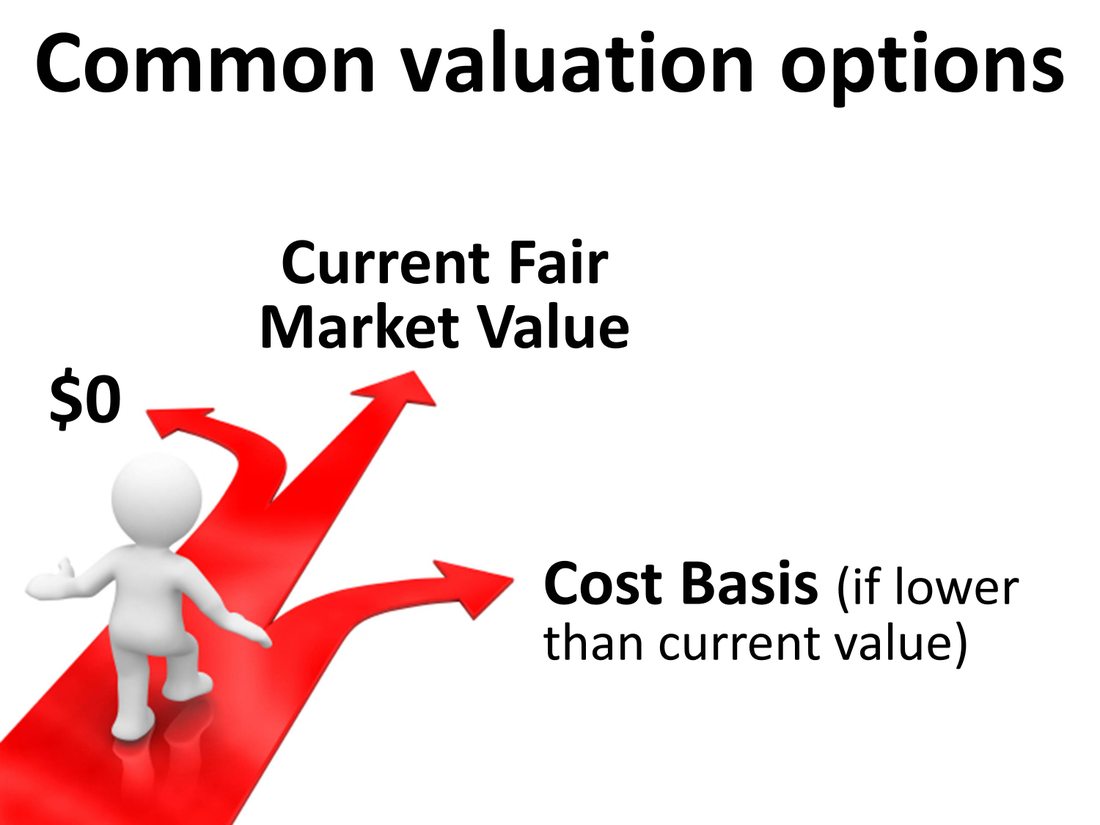
The most common valuations fall into three categories. With a few exceptions, the value for tax deduction purposes of a charitable gift of property will be (1) the fair market value of the property, (2) the cost basis of the property - only where such basis is less than the fair market value of the property, or (3) nothing. Notice that the most advantageous valuation that a donor can receive under any circumstances is the fair market value of property. This is an important fact when working with donors, because the almost universal expectation is that the charitable gift of property will generate a charitable deduction equal to the value of the property. But often, it won't. Asking for a property gift that generates no deduction or a much reduced deduction without understanding that reality in advance places the fundraiser or advisor in a bad position. Thus, knowing the rules for deducting gifts of property is a prerequisite for suggesting them. At least this is true if the fundraiser or advisor wants to avoid embarrassment, financial loss, and broken relationships. So, let's explore the three most common valuation options for property given to charity.
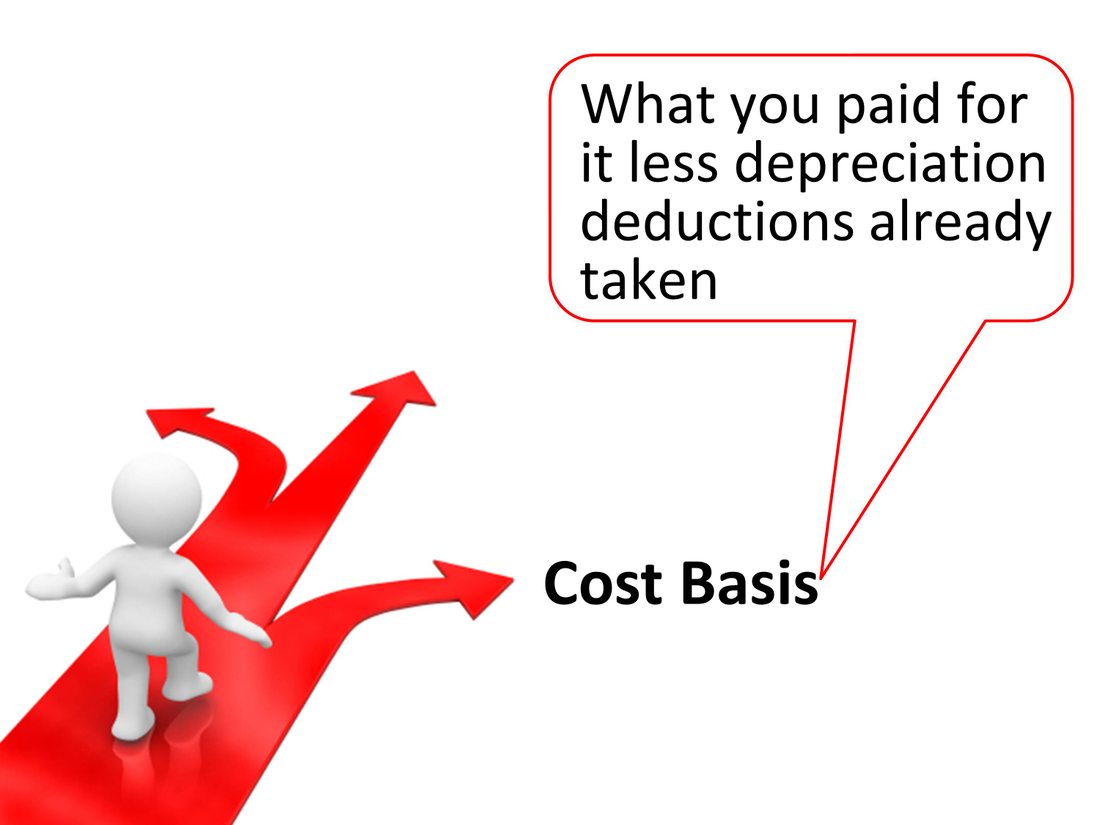
One of the common valuation options for charitable gifts of property is the property's "cost basis," or what is referred to more technically as "adjusted basis." The term cost basis is used here because, in most cases, the adjusted basis is simply the amount paid for the item by the donor (i.e., its cost to the donor). So, if a donor paid $100 for an item that is now worth $200, the deduction for giving that item to charity will be $100 if the gift is valued at its cost basis. Note that the cost basis valuation of charitable gifts of property is never used when the cost basis is greater than the property's fair market value. Cost basis valuation of gifts of property can only lower the value of the gift compared with its fair market value, not raise it.
The cost basis of property can include other items besides the initial purchase price. For example, if a person purchases a house for $100,000 and then spends $30,000 on an addition to the house, his basis in the home is $130,000. So, the basis of a property includes both its initial purchase price and any subsequent capital expenditures.
Calculating the basis of a property becomes more complex if it involves depreciation deductions. Not all property is subject to depreciation deductions. However, this is common with property that is used for commercial business purposes. A depreciation deduction allows a person to claim that the property has become less valuable because it is wearing out. For example, if someone purchases a $5,000 computer for her business, she can claim that after one year of use that the computer is worth $4,000. Consequently, she will have a depreciation deduction of $1,000. She can do this for each of the first five years that she uses the computer in her business until, after five years, it is completely depreciated. If after five years she has taken depreciation deductions of $5,000, her basis is $0. She paid $5,000 and then deducted $5,000 of depreciation deductions. Thus, $5,000 - $5,000 = $0.
Depreciation deductions affect charitable deductions for gifts of property because a taxpayer can't deduct the same item twice. If a $5,000 computer purchase has already generated $5,000 of deductions (through depreciation), the taxpayer cannot then give it to charity and generate another $2,000 deduction - even if it is truly worth $2,000. This would mean deducting the same item twice. As a result, the value of property for purposes of determining the charitable deduction is always reduced by any depreciation deductions that have already been taken. This is true for gifts that are valued at cost basis. It is also true for gifts that are valued at fair market value. Of course, not all property can be depreciated. In fact, depreciation is not a concern in most property gift transactions. But, it is an important concept to keep in mind for those cases when it does arise (primarily physical items used in business operations).
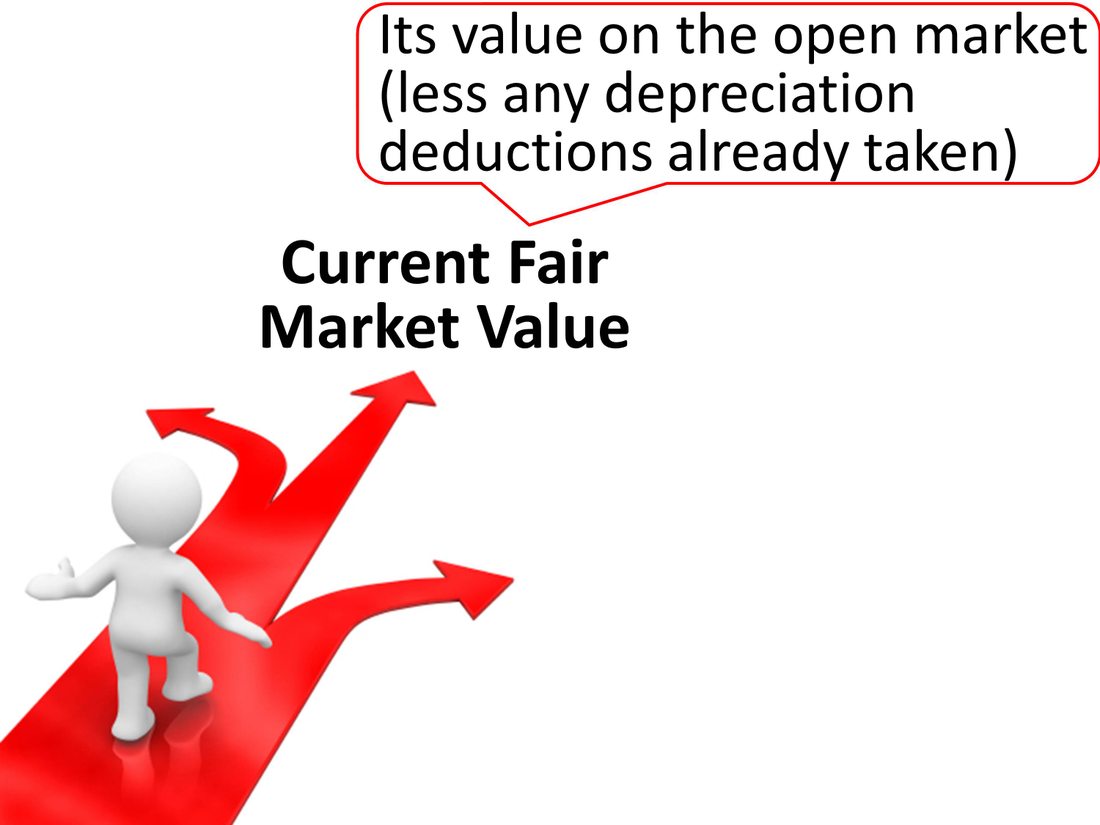
Charitable gifts of property can also be valued at their current "fair market value." The IRS indicates that fair market value is the price that property would sell for on the open market. It is the price that would be agreed on between a willing buyer and a willing seller, with neither being required to act, and both having reasonable knowledge of the relevant facts. For our purposes, it is easiest to think of fair market value as simply the answer to the question, "What could you normally sell it for?" or, "What is it worth?" As mentioned above, even when property can be deducted at its fair market value, this deduction must be reduced by any previous depreciation deductions already taken on that property by the donor. (Because, again, deducting the same dollar more than once is not allowed.)
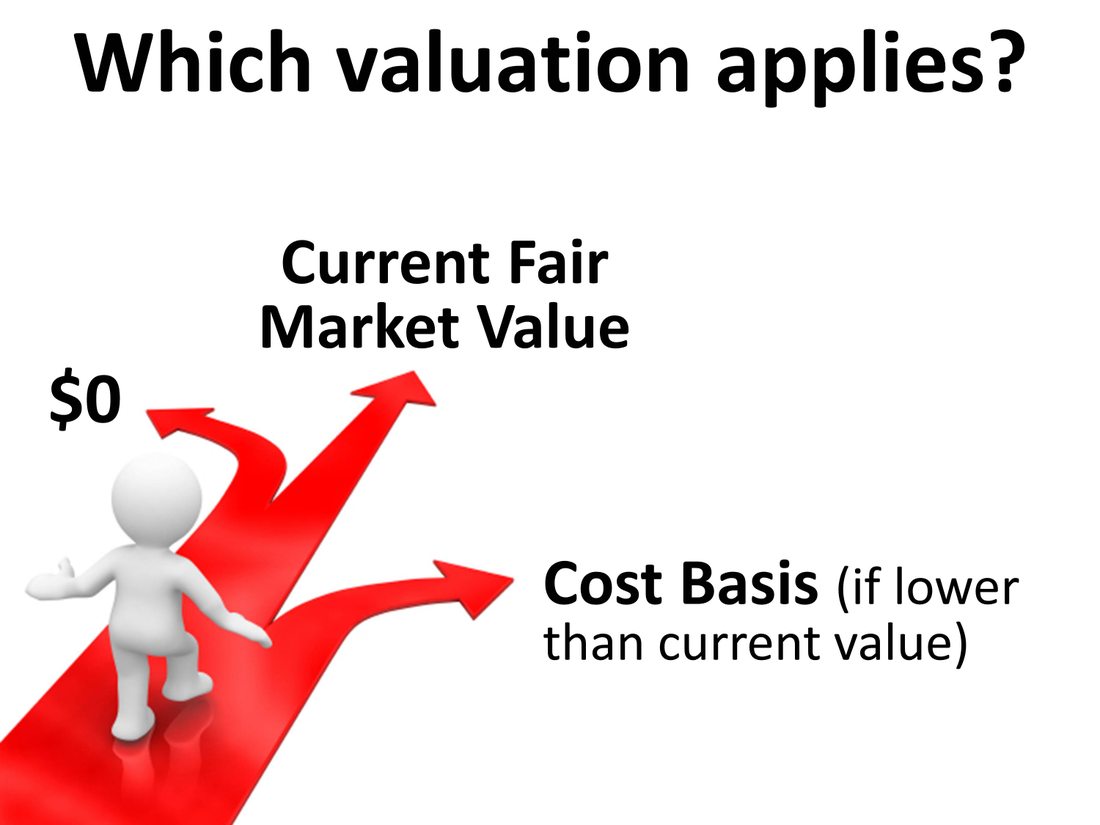
When valuing an item of property to be given as a charitable gift, the initial issue is, for almost all transactions, "Which of these 3 valuation approaches apply?" How will the item be valued for purposes of the charitable tax deduction? Will the donor be able to deduct its fair market value, its basis, or nothing at all? Next, we review the basic framework that determines which of these deduction amounts the donor can use.
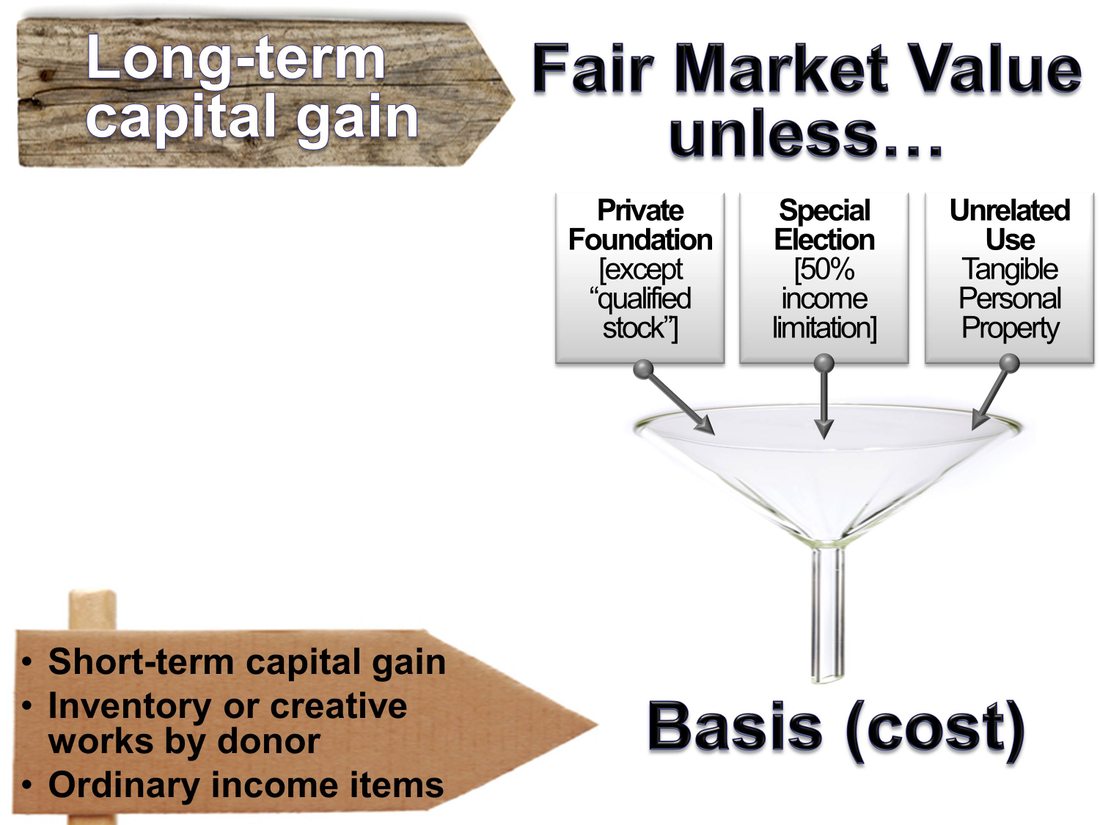
When proceeds from the sale of the property would have been considered ordinary income if the donor had sold the property (rather than given it to a charity), then the donor may deduct only his or her basis in the property. For example, if a cobbler received $100 for selling a pair of his shoes, this money is considered to be ordinary income. Selling shoes is his ordinary business. If the cobbler gave a pair of shoes that normally sells for $100 to a charity, his deduction would not be $100 (the fair market value). Instead, his deduction would be limited to his cost basis in the shoes (i.e., his cost of materials in the shoes). Or suppose a famous artist painted a painting. Then she gave it to a charity. Her deduction would be limited to the cost of the canvas and paint used in the painting. Just as with the cobbler selling shoes, if the artist had sold the painting, the money from the sale would have been taxed as ordinary income.
The cost basis valuation also applies to any property that has been held by the donor for one year or less. If this property had been sold for a profit, that profit would have been short-term capital gain. All such short-term capital gain property is valued at its basis for purposes of the charitable deduction. (Any property that would have generated a loss if sold would not be valued at its basis because, in that case, the basis would be higher than the fair market value. The donor is never allowed to use basis for valuation if it is higher than fair market value.)
The only type of non-cash property that has a chance of being valued at fair market value for a charitable deduction is long-term capital gain property. We begin with the assumption that long-term capital gain property can be valued at its fair market value for charitable tax deduction purposes. However, several circumstances can cause long-term capital gain property to drop out of fair market value valuation and be reduced to cost basis valuation.
The first scenario where long-term capital gain property can be dropped into cost basis valuation is if the property is given to a private foundation, rather than to a public charity. Although here there is an exception to the exception: if the gift is "qualified stock" then it can still be deducted at fair market value. Another reason that long-term capital gain property may not be valued at fair market value for tax deduction purposes is if the donor has made a "special election" to accept the lower valuation in exchange for a higher charitable deduction income limitation. (This is discussed in the chapter on income limitations for charitable deductions.)
A third circumstance when long-term capital gain property will not be valued at its fair market value is when such property is "unrelated use" tangible personal property. It is easiest to think of tangible personal property as movable physical property. This excludes immovable real estate such as land or anything permanently attached to the land, like a building. This also excludes intangible personal property, such as shares of stock or bonds. (Stocks and bonds, physically, are just pieces of paper. They have value only because of the rights they represent, not because of the paper they are printed on.) "Unrelated use" tangible personal property is property that the charity does not intend to use in furtherance of its charitable purposes. If, for example, the charity intends to simply sell the gifted item, then the item is "unrelated use" property. (Note that this is true even though the cash from the sale of the item will be used to further the charitable purposes of the organization.)
Capital loss property is property that is worth LESS at its sale than the owner orginally paid for it. In that case, the fair market value would be less than the cost basis of the property. If the fair market value is less than the cost basis of the property, then the donor cannot deduct the fair market value regardless of what kind of property is being gifted. If the donor is contributing loss property, short-term or long-term makes no difference for gift valuation.
In practice, donors should never give capital loss property. Instead the loss should be realized and deducted upon the sale of the property. For example, if a donor bought a share of stock for $110 and it is now worth $10, it is better for the donor to sell the share and then give the proceeds to charity, rather than to give the share directly to the charity. If he sells the share, he will recognize a loss of $100 ($110 purchase price less the $10 sale price). This loss can offset other gains that he might otherwise have to pay taxes on. But if he gives the share directly to a charity, he loses the ability to recognize that loss, and so he loses a valuable tax benefit. The charitable tax deduction is the same whether he gives the share directly to the charity or sells the share and then gives the proceeds to the charity (i.e., $10). This is why capital loss property should not be given directly to the charity. It should instead be sold and the proceeds given to the charity.
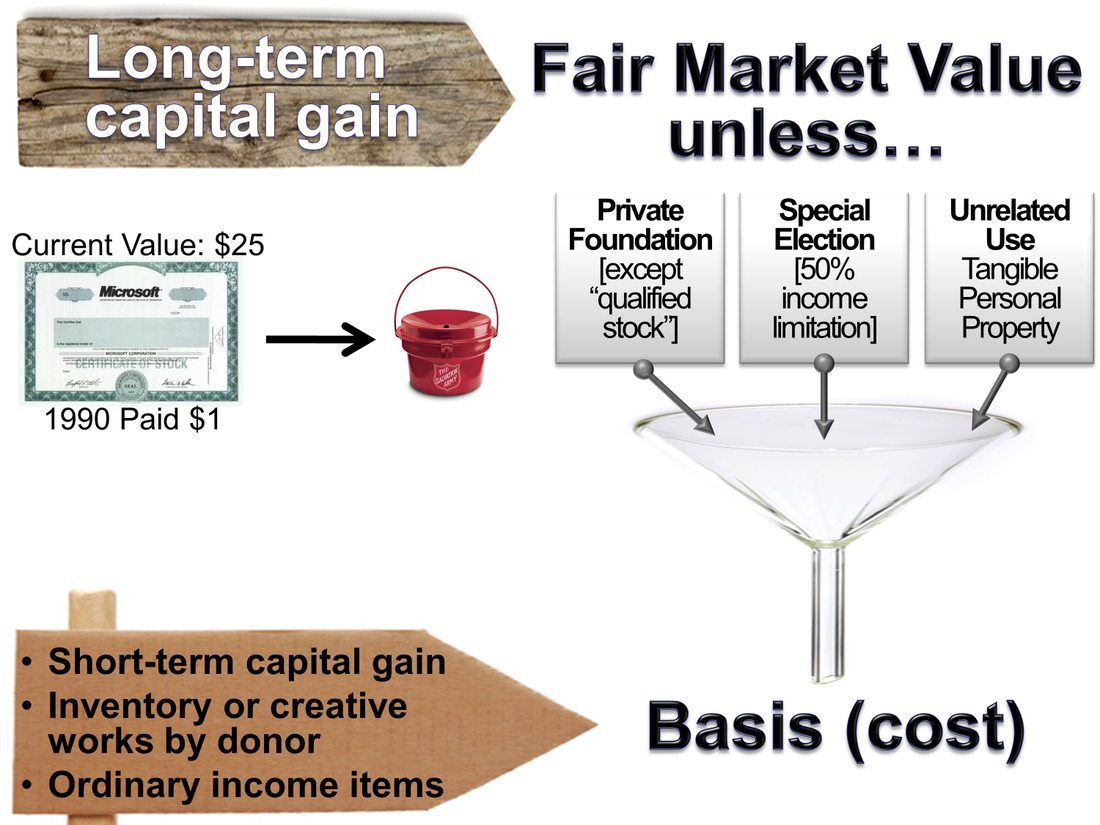
Now consider some examples that demonstrate how these rules function with specific gifts. Suppose that a donor owns a share of stock that he paid one dollar for in 1990, which today is worth $25. He gives that share of stock to a public charity. How much could he deduct for that charitable gift?
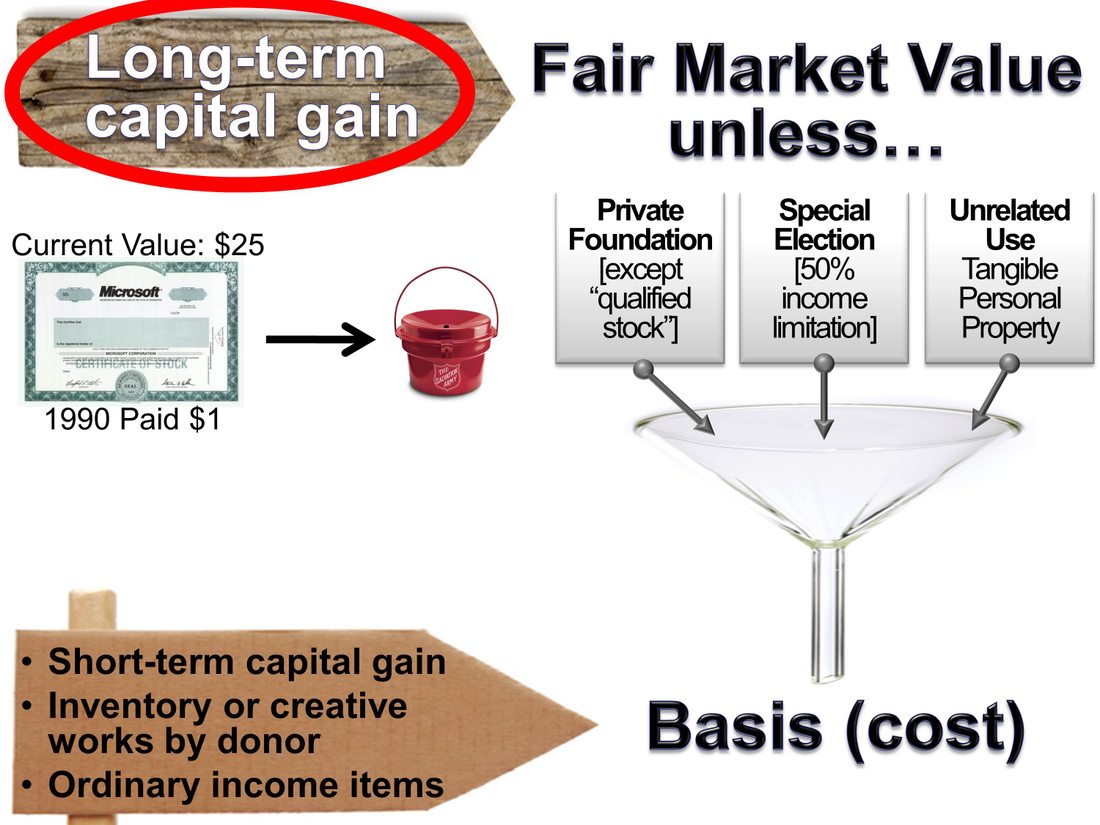
Notice that the stock is long-term capital gain property. Why? First, it has gone up in value, therefore, it is gain property. Second, the donor has owned it since 1990. This means he has owned it for more than 12 months and, therefore, it is long-term capital property.
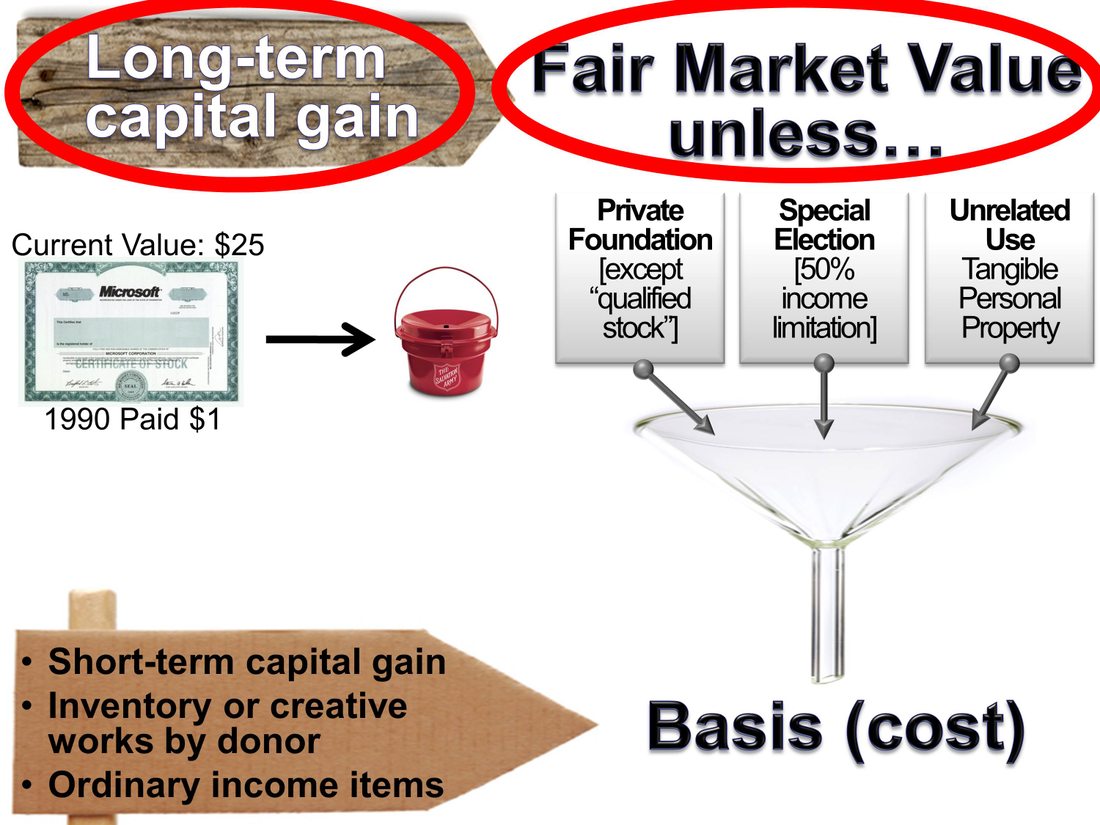
Because it is long-term capital gain property, this means that the donor can deduct its fair market value (in this case, $25), unless one of the three exceptions applies.
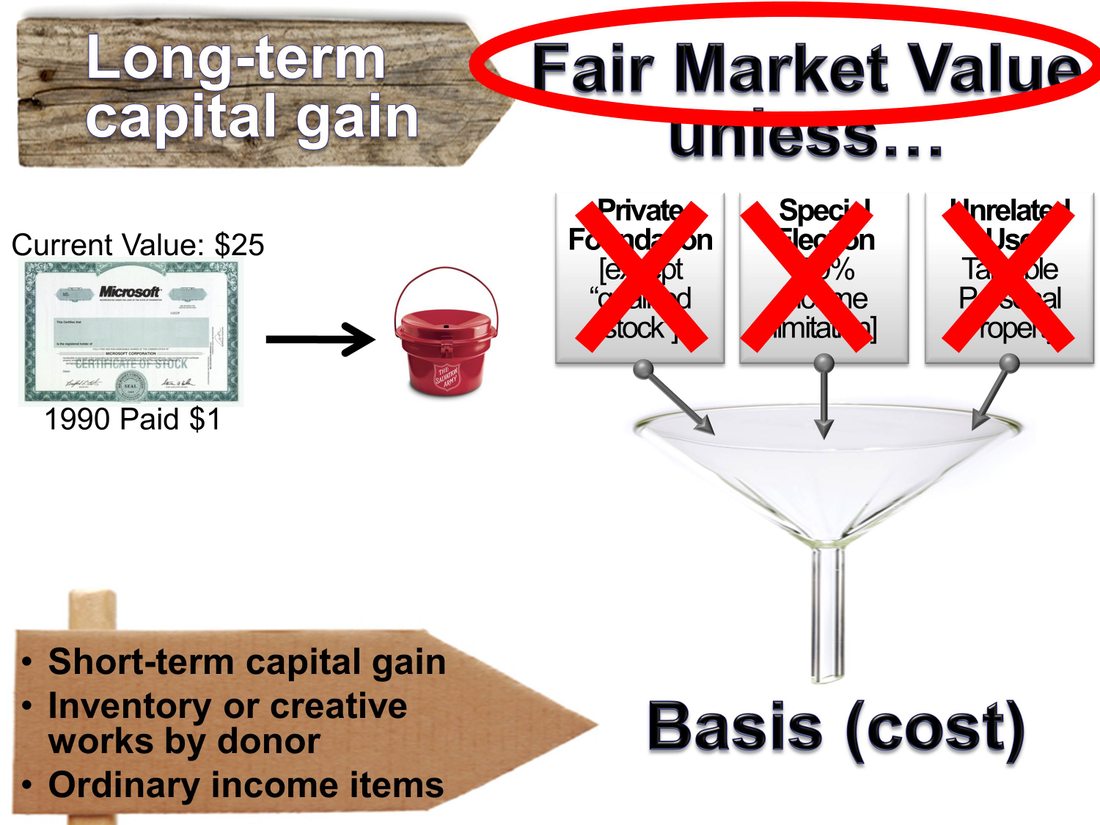
In this case, none of the three exceptions apply. The donor is not giving the property to a private foundation, but instead is giving it to a public charity. The donor has not made a special election to reduce the valuation, so that exception does not apply. And finally, this is intangible personal property, therefore, the third exception, which relates to tangible personal property, does not apply. Because none of the three exceptions apply, the donor can deduct this gift at its fair market value of $25.
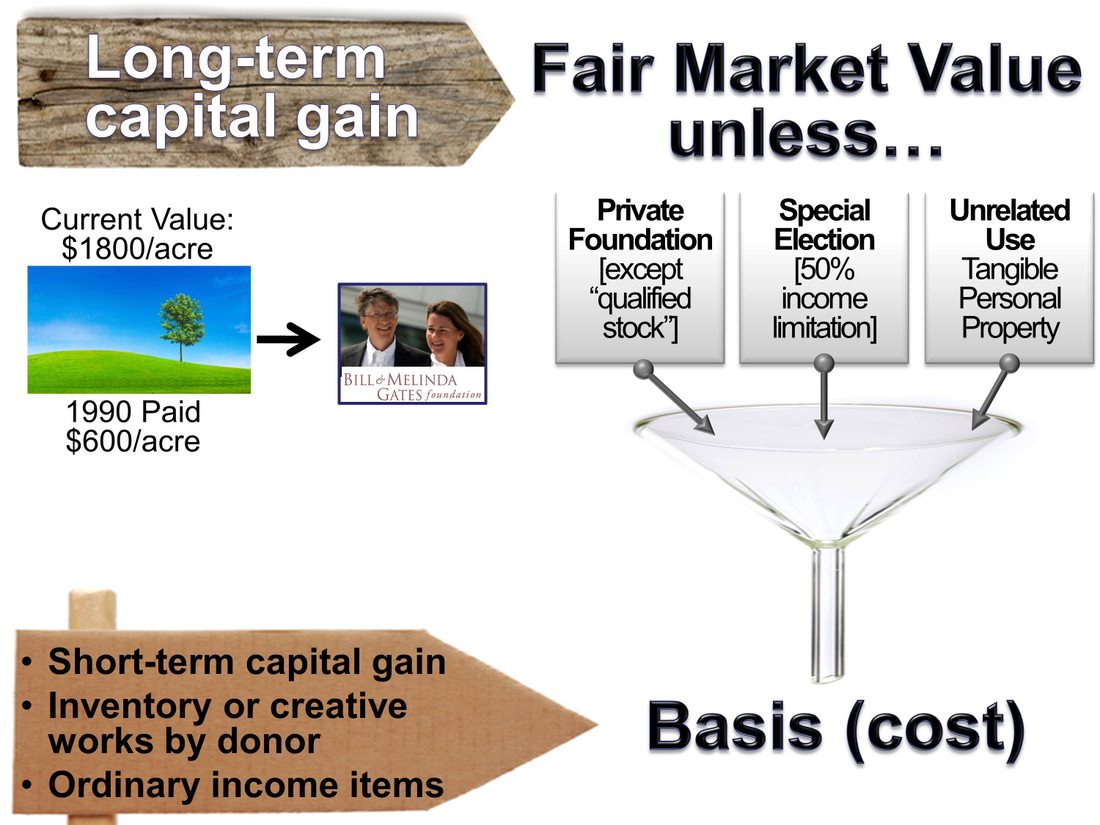
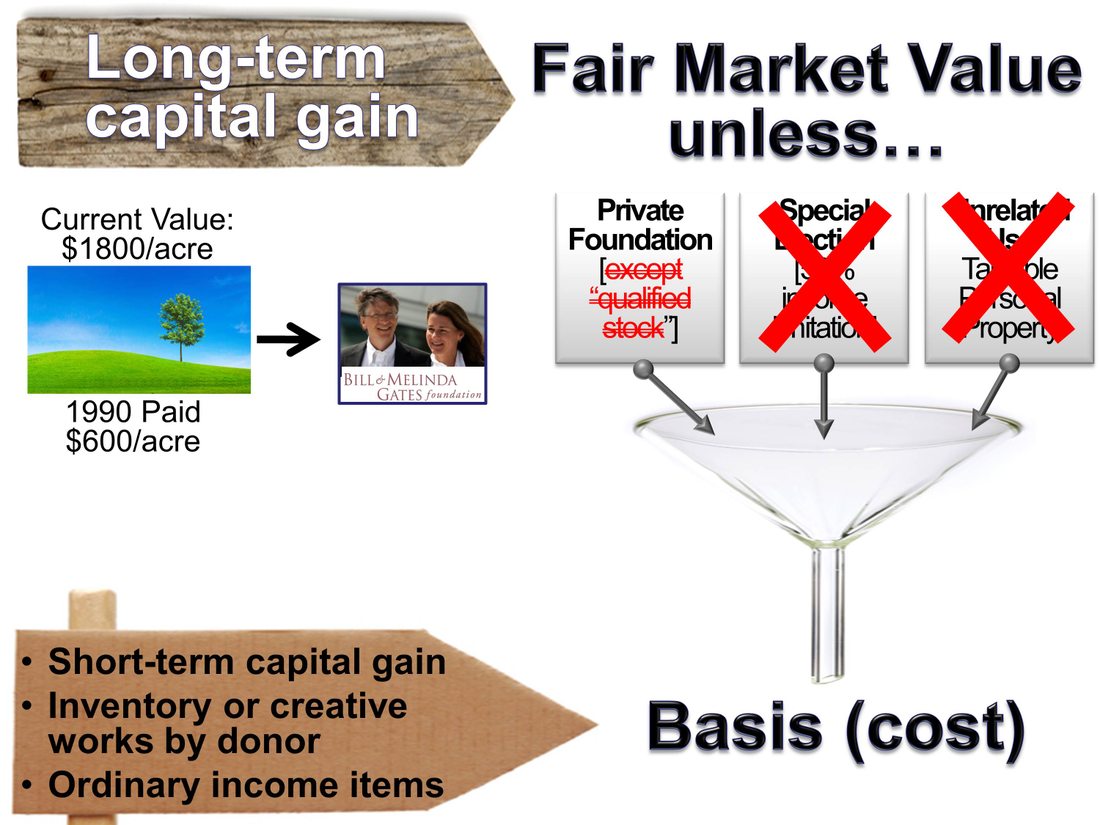
Now suppose the donor has farmland that he purchased for $600 an acre in 1990, which is now worth $1800 an acre. He contributes this farmland as a gift to a private foundation. How much per acre can he deduct for this gift?
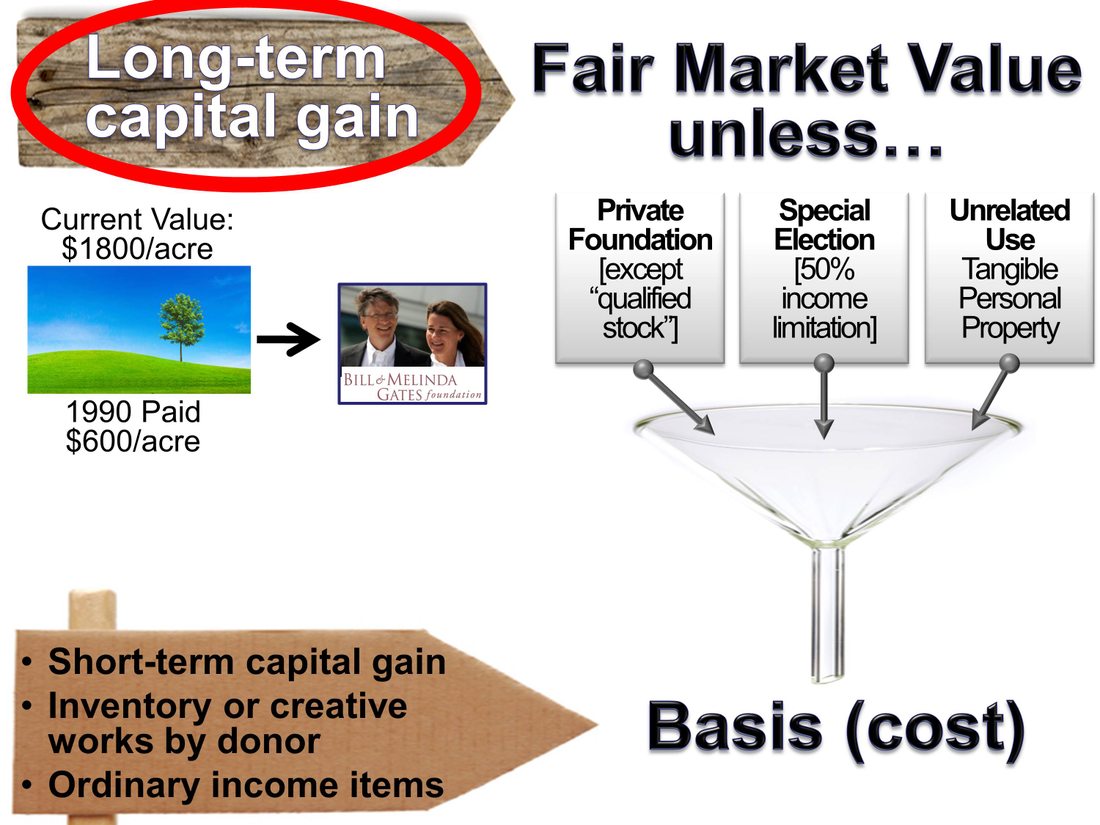
As before, we begin by recognizing that this is long-term capital gain property. First, it has gone up in value. Second, the donor has owned it for more than 12 months.
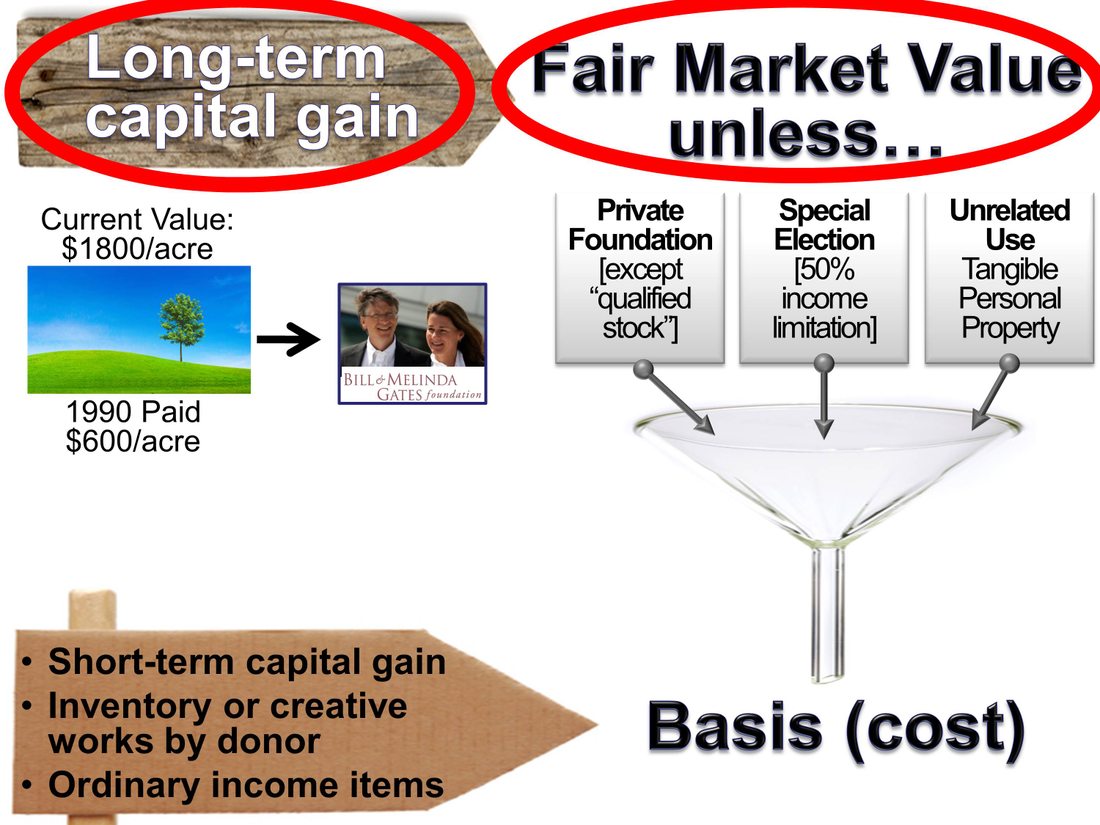
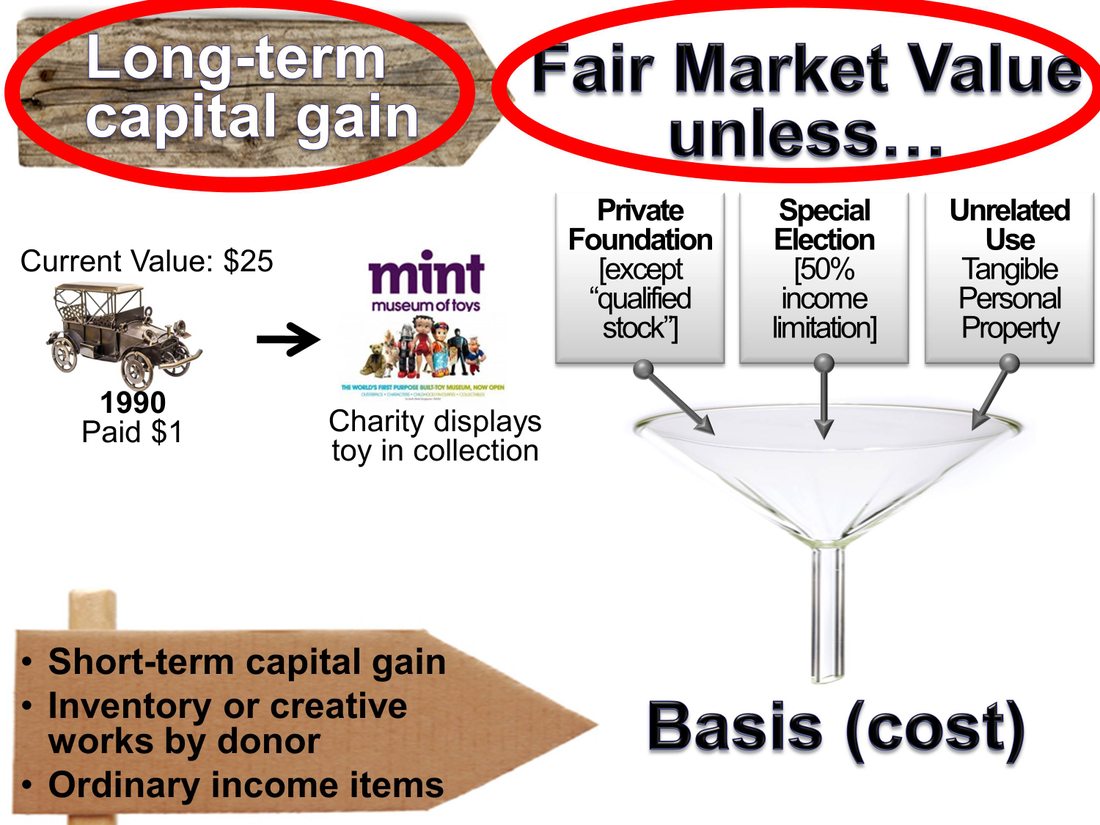
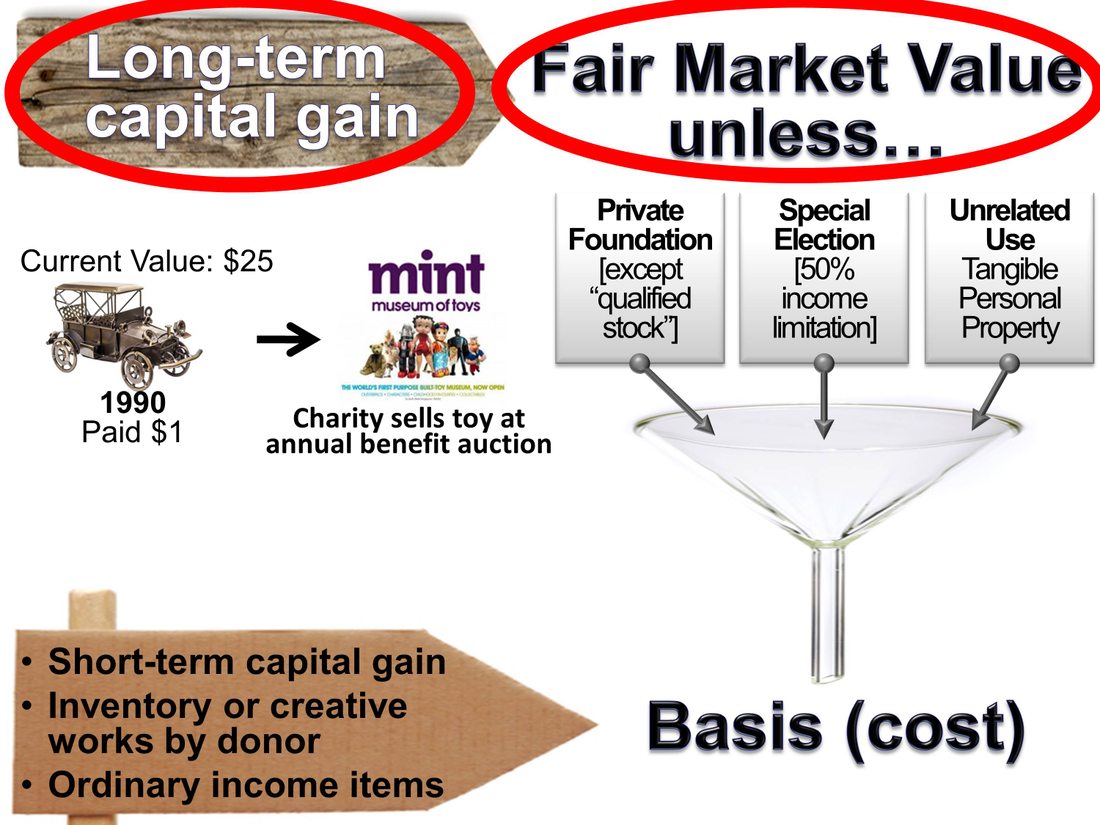
Because this is long-term capital gain property, the donor can normally deduct its fair market value, unless one of the exceptions applies.
The donor has not made a special election to have his gift's valuation lowered, so that exception does not apply. Similarly, this is not tangible personal property. (It is real property.) Therefore, the tangible personal property exception does not apply either. However, the donor has made this gift to a private foundation. Consequently, he will not be able to deduct its fair market value, unless it is "qualified stock." Clearly, this is not any type of stock shares, because it is real property. So, this exception to the exception is not relevant.
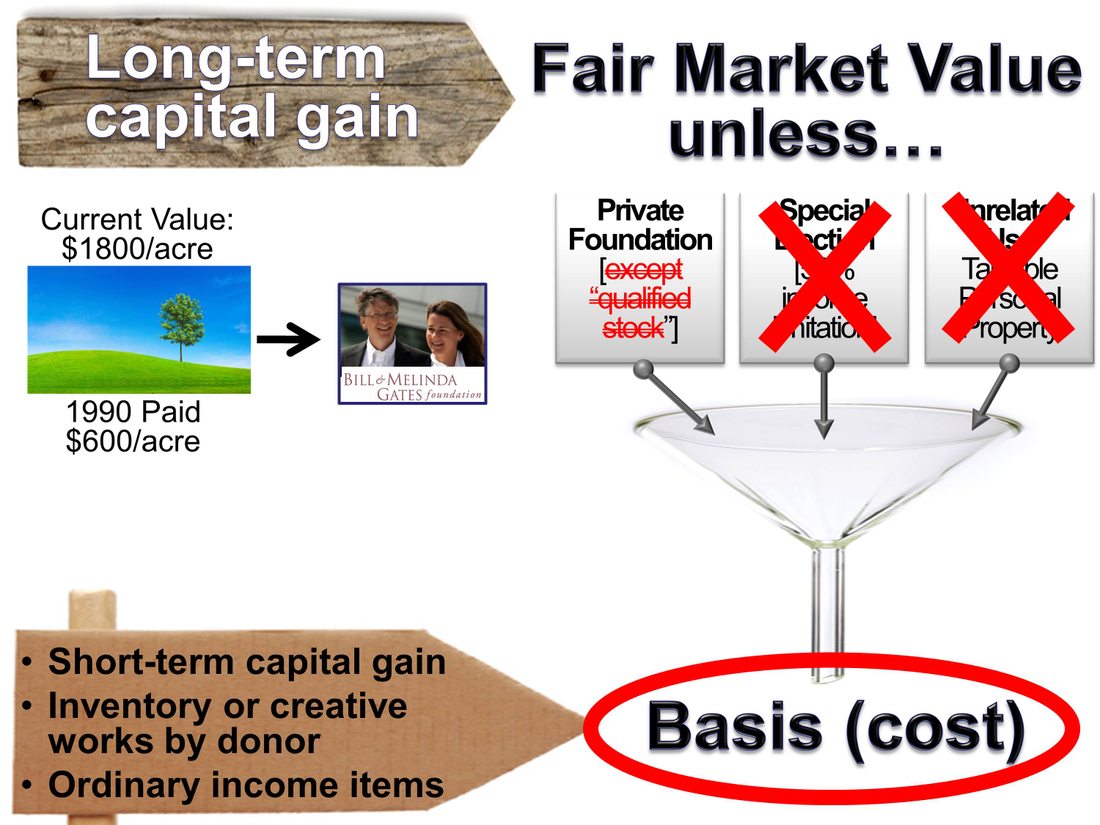
As a result of making this gift to a private foundation (since it is not "qualified stock"), the donor's deduction for the charitable gift of land will be limited to its cost basis. In this case, that means that the donor's deduction will be limited to $600 per acre.
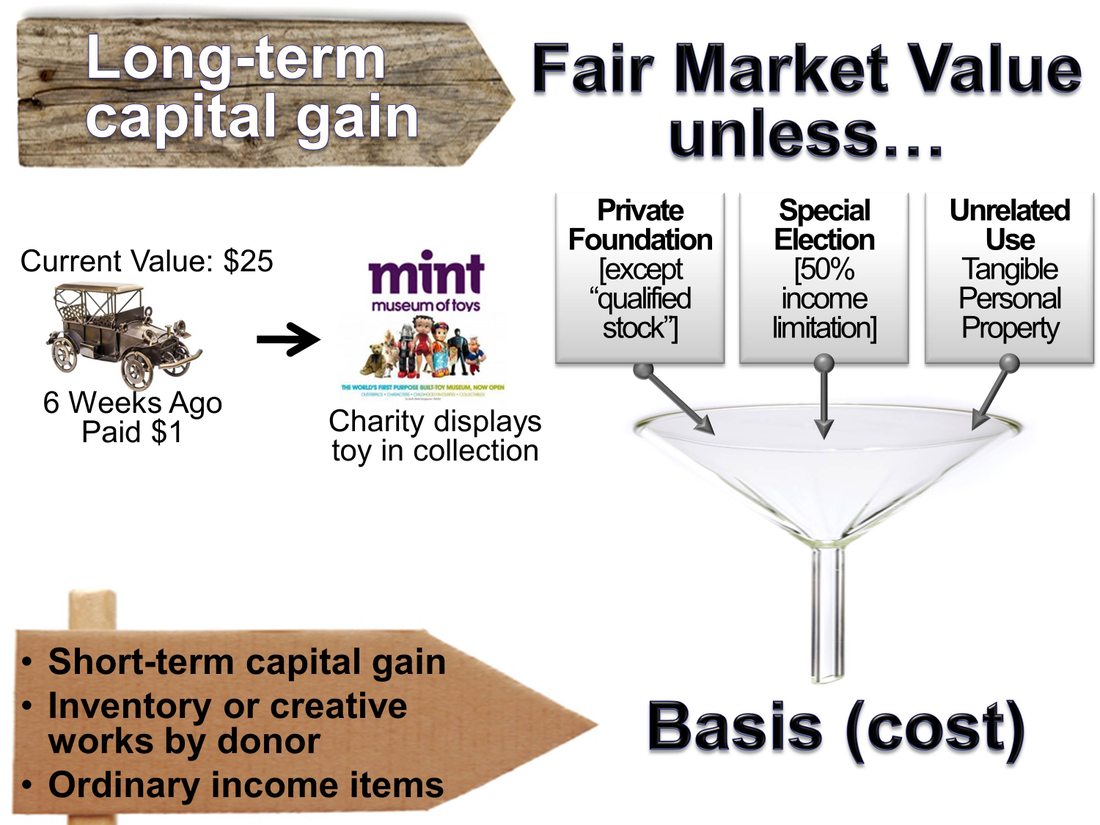
Next, consider an example involving a different kind of property. Suppose a donor purchased an antique toy car six weeks ago for $1. This was quite a good purchase, because today the value of the antique toy car is $25. The donor's plan is to give the toy car to a museum of toys that is also a public charity. The charity is interested in the car for its historical value and intends to display the car in its museum collection. How much can the donor deduct for the gift of the antique toy car given to the public charity?
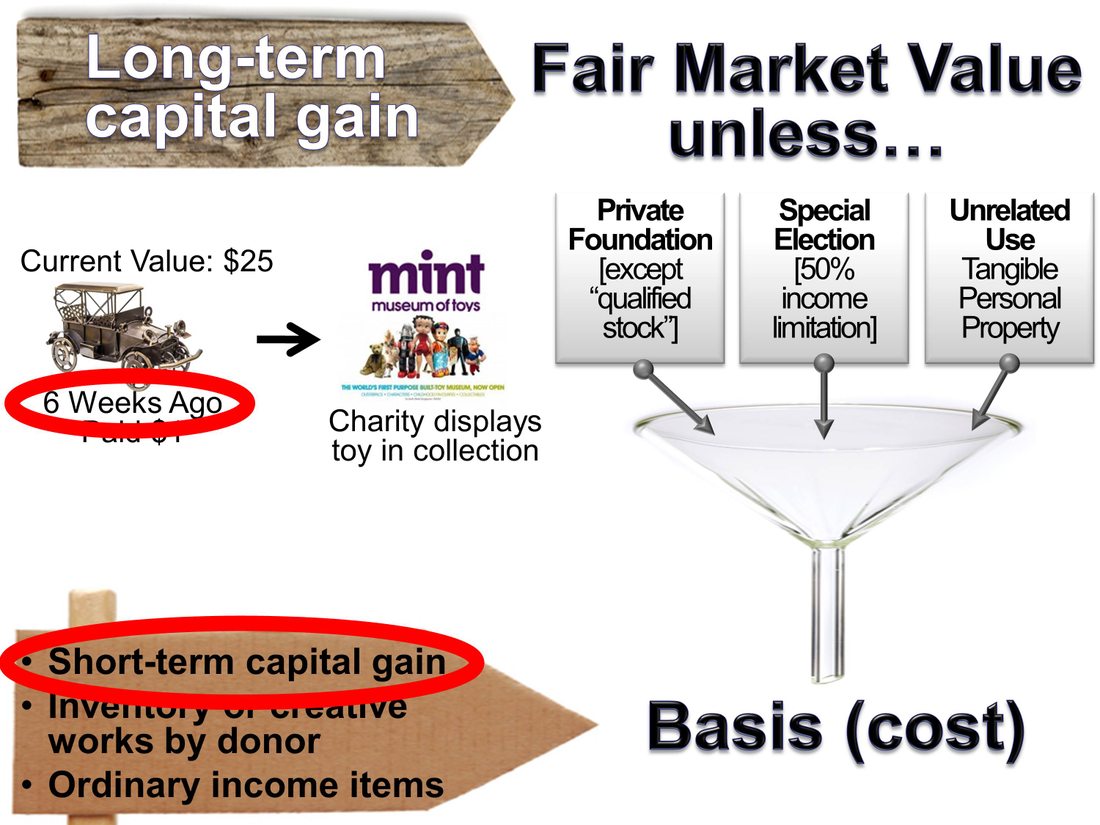
The answer to this question is actually simpler than it may seem at first. Because the donor has owned the antique toy car for only six weeks, it is short-term capital gain. Because it is short-term capital gain, the rules concerning "related use" or "unrelated use" tangible personal property become irrelevant. The gift must be valued at the lower of fair market value or basis regardless of its usage by the charity.
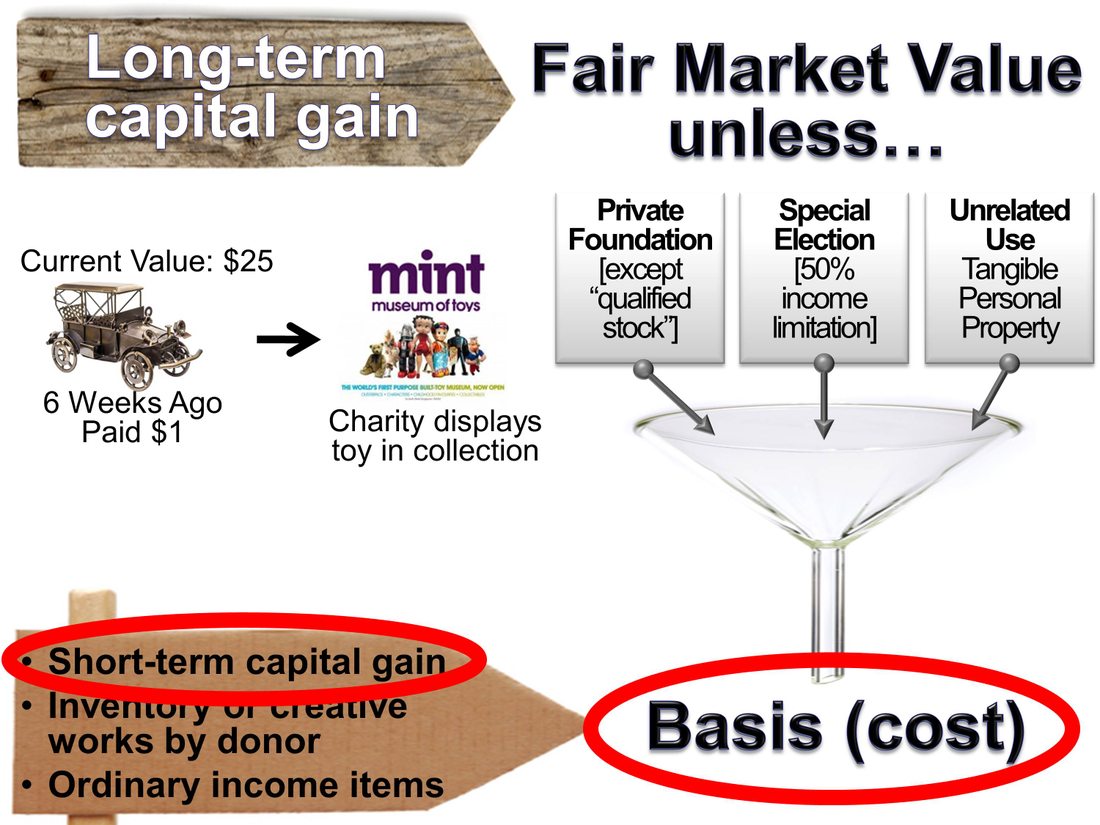
These exceptions are irrelevant because, as short-term capital gain property, this item may be valued only at cost basis. (As always, valuing at cost basis assumes that the cost basis is less than fair market value. Here, the cost basis of $1 is less than the fair market value of $25.)
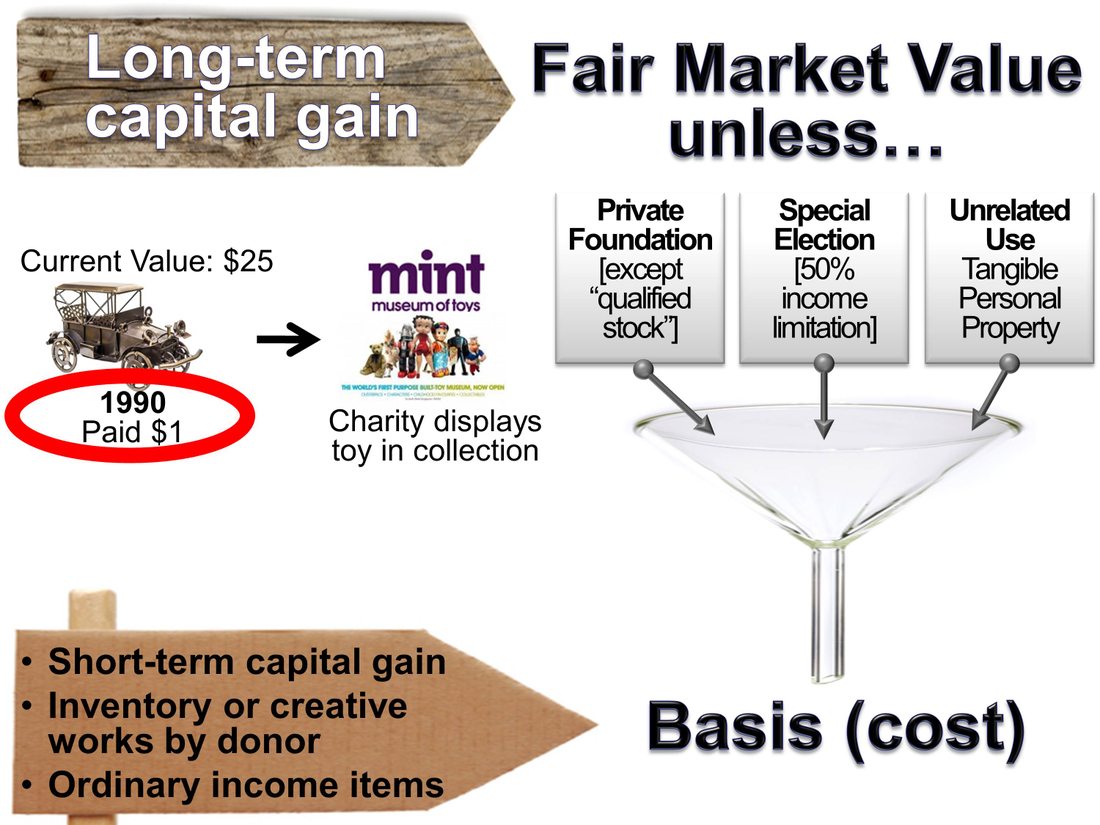
Now consider a slightly different example. Suppose that the donor purchased the antique toy car, not six weeks ago, but in 1990. How does this change the result?
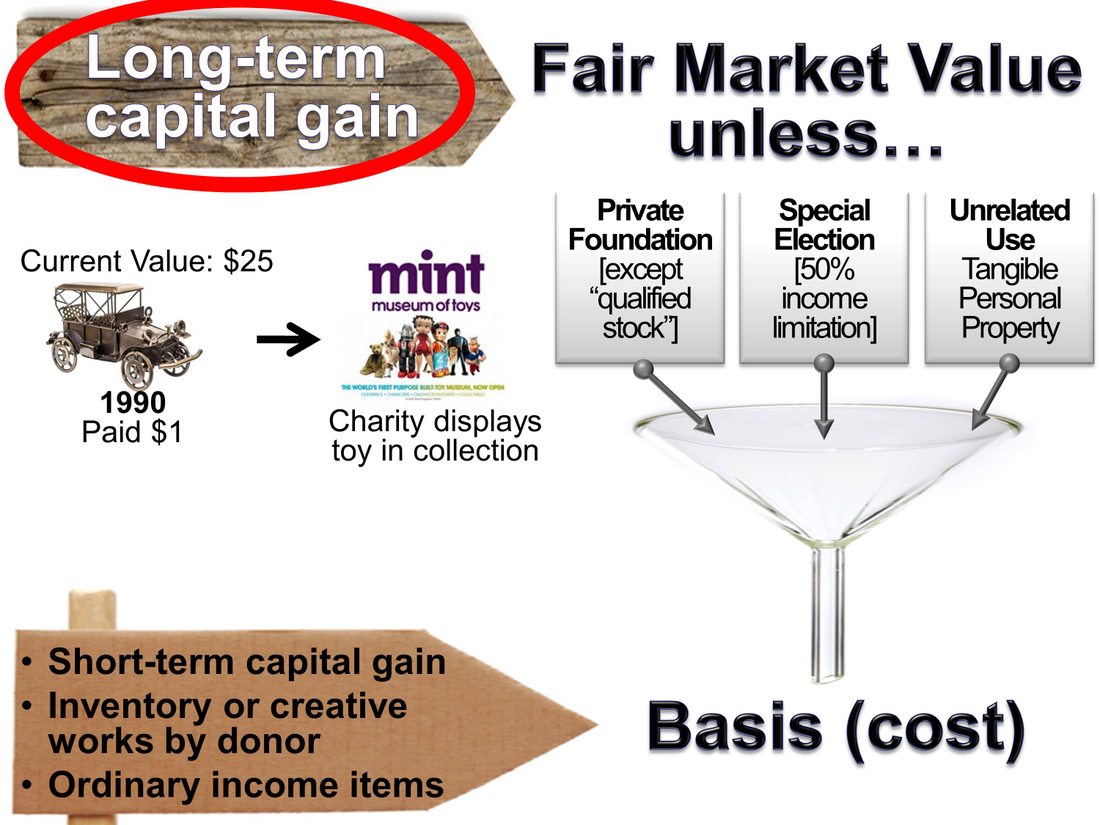
To begin with, since the donor has owned the property for more than 12 months and it has gone up in value, this property is long-term capital gain.
Because this is long-term capital gain property, there is the potential to deduct the full fair market value of the gifted property, rather than only its cost basis. Of course, this is true only if none of the exceptions apply.
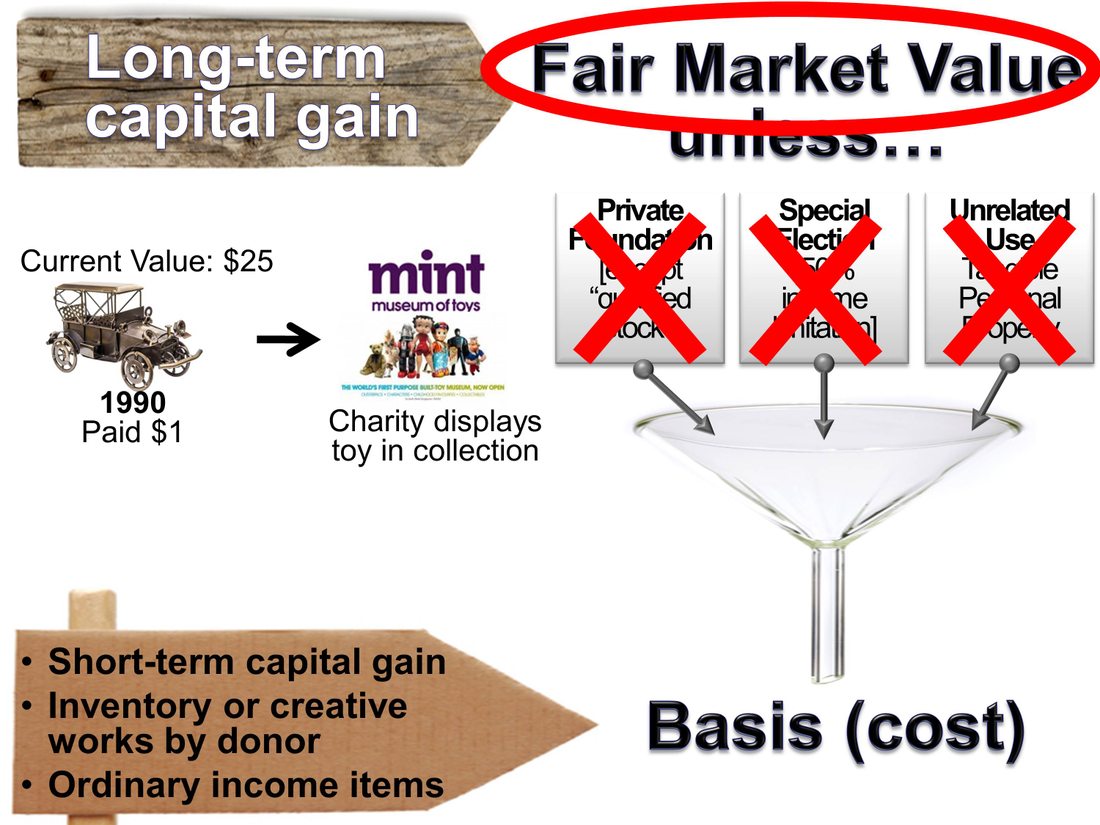
The first exception does not apply, because this is not a gift to a private foundation. It is a gift to a public charity, in this case a museum of toys. Next, there was no mention of a special election, so this exception does not apply either. Finally, this is tangible personal property and consequently the unrelated use exception could apply. However, in this case, the charity will actually be using the gifted item in furtherance of its charitable purposes. Thus, this property is related use property, not unrelated use property. Because none of the exceptions apply, the donor is allowed to deduct the full fair market value of the property donated to the charity. In this case, it is important that the charity "intended" to use the item in its charitable operations by displaying the toy in its collection. How can the IRS prevent abuse of this rule by charities that might say they "intend" to use gifts of property, but then simply sell the gifted property?
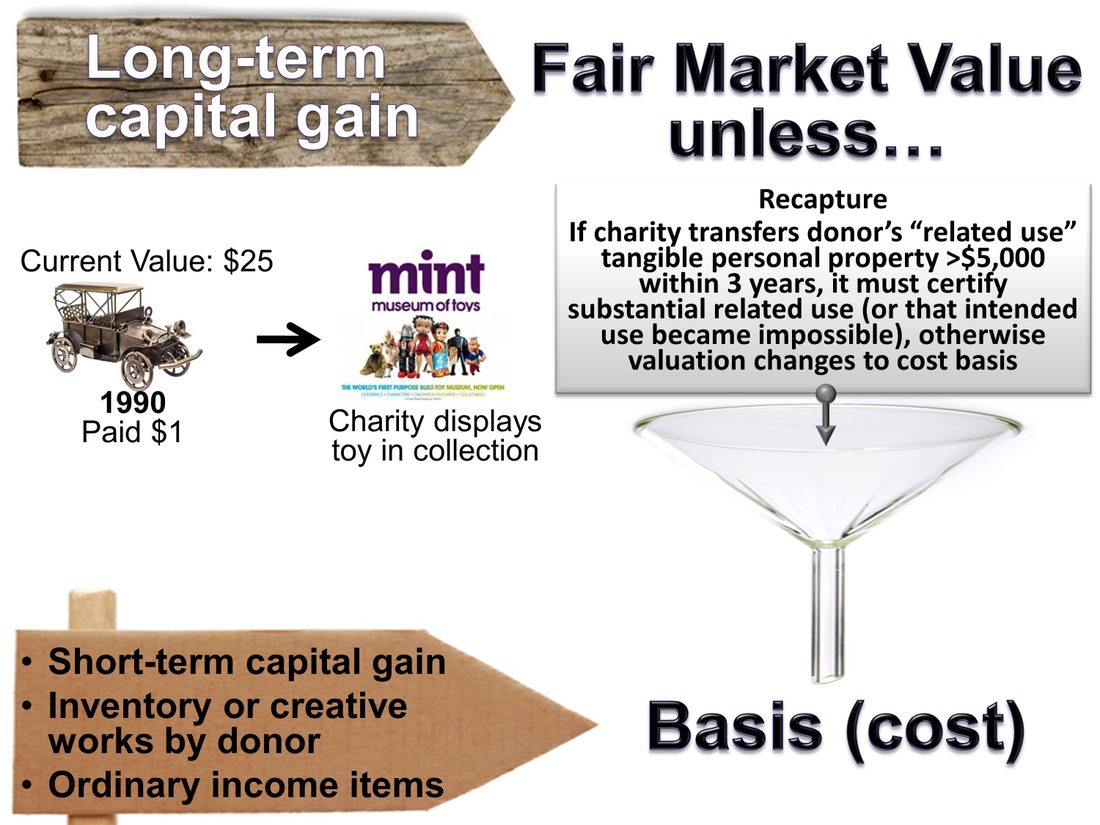
In this case, abuse is limited by the recapture rule. If a charity sells (or otherwise transfers) the property item within three years, the valuation could change from fair market value to cost basis. Such a change of valuation would require the donor to amend his or her tax return to reflect the lower deduction. This recapture rule applies only to tangible personal property worth more than $5,000. (The IRS does not want to hassle with recapture for small gifts.) For these larger gifts, a transfer or sale of the property by the charity within three years will lead to the reduced valuation for the charitable deduction. This occurs unless the charity certifies that it made substantial related use of the property prior to sale or that the intended use became impossible.
For example, if the donor's toy car were worth $25,000 (instead of $25) and the charity sold the toy three months later, then the original deduction would be subject to recapture. However, if the reason the charity sold the car was because their museum location burnt down, making it impossible to display the car as originally intended, then no recapture would be required (assuming that the charity certified that the original intended use became impossible). Alternatively, if the charity had, for example, displayed the car for 2 ½ years in its collection prior to the sale of the item and it was willing to certify this substantial related use, this certification could also prevent recapture. Obviously, the simplest and cleanest way to avoid recapture is to make sure the charity does not sell the item for at least three years. If the charity does sell within three years, but it also certifies that one of these two exceptions applies, that will also avoid recapture. However, this certification must be accurate. The charity must sign under penalty of perjury, and there is a $10,000 fine if the charity provides false information.
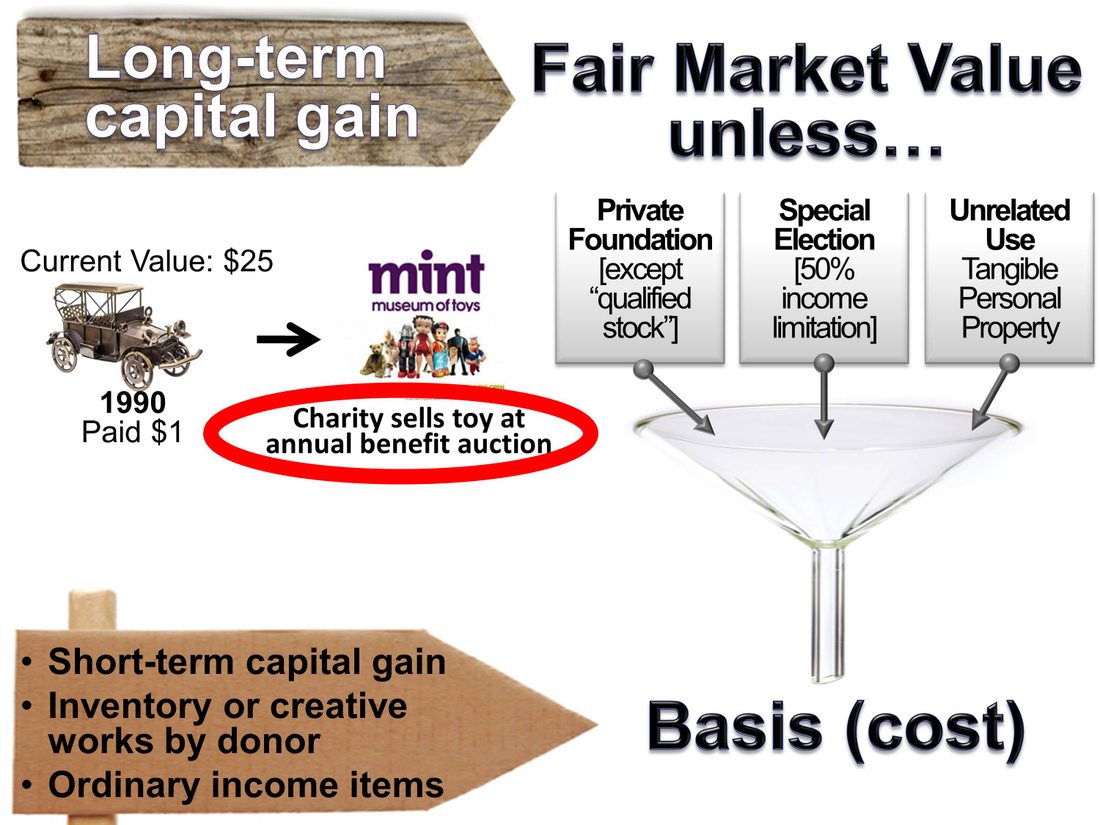
So, what happens if the charity does not use the item, but instead simply sells it soon after receiving it? In this case the donor gives his antique toy car to a public charity that displays toys in its museum, but the charity doesn't want to display the donor's toy. The charity just wants to sell it. So, after the donor has given the toy to the charity, the charity sells the toy at its annual benefit auction. What happens then?
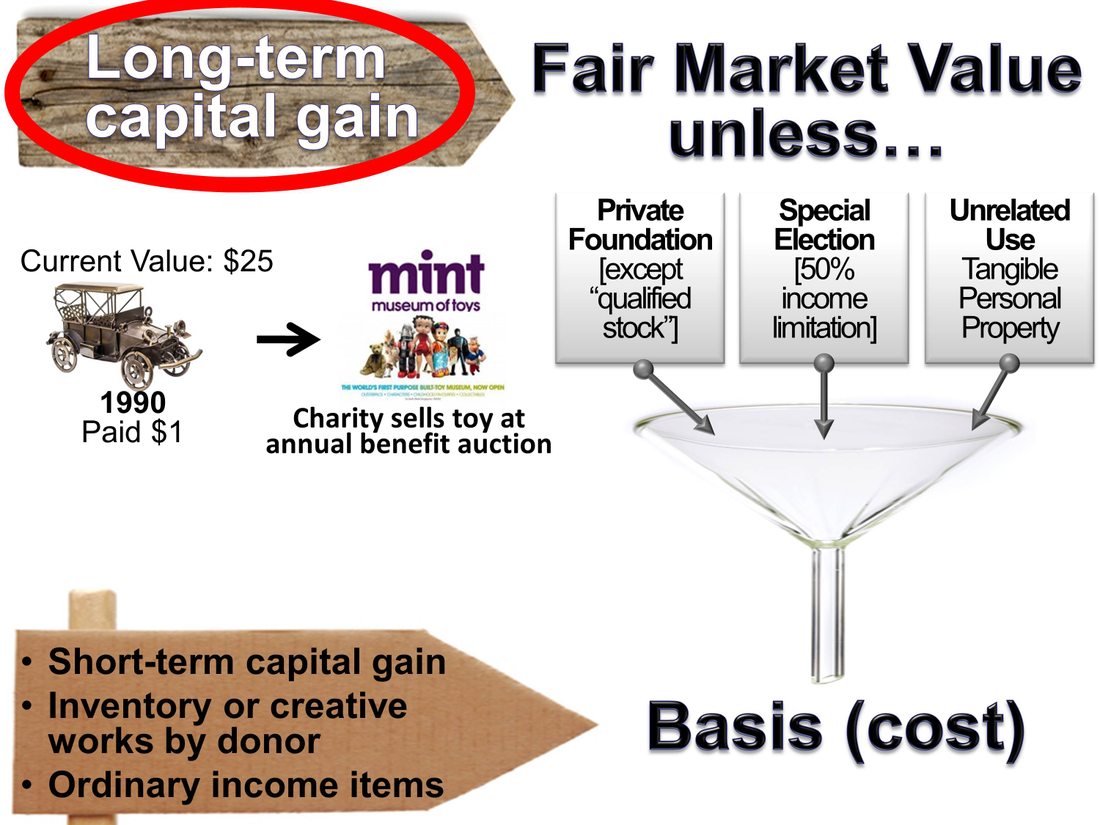
Once again, this is still long-term capital gain property because the donor has owned it since 1990 and it has gone up in value.
Because this is long-term capital gain property, there is at least the possibility that it could be valued at fair market value unless one of the exceptions applies.
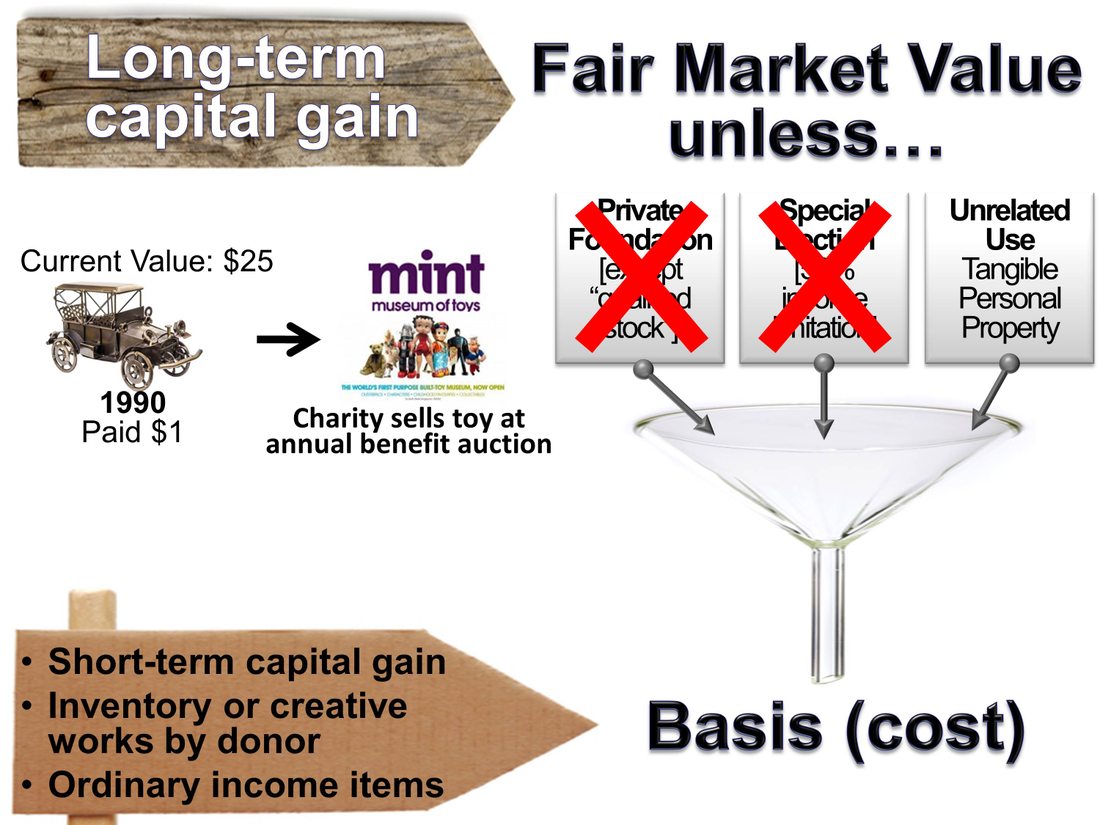
In this case, one of the exceptions does indeed apply, because this is unrelated use tangible personal property. It is unrelated use property because the charity did not use it. Instead, the charity simply sold it for money. It is tangible personal property because it is a moveable physical item. Thus, this tangible personal property is not being used by the charity, but is instead simply being sold, and thus the exception to fair market valuation does apply.
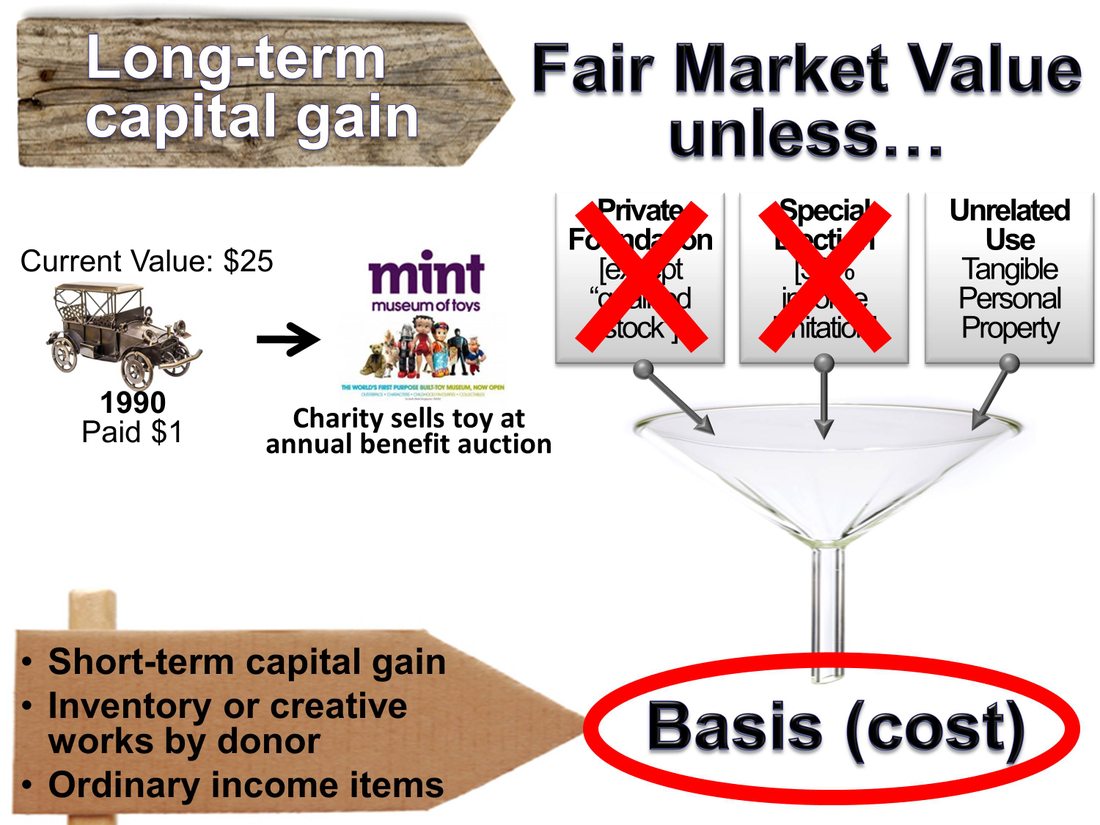
Because one of the exceptions applies, the donor cannot use the fair market value for calculating the deduction. Instead, the valuation must drop down to the cost basis valuation. So, the gift of an item worth $25 generates a deduction of only $1.
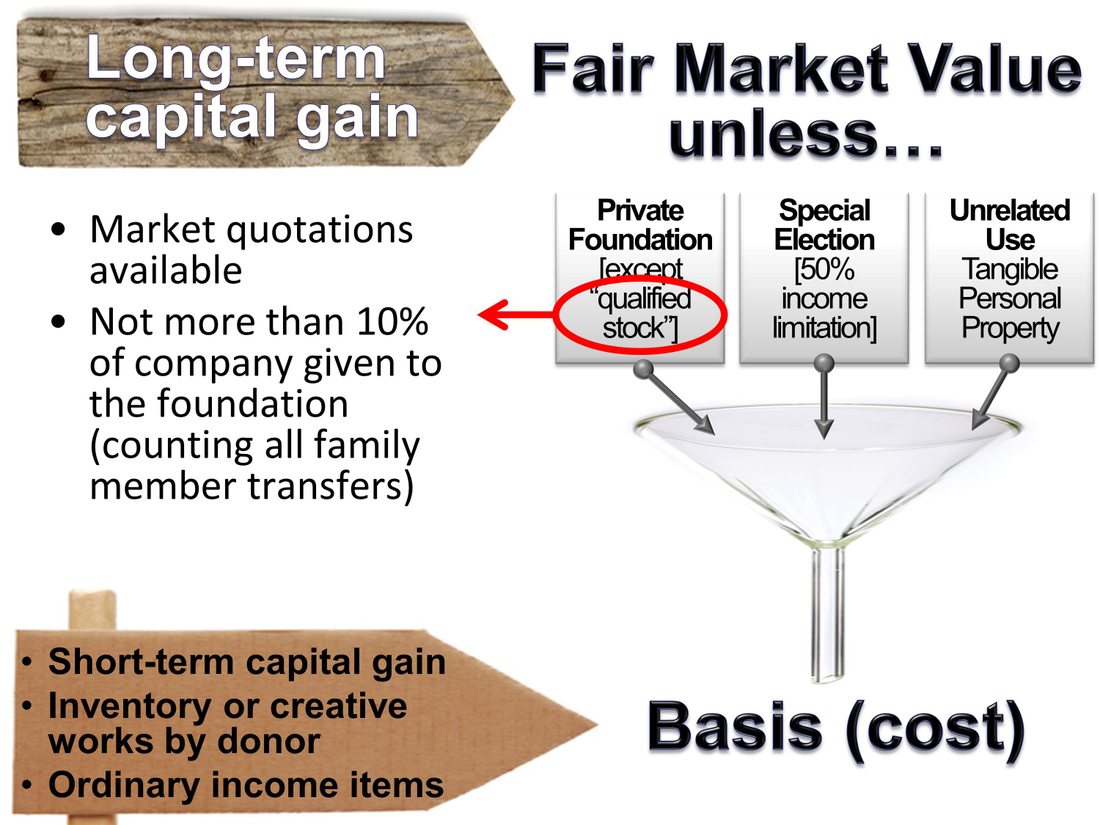
An exception to the exception is the rule related to "qualified stock". Qualified stock is typical publicly traded stock. That is, stocks that are traded on an exchange such that market quotations are regularly available. For example, any stock traded on the New York Stock Exchange can be qualified stock. In addition to being a publicly traded stock, the private foundation cannot have more than 10% of the entire company when counting all family member transfers together.
What is the thought behind this rule? The intent is to avoid giving special benefit to large, closely-held, insider transactions. Consider the case of a family owned business where family members transfer most shares of the business to their own private family foundation. This transaction has some potential for abuse. The family members controlled the asset before the gift. And now, as board members of the private family foundation, they control the asset after the gift (at least until it is sold). Determining the fair market value of shares in a family owned business may be quite difficult. This is especially true for closely held corporations where other investors may be uninterested in owning a minority share when the family still controls all aspects of the business. Because private family foundations are often controlled by the donor or the donor's family, these transfers are generally less desirable than gifts to traditional public charities
The exception is allowed for cases in which the property given is almost like cash. It is almost like cash because the shares are reglarly traded and have an easily identifiable value. It is also like cash because it is not a very large share of the total ownership of the corporation (even when considering all family members' transfers together). Given the cash-like nature of the transfer, there is less concern about inappropriate or abusive transactions, making a fair market value deduction more appropriate. Let's look at an example of the mechanics of this kind of transaction.
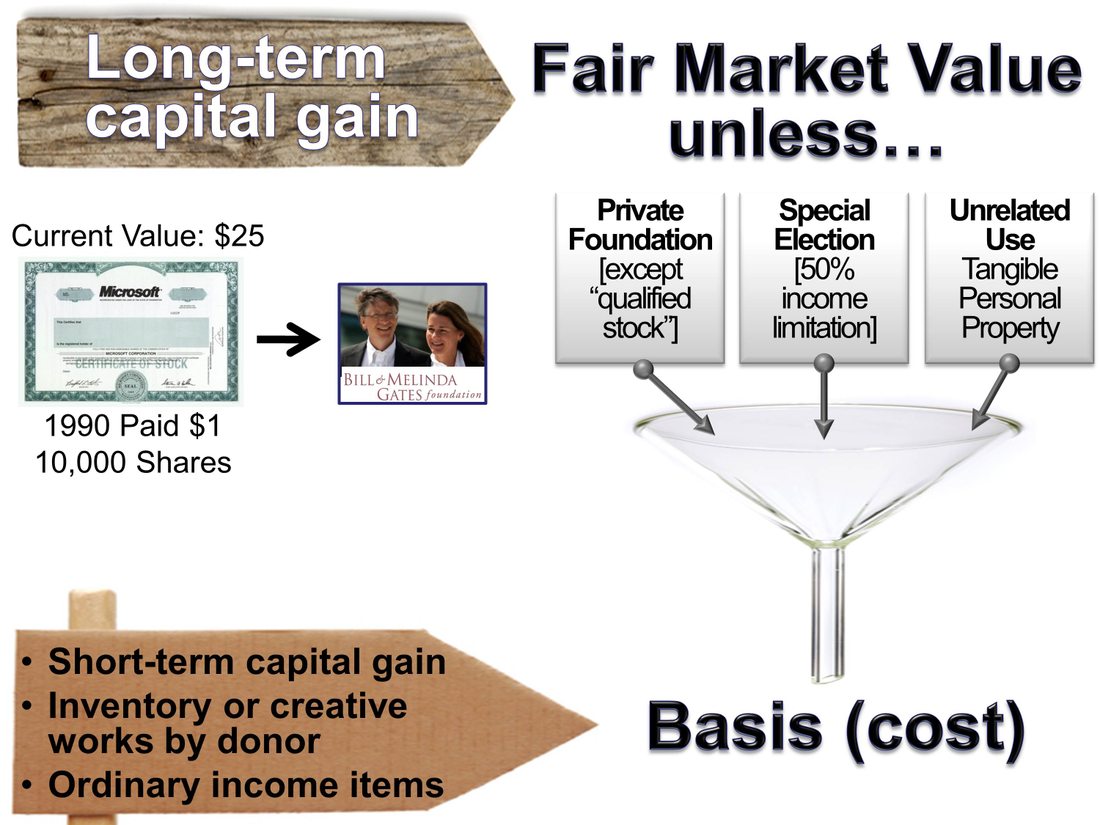
Suppose a donor owns 10,000 shares of Microsoft Corporation (a publicly traded corporation), which she originally paid $1 per share for and is today worth $25 per share. The donor gives these 10,000 shares to a private foundation. What is her deduction for this gift?
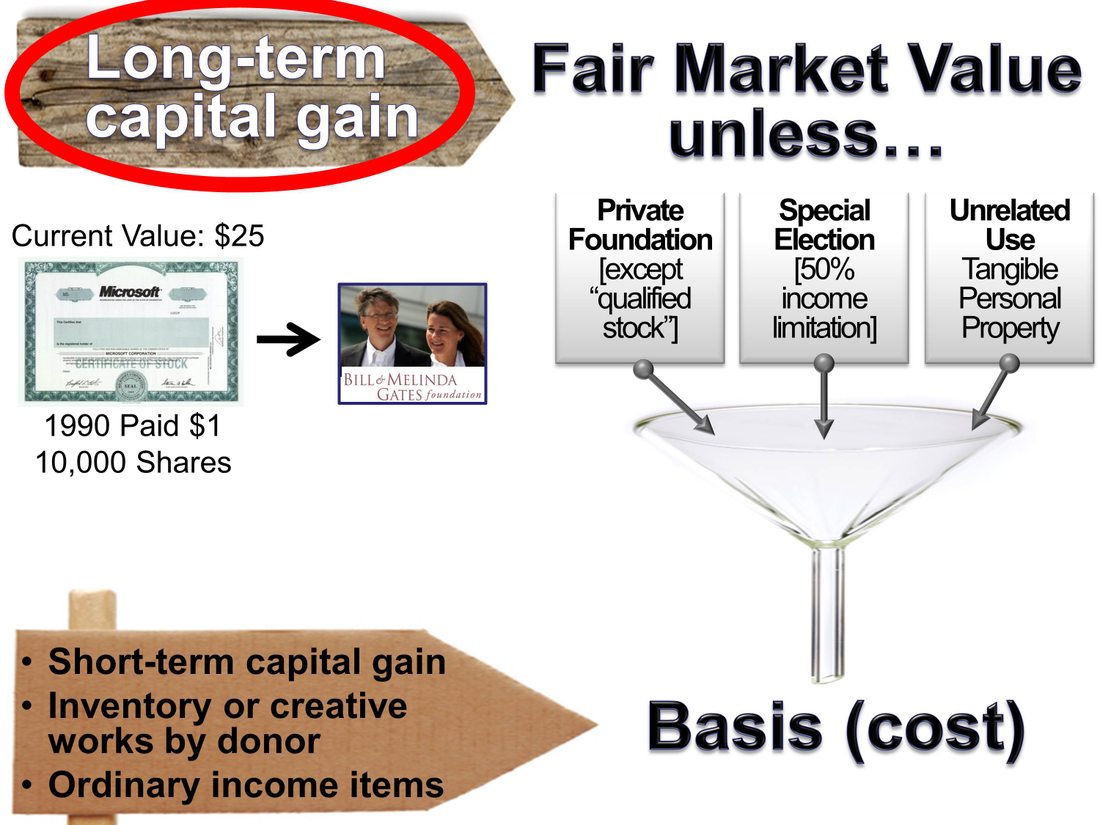
Initially, it is useful to note that this is long-term capital gain property. This is true because the donor has owned it for more than 12 months and it has gone up in value.
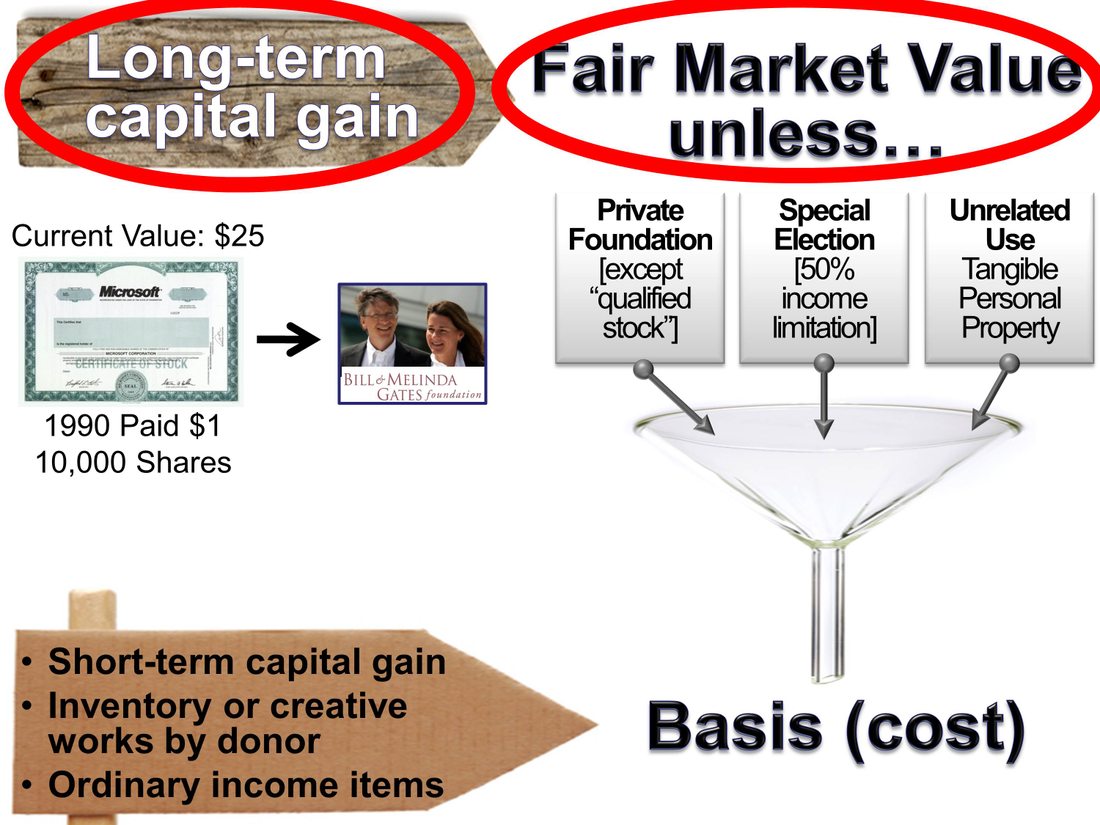
Because it is long-term capital gain, there is at least the potential that the donor can deduct its fair market value, unless one of the exceptions apply.
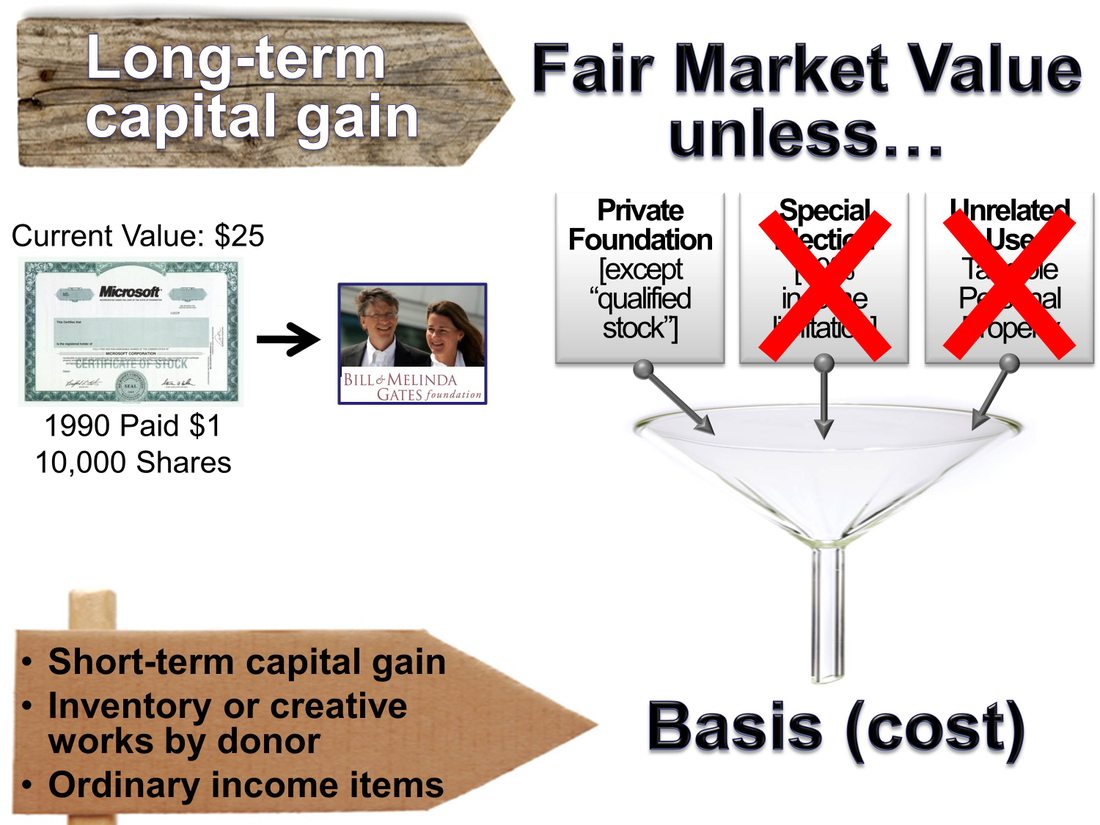
In this case, the donor is giving the property to a private foundation, so one of the exceptions to a fair market value deduction does apply, unless the donor qualifies for the exception to the exception.
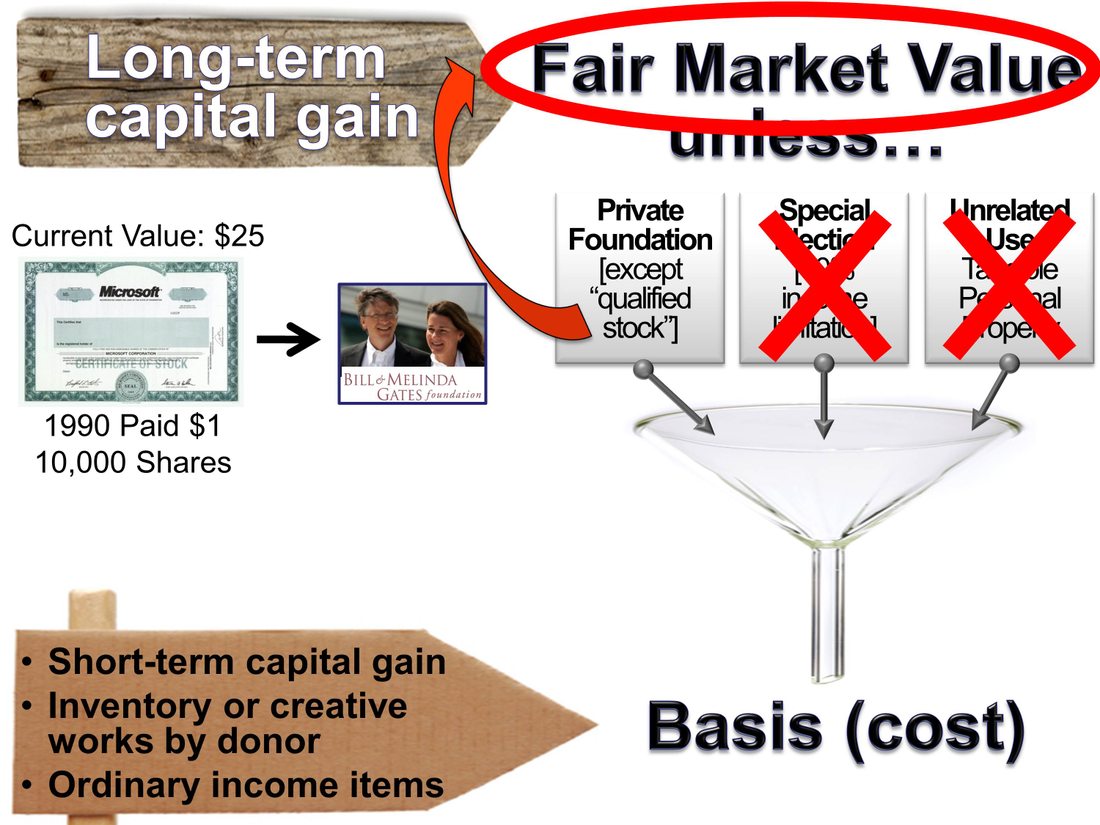
Because the donor is giving qualified stock, the normal rule for private foundations does not apply. As a result, the donor is allowed to deduct the fair market value of the shares of stock. Thus, the donor's deduction is $25 per share ($250,000) rather than $1 per share ($10,000). The property is "qualified stock" because it was publicly traded (meaning that market quotations are available) and because 10,000 shares is much less than a 10% ownership interest in the corporation (given that it has millions of shares).

From time to time there have been special kinds of property that have been used in tax abuse schemes. As a result, Congress has acted to create special rules that apply only to specific types of property, usually in response to these tax abuses. For these special kinds of property, the normal rules are modified. Special charitable donation rules apply to clothing, household items, cars, boats, airplanes, taxidermy, inventory, patents, and other intellectual property.

Considering the complexity of the "standard" rules that we have already reviewed, why would Congress add these special rules for specific assets? The answer is that Congress reacted to ongoing abuses that fit the normal rules, but were still considered to be inappropriate.
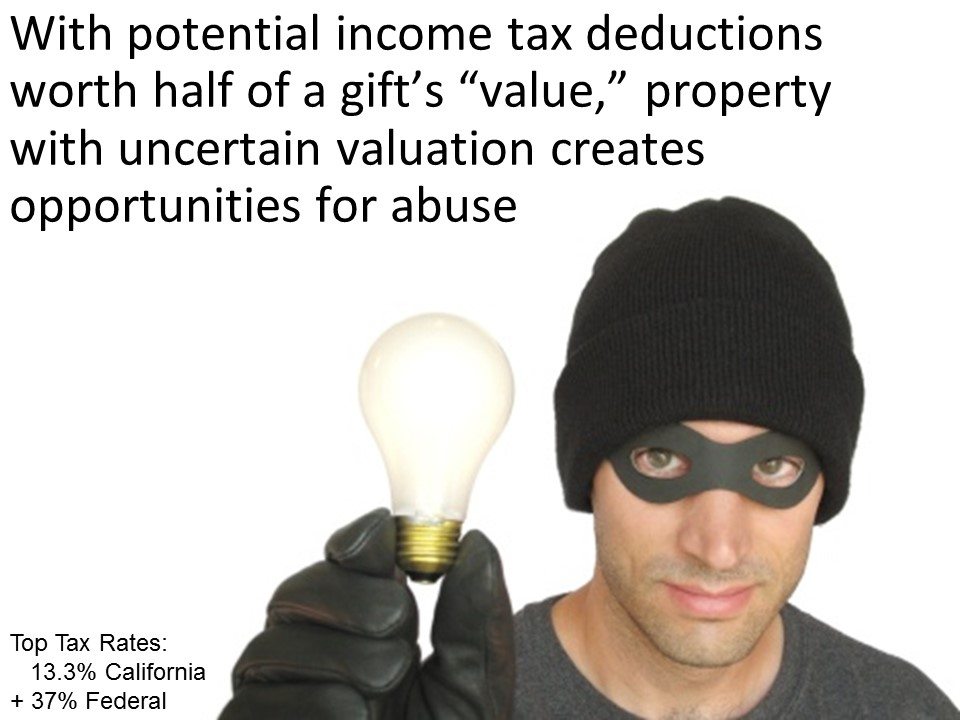
There is always a special potential for abuse in the area of deductions for gifts of property when the property has an uncertain valuation. Consider that if a taxpayer was at the top federal tax rate of 37%, and at the top state tax rate in a state like California, where the top rate is 13.3%, that a deduction is worth nearly half of the value of the gifted property (48.3%). (This is in the typical case when there is no additional federal deduction available for state taxes.) When a property is difficult to value or difficult to sell, but can be immediately converted into a tax benefit worth over $.50 of every appraised dollar, it can make such transfers highly attractive, even to those with little or no charitable intent. If a difficult-to-value item of property can be appraised for two or three times what it could actually be sold for in an immediate sale, it could be more profitable to donate the property, rather than to sell it. Such financial incentives make gifts of difficult-to-value assets ripe for abuse.

What do the abuses that led to special rules look like? For example, a person might have old clothes that she would otherwise throw in the trash because they have little or no resale value. But instead of throwing them away, she could give them away and generate a charitable deduction. She might attempt to value the deduction based on the original cost of the clothing or some "estimated" value based on a percentage of the original cost, when in reality the poor quality clothing has little or no resale value.
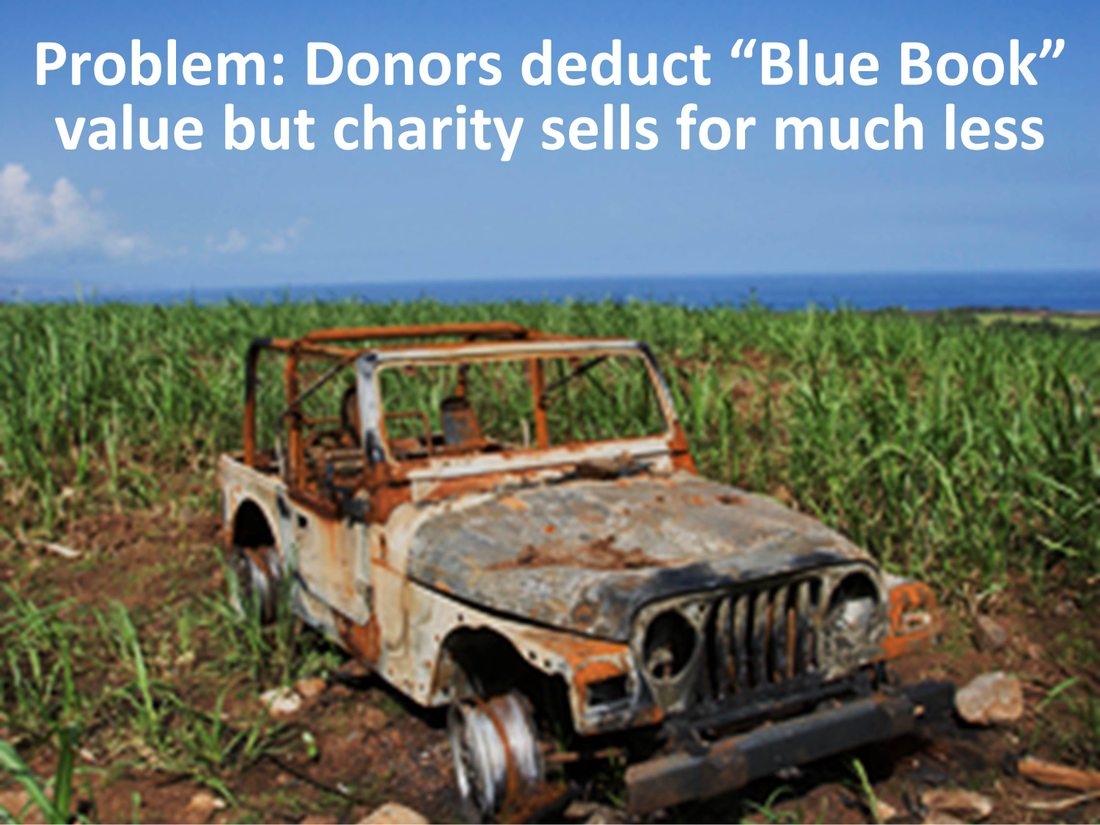
Another abuse could result from gifts of automobiles where the automobile has some defect that reduces its value below the normal resale value for that model and year of car. Even though in reality the automobile may be worth nothing, except in a junkyard, taxpayers may be tempted to donate the vehicle and deduct the standard value for a vehicle of that age, make and model (i.e., the "blue book" value).

A particularly egregious abuse occurred in the area of donating stuffed animals to a wildlife museum. In this scheme, the taxpayer would go on safari to hunt exotic animals, have the animals stuffed, and then donate the animals to a wildlife museum. An appraisal firm would provide a high valuation for exotic stuffed animals (a valuation which might be difficult to disprove given the rarity of transactions and the high cost of acquiring new exotic stuffed animals). A few small wildlife museums were willing to accept these donations (often taking in thousands of animals). The donor would then deduct his cost basis in the stuffed animal, including all of the costs of acquiring the animal, such as the entire expense of the safari travel. Thus, the tax code was essentially funding a substantial portion of safari tourism intended to kill exotic animals.

A different problem arose with copyrights and other intellectual property not simply because of the risk of fraud, but also because of the enormous difficulty in valuing such intellectual property in advance. If a best-selling author, like John Grisham, wrote a new book and immediately donated the copyright of the book to charity, such a donation would be enormously valuable. If a less well-known author did the same, the donation could be highly valuable or it could be worth nothing. The difficulty is that it may be impossible to tell at the time of the donation how much the gift is worth. No amount of sophistication, education, experience, or integrity of any appraiser can correct this problem.
Because of the wide variety of problems and issues with these special kinds of property, each of them now has their own special rule limited only to that specific kind of property.

Clothing and household items typically cannot be deducted unless they are in "good used condition or better." Requiring "good used condition" is intended to exclude worn out clothes. An exception to this rule is allowed if the donor is giving more than $500 of clothing and the donor includes a qualified appraisal of the clothing with the tax return. Thus, small donations of clothing in poor condition are not deductible. Large donations of such clothing may be deductible, but only if accompanied by a qualified appraisal.
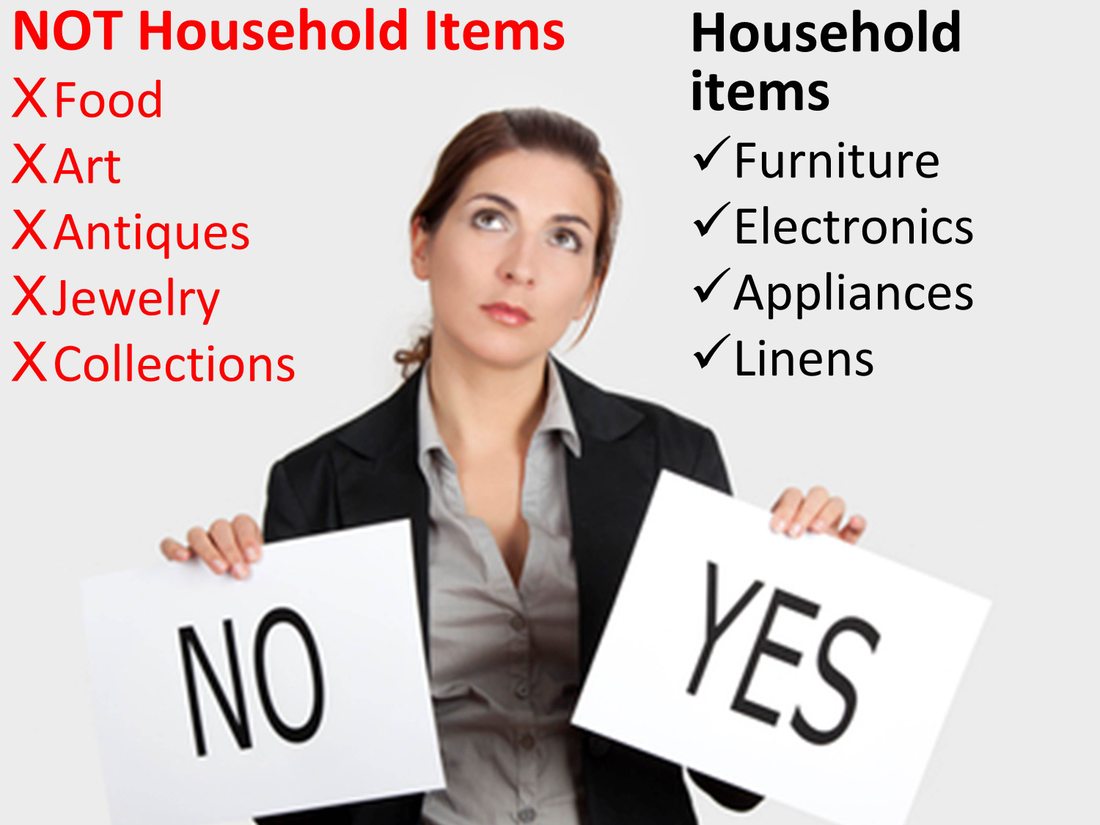
This same rule applies not only to clothing, but to other household items. The term "household items" does not include art, antiques, jewelry or collections. Instead, it refers to items like furniture, electronics, appliances, linens and the like. These household items may not be deducted unless they are in "good used condition or better" or where the donation is accompanied by a qualified appraisal indicating a value in excess of $500 for the entire donation.
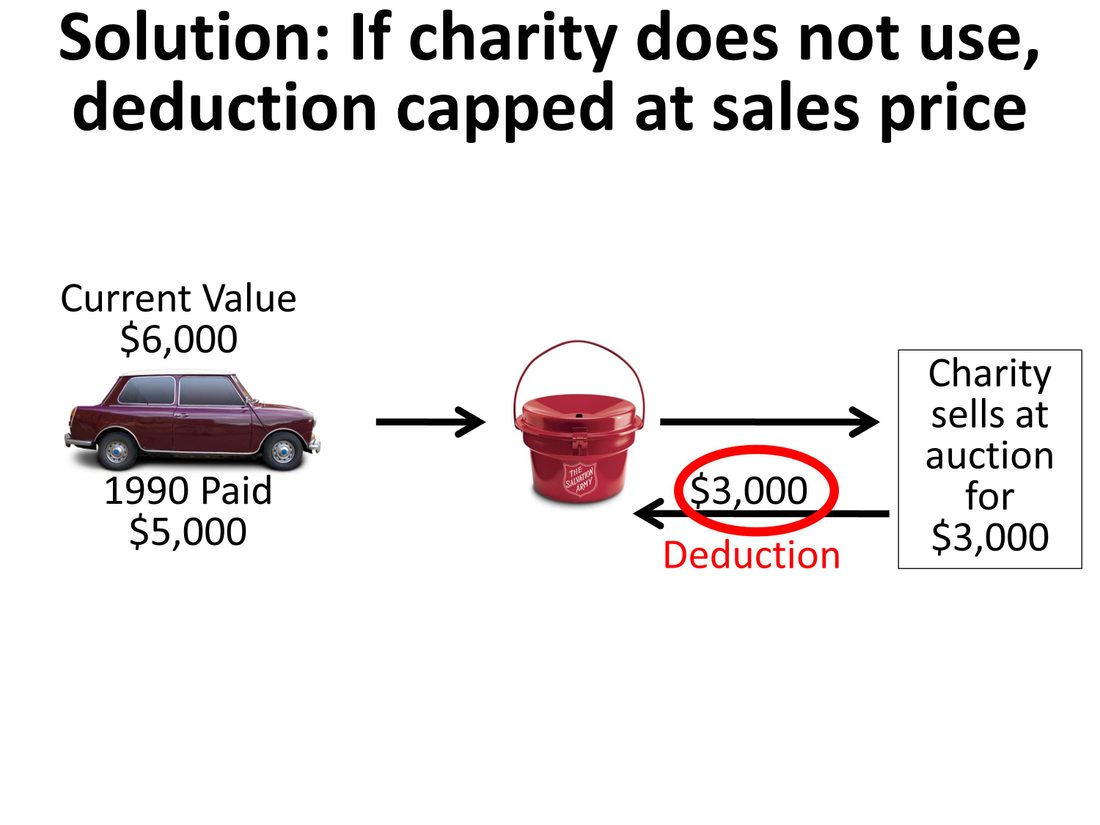
In order to prevent abuse with contributions of automobiles the special rule is that if the charity sells the automobile, the deduction may be no greater than the actual sales price. For example, suppose a donor paid $5,000 for a vehicle (i.e., basis) and it is currently worth $6,000 (i.e., fair market value). The donor gives that vehicle to a charity, and the charity sells it. Unfortunately, in this case, the charity does a poor job of pricing the vehicle. As a result, the vehicle sells for only $3,000. In that case, the donor can only deduct $3,000. This is true even though both the basis and the fair market value were higher than $3,000. This rule can only lower the charitable deduction from the amount that would normally result from the standard valuation rules for gifts of property. If, for example, two benefactors of the charity ran the bid for the vehicle up so that it sold for $10,000, the deduction for the contribution of the car would not be $10,000. As a gift of tangible personal property not used by the charity, the deduction would be the lower of fair market value or basis, which in this case is $5,000.
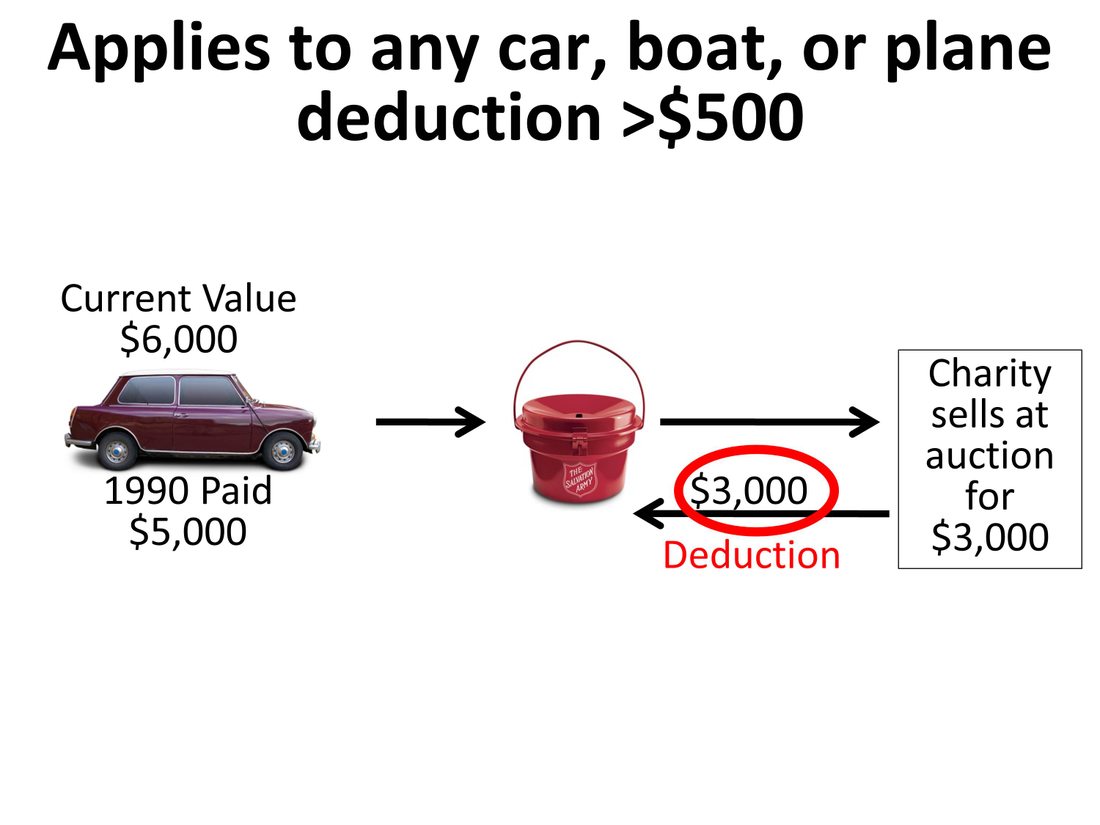
This same rule applies not only to automobiles, but also to boats and even planes. However, the IRS does not require this reduction if the charitable deduction was $500 or less. (Although it seems unlikely that automobiles, boats, or planes would commonly be worth $500 or less.)
An exception to this rule applies if the charity will actually use the vehicle in furtherance of its charitable purposes, or intends to give the vehicle to a needy person rather than to sell it. If the charity is willing to certify this usage on IRS Form 1098-C, then the donor can use the normal rules for valuing this gift of property (which in this case means following the rules for either short-term or long-term related use personal property).
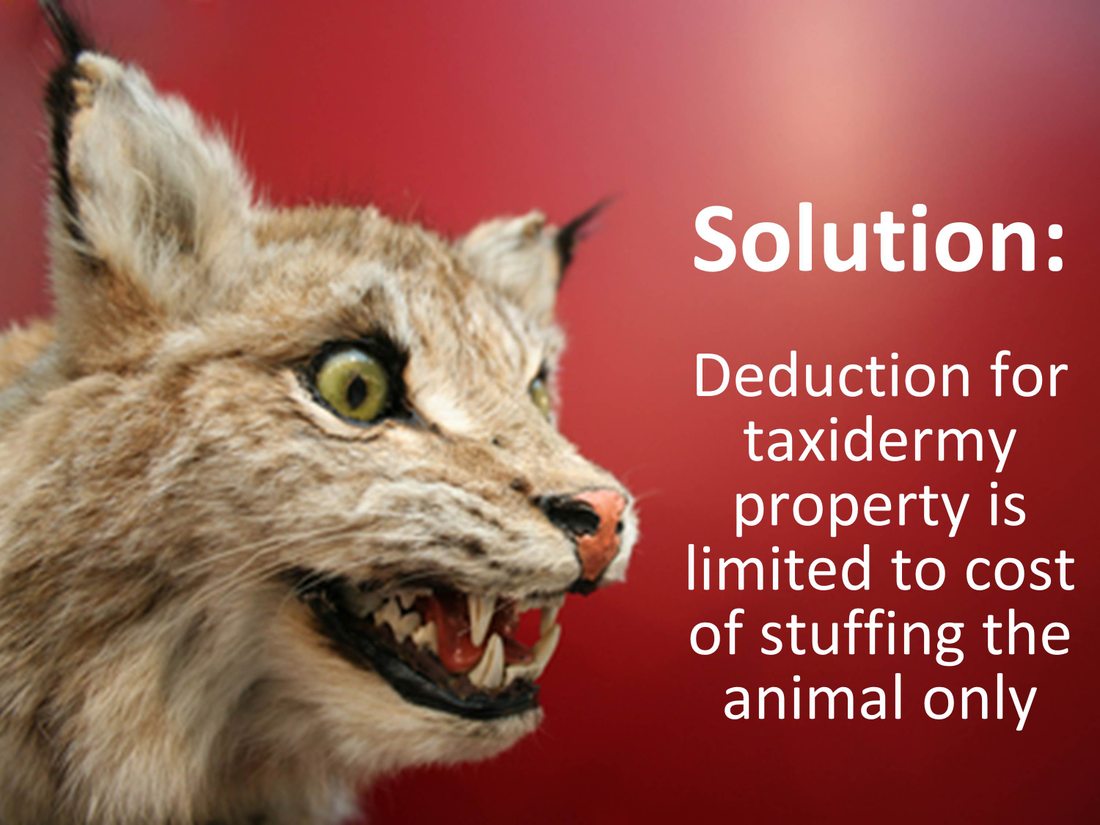
To address the problem of tax-deduction financed safari trips, Congress limited deductions for taxidermy property to the cost of stuffing the animal only. Thus, none of the other costs of acquiring the animal may be deducted.
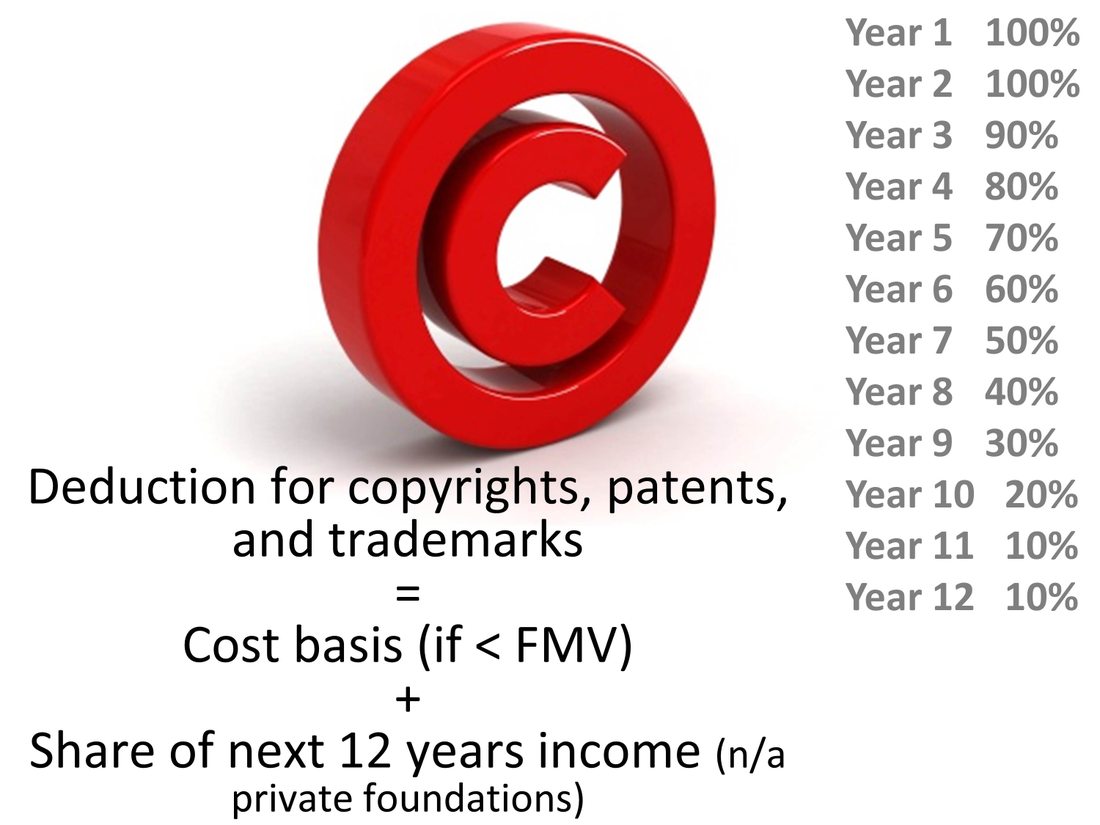
Deducting charitable gifts of copyright (or other intellectual property, such as patents and trademarks) is not simply a problem of fraud or abuse, but is fundamentally a problem of accurately valuing the property in advance. To resolve this issue, Congress allowed for the deduction of cost basis plus a share of the next 12 years of income from the intellectual property right. Thus, the full deduction does not come at the time of the initial transfer. Instead, the donor receives a stream of deductions over 12 years. In this way, the author giving a copyright to a charitable entity does not need to accurately predict its future value in advance, but instead can simply deduct a share of the actual dollars that go to the charity as a result of the gift. This deduction of the income stream is only available for gifts to public charities and not to private foundations.
Note that, as in all other forms of charitable property deductions, the cost basis is deductible only if such basis is less than fair market value. Thus conceptually, it may still be necessary to estimate the fair market value of an intellectual property right in advance. However, in practice, many such rights have little or no cost basis. For example, an author's cost basis would include only some paper and ink, and would not take into account his or her time spent in producing the work. (Note that time and effort are excluded from cost basis in other areas as well. For example, if a taxpayer purchases a dirty car for $5,000 and then spends three months cleaning and detailing it, his basis in the car is still only $5,000.)
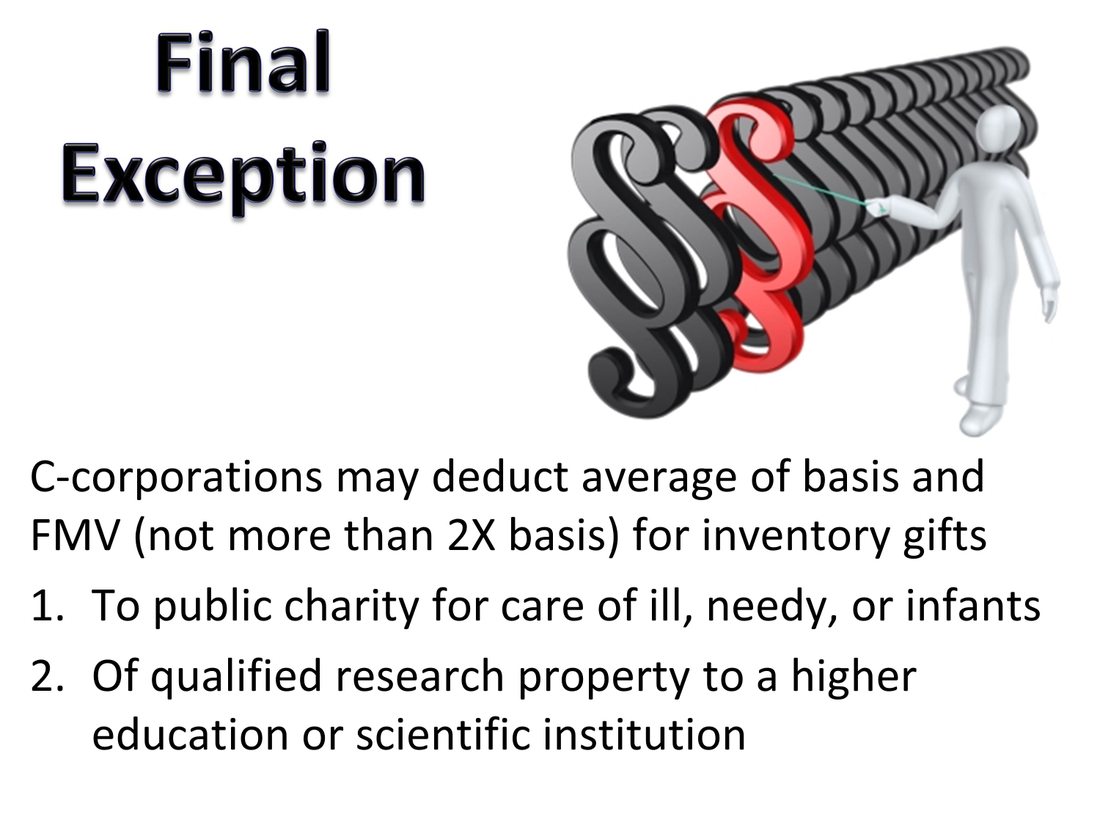
Another exception to the standard valuation rules involves an unusual compromise on valuation. The normal rule for gifts of inventory is that only the cost basis of inventory is deductible. However, the tax code provides a special increase in the deduction for specific types of inventory gifts. If the donor is a standard corporation (known as a C-corporation, as opposed to the closely held, S-corporation), and is giving inventory to a public charity for care of ill individuals, needy individuals, or infants, or it is giving qualified research materials to a institution of higher education or other scientific institution, then the donor corporation can receive a higher deduction. This higher deduction will be the average of basis and fair market value. Thus, the Corporation receives neither the most favored status (which would be fair market value) nor the less favored status (which would be cost basis), but instead receives something in the middle.
However, this deduction is still limited to no more than double the cost basis in the gifted items. This is to prevent a scenario where the cash value of the deduction was worth more than the cost of manufacturing the property.
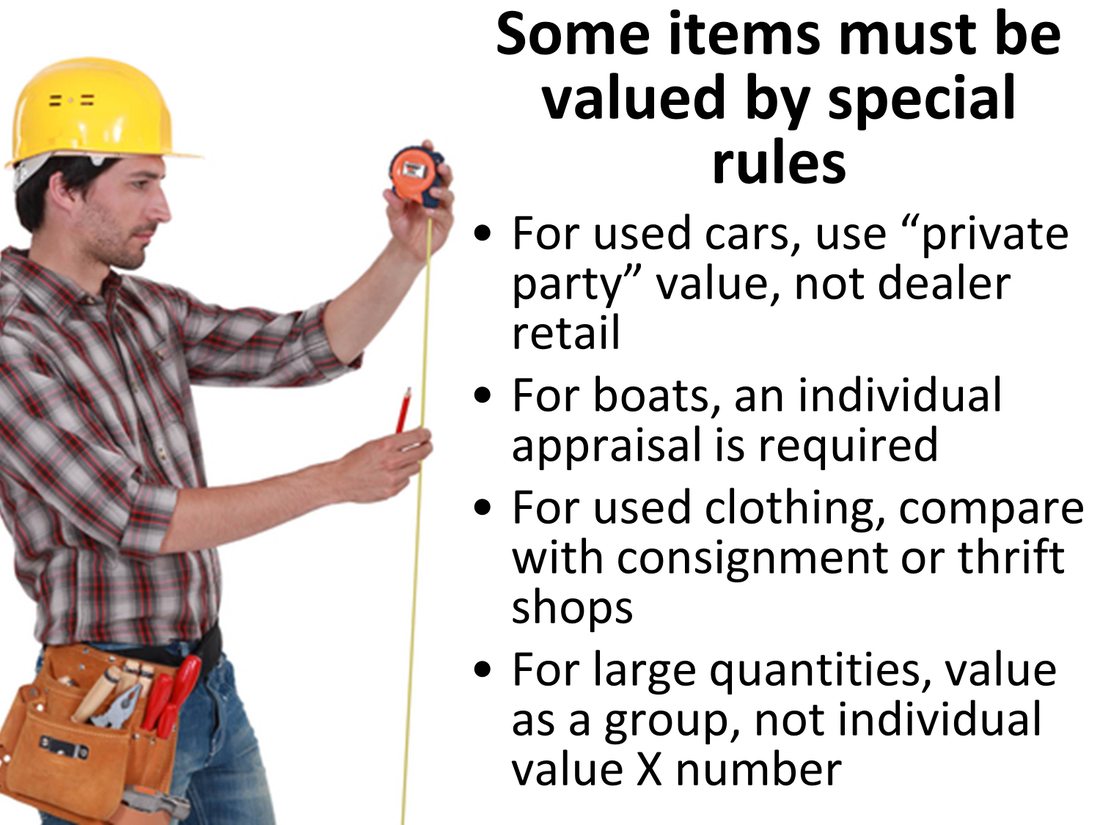
Although not exceptions to the general rules, some items can be hard to value and consequently, the IRS requires a special kind of valuation for these items. For example, in determining the fair market value of a used car, taxpayers must use the private party value and not the amount for which it would sell on a dealer lot. For boats, taxpayers may not estimate fair market value by simply looking at the price of boats of similar size and age. Instead, boats require an individual appraisal. This is because there can be dramatic differences in the value and seaworthiness of boats of the same age and size, making generic valuations less relevant. These rules help to prevent scenarios where it is more profitable to give the item of property than to sell the item of property. For example, if a donor had a boat that had significant issues with rotting and seaworthiness, its actual value may be only a fraction of what a boat in good condition of a similar size and age would sell for. If the donor was allowed to deduct a gift of such a boat based only upon its size and age, it could create a situation where the cash value of the deduction was worth more than what the donor could sell the boat for. This is precisely the situation that tax policy wishes to avoid and hence the reason for requiring individual appraisals for boats. Similarly, when valuing gifts of clothing, the valuation must be based upon what the used clothing would sell for in a consignment or thrift shop not based upon what it sells for new in a retail environment. Of course, the difference between what an Armani suit sells for in an upscale retail environment and what a used Armani suit would sell for in a thrift shop is dramatic.
Finally, for gifts of large quantities of individual items, valuation must be based upon the value of the entire lot of items. It is not permitted to estimate the value of a single item and multiply that by the total number of items gifted. For example, suppose a donor found a box of 1,000 beanie babies on sale on eBay for $1,000. If the donor purchased these then gave them to an orphanage over a year later for use in their charitable activities, the donor could be entitled to a deduction of fair market value (long-term capital gain related use personal property). However, even if the fair market value for a single beanie baby toy was $5, the donor could not claim a fair market value for the gift of $5,000 ($5 X 1000). Instead, the fair market value would be the value of the entire lot of 1,000 such beanie babies sold as a single lot.
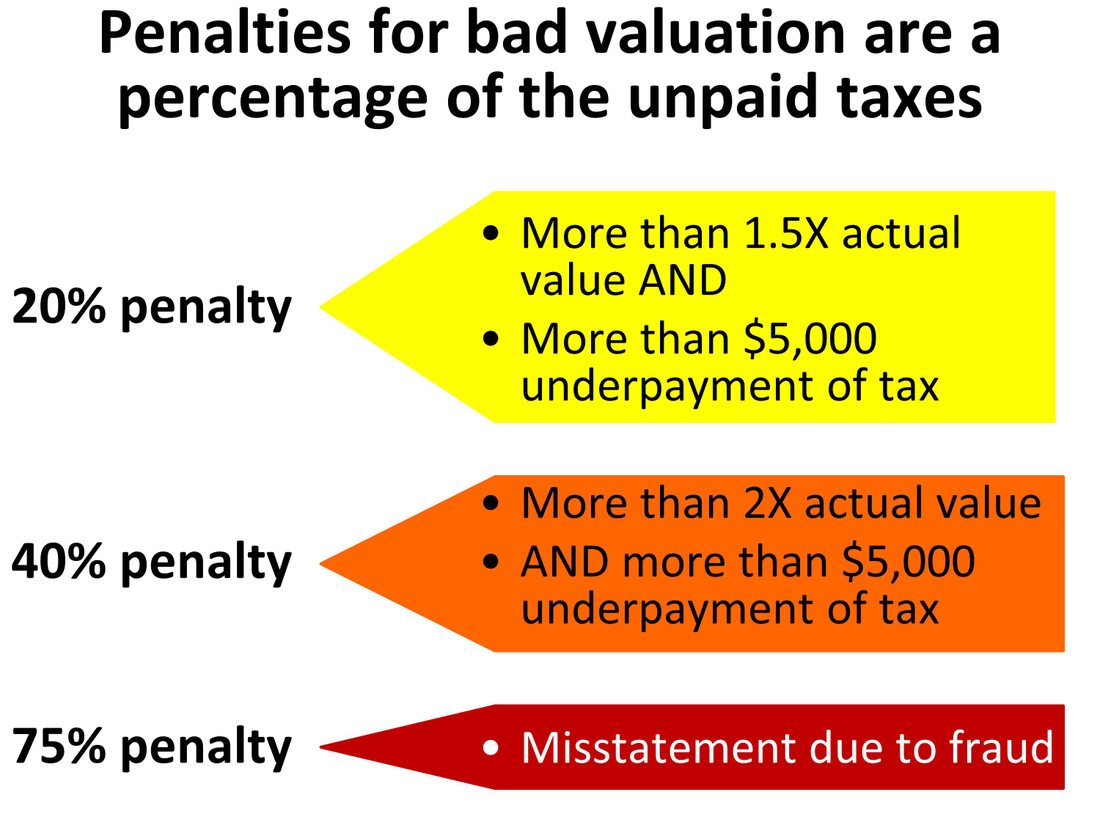
If during an audit a charitable gift is found to be overvalued, this will result in the need to reduce the deduction to an appropriate value. This creates the need to pay for additional taxes and any interest accrued since the due date for those taxes. In addition to this repayment and interest there can be penalties for overvaluing a charitable gift. Those penalties depend upon the amount of the gift and the degree of over-valuation. If the gift was valued at greater than 50% of its true value and, as a result, there was more than $5,000 in underpayment of tax, then the taxpayer must pay not only the additional taxes, but also an additional 20% of the unpaid taxes. If in the previous case, the valuation was more than double the item's true value, then the penalty would be an additional 40% of the unpaid taxes. Finally, if the misstatement of value was due to fraud, the penalty would be an additional 75% of the unpaid taxes, regardless of the amount of underpayment or the degree of over valuation. (Tax fraud can lead not only to financial penalties, but also to imprisonment.)

As discussed in the chapter on documenting charitable gifts, the donor is often required to obtain an appraisal in order to deduct gifts of property. Can the taxpayer avoid the penalties discussed above if the taxpayer had a qualified appraisal for the amounts reported? The answer is: it depends.
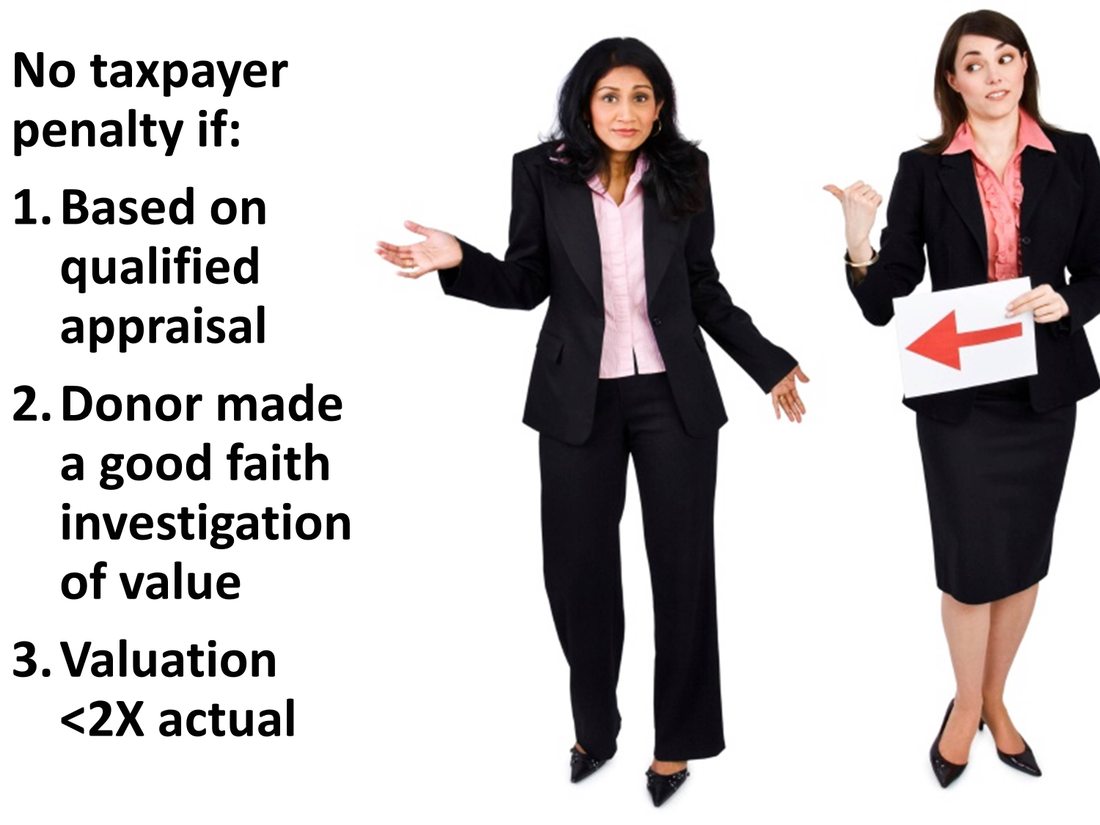
There will be no taxpayer penalty if the valuation was based upon a qualified appraisal, the donor made a good-faith investigation of value, and the valuation was less than double the actual value of the item. This exception would not apply if the appraisal was not a qualified appraisal based upon IRS guidelines. Even if the appraisal was a qualified appraisal, the donor is still required to have made a good-faith investigation of the value of the item, besides simply relying upon the appraisal. But if both of those conditions apply, and the appraised value was less than double the actual value, then no penalty will apply. However, the unpaid tax resulting from the overvaluation must still be paid along with any interest.
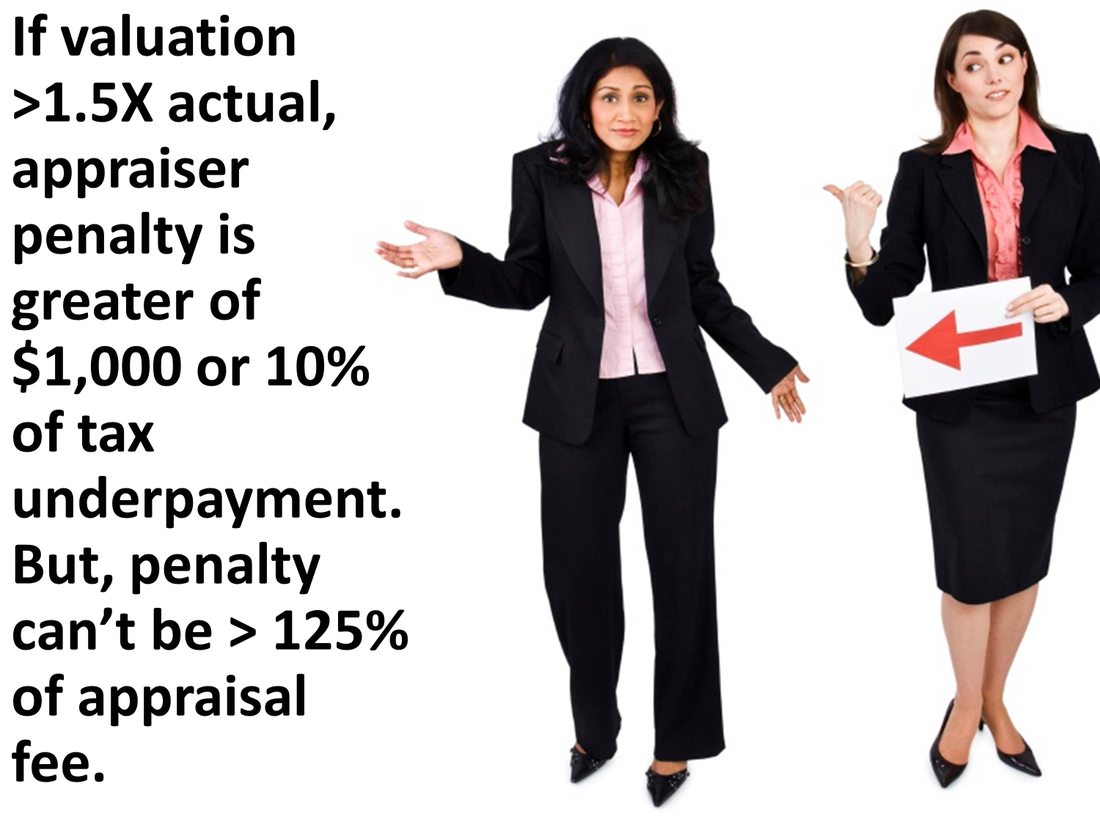
What are the penalties to the appraiser for making an excessive appraisal of an item of property gifted to a charity? If the valuation was more than 50% greater than the actual value of the item, the appraiser's penalty will be the greater of $1,000 or 10% of the tax underpayment. This penalty could be potentially catastrophic for appraisers who appraise items of extremely high value. Recognizing that such a rule would prevent even legitimate appraisers from functioning, the tax code limits the penalty for appraisers to 125% of the appraiser's fee for making the appraisal. If an appraiser charges $1,000 and values a piece of artwork at $10 million when it was actually worth only $5 million and this error results in a $1.5 million tax underpayment, the appraisers penalty will not be $150,000 (10% of the tax underpayment), but instead would be 125% of the appraisal fee, or $1,250.
One interesting case that illustrates the sometimes unusual results from property valuation is that involving a work of art called "Canyon." This work of art was inherited by the heirs of an estate. The IRS appraised the value of the artwork at $65 million and charged $29.2 million in estate taxes on the item. This valuation was based upon the IRS definition of fair market value, which is the price that property would sell for on the open market. The problem in this case is that the artwork incorporated the use of a taxidermy eagle. The sale of such taxidermy eagle feathers or parts is prohibited by federal law. Consequently, the estate was required to pay a large tax on an item that could not be sold. This is an interesting example of what could happen with items where the sale is restricted by law, but the valuation is based upon the price that the item would sell for on the open market. In this case, the heirs would have been much better off if the artwork have been gifted to a charity, rather than inherited by them. In the final settlement, the IRS allowed the heirs to retroactively donate the artwork, treating it as if the gift had been made by the estate, thus generating no net estate taxes on the donated artwork.