
THIS CHAPTER WILL REVIEW INCOME LIMITS ON CHARITABLE DEDUCTIONS. THIS IS, UNFORTUNATELY, A POTENTIALLY CONFUSING AND CHALLENGING AREA OF GIFT PLANNING. THERE ARE A VARIETY OF DIFFERENT LIMITATIONS ON CHARITABLE DEDUCTIONS, DEPENDING UPON THE NATURE OF THE GIFT AND THE RECIPIENT. EVEN MORE COMPLEX ARE THE RULES FOR HOW THESE DIFFERENT LIMITATIONS INTERACT IN THE CURRENT AND FUTURE YEARS. AS MUCH AS POSSIBLE, THIS CHAPTER WILL ATTEMPT TO SIMPLIFY, SUMMARIZE, AND VISUALIZE THESE RULES IN A WAY THAT MAKES THEM AS UNDERSTANDABLE AS POSSIBLE. NEVERTHELESS, THE READER MUST RECOGNIZE THAT THIS IS A DIFFICULT AREA OF CHARITABLE TAX LAW AND UNDERSTANDING IT MAY REQUIRE SOME EFFORT.

Why is all of this effort justified? Very little wealth in this country is held in the form of cash or cash equivalents like checking accounts, savings accounts, or money market accounts. If an advisor or fundraiser wants to be involved with large charitable transactions, he or she must understand how to work with gifts of assets rather than just working with cash. These income limitations rules are particularly critical issues for gifts of assets. A fundamental expectation for any advisor or fundraiser who is going to suggest the charitable transfer of an asset is, at the very least, to understand what charitable deduction that transfer will generate. The first step in that process is to understand how the asset will be valued for purposes of the charitable deduction. (That topic is covered in the chapter on valuation of charitable gifts of property.) The second step in that process is to understand when those charitable deductions can be used, when they must be carried forward into the future years, and when they may be lost altogether. (This is the topic of the current chapter.) Although the process of understanding the rules for both steps can be a challenge, this understanding is a clear prerequisite to intelligently recommending substantial gifts of assets. It is simply not appropriate to recommend a gift of substantial assets while having no understanding of the charitable deductions that will be generated or whether or not those deductions can even be used. The fundamental importance of this understanding as a prerequisite to encouraging large gifts of assets justifies learning the rules on income limitations for charitable deductions.

Beginning with the fundamentals, people in the United States usually pay taxes on income. People pay these taxes to the federal government. In most states, people also pay additional income taxes to the state government.
The next fundamental reality is that charitable gifts can sometimes be deducted from income. These deductions are valuable to the extent that they reduce the taxes owed. Consequently, to recommend a charitable transfer, it is essential to have an understanding of the deductions that will be created as a result of those transfers.
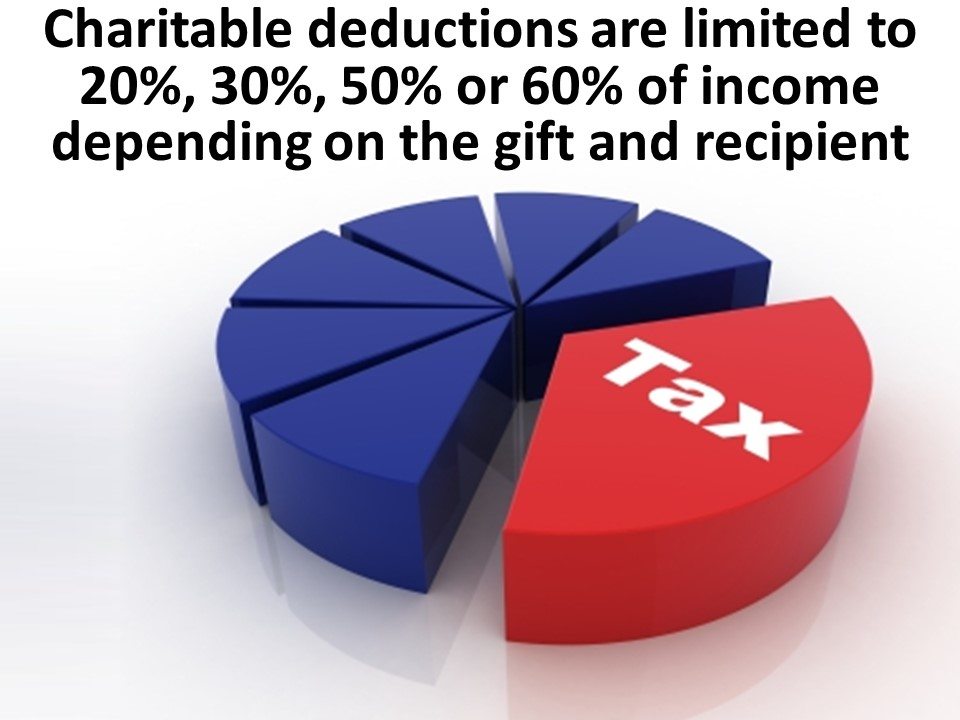
What is less well known is that charitable deductions may not normally be used to eliminate 100% of a person's taxable income. The total share of income that can be eliminated through charitable deductions in any one year may be 20%, 30%, 50%, or 60%, depending on the nature of the gift and the nature of the charitable recipient. Charitable deductions beyond these limitations cannot be used in the current year, but instead must be carried forward into future years. If the charitable deduction cannot be used within the following five years, it will expire. Consequently, it is possible for large charitable transactions to generate large charitable deductions that have absolutely no value because the income limitations are otherwise exceeded in the current and carry-forward years. Because advising a donor about a large charitable gift without understanding when that gift will generate no (or limited) useable charitable tax deductions is inappropriate, it is important to understand these income limitation rules.
Why should these income limitation rules exist? It would certainly be possible to have a tax code that placed no limitations on the total amount of charitable deductions that could be used in any year. The law could allow for donors to deduct up to 100% of their income. But it does not. Why not?
Encouraging charitable gifts is an important government policy objective, but it is not the only objective. If the law placed no limitations on the amount of charitable deductions, this could reduce the funds available for traditional government functions below an appropriate level. Charitable giving is useful, but at least some money must go to the government in taxes. The income limitations on charitable deductions ensure that this will occur.
Aside from the concern with the overall level of revenue is the concern about who does and does not pay taxes. If there were no limits on charitable deductions, then those people with large assets relative to their taxable income (i.e., the wealthy) would be able to completely avoid income taxes by annually transferring assets to charity. This is especially concerning given that these transfers might very well go to private family foundations controlled by these wealthy donors. Those who did not have large assets relative to their income could not avoid taxation in this way. This could create a system where income taxes would be paid only by those who were not wealthy.

Such an outcome, where only wealthy people paid no income taxes, is potentially offensive. The income limitations on charitable deductions prevent this outcome. Regardless of what is transferred to charity, a person cannot deduct more than 60% of his or her income. For transfers of less-favored assets or transfers to less-favored charitable entities (such as private family foundations) the share of income that can be deducted is even less.

There is sometimes confusion about the importance of the income limitation rules. If we are thinking of charitable gifts as gifts from income, rather than gifts of accumulated assets, it is difficult to imagine who would be making such large gifts of income.

We might think that these income limitations would apply only to some rare individuals who desired to spend just a tiny fraction of their income. If we think of charitable gifts as coming from income, then a person wishing to give away 80% or 90% of income must have taken some extreme vow of poverty! Since such individuals are rare, and, even when they do exist, are unlikely to be major donor prospects, this can make the income limitation rules seem almost irrelevant. This inaccurate perception arises from thinking of charitable gifts as coming out of income, rather than from assets.
In reality, the income limitation rules are far from irrelevant. Their significance is not from low wealth individuals giving away most of their income, but rather from high wealth individuals making substantial transfers of assets. One study using IRS income and estate tax data found that nearly 75% of contributions by very wealthy individuals ($100MM+) generated no charitable deduction. (Joulfaian, D. (2001). Charitable giving in life and at death, in Rethinking Estate and Gift Taxation, Eds: W. G. Gale, J.R. Hines Jr., & J. Slemrod, Washington, DC: The Brookings Institution Press, 350-374.)
The issue arises with high net worth individuals, not only because their assets are a very high multiple of their reportable income, but also because charitable planning often involves large one-time transfers, rather than consistent transfers over many years. For example, a person may wish to transfer a large block of low basis shares in a family owned corporation into a Charitable Remainder Trust prior to contemplating the sale of the business. (This transaction can avoid the capital gains taxes that would otherwise have to be paid upon the sale of the business.) Such transactions usually envision a single large transfer of assets in one year. These large one-time transfers regularly come into conflict with the income limitation rules.
Income limitation rules can become an issue not only for large transactions of the super-wealthy, but also for anyone with high assets relative to income. This is particularly common among retirees who have accumulated substantial assets, but may have little regular income. Among the wealthiest older adults, adjusted gross income represents less than 4% of net assets (Joulfaian, D. (2001). Charitable giving in life and at death, in Rethinking Estate and Gift Taxation, Eds: W. G. Gale, J.R. Hines Jr., & J. Slemrod, Washington, DC: The Brookings Institution Press, 350-374.) In fact, a large share of people in the United States giving 10% or more of their income to charity are relatively wealthy retirees with high assets and low income. (James, R. N., III, & Jones, K. S. (2011). Tithing and religious charitable giving in America. Applied Economics, 43(19), 2441-2450.)
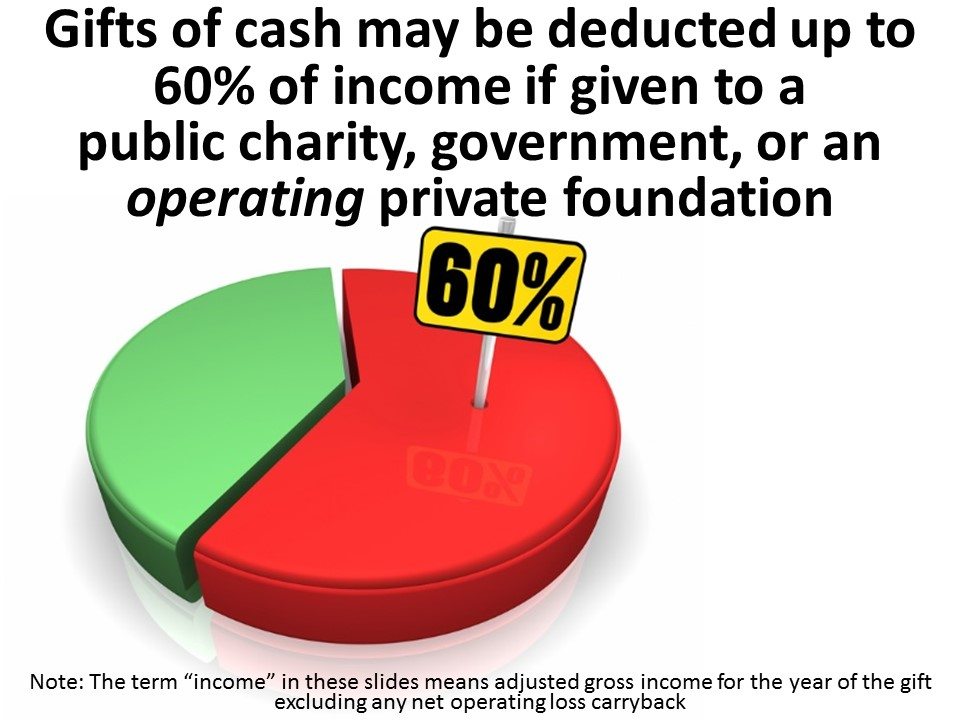
The highest share of income that may be deducted using charitable deductions is 60%. This highest limit is reserved for gifts of cash going to a public charity, government, or operating private foundations. Because gifts to governments or operating private foundations are rare, the remainder of the chapter will simply refer to gifts to public charities.
Note that the typical private foundation is a non-operating private foundation. In other words, it simply holds assets and makes distributions to public charities, but it does not actually run nonprofit ventures such as schools, hospitals, or churches. In the remainder of this chapter, the term "private foundation" will refer, technically, to this most common type of private foundation, the non-operating private foundation. This chapter will also refer generically to "income." Technically, the definition of income for charitable income limitation purposes is adjusted gross income for the year of the gift excluding any net operating loss carry back. But no one wants to read "adjusted gross income for the year of the gift excluding any net operating loss carry back" 300 times, so this chapter will simply use the term "income."
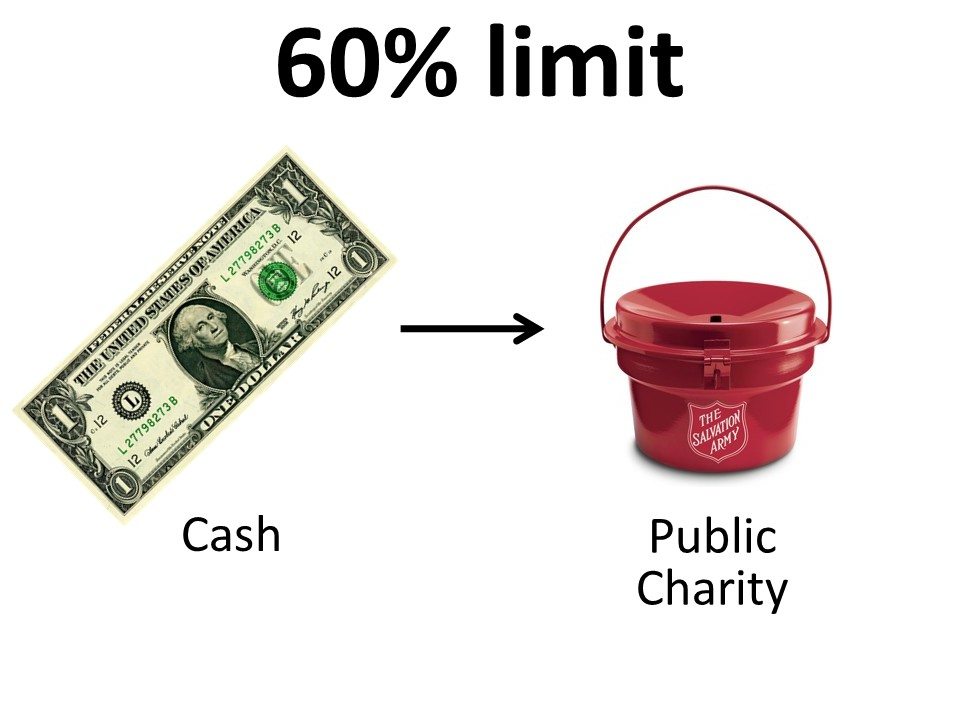
Different income limitations apply to different charitable transfers, depending upon the nature of the gift and the nature of the charity. The highest limit, 60% of income, applies only to gifts of cash to a public charity. This is given the highest income limitation because it is the most favored asset (cash) being given to a favored charitable entity (a public charity). There are no extra tax benefits from giving cash (e.g., no avoidance of capital gains taxes), and no need to estimate its value (thus, no room for valuation manipulation), so it is the most favored asset. Public charities are generally favored in tax law as compared with private foundations. That general concept is applied here in that the 60% income limitation is available only for gifts of cash to public charities, not for gifts of cash to private foundations. As in other areas of charitable planning, the rules for gifts of cash are relatively straightforward, but the rules for gifts of property can become more complex.
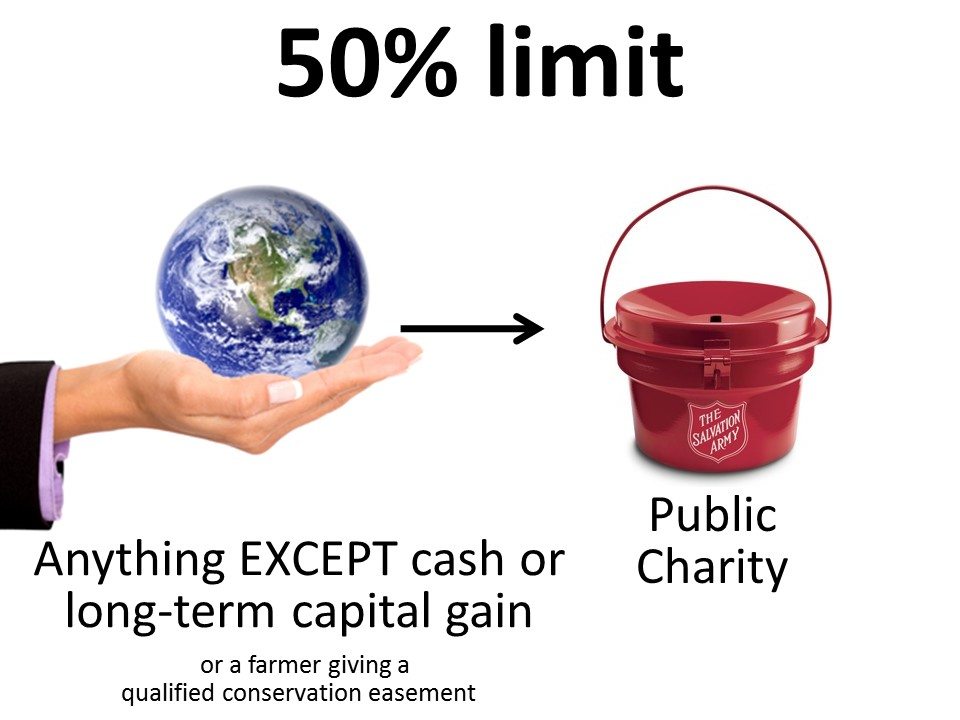
The general rule is that deductions from charitable gifts of non-cash property made to a public charity can reduce a taxpayer's income up to 50%. This 50% level for non-cash gifts is reserved for public charities and does not apply to private foundations. However, deductions for some types of long-term capital gain property, even if given to a public charity, will be limited to 30% of income. Although not discussed in this text, there are also special rules for giving qualified conservation easements allowing farmers to have a 100% income limitation for such gifts.
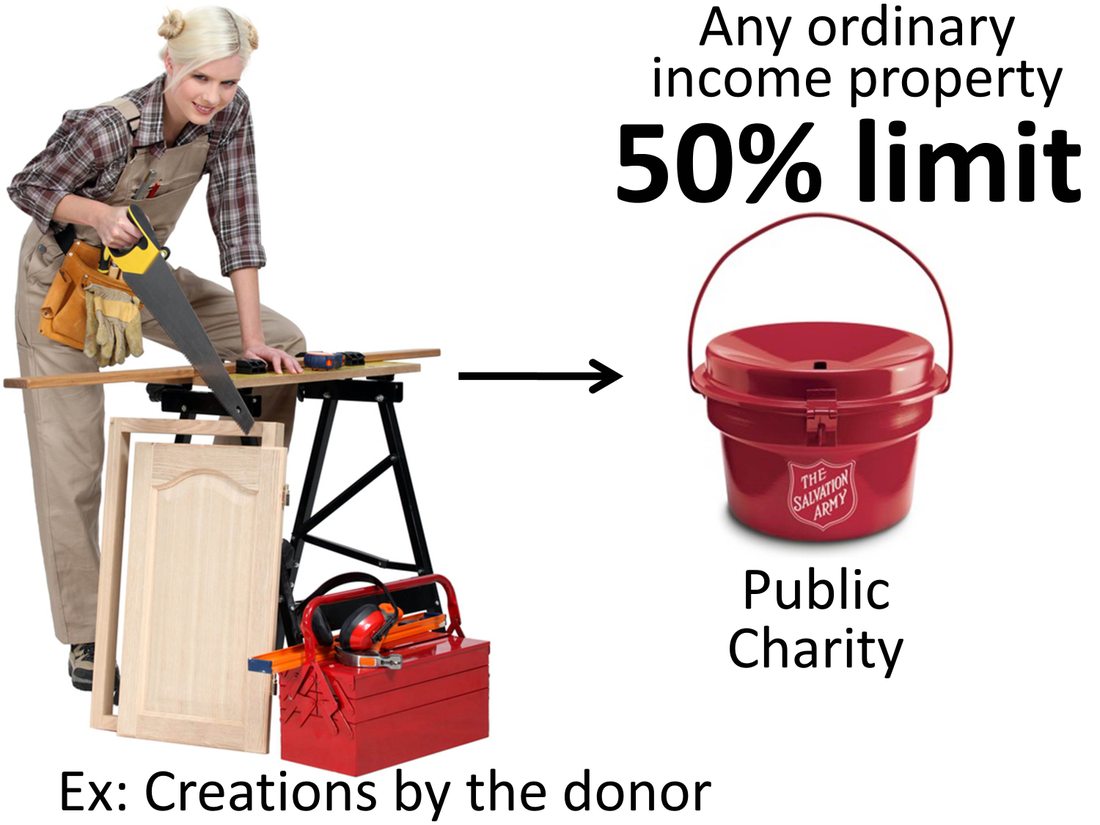
To begin with, gifts of any non-cash property treated as ordinary income given to public charities can be deducted up to 50% of income. There are no attractive valuation benefits from giving ordinary income property, because it is valued at the lower of cost basis or fair market value. Thus, here a moderately favored asset (ordinary income property is not long-term capital gain) being given to a favored organization (a public charity), results in the highest income limit for non-cash property of 50%.
Several types of non-cash property will be treated as ordinary income if sold, and all will receive a 50% income limitation when given to a public charity. The first example of ordinary income property is creations by the donor. Thus, if a donor were to build cabinetry for the office of a public charity and donate that cabinetry to the charity, the deductions for this type of gift would be subject to the 50% income limitation. (Of course, the deduction for this type of gift is limited to the cost of materials, even if fair market value is much higher.) Other gifts of creations by the donor could include examples such as artwork or a manuscript.
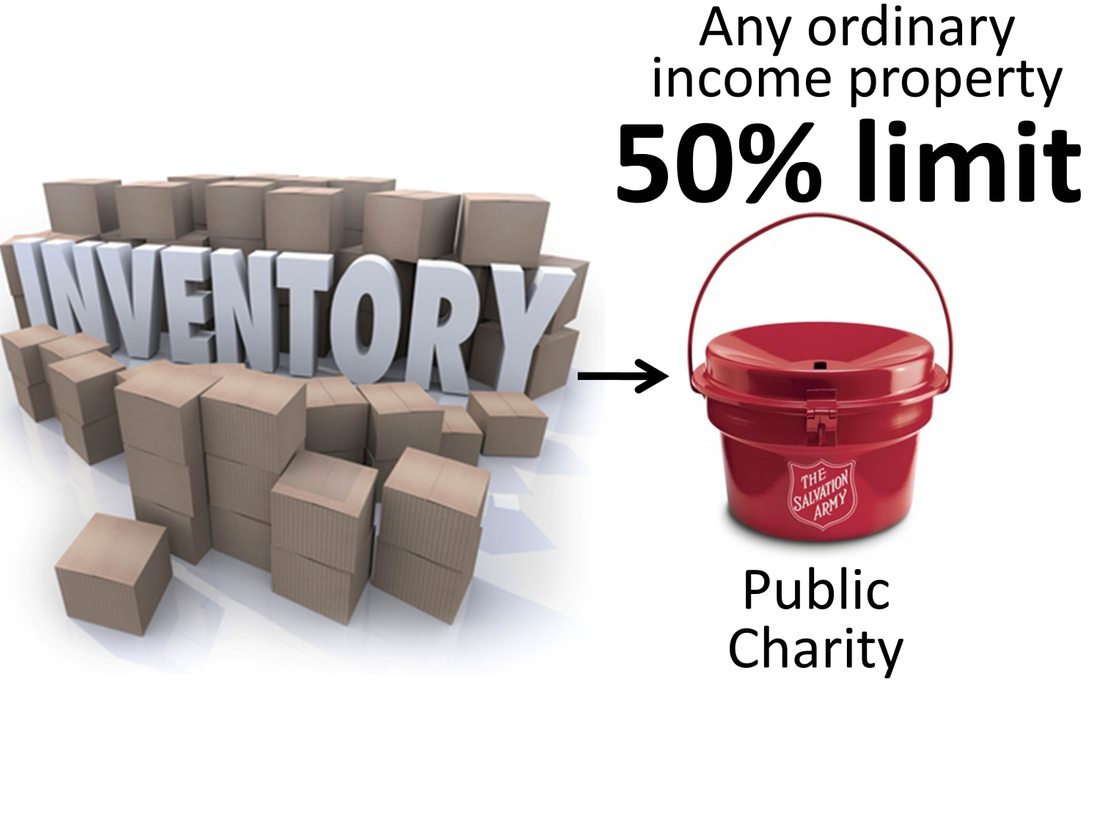
Inventory from a business is also ordinary income property. In cases where this inventory is given to a public charity, such gifts would be subject to the highest income limitation for non-cash property of 50%. For example, if the owner of a local hardware store (sole proprietorship) were to donate cans of paint from the store's shelves to a public charity, the owner's deduction would be subject to the 50% income limitation. As before, the amount of the deduction would be the lower of the cost basis in the paint or its fair market value. This relatively lower valuation is somewhat offset by the ability to use the highest income limitation.
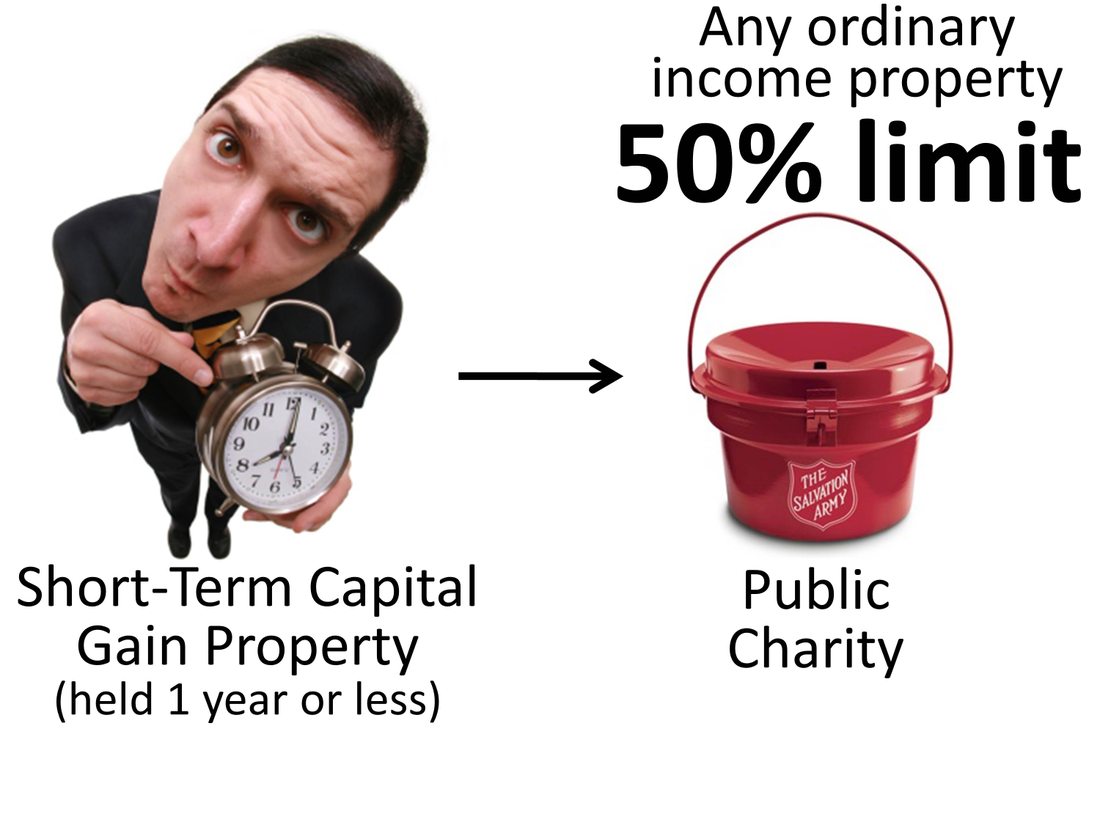
The final major category of property taxed as ordinary income is short-term capital gain property. This is any capital gain property held for one year or less prior to its sale or transfer to the charity. These types of assets are valued at the lower of cost basis or fair market value. Given this less advantageous valuation, such gifts are limited only by the highest non-cash income limitation of 50%.

All of these different types of non-cash property - works created by the donor, inventory, and short-term capital gain property - are all given the same income limitation of 50% when transferred to a public charity. They are all treated the same because they all fall into the category of non-cash property other than long-term capital gain property.
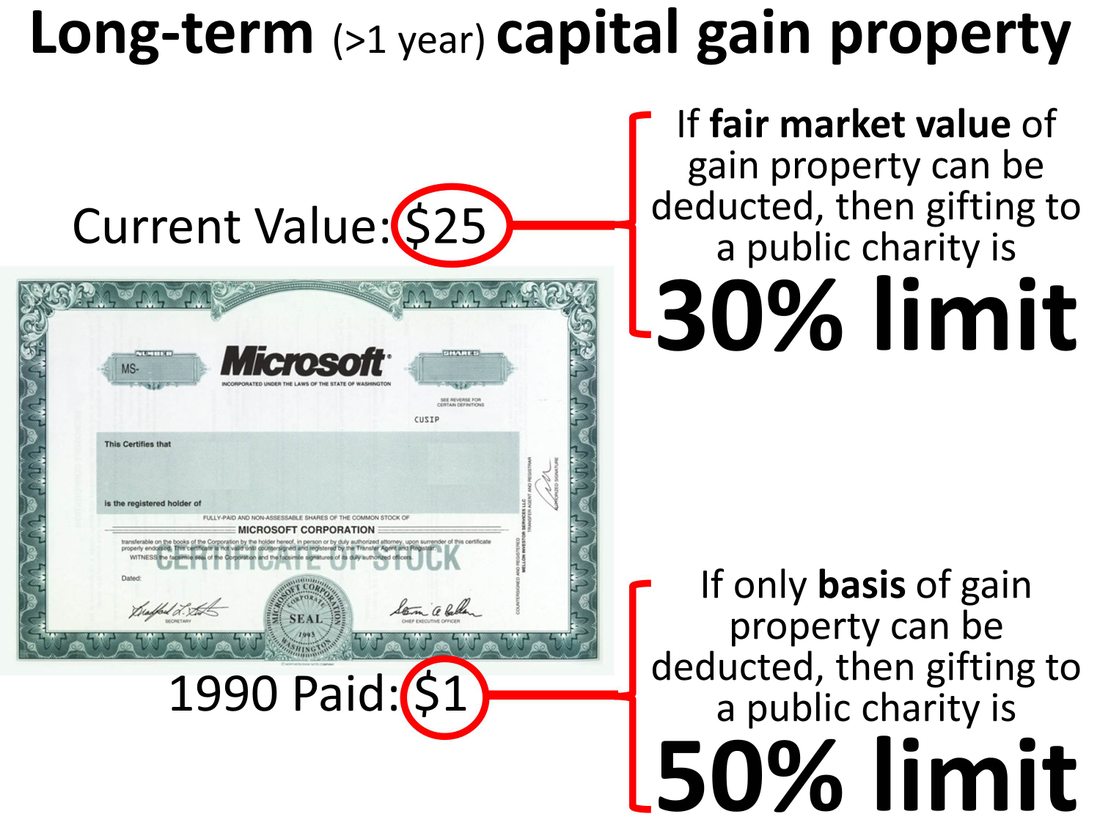
Why is long-term capital gain property treated differently than everything else? Gifts of long-term capital gain property come with a potential double tax advantage to the donor. First, the donor is allowed to deduct the full fair market value of the property transferred to charity. Second, the donor never had to pay any taxes on the appreciation (growth) of the property which generated the tax deduction. This combination of tax advantages does not apply to gifts of other assets such as cash or ordinary income property (which is valued at the lower of its basis or fair market value). Although the tax code allows this special benefit for gifts of long-term capital gain property, the income limitations lower the maximum amount of such deductions that can be used from this type of transaction in any one year.
It might help to think of long-term capital gain property valued at fair market value as a "less-favored" asset. When a donor gives this less-favored asset to a favored recipient (public charity), the income limitation is lowered to 30%. The "favored" or "less-favored" terminology is not from the tax code, but may be a useful concept to help understand intuitively why the rules are as they are. For example, in order to get the highest income limitation of 60%, a donor must give the most favored asset, cash, to a favored charitable entity, e.g., a public charity. Giving a moderately favored asset, e.g., short-term capital gain property, to a favored charitable entity, e.g., a public charity, results in a 50% income limitation. If a donor gives a less-favored asset (long-term capital gain property valued at fair market value) to a favored charitable entity (a public charity), the income limitation is lowered to 30%. Similarly, if a donor gives any favored asset (e.g., cash or ordinary income property) to a less-favored charitable entity (a private foundation), the income limitation is also lowered to 30%. And, finally, if a donor gives a less-favored asset (long-term capital gain property) to a less-favored charitable entity (a private foundation), the income limitation is lowered to 20%. This concept reduces a range of complex rules to the simple equations of:
Most Favored Gift + Favored Recipient = 60%
Moderately Favored Gift + Favored Recipient = 50%
Disfavored Gift + Favored Recipient = 30%
Any Favored Gift + Disfavored Recipient = 30%
Disfavored Gift + Disfavored Recipient = 20%
Within this context, long-term capital gain property is a disfavored asset. But, the reason it is disfavored is because it can be deducted at fair market value. So, in many cases where long-term capital gain property given to a public charity must be valued at cost basis, it is no longer a disfavored asset. This means that gifts of long-term capital gain property to a public charity may be subject to either a 50% limit (usually when valued at cost basis) or a 30% limit (usually when valued at fair market value).
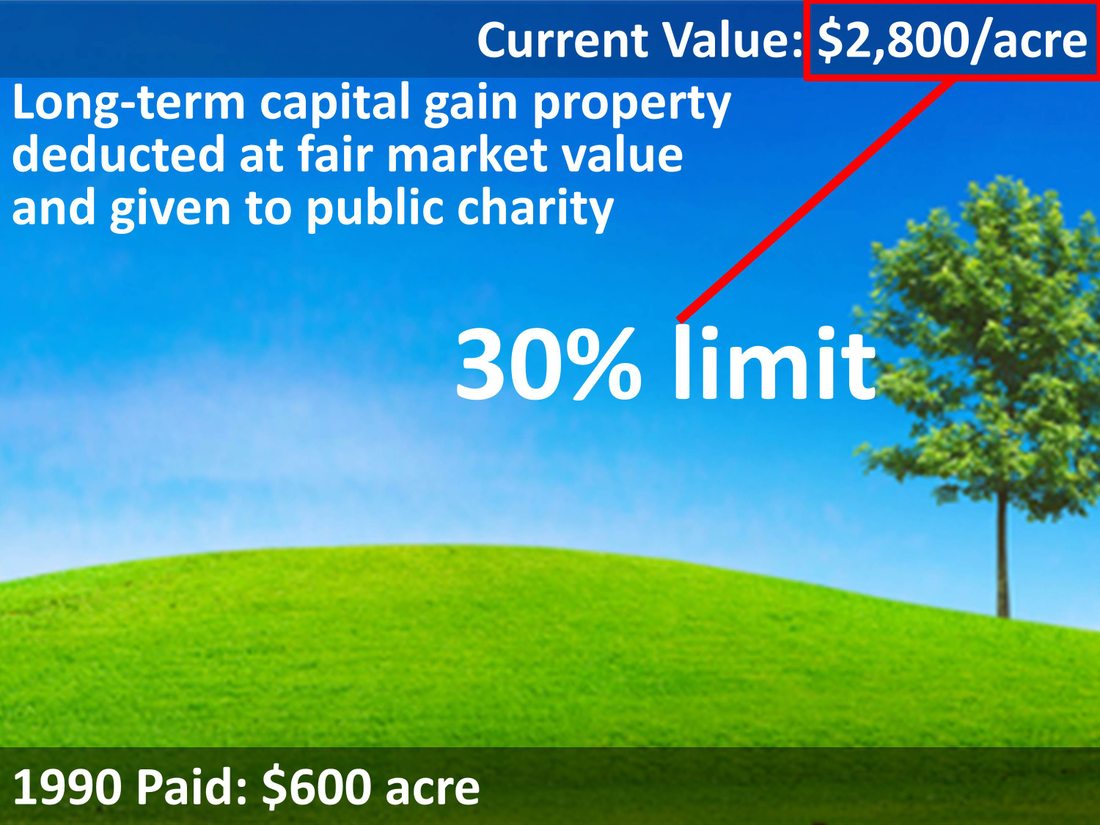
Consider the gift of an acre of investment land where the donor purchased the land in 1990 for $600, and today it is worth $2,800. The gift of this land to a public charity would normally generate a charitable deduction of $2,800. The donor receives the benefit of a large deduction and also avoids paying capital gains taxes on the $2,200 of growth. (This is more beneficial than selling the land, paying the capital gains tax, and then transferring the net proceeds to the charity as cash.) Because the donor receives this special tax benefit, the tax code limits the amount of these deductions in any one year to 30% of the donor's income, requiring all such additional deductions to be carried forward into future tax years.

If, however, the donor is willing to give up this special tax advantage and deduct only the basis of all long-term capital gain property gifts, then the donor is allowed to use such deductions from gifts to public charities up to 50% of his or her income. This "special election" applies to all long-term capital gain gifts made in a year. The donor may not select some gifts for this treatment and exclude others. In this case, the donor would be allowed to deduct only $600 for the gift of the acre of land to a public charity, rather than $2,800. However, charitable deductions for these types of gifts to public charities could be used to reduce up to 50% of the donor's income. Obviously, taking this "special election" makes sense only for donors whose charitable deductions would otherwise be carried forward into future years. It may also be particularly attractive in cases where donors are giving long-term capital gain property that has appreciated very little.

As discussed in the chapter on valuation of property gifts, tangible personal property has special rules for valuation. Tangible personal property includes all of those items that can be seen and touched and moved, such as the items in a typical garage or home, but would not include the garage or house itself, because those are attached to the land, making them real property.
Tangible personal property does not include financial instruments such as stocks or bonds. These are intangible personal property items. Stock or bond certificates do not have value from their physical properties as paper, but instead have value only from their intangible legal properties.
Although tangible personal property has special rules for valuation, the general concept used with other long-term capital gain property applies here as well. If the gift of long-term capital gain tangible personal property to a public charity is valued at its basis, the deductions can be used up to 50% of income. If, instead, it is valued at fair market value, those deductions can be used only up to 30% of income.
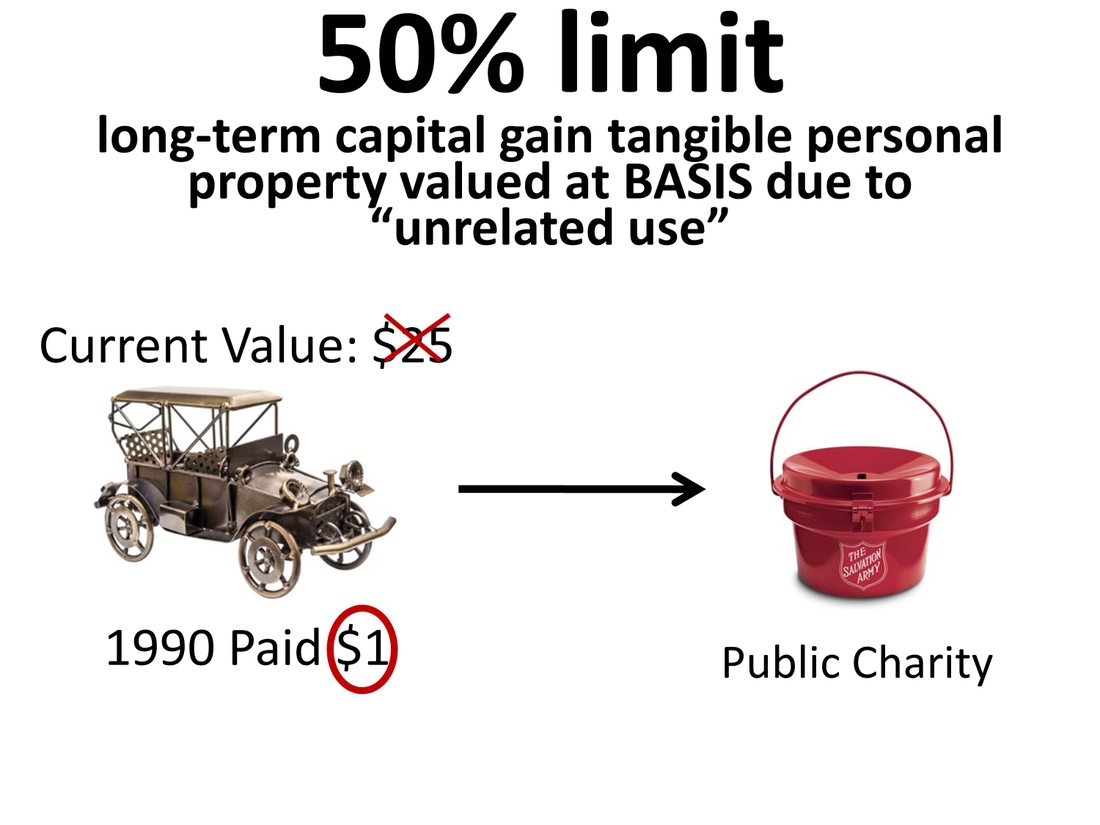
Suppose a donor purchased an antique toy car in 1990 for $1 and today it is worth $25. If the donor gives the toy to a charity that will immediately sell it, the deduction for the gift will be limited to its basis, in this case $1. The deduction is limited to basis because the charity is not using the property itself in its charitable function, but is instead selling the property, and using the proceeds. Although the donor receives a lower deduction, these deductions may be used to reduce up to 50% of the donor's income.
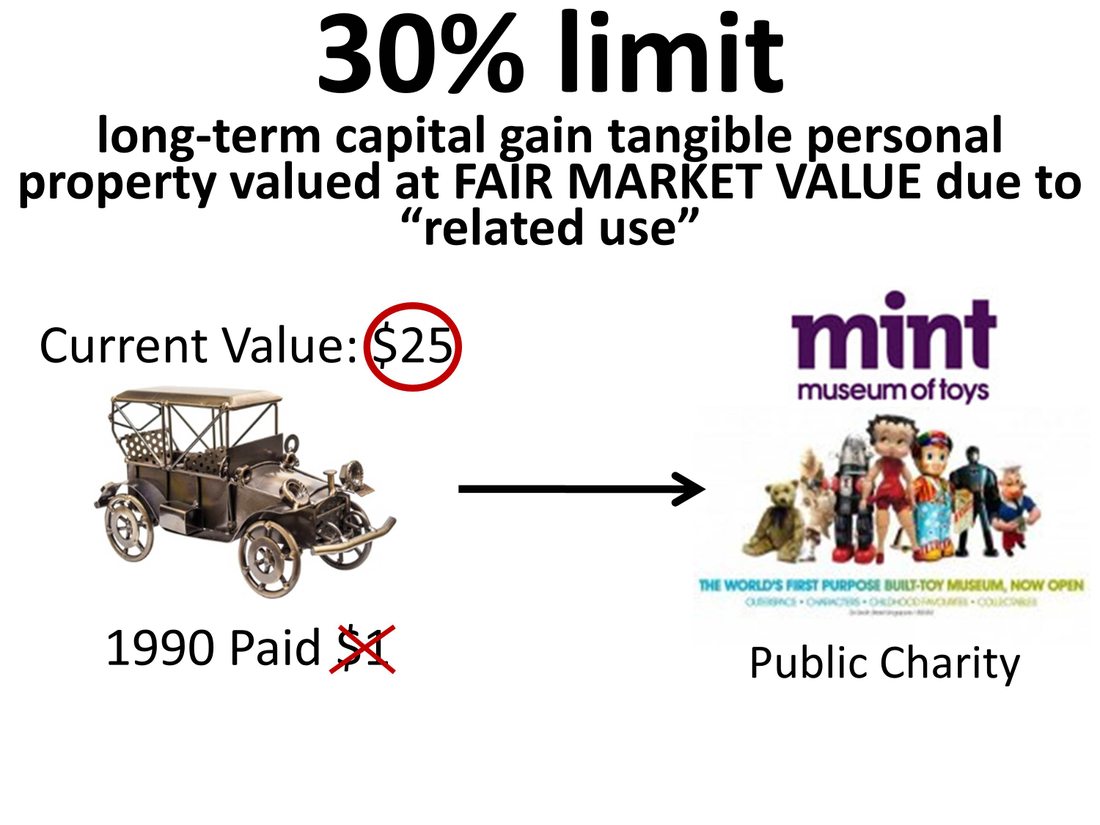
Conversely, if the donor were to give the antique toy to a public charity that displayed it in its museum as part of its nonprofit function, then the donor could deduct the fair market value of the gift. Thus, the donor would receive a charitable deduction of $25 rather than $1. Along with this greater deduction, however, comes the limitation that such deductions may reduce income by no more than 30% in any one year. (Note that this fair market value deduction is available only for long-term capital gain tangible personal property. Short-term capital gain tangible personal property is valued at the lower of its basis or fair market value, regardless of use by the charity.)
Although the rules for long-term capital gain tangible personal property are different from those for other types of long-term capital gain property, the principle is similar. If a donor receives the higher (fair market value) deduction valuation for a gift to a public charity, then the donor receives the lower income limitation.
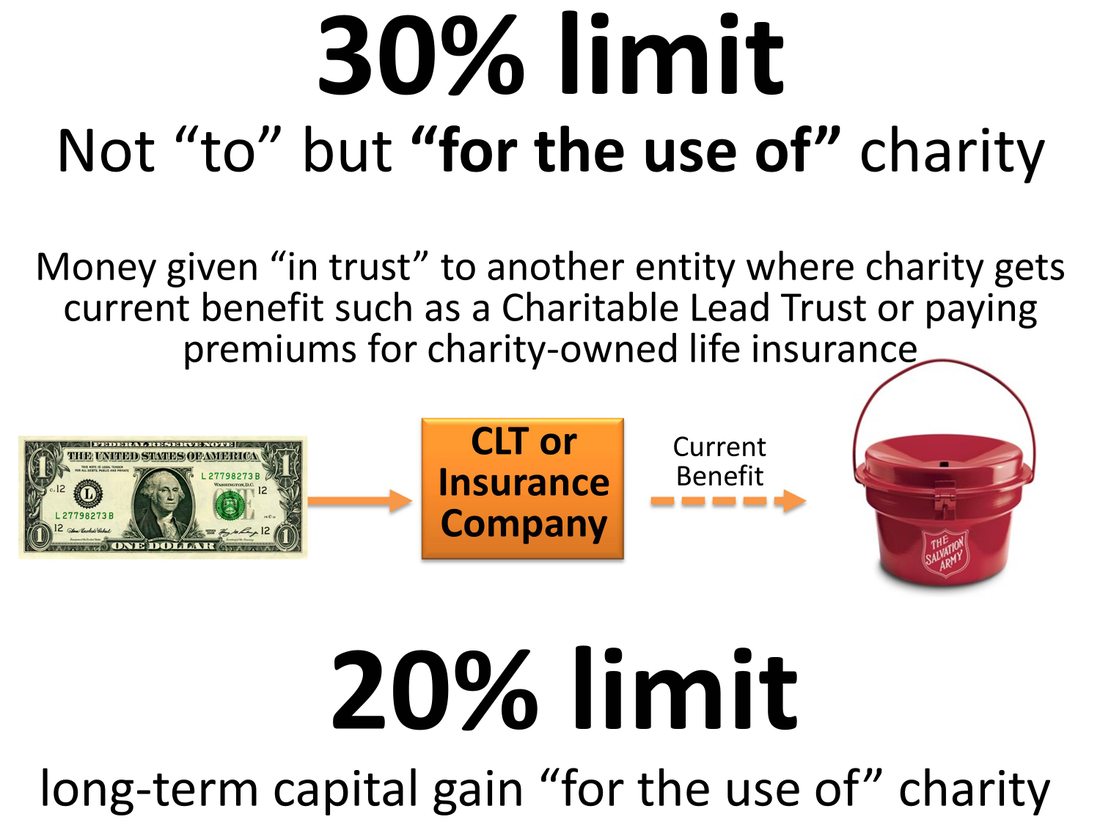
As mentioned previously, 50% is the default income limitation for deductions from non-cash charitable gifts to public charities. An exception to that rule is made for gifts of long-term capital gain which, in some cases, trigger a 30% income limitation. There are, however, some deductible gifts which are not considered to be made "to" a public charity, but still benefit a charity. These relatively rare transactions fall into the category of gifts made "for the use of" charity. Gifts, even gifts of cash, made not "to" a charity but "for the use of" a charity do not qualify for the 50% income limitation, but instead qualify for a 30% income limitation. Such gifts of long-term capital gain are restricted to only a 20% income limitation.
Although the general principle is that this term encompasses any money given "in trust" to another entity where the charity receives current benefits, there are really only two common scenarios where this issue arises. The first is paying premiums directly to a life insurance company for charity owned life insurance policies. The charity benefits from the transaction, because its life insurance policy premiums are paid. However, the money actually goes to the life insurance company, which is not a charitable entity. Similarly, a deductible gift can be made to a grantor Charitable Lead Trust, where the trust pays a fixed amount of the gift to a charity each year for a period of years, with the remainder going to some non-charitable beneficiary. Again, the transfer to the Charitable Lead Trust benefits the charity, but the charity does not receive its share directly - only indirectly over time through the trust. [Note that this issue does not relate to Charitable Remainder Trusts, because Charitable Remainder Trusts are themselves charitable entities whereas Charitable Lead Trusts are not.] Given that these are normally the only two applications of this special rule, it may be easier to simply note these two scenarios as exceptions rather than thinking of the general principle involved. As discussed below, the carryover of deductions in excess of these limitations "for the use of" charities is currently uncertain.
Public charities are favored recipients in the income limitation rules. Consequently, gifts to such charities can generate deductions with an income limitation of 50% or even 60%. In contrast, gifts to private foundations never generate greater than a 30% income limitation. Private foundations are somewhat less favored by the tax law. Typically, private foundations are controlled by the donor and the donor's friends and family. Although such private foundations do make annual distributions to public charities, they do not directly operate or manage charitable work. Being one step removed from charitable work and typically being controlled by the donor and the donor's family, these entities are given tax benefits, but not to the same degree as public charities.
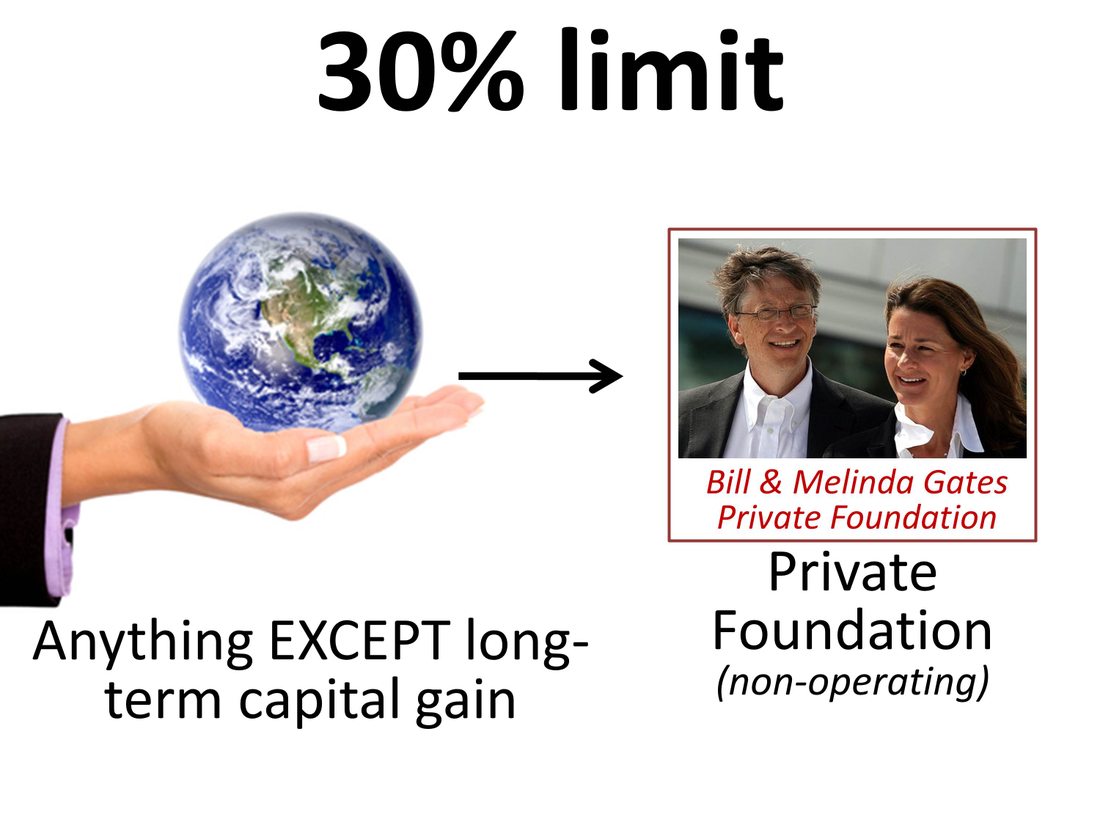
The rules for income limitations for gifts to private foundations are somewhat similar to those for gifts to public charities. Any gifts, except for long-term capital gain, qualify for the highest income limitation for private foundations, which is 30%. Conceptually, this is a favored asset (i.e., not long-term capital gain) being given to a disfavored organization (i.e., a private foundation). Thus, the donor receives neither the highest income limitation of 60% (reserved for the most favored gift, cash, going to favored organizations) nor the lowest income limitation of 20% (reserved for disfavored assets going to disfavored organizations).
Although the slides use the example of the Bill & Melinda Gates Foundation as a private non-operating foundation, donors rarely give to other people's private foundations, but instead create their own private family foundations, which, along with their friends or family members, they typically control and manage. Indeed, often one of the defining characteristics of a private foundation is that it does not receive substantial charitable gifts from the general public. Instead, private foundations are typically supported predominantly by gifts from one family.
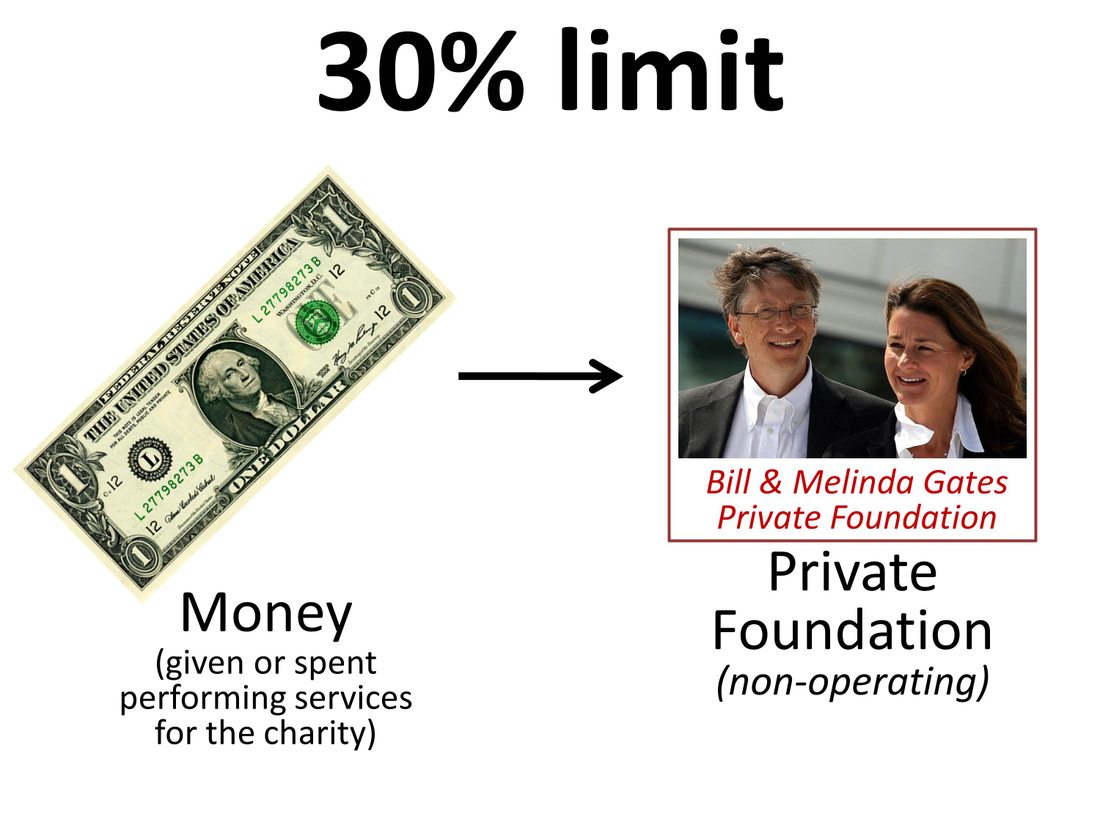
The same types of gifts which qualified for the 50% or 60% income limitation when given to a public charity will qualify for a 30% income limitation when given to a private foundation. The simplest example is, of course, a gift of cash. Such gifts of cash include both cash given directly to a charity and cash spent performing services on behalf of a charity. (There is no deduction for time and effort spent on behalf of a charity.)
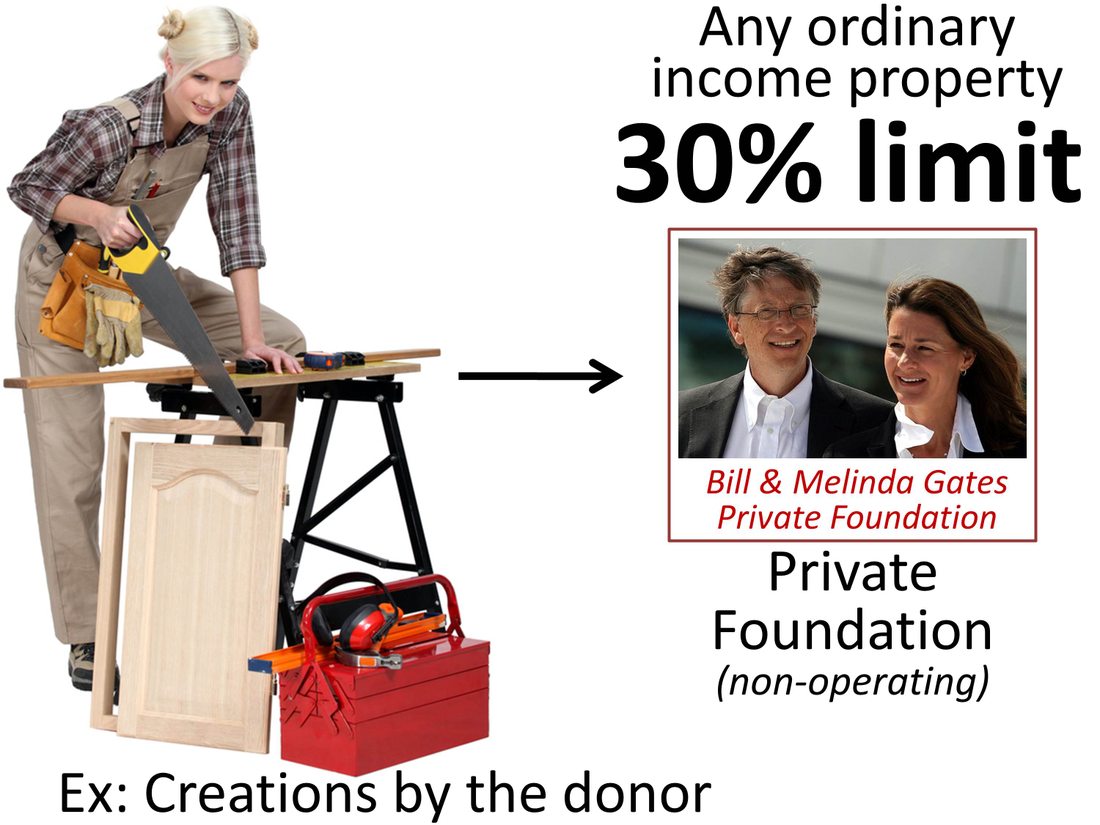
Gifts of ordinary income property also qualify for the private foundation's highest income limitation of 30%. Ordinary income property includes any creations by the donor.
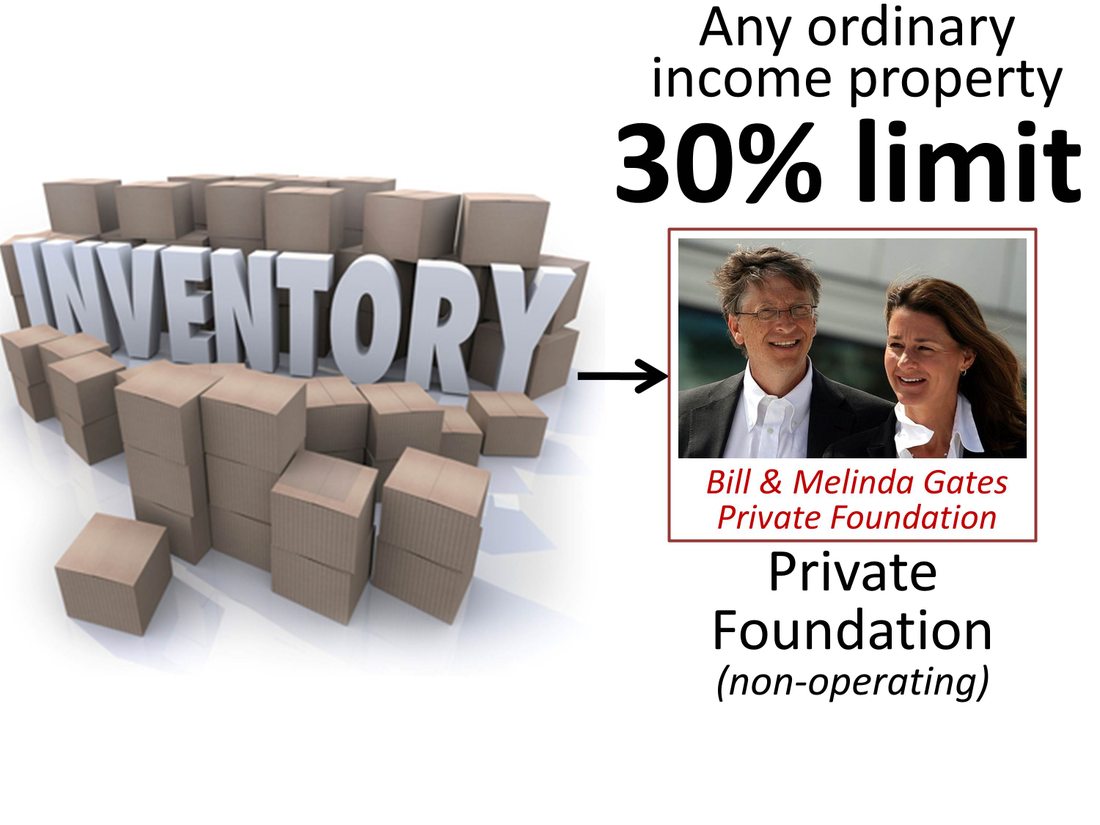
Ordinary income property also includes any inventory given to the private foundation. Such gifts also qualify for the highest income limitation available for gifts to private foundations of 30%.
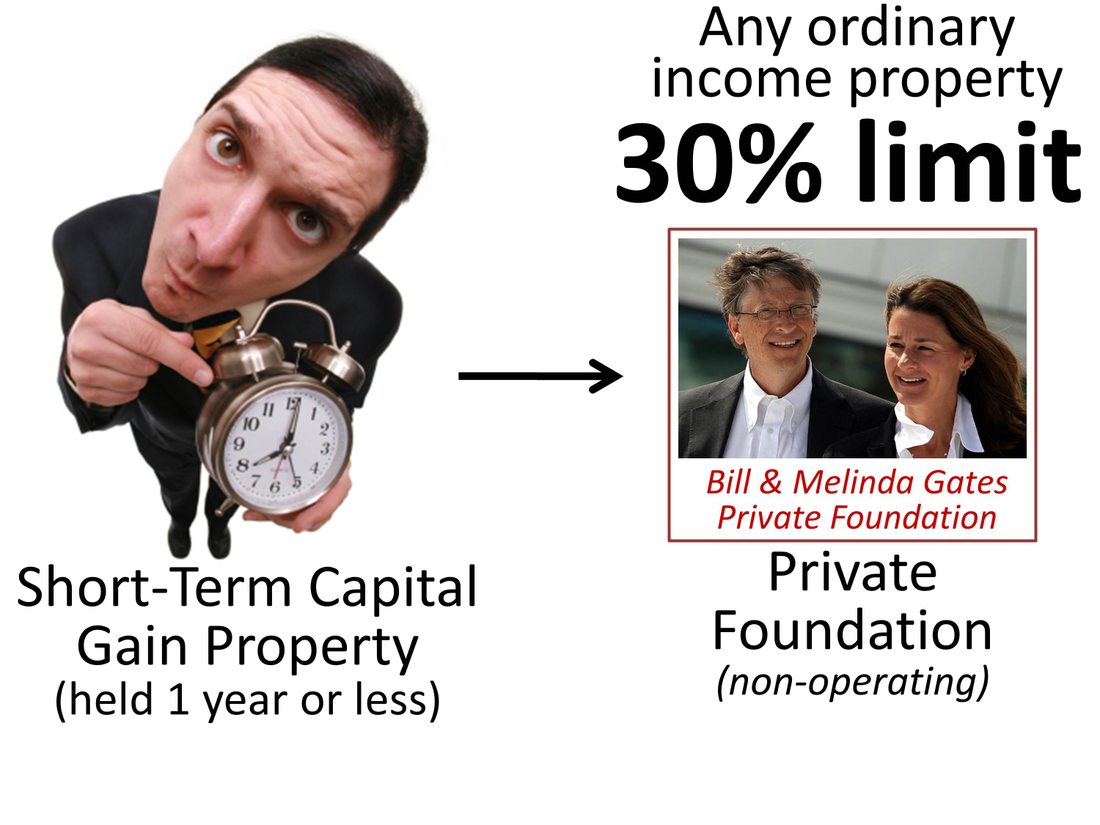
And finally, also as before, short-term capital gain property (capital gain property held for one year or less) is treated as other forms of ordinary income property and also qualifies for the highest income limitation available for gifts to private foundations (30%).
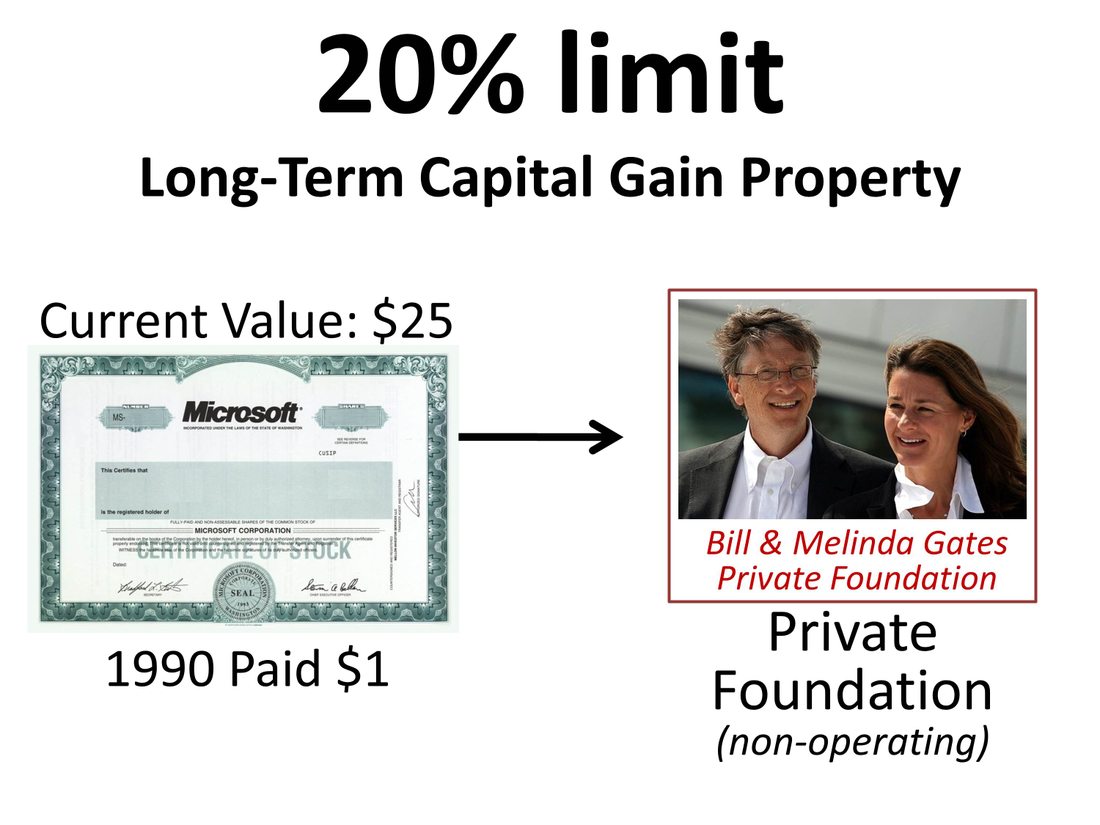
When donors give a disfavored asset (long-term capital gain property) to a disfavored organization (private foundation), this results in the lowest income limitation for individual donors of 20%. This rule is simpler than that for public charities, because there are no exceptions that can increase this percentage, such as the "special election." Thus, the donor will receive the 20% income limitation, regardless of whether the long-term capital gain property was valued at fair market value (available only for "qualified stock") or at basis. Similarly, such gifts given "for the use of" rather than "to" a public charity (via a Charitable Lead Trust or payment of premiums on charity-owned life insurance) also have a 20% limit.
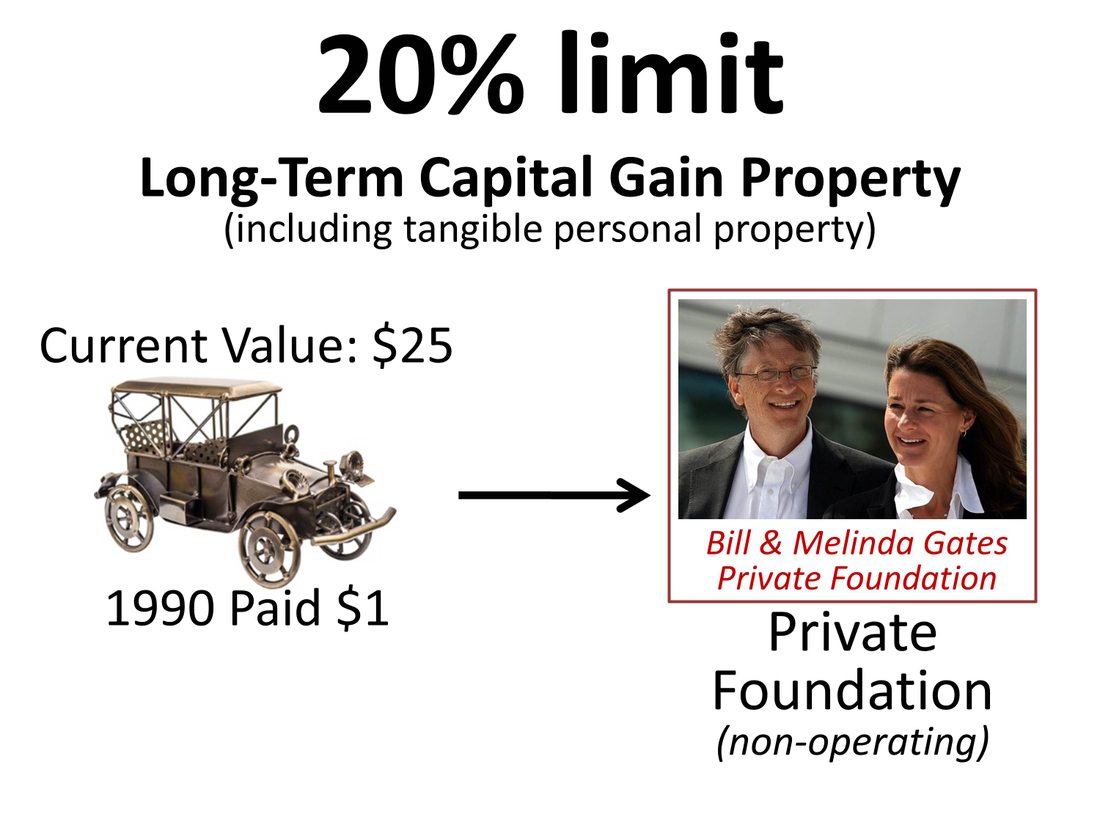
Just as the "special election" exception does not affect the income limitation for long-term capital gain property given to private foundations, so too the "unrelated use" exception for long-term capital gain tangible personal property does not affect the income limitations for gifts to private foundations. Similarly, gifts of tangible personal property to a private foundation are valued at the lower of basis or fair market value, regardless of the "related use" issue. In sum, the income limitation rules for gifts of long-term capital gain property are much simpler for private foundations. In such cases, the limitation is always 20%.
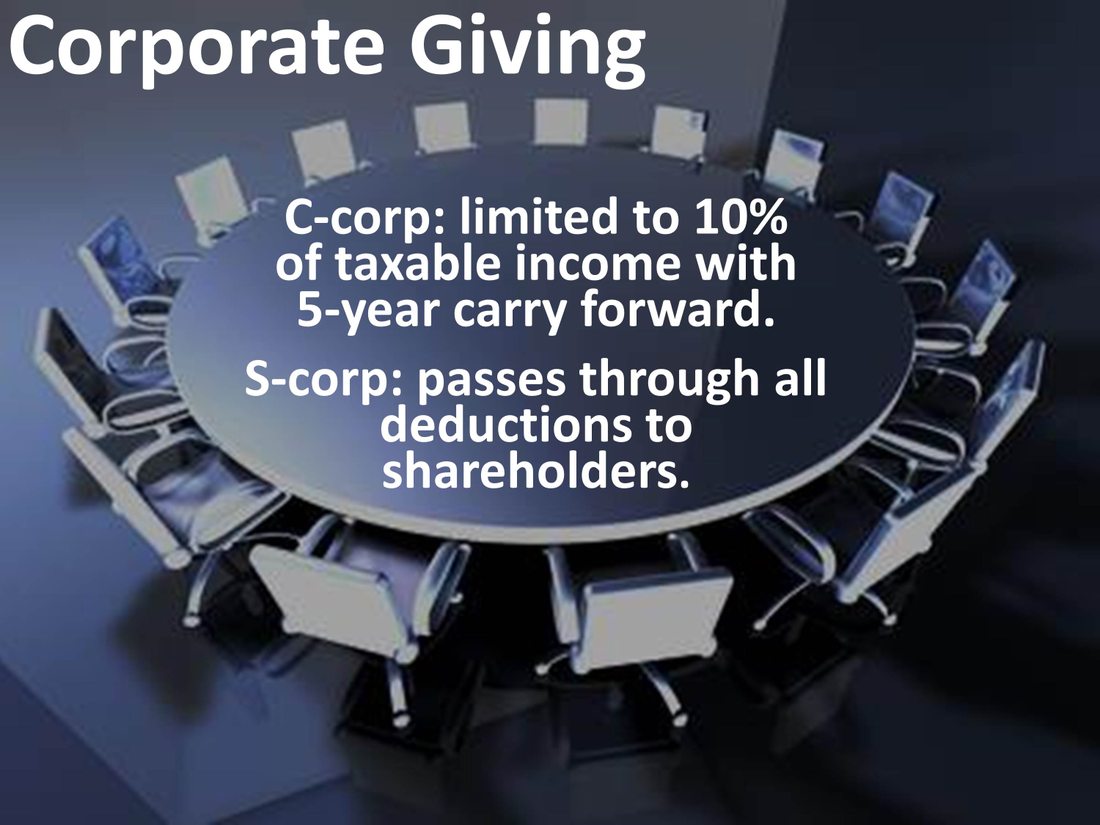
The previous income limitation rules apply to charitable deductions for individual taxpayers. Corporate giving for traditional C-corporations follows a single rule limiting deductions to 10% of taxable income. Just as with individual taxpayers, C-corporations can also carry forward excess charitable deductions for up to five additional years. S-corporations do not have separate income limitation rules, because all deductions simply pass through to become the personal deductions of the individual shareholders.
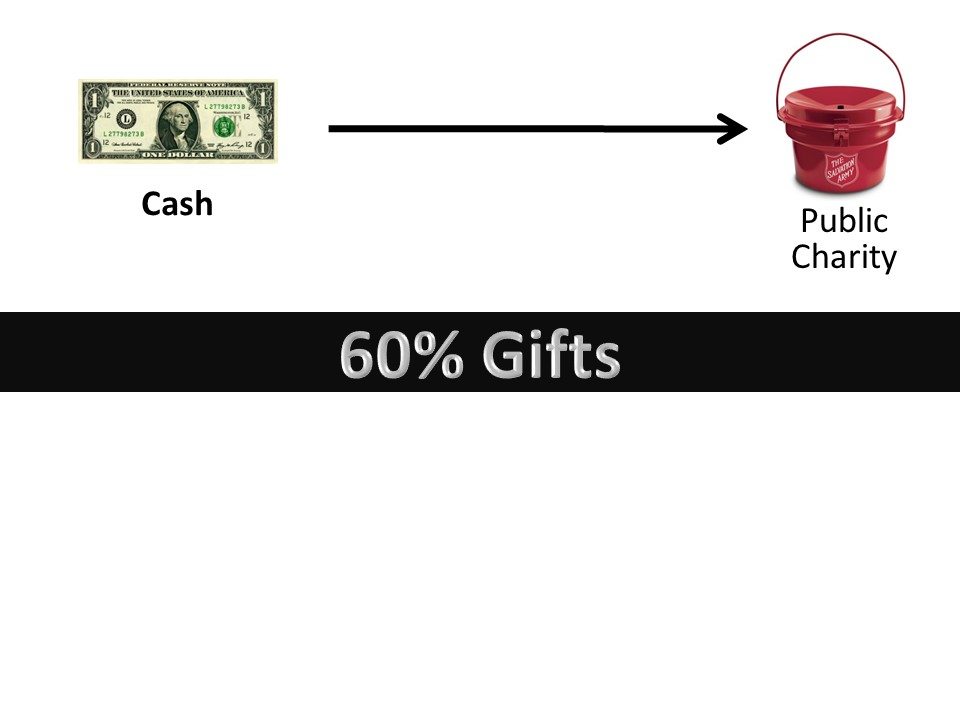
The highest limitation for charitable deductions of 60% of income applies only to gifts of cash to a public charity. This is the most favored asset, cash, going to the favored recipient, a public charity, resulting in the highest limitation, 60% of income.
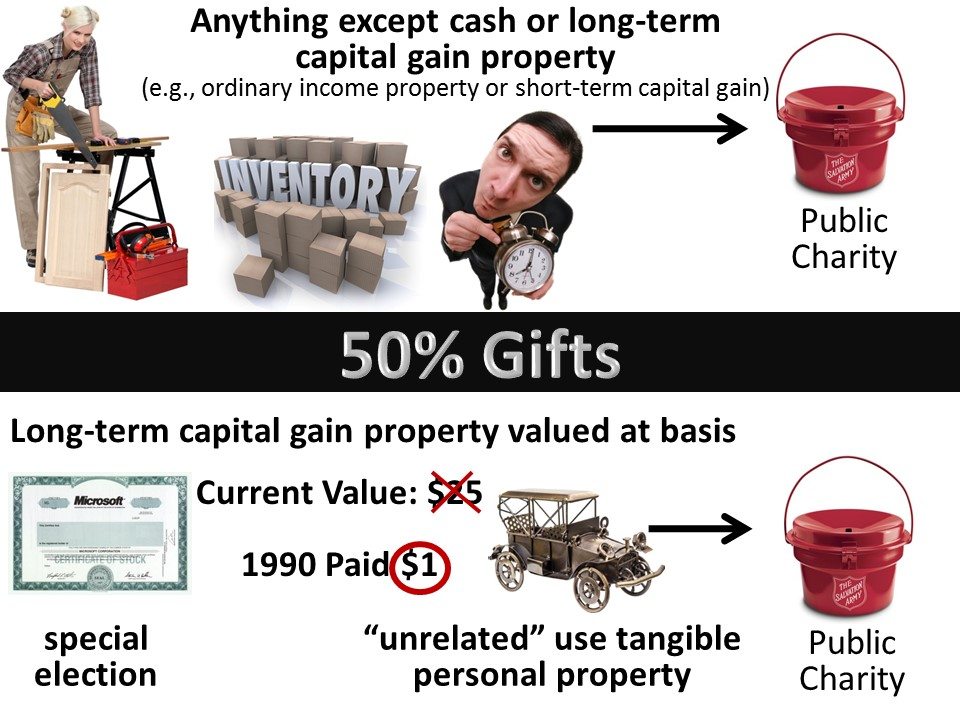
In order to receive the highest non-cash income limitation of 50%, a donor must give a public charity a non-cash asset that is either not long-term capital gain property, or is long-term capital gain property that is valued only at its basis and not its fair market value. (Such lower valuation can occur through a "special election" or a gift of "unrelated" use long-term capital gain tangible personal property.)
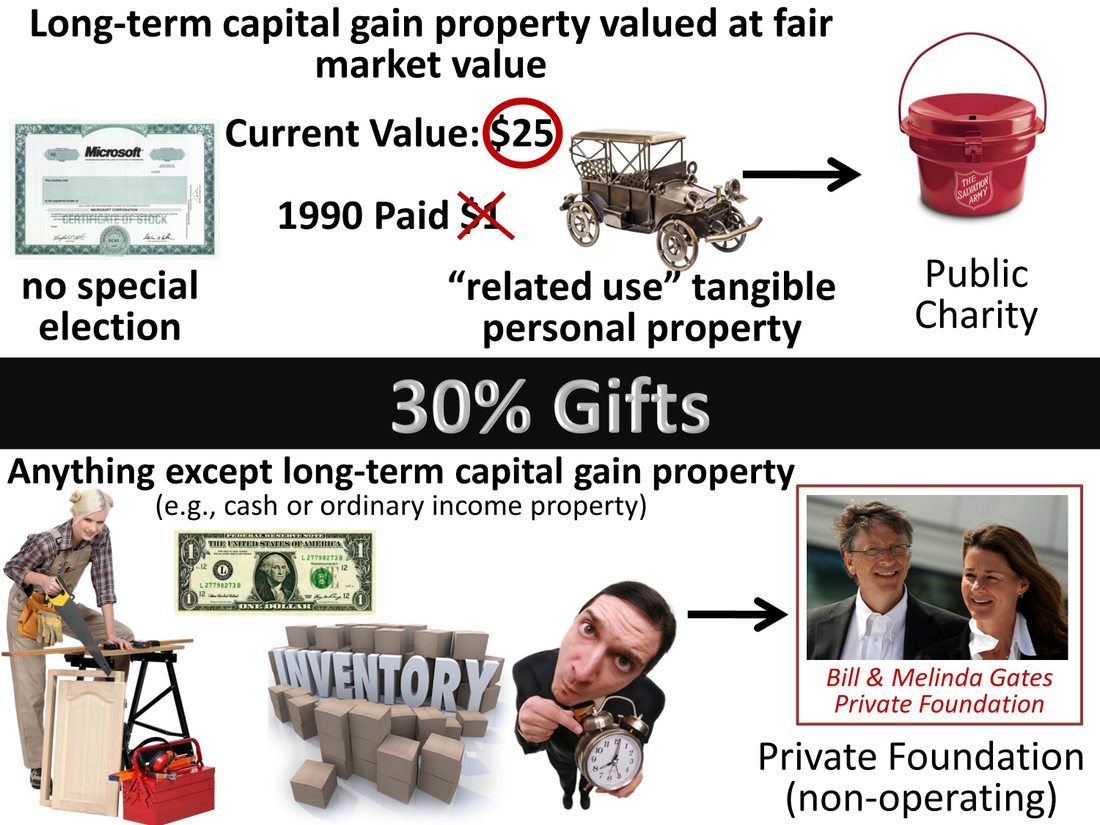
In order to receive the middle level non-cash income limitation of 30%, a donor must either give disfavored property (long-term capital gain valued at fair market value) to a favored charitable entity (e.g., a public charity), or give favored property (cash or property that is not long-term capital gain) to a disfavored charitable entity (e.g., a private foundation).
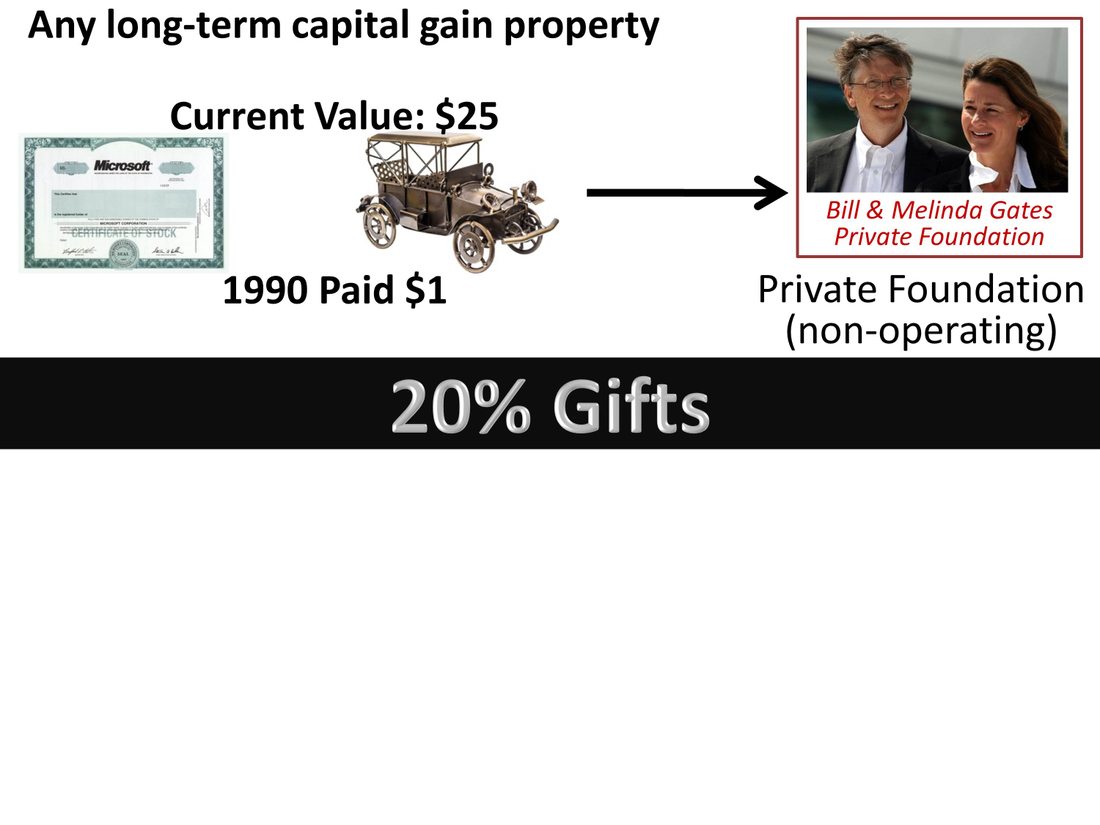
Finally, in order to receive the lowest level income limitation of 20%, a donor must give disfavored property (long-term capital gain) to a disfavored charitable entity (e.g., a private foundation).
So far, the chapter has reviewed the income limitations for charitable deductions from different types of gifts to different organizations. But, what happens when these income limitations are exceeded?
When income limitations are exceeded, the charitable deductions are not lost. Instead, the excess deductions must be carried over to future years. As soon as there is a year in which the income limitations are not exceeded for the type of charitable deduction carried over, those deductions may be used. However, the deductions must be used in one of the five years following the year of the gift. Otherwise the charitable deduction will expire. (Regulation 1.170A-10(a)(1) and PLR 8824039 indicate that excess gifts "for the use of" charity cannot be carried forward, but IRS publication 526 and PLR 200010036 indicate that they can be.)
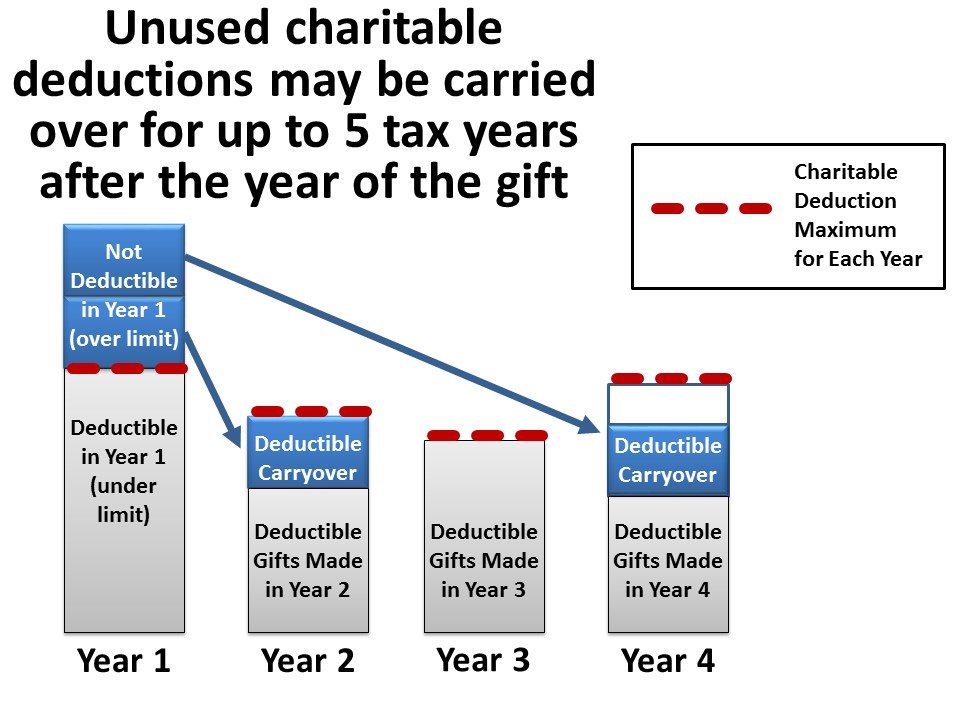
This chart is a visual demonstration of how unused charitable deductions may be carried forward. In each year, the dashed line represents the charitable deduction maximum dollar amount for this type of gift. In year one, the donor gives more than the charitable deduction maximum level. The portion given in year one up to the income limitation is shown below the dashed line and that part may be deducted in year one. The amount above the dashed line in year one must be carried over into future years. In year two, the donor makes additional deductible gifts (designated in dark text). Note that gifts made during the year will be counted first, prior to counting any carryover deductions. After counting these gifts made in year two, there is still remaining space under the income limitation maximum for year two. Thus, part of the carryover deduction may be used in year two. In year three, the donor makes gifts up to the maximum income limitation. Consequently, no carryover deductions may be used in year three. Finally, in year four, the donor again makes gifts, but there is still remaining space under the income limitation maximum for that year. Thus, the remainder of the carryover may be deducted in year four, leaving no additional carryover for future years.
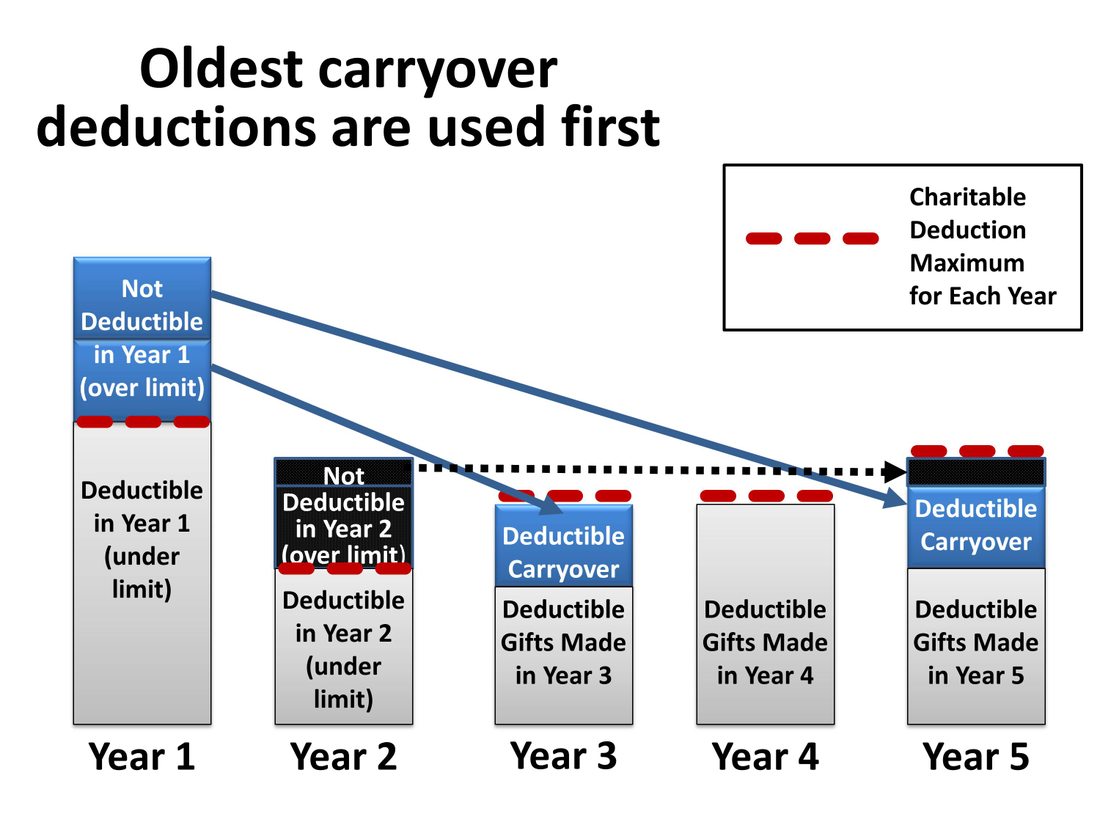
When a donor has carryover charitable deductions from multiple years, the oldest carryover deductions will be used first. This rule is advantageous to the donor because carryover deductions will expire after the fifth year following the year of the charitable gift. So, the donor would prefer to use the oldest carryover first to reduce the risk of the charitable deduction carryover expiring. In the example in the chart, the donor gives more than the income limitation amount in both year one and year two. In year three, the donor gives less than the income limitation maximum, allowing for the use of carryover deductions. The carryover deductions from year one are used in year three, and not the carryover deductions from year two, because the carryover deductions from year one are older. In year four, the donor makes gifts up to the income limitation and thus no carryover deductions may be used in that year. Finally, in year five, the donor again gives less than the income limitation maximum, allowing the remainder of the carryover deductions from year one to be used. After all of the year one deductions from this type of charitable gift are used, only then can the carryover deductions from year two begin to be used.
These scenarios assume that the donor uses all of the charitable deductions generated in each year. But, what happens if a donor with carryover charitable deductions takes no itemized deductions for a year, and instead takes the standard deduction? (Taking the standard deduction is an alternative to taking individual itemized deductions such as the charitable deduction or mortgage interest deduction.)
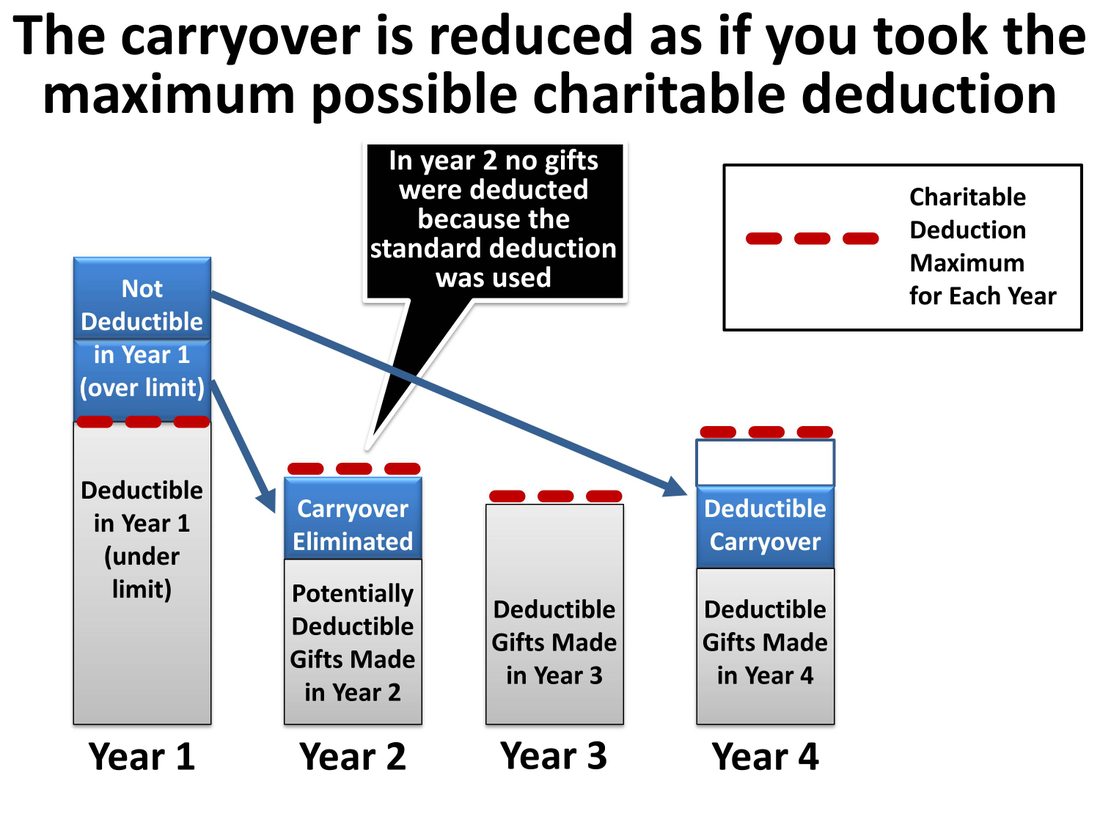
Even though the donor uses no itemized deductions in the year when he or she takes the standard deduction, the carryover charitable deductions will be eliminated as if the donor used as much of the charitable deduction as would have been possible (i.e., up to the income limitations) if the donor had itemized deductions. In this example, the donor made excess charitable gifts in year one, generating carryover charitable deductions. In year two, the donor made some deductible charitable gifts, but chose not to deduct those gifts in favor of taking the standard deduction. Even though the donor does not use any of the carryover deductions in year two, these carryover deductions will be eliminated as if the donor had used as much as would have been possible had the donor itemized deductions. Thus, the donor will lose carryover deductions in the amount of the difference between the income limitation in year two for this type of gift and the deductible gifts made in year two. This unpleasant result means that using the standard deduction is not an effective way of preserving carryover charitable deductions. Next, in this example, the donor makes deductible gifts up to the income limitation for this type of gift in year three, meaning that no carryover can be used in year three. And finally in year four the donor makes additional gifts, but not up to the maximum level, thus leaving room for the remaining carryover deductions to be used in that year.
The previous example considers how the donor can use these carryover deductions during the five tax years following the year of the gift. However, what happens if the donor dies with unused carryover deductions?
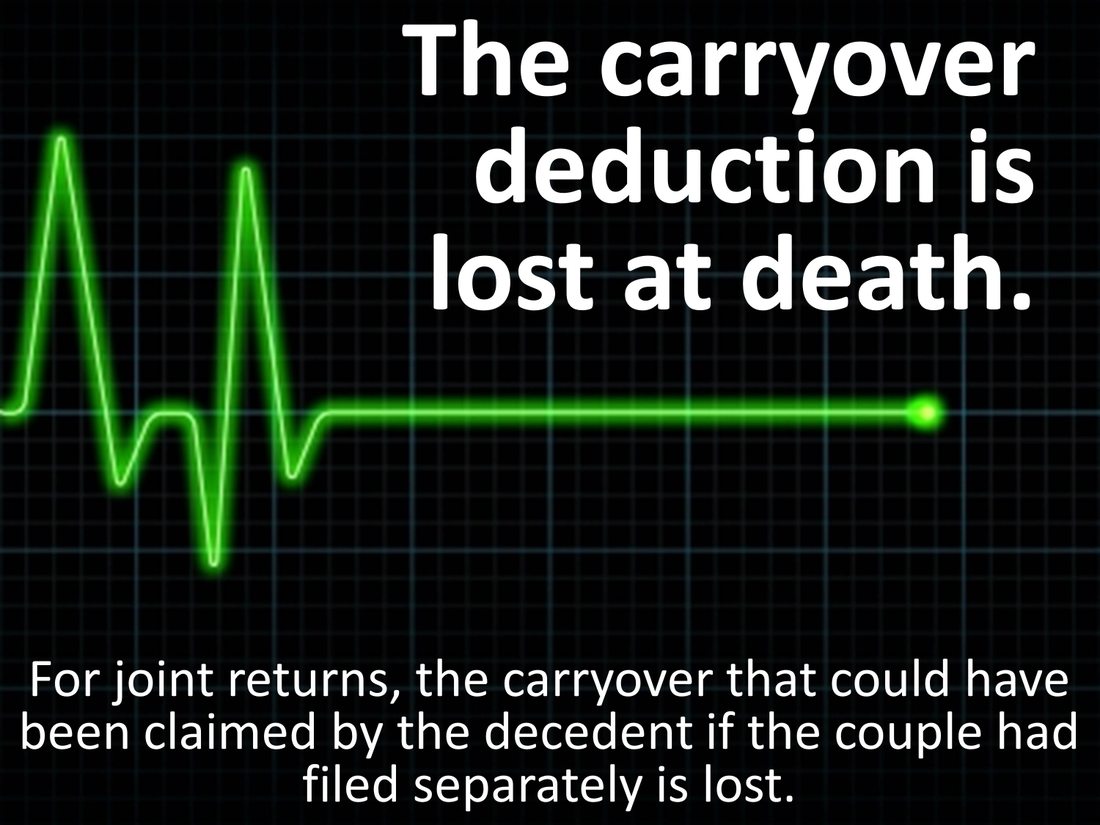
The answer, unfortunately, is that carryover charitable deductions are simply lost at death. For joint returns, the amount of carryover lost is equal to the carryover that could have been claimed by the decedent if the couple had filed separately. Thus, when a donor makes charitable gifts in excess of the income limitations, there is a risk that those carryover deductions may not ever be used. This could happen because the donor's subsequent income limitations (after absorbing current giving deductions in each year) are insufficient to absorb the carryover deductions, or because the donor dies prior to using the carryover deductions.
The previous section reviewed which income limitations apply to which type of gifts. However, it did not examine how the different limits work together. This is a complicated but important question because a donor may be dealing with a variety of different limits that interact in different ways. (A donor cannot, for example, deduct up to 50% of his income with one type of gift and then deduct another 30% of his income with another type of gift and then deduct the final 20% of his income with a final type of gift.)
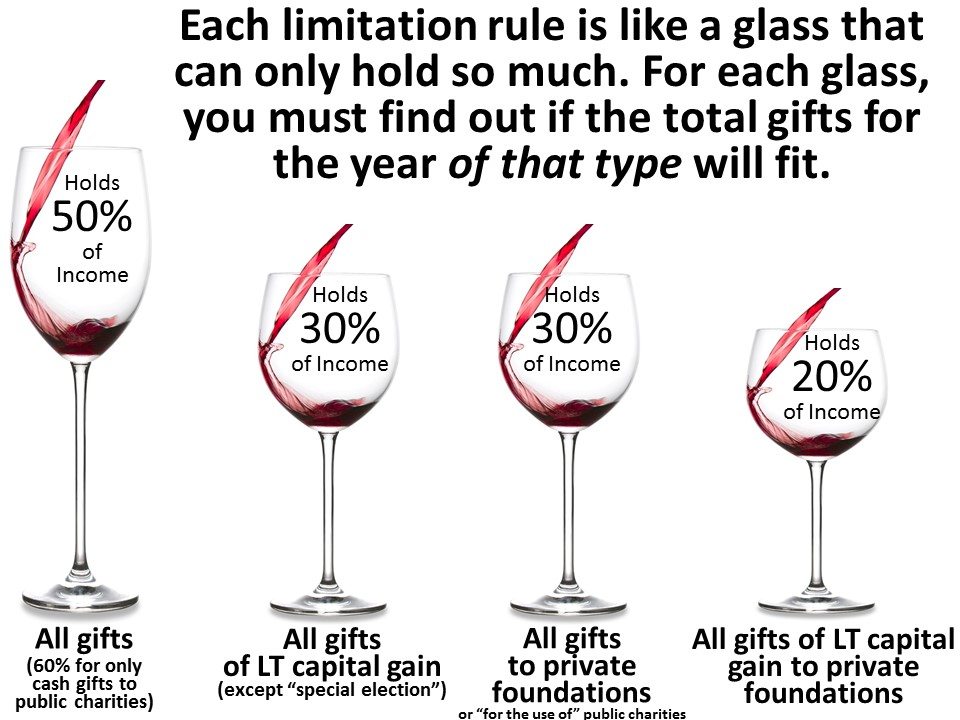
It may be helpful to conceptualize the interaction of these rules by thinking of four different glasses. Each glass represents a specific income limitation rule for specific types of gifts. The question then becomes if the total of each type of gift made during a year can be "poured into" each type of glass. The first glass can hold up to 50% of income (or up to 60% of income if used exclusively for gifts of cash to public charities). All deductible charitable gifts for the entire year must be "poured" into this first glass. The second glass can hold up to 30% of income. Into this glass the donor must put all gifts of long-term capital gain (regardless of the recipient charity), excluding only capital gain for which a "special election" has been made. The third glass can also hold up to 30% of income. Into this third glass, the donor must put all gifts to private foundations made during the year (as well as any gifts made "for the use of" public charities, usually meaning deductible gifts to a Charitable Lead Trust or to a life insurance company to pay for charity owned life insurance). The final glass can hold only 20% of income. Into this final glass, the donor must put all gifts of long-term capital gain property made to private foundations during the year.
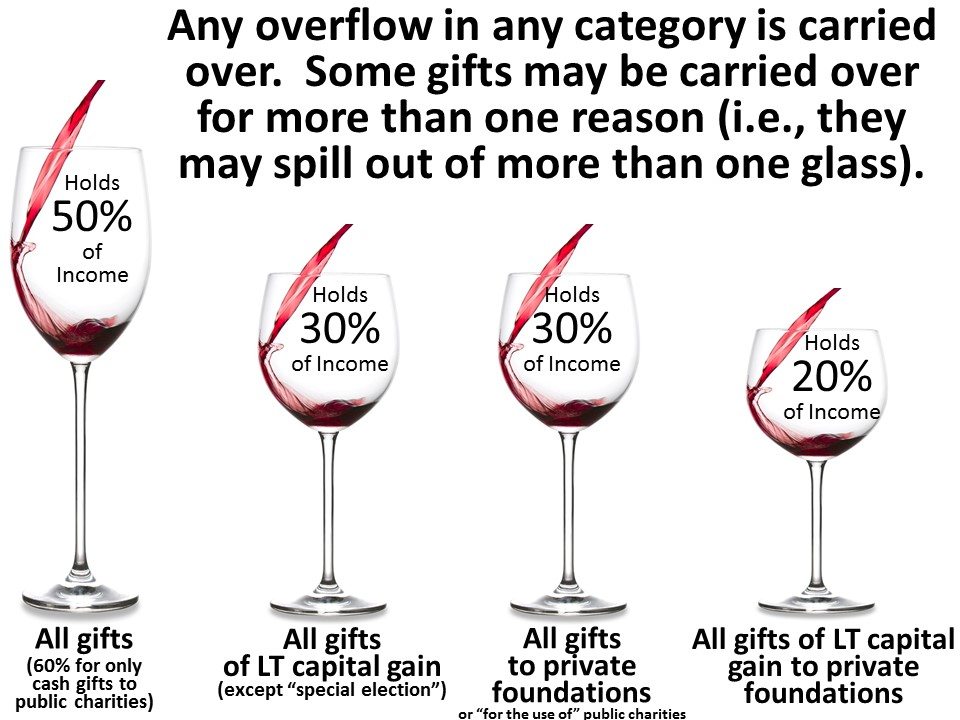
If the gifts of a particular type cannot all fit into the relevant glasses, there will be overflow. This overflow represents carryover deductions that cannot be used in the current year. Note that this spillage analogy works to calculate which deductible gifts must be carried over. The amount that can be deducted is the total deductible charitable gifts for the year, minus what must be carried over. (Do not attempt to use the glass analogy to calculate the amount of deductions for a current year by thinking about how much remains in each glass, but instead focus only on the amount of overflow as representing deductible charitable gifts that must be carried forward into future years.)
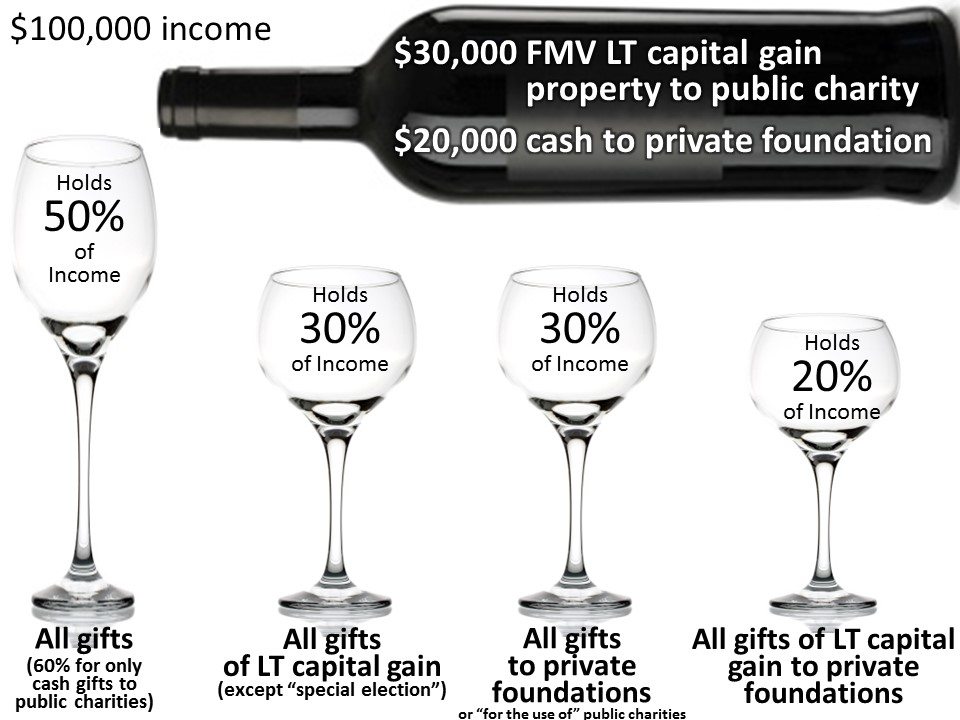
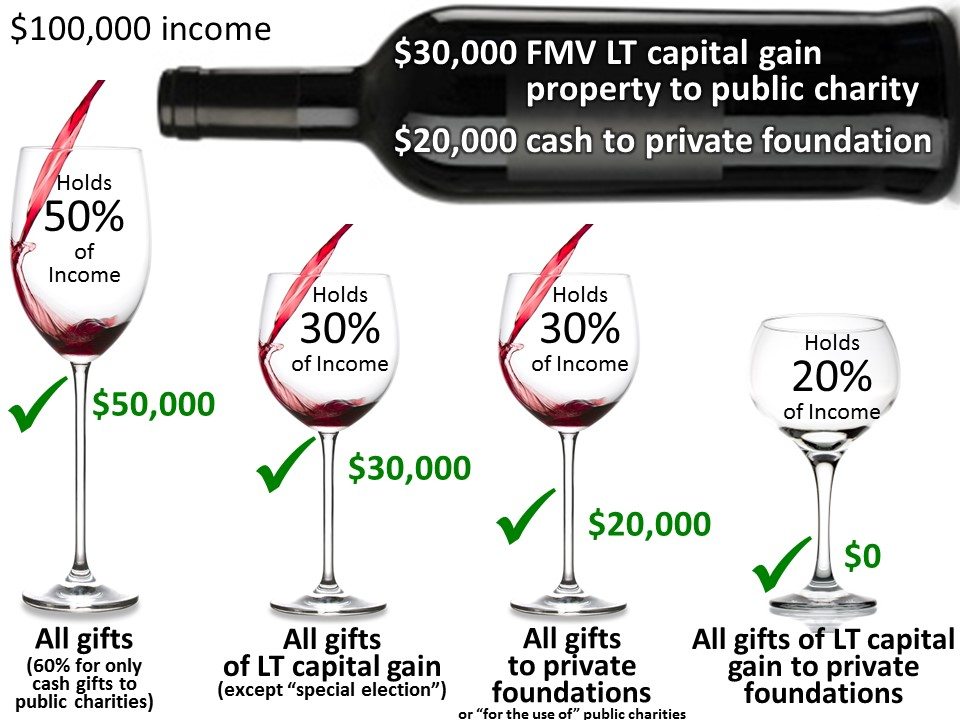
As a first example, consider a donor with $100,000 of income (as before, this means adjusted gross income excluding any net operating loss carry back). During the year, the donor has made a total of $30,000 of gifts of long-term capital gain property (valued at fair market value) to a public charity and $20,000 of cash gifts to a private foundation. Next, consider what happens when attempting to "pour" these gifts into each glass.
The first glass can hold up to 50% of income (unless it is holding only gifts of cash to a public charity). All gifts must be poured into this first glass. In this case, all gifts combined total $50,000. 50% of income also totals $50,000. Thus, there is no spillage with the first glass and therefore no carryover resulting from the first glass. The second glass can hold up to 30% of income. Thus, in this case, it can hold up to $30,000. Into this glass must be poured all gifts of long-term capital gain (except "special election" capital gain). The donor made a total of $30,000 of such gifts during the year and so, once again, there is no spillage. The third glass can also hold up to 30% of income. This third glass holds all gifts to private foundations, which in this case amount to $20,000. The $20,000 of gifts to private foundations easily fits into the $30,000 glass size and so, once again, there is no overflow. The final glass relates to gifts of long-term capital gain to private foundations and no such gifts were made during the year. So again, there is no spillage.
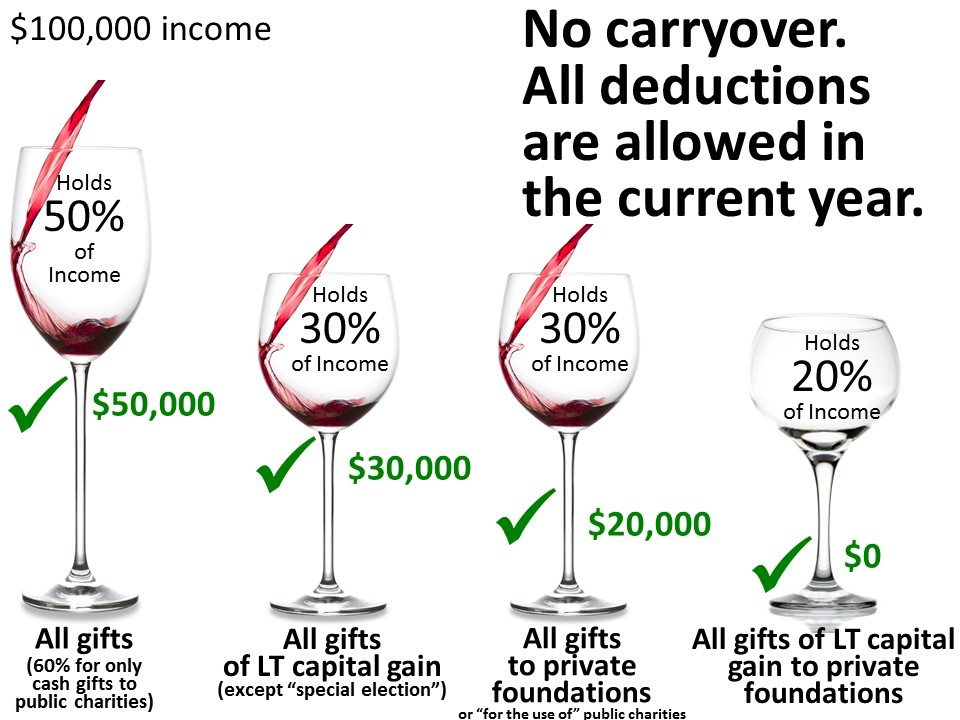
Because there was no spillage or overflow out of any of the four glasses there is no carryover. Thus, all charitable deductions will be allowed in the current year. (Remember that in this analogy the amount of charitable deductions allowed in the year is the total amount of deductible charitable gifts less any gifts that must be carried forward.)
The previous example did not create any carryover. However, before looking at one of these carryover examples, it is useful to know which type of gifts gets deducted first and which type of gifts are carried forward first. For example, if there is spillage out of the first glass into which all gifts must be poured, which gifts are carried forward? This is an important issue because the gifts carried forward retain their original identity. This means they must, in the future year in which they are used, be able to fit into each income limitation "glass" related to that type of gift.
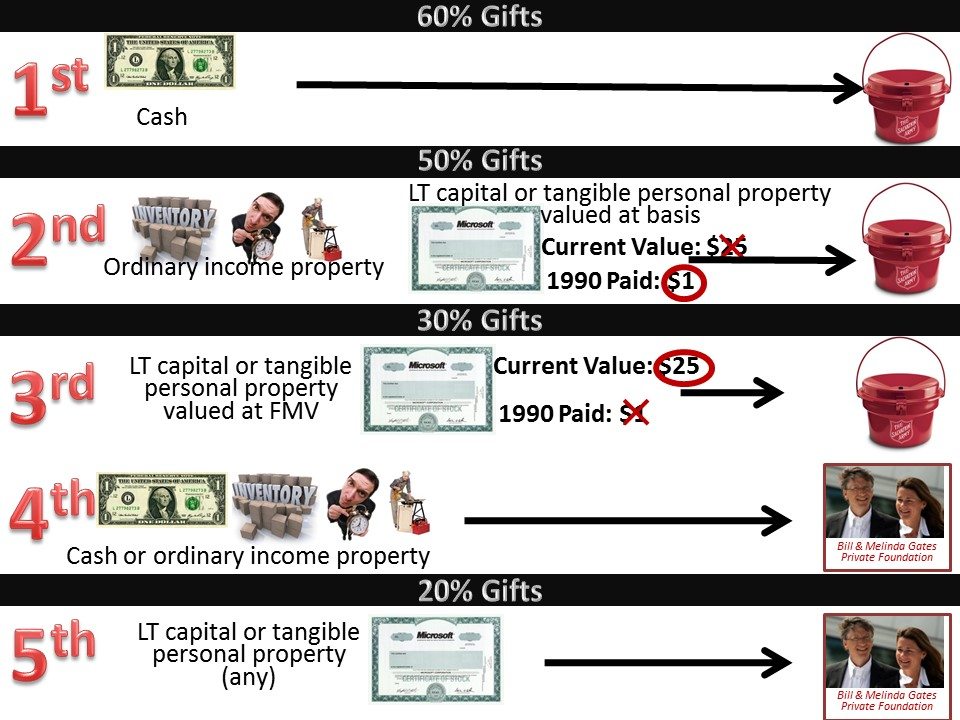
Fortunately, the question of which gifts are deducted first follows the same pattern of preference seen with regard to which gifts have the highest income limitations. In other words, the more preferred gifts will be deducted first and the less preferred gifts will be carried over first. So, the most favored gift (cash) given to the favored recipient (public charity) will be deducted first. Moderately favored property (non-cash property that is not long-term capital gain property valued at fair market value) given to a favored charitable recipient (e.g., a public charity), will be deducted second. Third, disfavored property (long-term capital gain property valued at fair market value) given to a favored charitable recipient (e.g., a public charity) will be deducted. Fourth, any favored property (cash or non-cash that is not long-term capital gain) given to a disfavored charitable recipient (e.g., a private foundation) will be deducted. Finally, the last type of gift to be deducted - and the first type of gift to be carried forward into future years - is disfavored property (long-term capital gain) given to a disfavored charitable recipient (e.g., a private foundation). This is the order that determines which type of gift will be counted first. If there is spillage out of a glass containing multiple types of gifts this ordering determines which type of gifts must be carried forward.
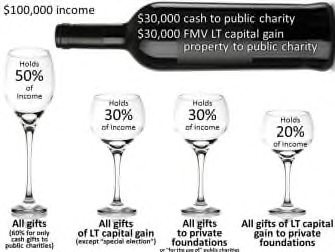
In this next example, the donor, once again, has $100,000 of income. During the course of the year, the donor has made a total of $30,000 of cash gifts to public charities and $30,000 of long-term capital gain property gifts (valued at fair market value) to public charities.
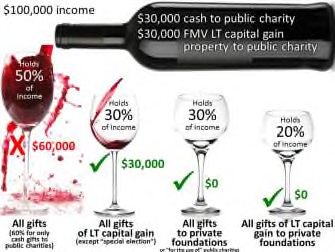
The first glass holds up to 50% of income (in this case $50,000) - or 60% of income if it is holding only gifts of cash to a public charity. All deductible charitable gifts of any type must be "poured" into this first glass. The donor has made a total of $60,000 of deductible charitable gifts during the year. If these gifts were only cash gifts to public charities, they could all fit into the first glass, but because they are not, the $60,000 cannot fit entirely into the $50,000 glass. Thus, there will be spillage and therefore carryover. There are no similar problems with the second glass, which can hold up to $30,000 of long-term capital gain gifts because only $30,000 of such gifts were made during the year. (These long-term capital gain gifts were not subject to the "special election" because they were valued at fair market value, i.e., "FMV" in the accompanying slide.) No gifts were made to private foundations during the year, so nothing goes into glasses three or four. There will be carryover due to the spillage from glass one. But, which gifts will have their deductions carried forward?
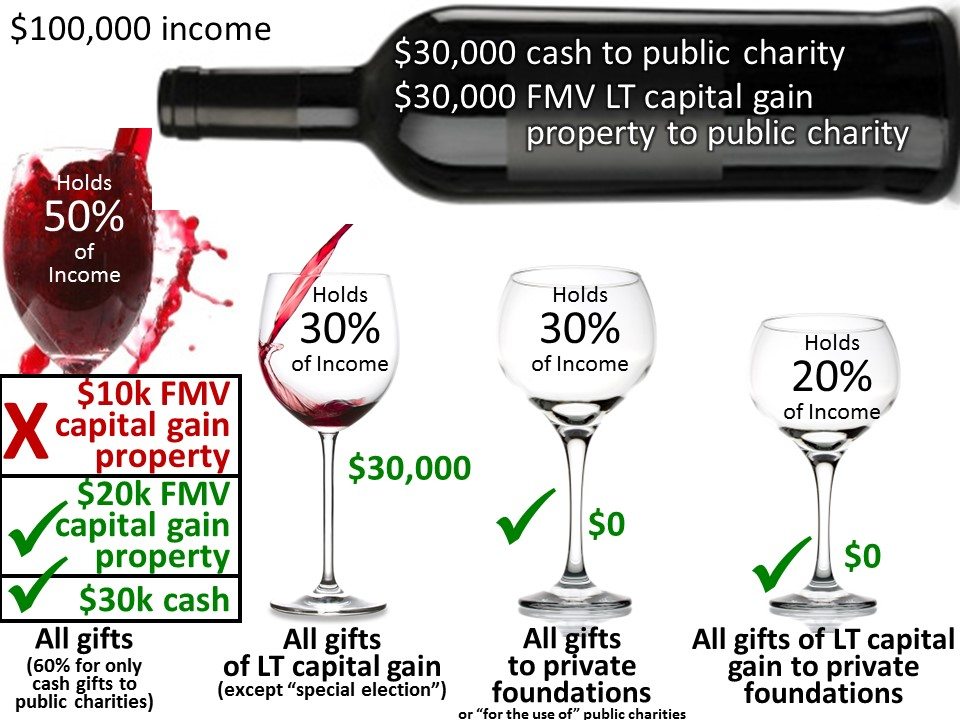
Because the first glass cannot hold all $60,000 of deductible gifts made during the year, some gifts must be carried forward. The $30,000 of cash given to a public charity is the most favored kind of charitable transaction. Consequently, this gift will be deducted first. This means that the $10,000 of carryover will come entirely from the capital gain property gifts made to public charity.
What happens if there are different gifts within the same category? For example, if there are gifts of short-term capital gain property to a public charity and also gifts of inventory to a public charity, which one gets carried forward? The answer is that it doesn't matter, because both of these types of gifts are treated identically for tax deduction purposes.
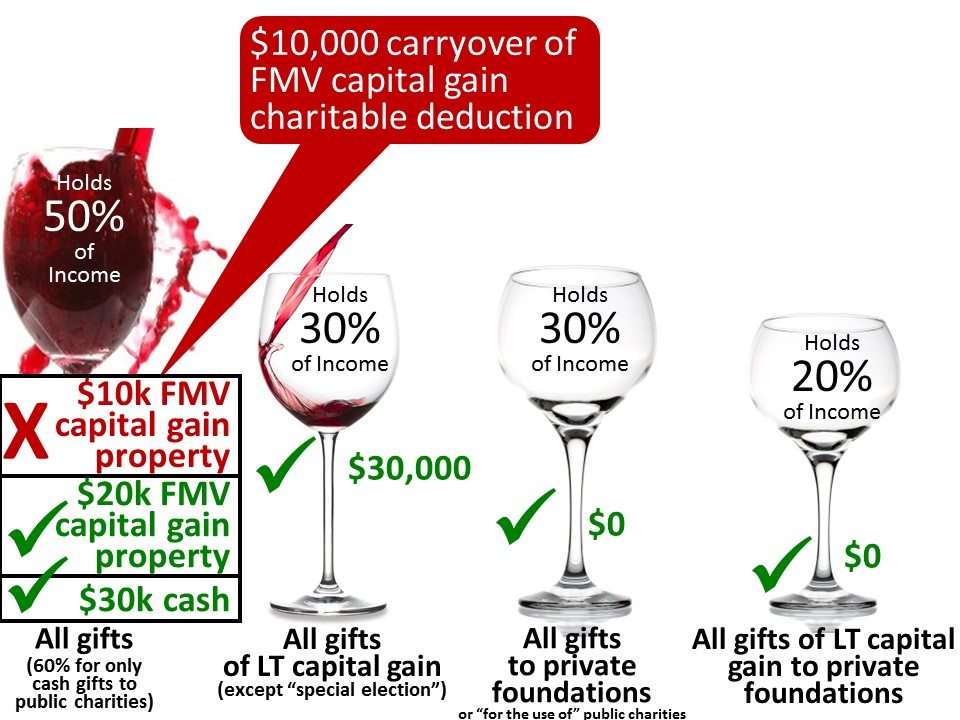
Because there is $10,000 that cannot fit into the first glass, this $10,000 of charitable deduction for fair market value capital gain property must be carried forward into future years.
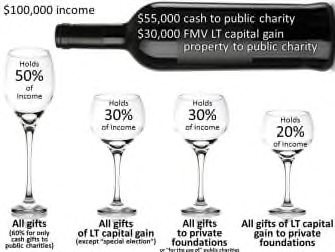
In this next example, the donor still has $100,000 of income. The donor makes a total of $55,000 of cash gifts to public charities, and $30,000 of gifts of long-term capital gain property (valued at fair market value) to public charities. How will this giving fit into the income limitation "glasses"?
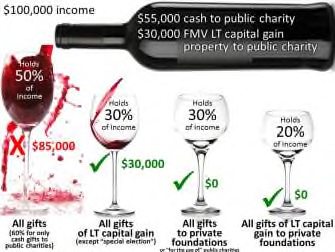
The total giving of $85,000 will not fit into the first glass, so there will be carryover of some deductions into future years. The second glass holds only gifts of long-term capital gain property. It can hold up to 30% of income, or in this case $30,000. The donor made $30,000 of gifits of long-term capital gain property, so there will be no carryover resulting from this glass. The third and fourth glass are irrelevant because no gifts were made to private foundations.
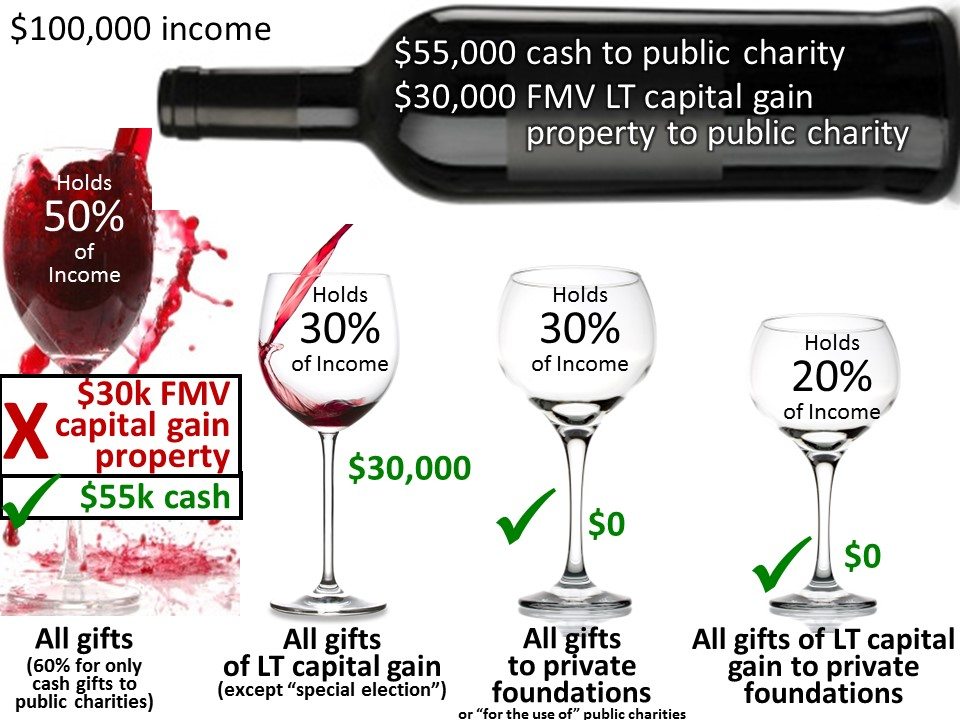
Deductions from some gifts will be carried over as the result of spillage from the first glass. As before, the most favored types of gifts are counted first, leaving the less favored gifts at risk of being carried forward. Thus, the $55,000 in gifts of cash to a public charity go into the first glass first. Because the first glass is thereby holding only gifts of cash to public charity, it can hold up to $60,000 in such gifts. Consequently, all $55,000 in gifts of cash to a public charity fit into the glass. However, none of the $30,000 in capital gain gifts will fit into the first glass. (The increased capacity from $50,000 to $60,000 applies only to gift of cash to a public charity, not to capital gain gifts.)
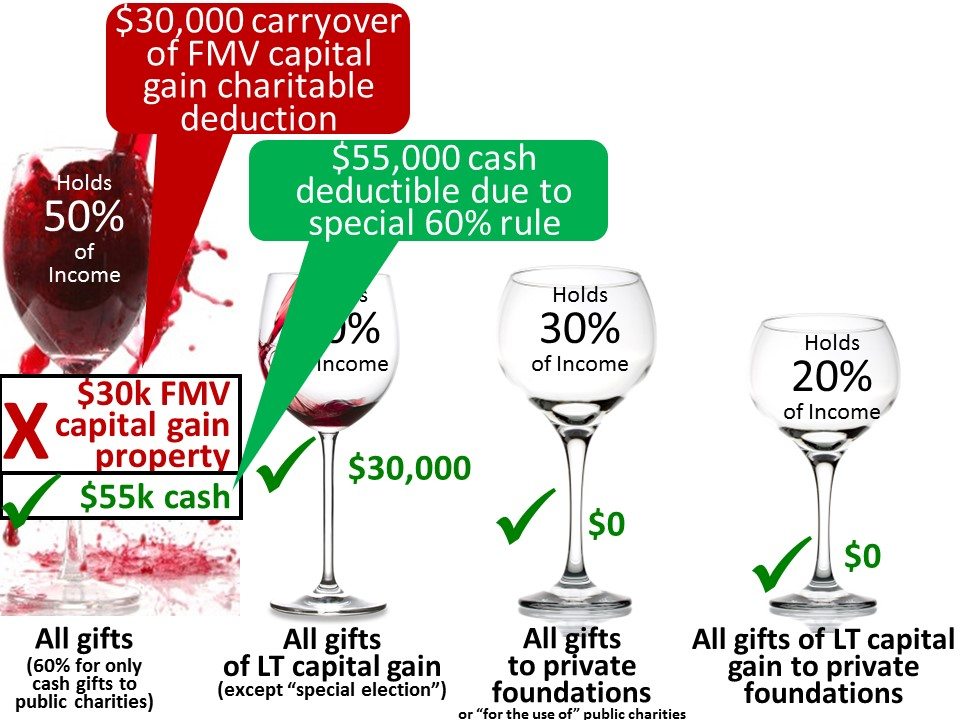
As a result, all $30,000 of capital gain gifts spill out of the first glass and must be carried over into future years. Even though the $30,000 of capital gain gifts do fit into the second glass, they must still be carried forward because they do not fit into the first glass. The $55,000 in gifts of cash to a public charity does not spill out of any glass and thus can be deducted in the current year. The first glass can hold the entire $55,000 in gifts of cash to a public charity because it can hold up to 60% of income when, as in this case, it is holding only gifts of cash to charity. It is not holding any of the capital gain gifts, as these all spill out of the glass, and must be carried forward into future years.
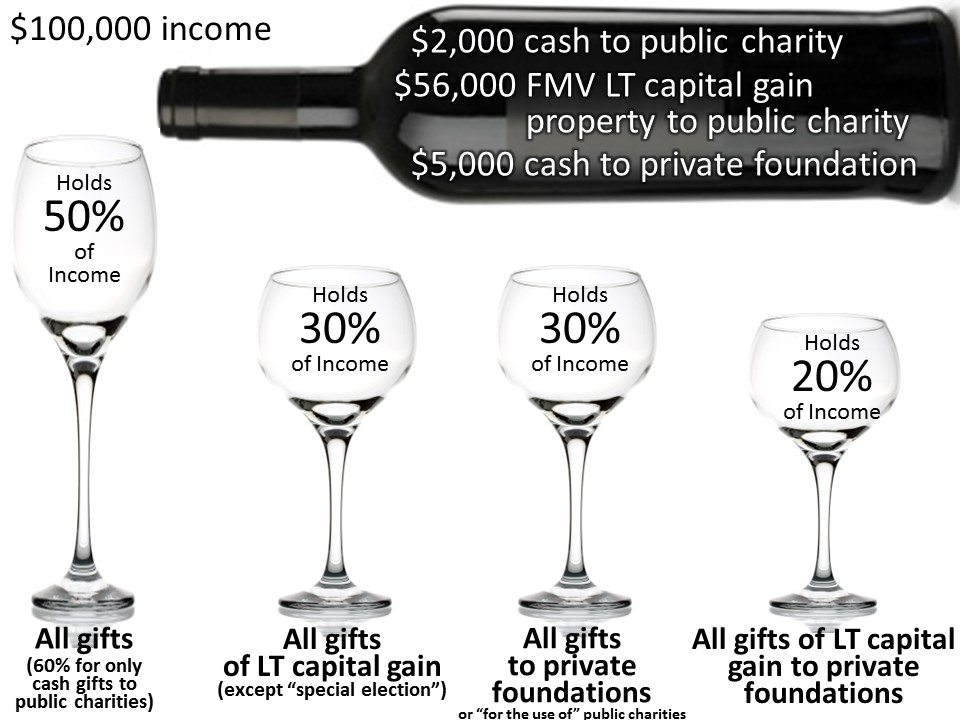
In this next example, the donor again has $100,000 of income. During the course of the year, the donor makes a total of $2,000 of cash gifts to public charities, $56,000 of gifts of long-term capital gain property (valued at fair market value) to public charities, and $5,000 of cash gifts to private foundations. Will this giving fit into the income limitation "glasses"?
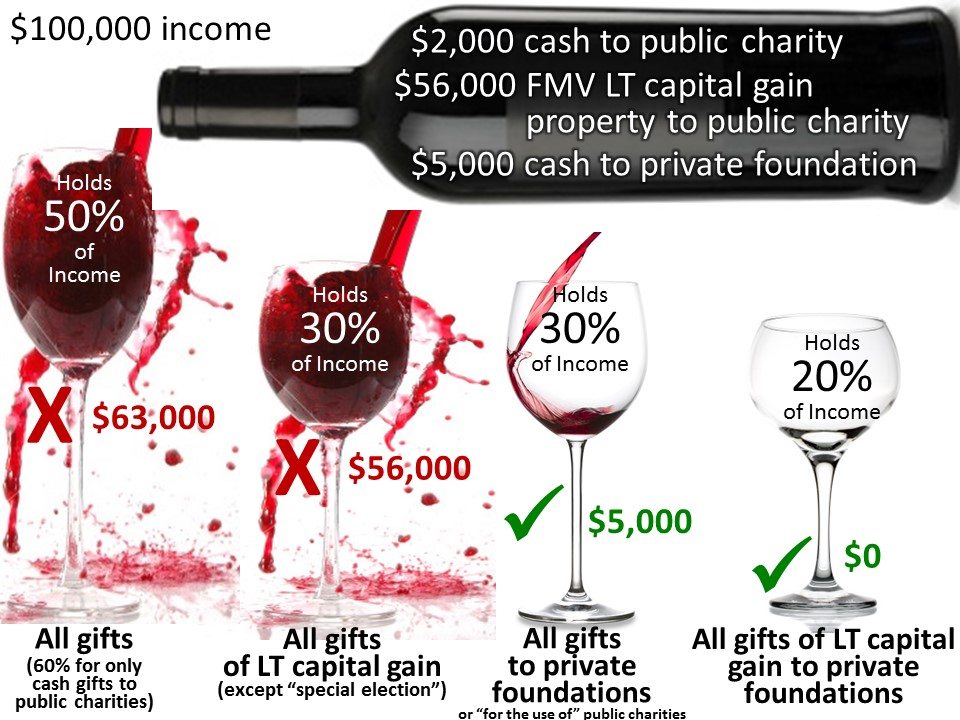
The first glass can hold up to $50,000 (or $60,000 when holding only gifts of cash to a public charity) and it includes all deductible charitable gifts made during the year. In this case, the donor has made a total of $63,000 of deductible charitable gifts. The special $60,000 limit does not apply here because only $2,000 of the gifts were cash gifts made to a public charity. Consequently, the first glass can hold only $50,000 and there will be $13,000 of spillage out of this first glass. The second glass can hold up to $30,000 and includes all gifts of long-term capital gain (except that subjected to a "special election"). The donor, however, has made $56,000 of long-term capital gain property gifts (valued at fair market value, and therefore not "special election" property). Thus, there will be $26,000 of spillage out of the second glass. The third glass contains all gifts to private foundations and can hold up to 30% of income, which in this case means $30,000. The total gifts to private foundations were $5,000, so there is no spillage out of this glass. There were no gifts of long-term capital gain to a private foundation, so the fourth glass is not relevant.
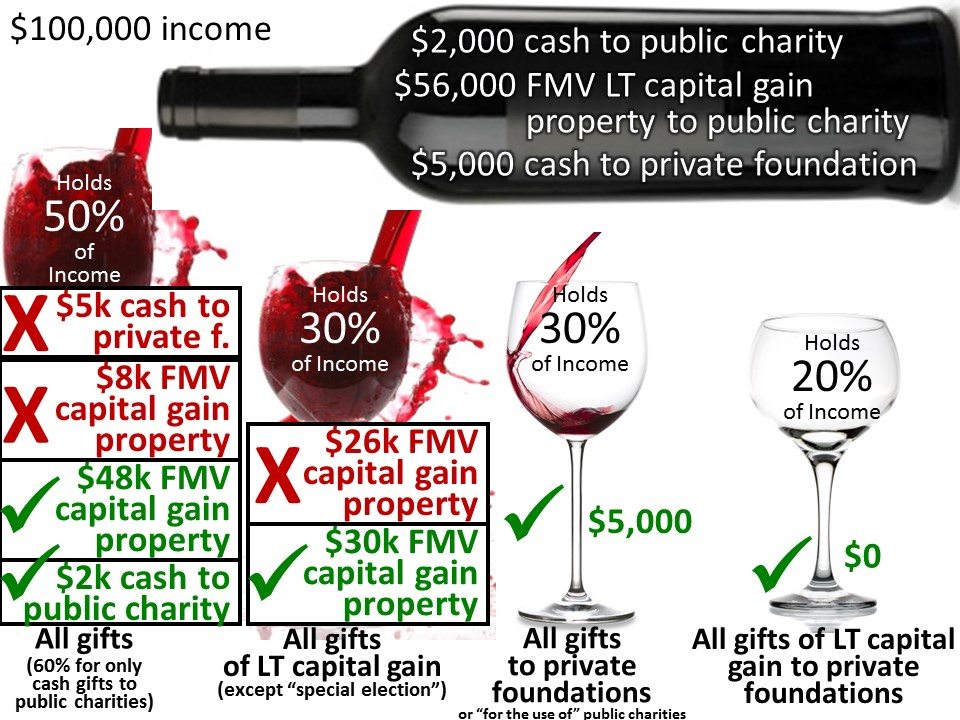
Which gifts are carried forward? The first glass will have $13,000 of spillage because there were a total of $63,000 of deductible charitable gifts and 50% of income is only $50,000. Gifts of cash to a public charity are the most favored type of gifts and so will be deducted first. Gifts of long-term capital gain to a public charity are deducted next. However, the cash to a public charity of $2,000 and the long-term capital gain property to public charity of $56,000 exceed the $50,000 holding capacity of this glass. Thus, $8,000 of the long-term capital gain property gifts to public charity must be carried forward into future years, because it has spilled out of the glass. Gifts of cash to a private foundation are deducted third (after gifts of cash to a public charity and gifts of long-term capital gain to a public charity). As a result, all of the $5,000 in cash gifts to private foundations "spills out" of the first glass and must be carried forward into future years.
In this case, there is also spillage out of the second glass, which makes things more complicated. The second glass can hold a total of $30,000 (30% of income) of long-term capital gain gifts. However, the donor made $56,000 of this type of long-term capital gain gifts. Thus, $26,000 of these long-term capital gain gifts spill out of the glass and must be carried forward into future years. $8,000 of that $26,000 of long-term capital gain gifts were already being carried forward because of the spillage resulting from the first glass. However, this just means that this particular $8,000 of long-term capital gain gifts will be carried forward for two different reasons (spillage out of glass one and spillage out of glass two).
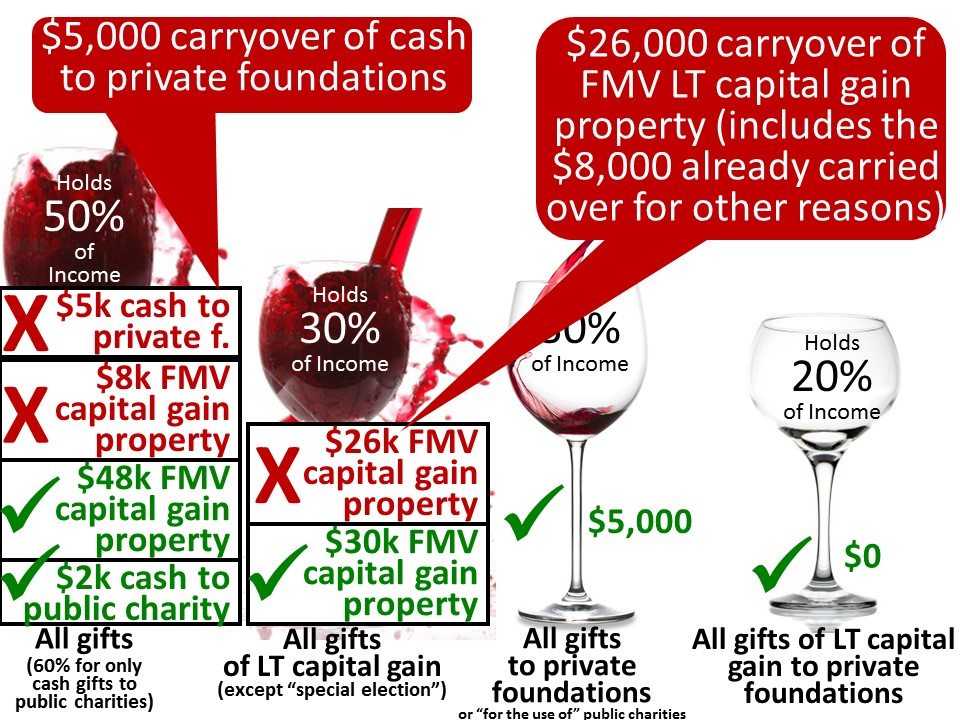
Note that the gifts for the year must fit into each glass separately. The calculation for each individual glass is not affected by what happens in the other glasses. It is not appropriate, for example, to say that only $30,000 of fair market value long-term capital gain property gifts must go into glass one, because the rest of the long-term capital gain property gifts have spilled out of glass two. Each glass is calculated without regard to the other glasses. This means that the same gift could be carried over for multiple reasons (i.e., the same gift can spill out of multiple glasses), as happened here with the $8,000 of long-term capital gain gifts that spilled out of both glasses one and two.
The result here is a carryover of both $26,000 of fair market value long-term capital gain property gifts to public charities and $5,000 of cash gifts to private foundations. Thus, $31,000 of charitable deductions, in total, must be carried forward into future years. The donor made a total of $63,000 of deductible charitable gifts, and $31,000 must be carried forward into future years. As a result, only $32,000 may be deducted this year.
Remember, the glass analogy is used to calculate the amount of carryover. To calculate the amount that can be deducted in the current year, simply subtract this total gifts carried over from the total deductible charitable gifts for the year. Do not attempt to calculate the deductible gifts for the year by using the dollar amounts with checkmarks by them in the accompanying image. So, for example, the $5,000 in gifts to private foundations was well below the maximum for glass three, but this gift was still carried forward because of the spillage from glass one.
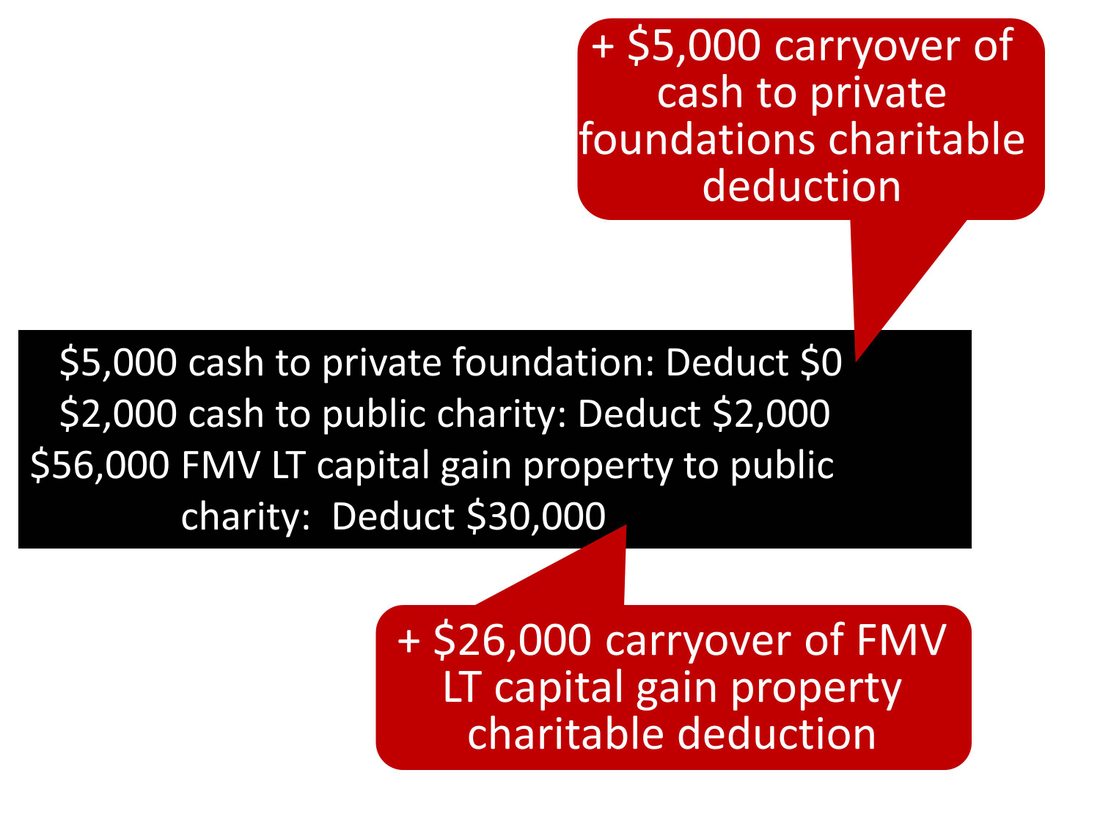
Returning to the three categories of gifts made by the donor during the year, the $5,000 of cash given to private foundations generated no deduction for this year, but did generate $5,000 of carryover deductions for future years. That $5,000 of carryover deductions will, in future years, still be treated as deductions for gifts of cash to private foundations. Thus, in order to be used, these carryover deductions must be able to fit into the relevant income limitation glasses for the future years. The $2,000 of cash gifts to public charities will all be deducted this year. Finally, the $56,000 of fair market value long-term capital gain property gifts to public charities resulted in a current year deduction of $30,000 and $26,000 of carryover. Again, this $26,000 of carryover will, in future years, still be characterized as fair market value long-term capital gain property gifts to public charities.
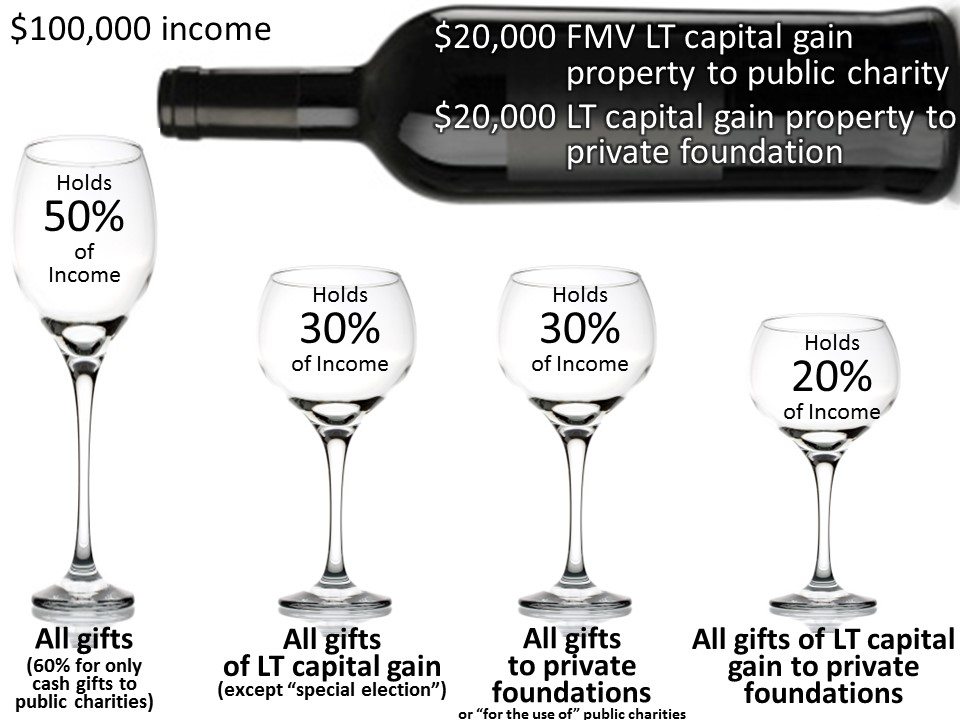
In this next example, the donor has given $20,000 of fair market value long-term capital gain property gifts to public charities and $20,000 of long-term capital gain property gifts to private foundations during the year.
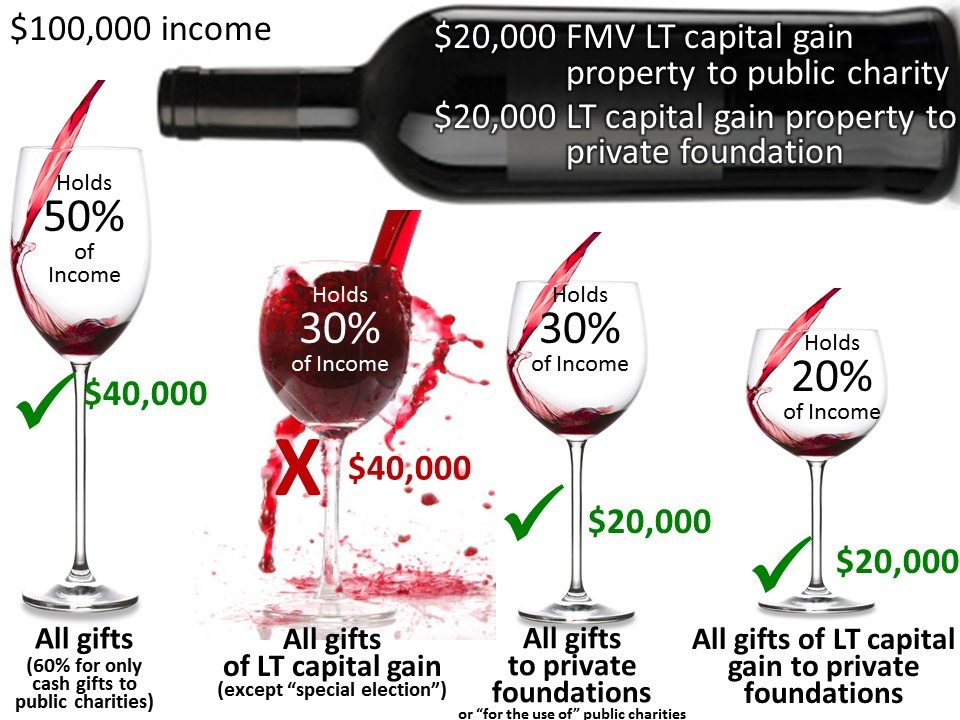
These gifts total $40,000, which fits into the first glass. However, all of these gifts are of long-term capital gain and not all $40,000 will fit into the second glass, which holds only $30,000. Thus, there will be $10,000 of carryover. The third glass holds up to $30,000 in this case, and contains all gifts to private foundations. Only $20,000 of gifts were made to private foundations this year. Therefore, there is no carryover resulting from glass three. Glass four can hold up to $20,000 in this case, and contains all gifts of long-term capital gain property given to private foundations. Exactly $20,000 of this type of gift was given, and consequently there is no spillage from this fourth glass.
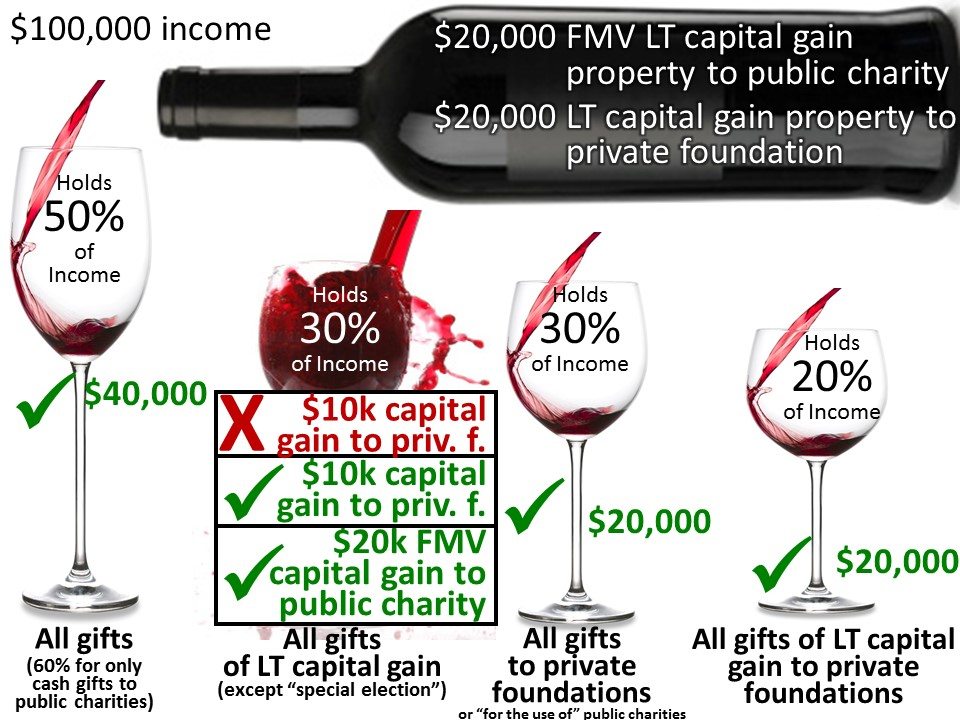
The previous slide indicates that $10,000 of deductible charitable gifts will have to be carried forward because of the spillage from glass two. But which type of gift is carried forward? Because long-term capital gain property gifts to public charities are deducted before long-term capital gain property gifts to private foundations, all $10,000 carried forward will be gifts of long-term capital gain property given to private foundations.
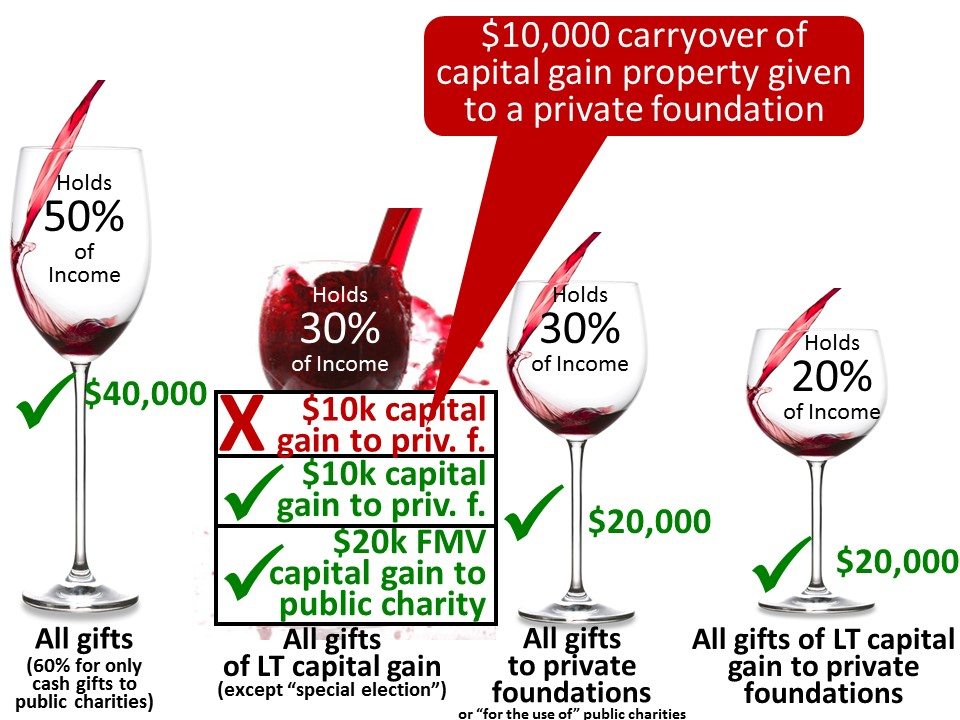
Thus, even though the entire capital gain property gift given to private foundations fits into glasses one, three, and four, $10,000 of this gift must still be carried forward into future years, because of the spillage from glass two.
The charitable floor eliminates itemized charitable deductions for gifts below 0.5% of AGI. Unless you bunch gifts so much that you touch one of the income-giving limitations. Do that and those deductions aren't lost. They just carry over until next year.
Suppose a taxpayer holds substantial appreciated assets but reports only $100,000 AGI every year. They donate $25,000 in appreciated assets in year one and year two. Each year, they deduct $25,000 minus the $500 charitable floor. This creates $49,000 in deductions. But suppose instead that they donate $30,001 in year one and $19,999 in year two. This creates $49,500 in deductions. They will deduct $29,500 in year one and $20,000 in year two. Why? Because the income limitation for gifts of appreciated assets is 30%. This means $1 of the first gift is carried over to year two. But because they reached this limit, the year one charitable floor is not lost. Instead, it carries over to year two. In year two, they deduct $19,999 + $1 carryover + $500 floor carryover - $500 floor (i.e., $20,000). As AGI and gift size increase, this benefit becomes more substantial. Normally, we think of the income giving limits as something to avoid, but in this case it provides a bonus by saving the otherwise lost deductions below the charitable floor.

This material is among the most complex in all of charitable gift planning. The analogies, explanations, and themes used in this chapter are intended to help the reader understand the rules intuitively. However, the comparisons made using spillage out of glasses and describing favored and disfavored property and favored and disfavored charitable entities are not examples or terms that come from the tax code or the IRS. These are put here only to be helpful. To the extent that these ideas do not help to visualize and internalize these rules, feel free to disregard them and focus more directly on the exact language of the Internal Revenue Code.