This chapter will examine how to document charitable gifts in order to preserve the income tax deduction. Admittedly, this is one of the less fascinating topics related to charitable planning. There is little room for creativity or interesting combinations, as is possible in other areas of charitable planning. Nevertheless, successfully obtaining the appropriate charitable deduction should be a fundamental expectation when working with any planned giving advisor. Part of obtaining that deduction requires appropriate documentation. So, despite the relatively dry nature of the material, it is essential material and, consequently, must be mastered.

To understand the importance of the documentation rules, it is useful to start with a common misconception. There is an expectation that as long as the donor was not abusing the system, and was, in fact, taking the "correct" deduction, that a documentation error would be a minor and correctable problem. If honest mistakes did not lead to severe penalties, being intimately familiar with the documentation rules would not be essential. Unfortunately, this perception is false. The consequences for even minor documentation oversights are dramatic and uncorrectable. Even if the donor actually deducts what would otherwise be the correct amount, minor documentation errors can reduce or completely eliminate the deduction. This cannot be fixed through later correction of the documentation errors.
Consider an example from a tax court case to illustrate the point. A donor made a charitable gift of $80,000 of non-publicly traded stock with a cost basis of $3,700. The valuation of the stock as being worth $80,000 was a correct valuation. However, the donor did not obtain a qualified appraisal prior to taking the deduction. (We will see later that such appraisals are required for gifts of nonpublicly-traded stock in this amount.) So, the donor correctly valued the gift and took the charitable deduction based upon that correct valuation. What, then, is the result of this oversight where the donor did not obtain a qualified appraisal in advance?
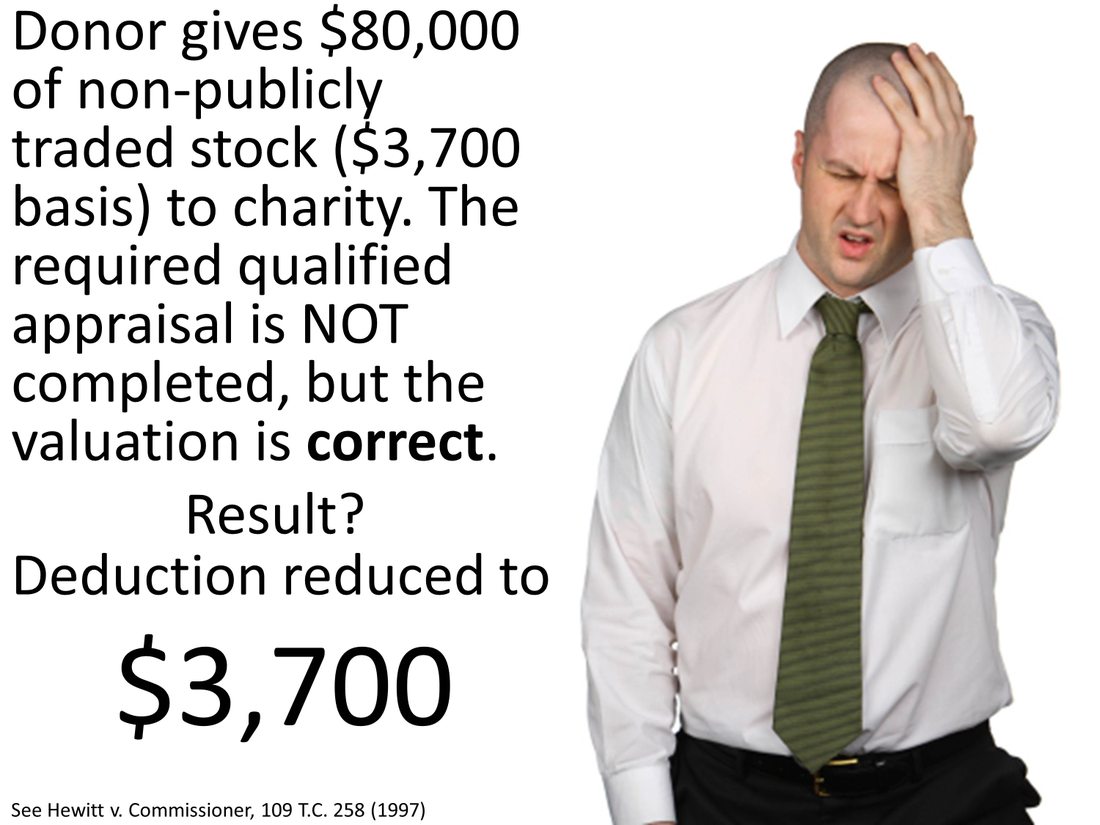
The result of the error in documentation was that the donor could not take the fair market value deduction (which was not adequately documented), but could take only the cost basis (which was documented). So, instead of having an $80,000 deduction, the donor had a $3,700 deduction. The loss of $76,300 of deduction could not be corrected by later obtaining a qualified appraisal. It was simply lost. (Translation: documentation is a big deal.)
Let's now look at another example involving an even larger charitable transfer. In this case, the donor gave $435,000 of equipment to a public charity. As we will later see, such gifts require a qualified appraisal. The donor did get an appraisal. The appraisal was correct in valuing the transfer at $435,000. However, the appraisal report and accompanying receipts omitted some information required for a qualified appraisal. After receiving notice of an audit, the donor corrected this problem by obtaining a new appraisal which met all of the qualifications for a qualified appraisal. Both the original appraisal and the new qualified appraisal correctly valued the equipment at $435,000. What was the result of this initial oversight by the donor, followed by the corrected appraisal?
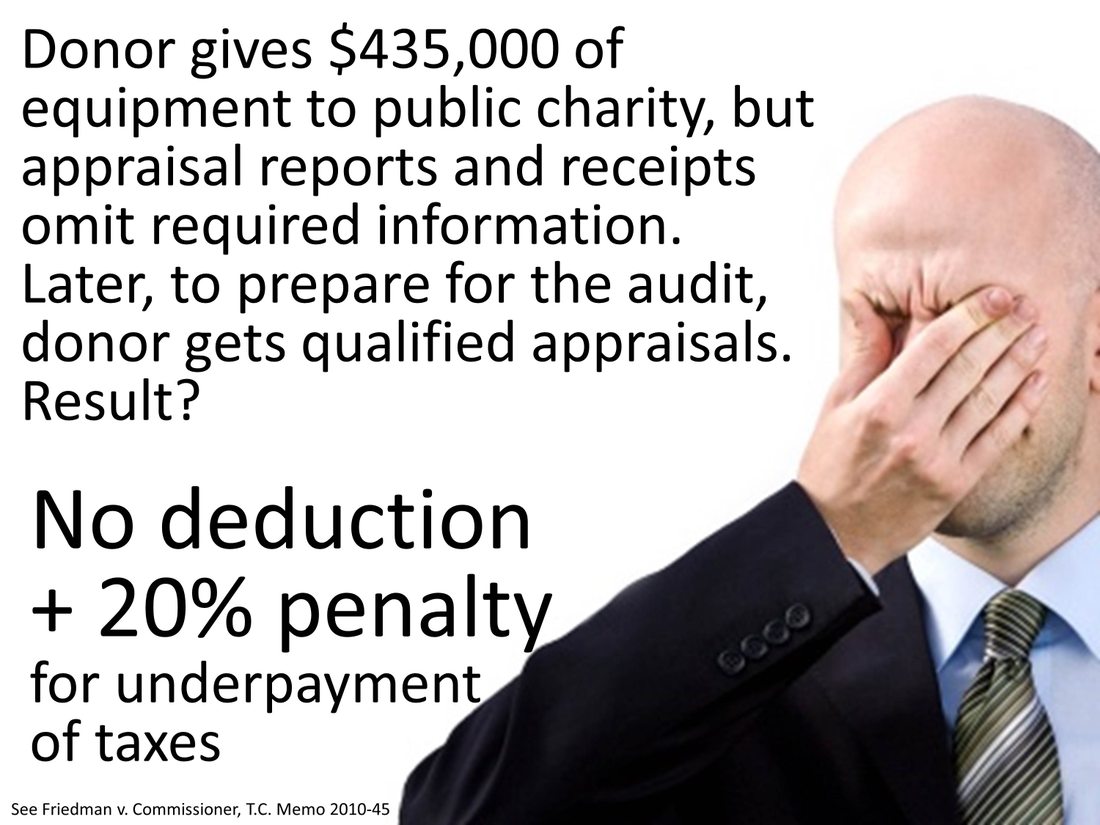
The donor's entire $435,000 deduction was disallowed. The donor had not followed the full requirements for documentation prior to taking the deduction. The lack of documentation meant that there would be no deduction. Attempting to fully document after the deduction was taken was irrelevant. As a result of losing this deduction, the taxpayer was required to pay the additional income taxes and make a 20% penalty payment for underpaying his taxes initially, along with accumulated interest since the original due date of the tax return. Thus, in this case, the donor ended with a tax result worse than if he had never made the charitable transfer in the first place. (Translation: documentation is a big deal.)

These examples show just how important it is to know and follow the documentation rules. Even if the material is a bit dry and uncreative, it is, nevertheless, essential for anyone involved with advising donors.

There are seven common levels of documentation requirements based upon the type and amount of the gift. As the complexity and amount of these gift types increase, so do the documentation requirements. The idea here is that documentation increases as the opportunity for abusing the tax deduction rules increases. There is, for example, relatively little potential for significant tax revenue loss from a deduction for a $50 cash contribution. Conversely, the opportunity to take a $500,000 deduction for the gift of artwork has a much greater potential for abuse.
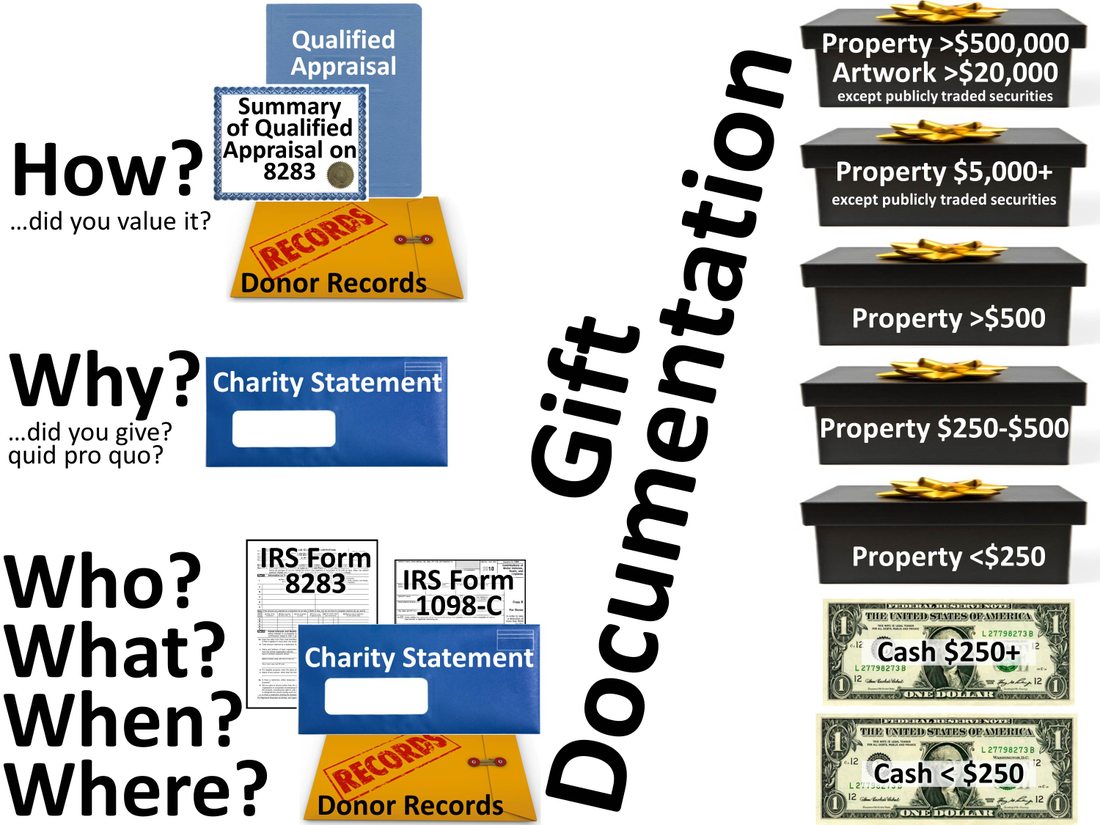
Different levels of documentation require answering different questions. All gifts must somehow document answers to the questions of, "Who made the gift?", "What was the gift?", "When was the gift made?", and "Where was the gift given?" Depending upon the level of documentation required, these questions may be answered by donor records, a statement from the charity, and/or completing IRS forms.
Some gifts must also document an answer to the question of whether or not the donor received any goods or services in return for the gift (i.e., this was part of the reason WHY the donor made the gift). The answer to this question can be documented only by a statement from the charity.
Finally, some larger gifts also require documentation of how the gift was valued. This "How?" question can be answered by donor records or a qualified appraisal. In some cases, the entire qualified appraisal must be submitted with the tax return and, in other cases, only a summary of the appraisal must be included on IRS Form 8283. This is the general framework for how documentation levels increase as gift amounts and complexity increases. The next section examines the rules in more detail, starting with the smallest gifts.
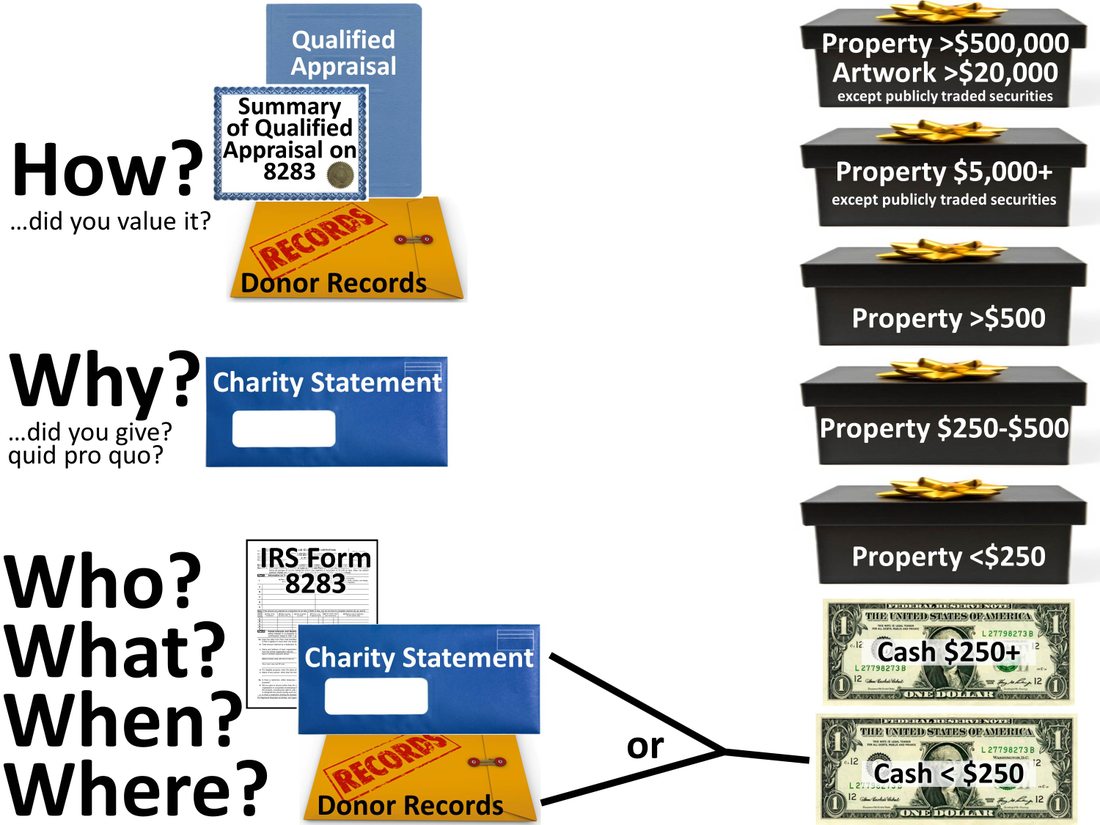
Gifts of cash under $250 require documentation of only the first block of questions (i.e., answers to the "Why?" and "How?" questions are not needed). For these small gifts, documentation can come from either donor records or a statement from the charity.
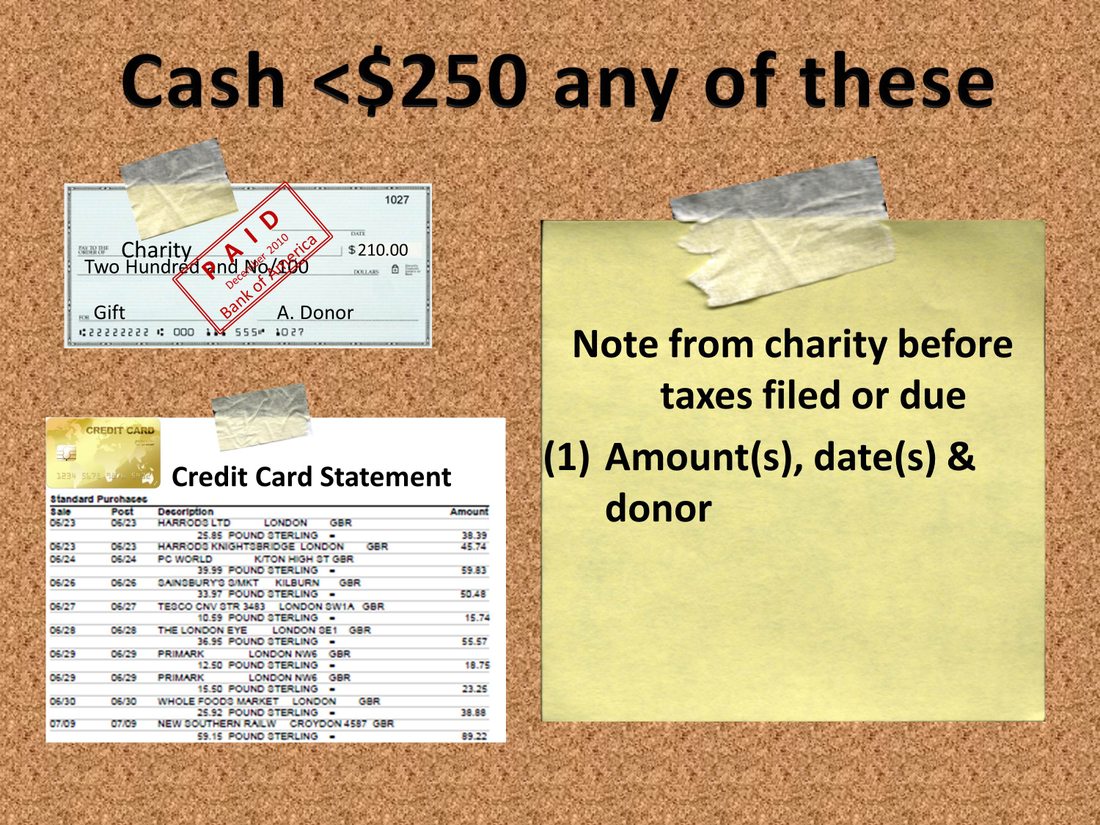
Specifically, cash gifts under $250 may be documented by a canceled check, a credit card statement, or a note from the charity indicating the amount, date, and the donor. As with other forms of documentation, this must be in place prior to taking the deduction. Thus, if a note from the charity is used, it must have arrived by the time the tax return was filed, or if the taxes were filed late, then the note must have arrived by the time that the taxes were due (including any extensions). No corrections are allowed using documentation created or received after taking the deduction (or after the tax return was due). Note that, because of these documentation requirements, deducting a gift of actual currency, no matter how small, requires a receipt from the charity indicating the amount, date, and donor. Note also, that a "credit card statement" here refers generally to any type of statement from a bank or financial institution demonstrating the amount and date of the gift, the donor, and the recipient charity. For example, a statement from a check card or debit card would also be sufficient.
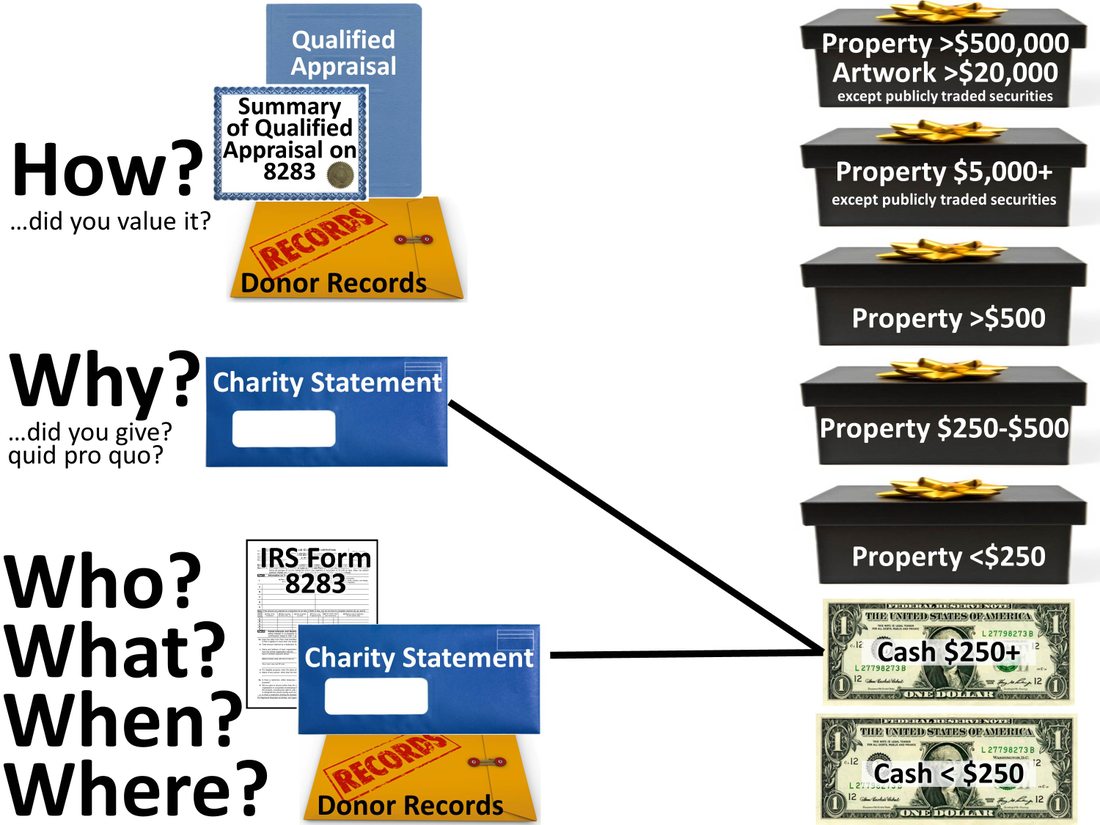
For gifts of cash of $250 or more, the documentation requirements are greater. Answers to the first block of questions can be documented only with a statement from the charity. In addition, the donor must have a statement from the charity indicating any quid pro quo related to the gift. Quid pro quo gifts refer to situations where a donor receives some item or service from the charity in direct exchange for the gift (such as, for example, a benefit dinner where the donor's ticket represents both a contribution and payment for a meal).
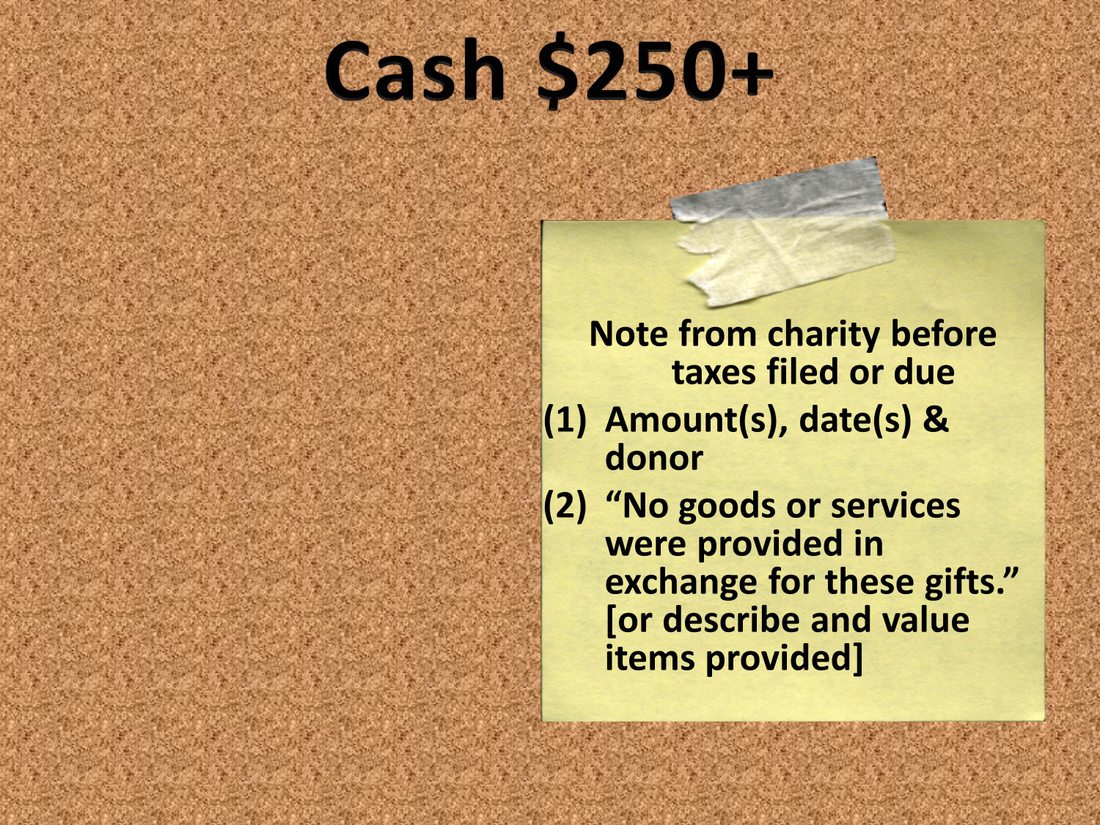
For gifts of cash of $250 or more, the only documentation permitted is a receipt from the charity indicating the amount, the date, the donor, and using the magic phrase, "no goods or services were provided in exchange for these gifts." (Of course, if the charity did provide goods or services in exchange for the gifts, the charity must describe and value the items.) A canceled check, for example, will not be sufficient to document gifts of $250 or more. Only a receipt from the charity with the previously mentioned elements will be sufficient.
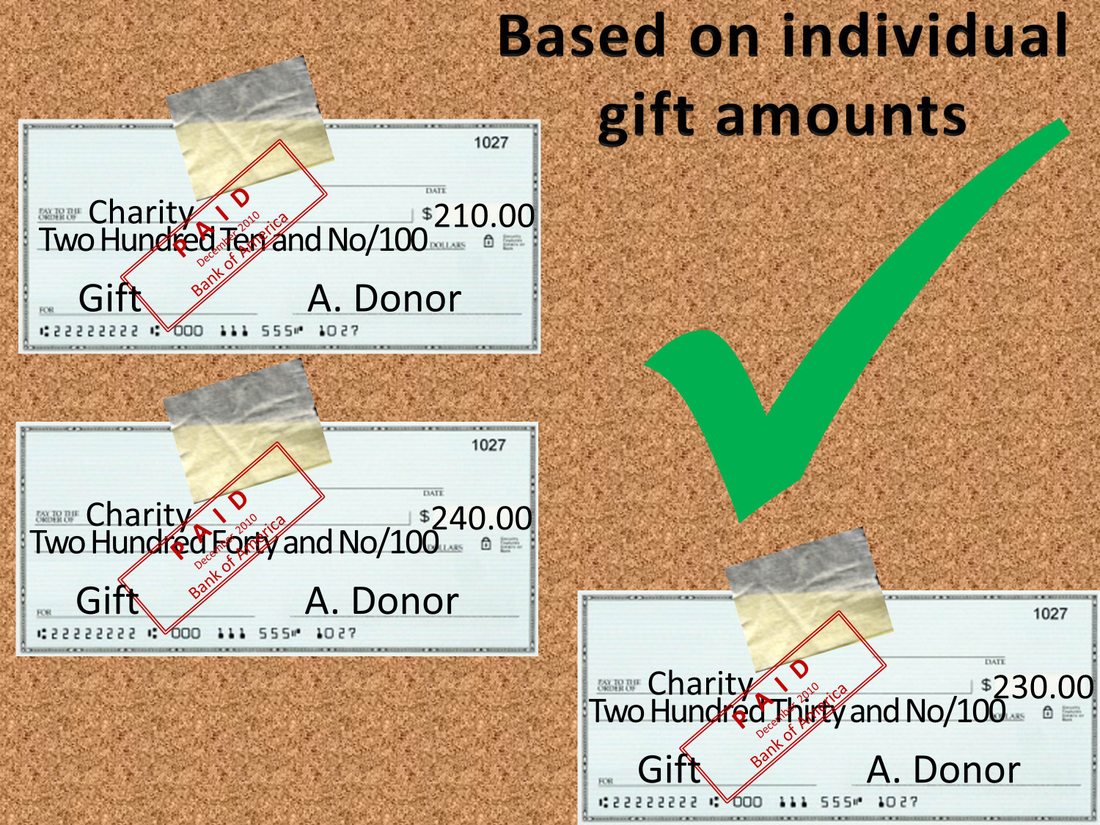
The documentation requirements are based upon each individual gift amount and not the total of all gifts made to the organization. For example, a donor could make $240 contributions every day of the year to a charity, and all of these gifts could be documented by the canceled checks. (However, in an extreme case, such as a donor simultaneously giving a stack of $240 checks to a charity, the IRS could collapse the transaction and treat it as a single transfer.)
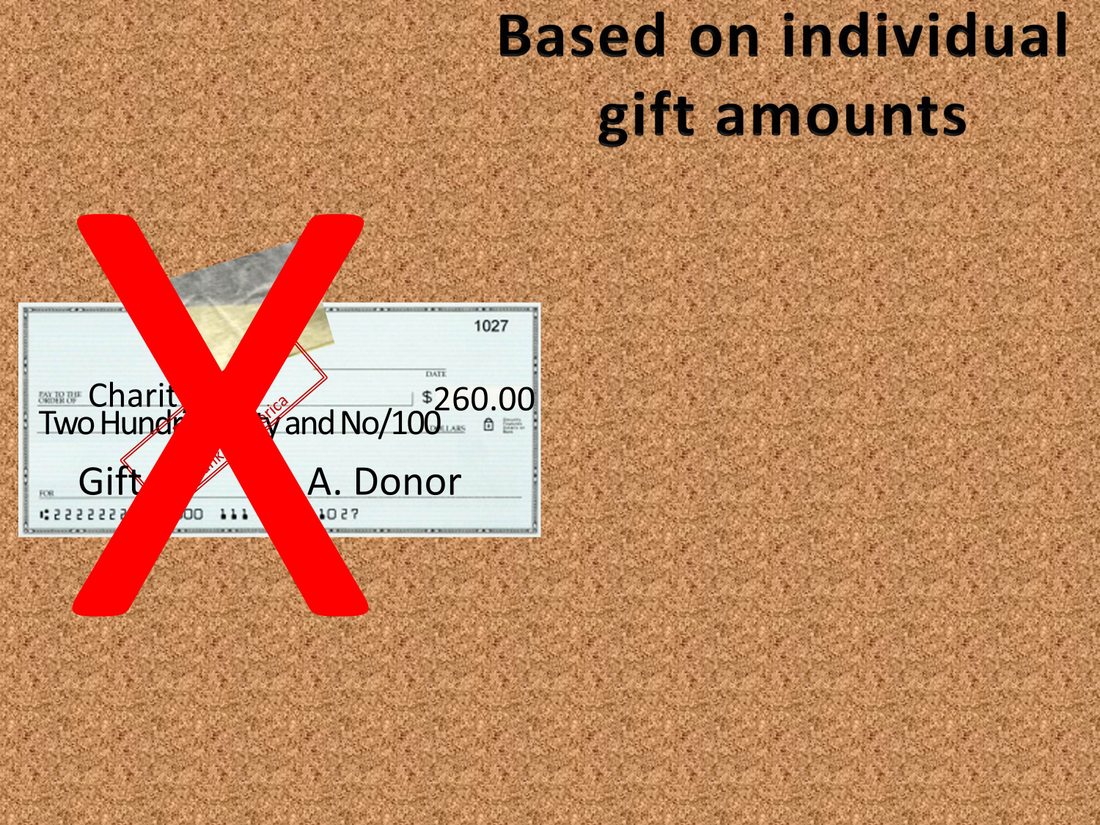
Even though a donor can document an unlimited number of charitable contributions under $250 with canceled checks, if any one contribution exceeded this amount, then a canceled check would not be appropriate documentation for that one contribution.

One exception to these documentation requirements for gifts of $250 or more applies to payroll deduction gifts made to a united appeal. Such gifts are problematic because there is no individual charity that could document the charitable transfer from a specific individual donor. Thus, it is not possible to comply with the typical substantiation rules.

Because of this difficulty, such gifts are exempted from the requirement for a receipt from a charity. Instead, donors can substantiate with evidence of a pledge card indicating that no goods or services were given in exchange for the gift and documenting the amounts by the W-2 or pay stub.

Gifts of money over $250 are all documented in the same way, regardless of the amount. Thus, at this point we have covered the rules for documenting gifts of money. However, much of the complexity in documentation, and much of the potential for abuse, comes from gifts of property. Let's now examine these rules.
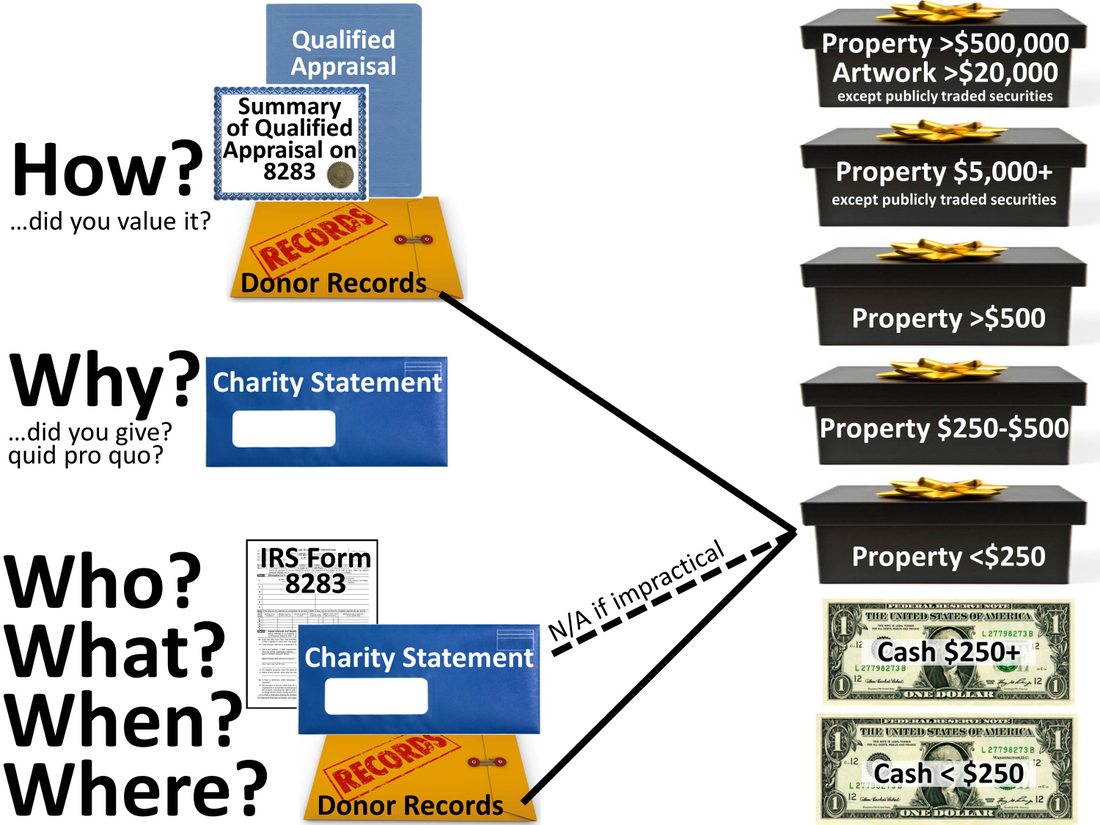
The smallest gifts of property (under $250) require donor records to answer the questions of "Who made the gift?", "What was the gift?", "When was the gift made?", "Where was the transfer made?", and "How was the gift valued?" Except where it is impractical, these donor records must include a receipt from the charity indicating what was given, when, where, and by whom.
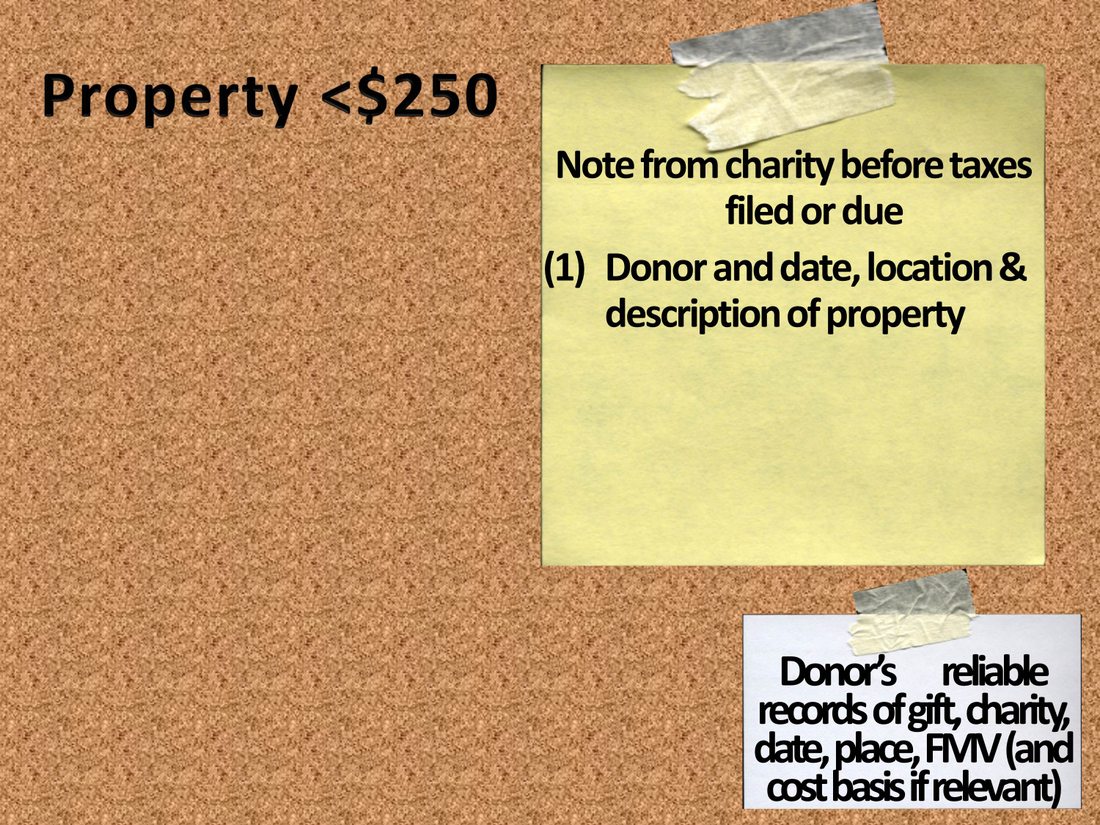
So, for gifts of property under $250, the donor must have a receipt from the charity indicating the donor, the date, the location, and the description of the property (except where obtaining such a note is impractical). The donor's own records should indicate these things as well (although these records may include the charity's receipt). However, in addition, the donor must have reliable records proving the fair market value of the property (and, if relevant, also proving the donor's basis in the property). Note that the charity is never expected to provide a valuation of the property. Although some charities may choose to include this in a receipt, such valuation has no legal effect. The charity is not qualified to give an appraisal.
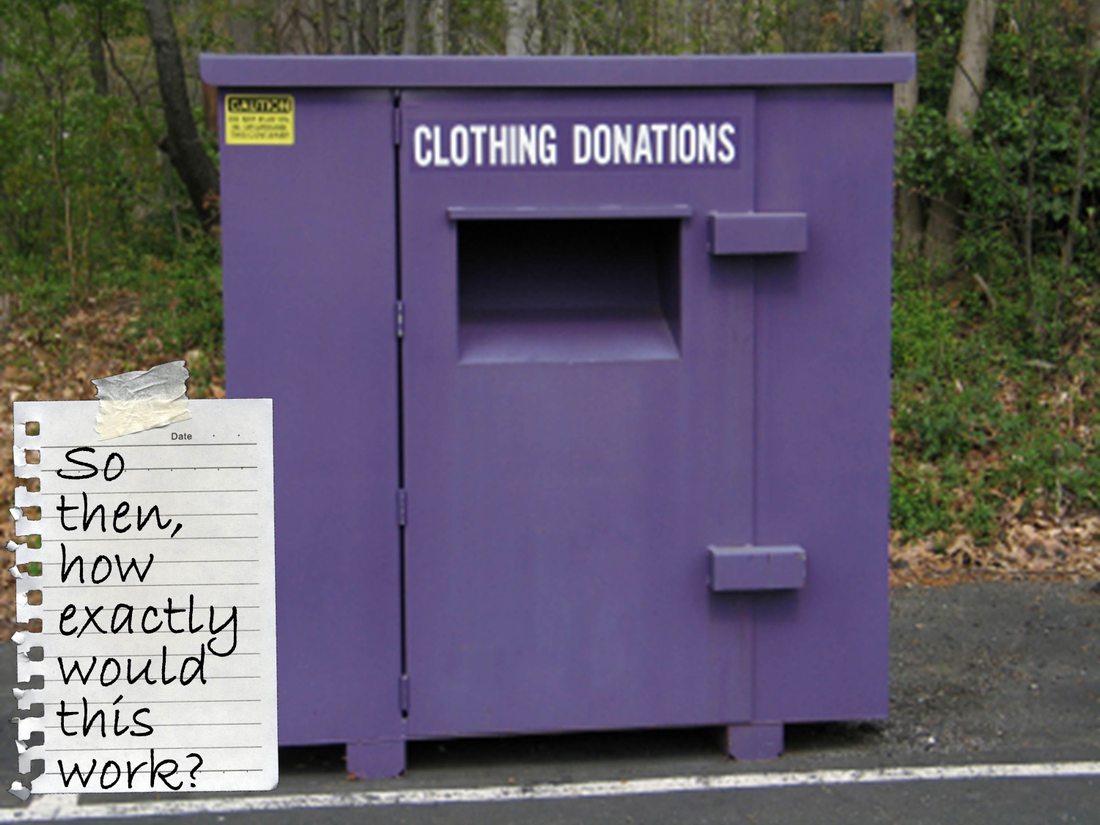
For small property gifts (under $250) an exception is made to the requirement of a receipt from the charity when such a receipt is impractical. A typical example of a scenario in which such a receipt is impractical is where the donor gives clothing or property to an unattended drop box.
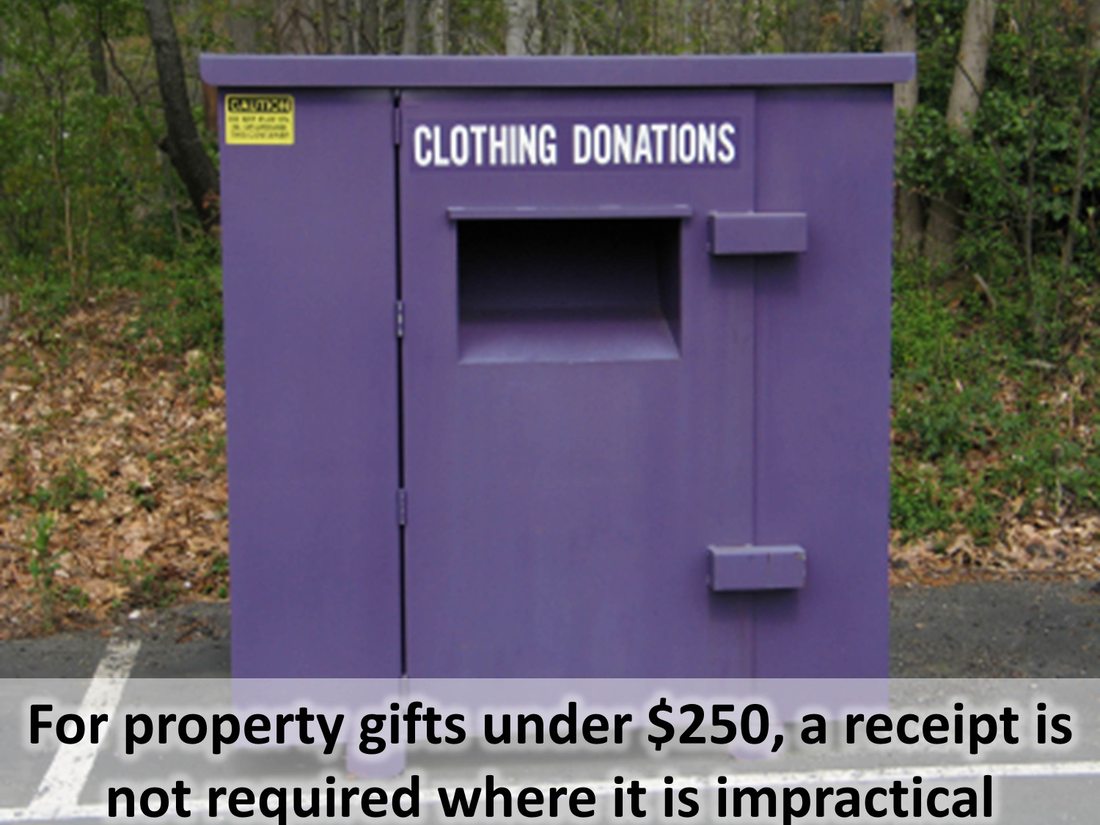
In such cases, no receipt is required from the charity.
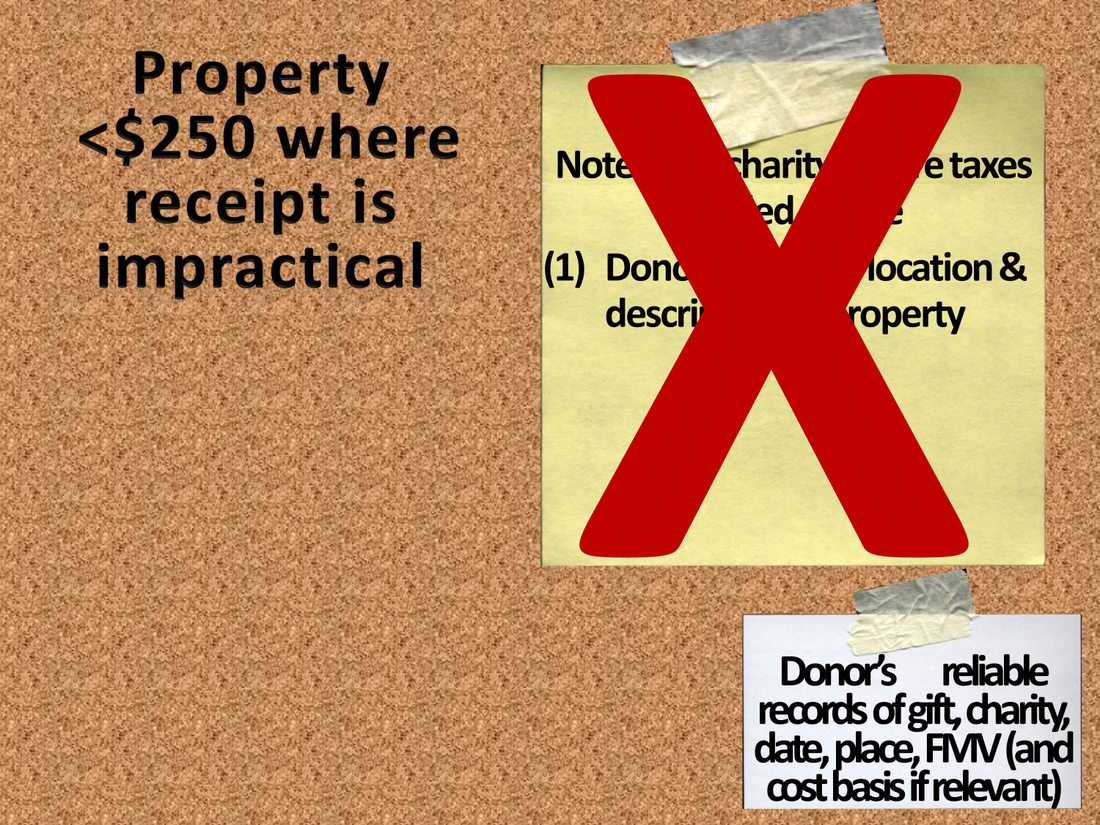
However, even when a receipt from the charity is not required, the donor must still provide reliable records documenting the gift, the charity receiving the gift, the date of the gift, the place of the gift, and the fair market value (and cost basis when relevant) of the property.
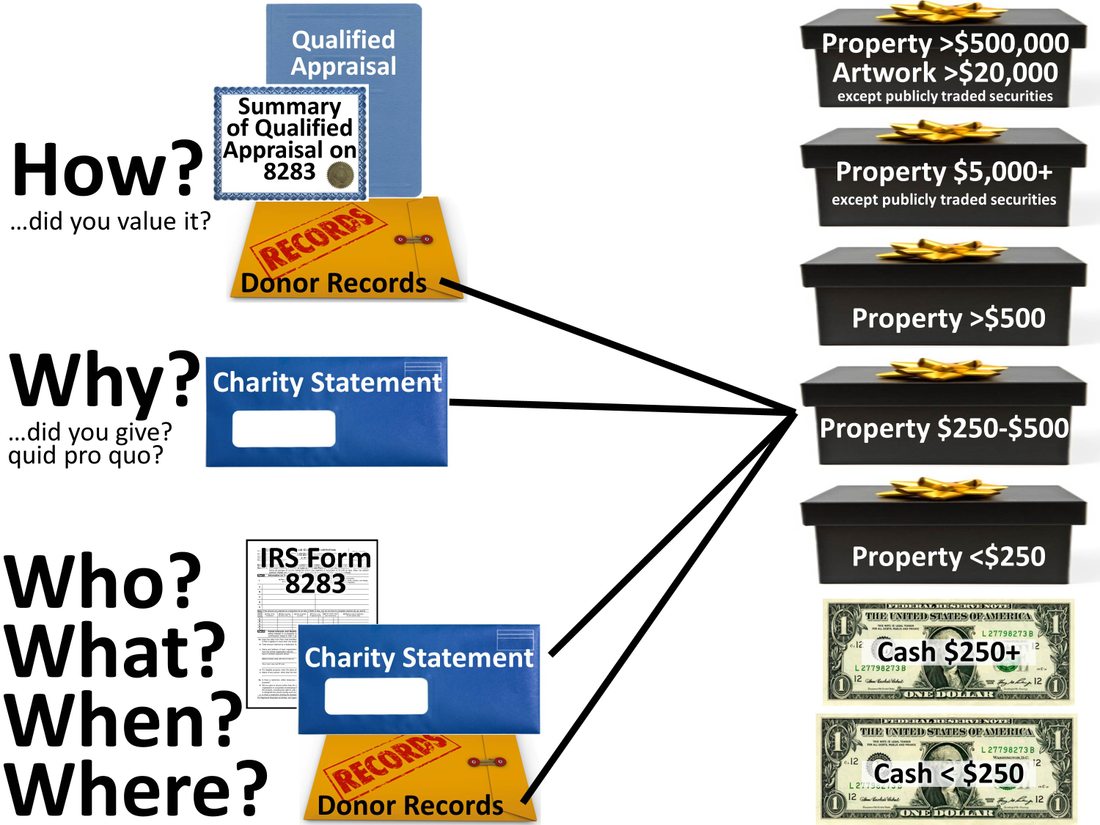
For gifts of property worth $250-$500, documentation must answer all of the potential questions (Who? What? When? Where? How? and Why?). In addition to the documentation required for smaller gifts of property, the donor now must provide a statement from the charity and there is no exception for impracticability. This statement must not only answer the basic questions (Who? What? When? Where?) but must also answer the quid pro quo question (i.e., Why?).
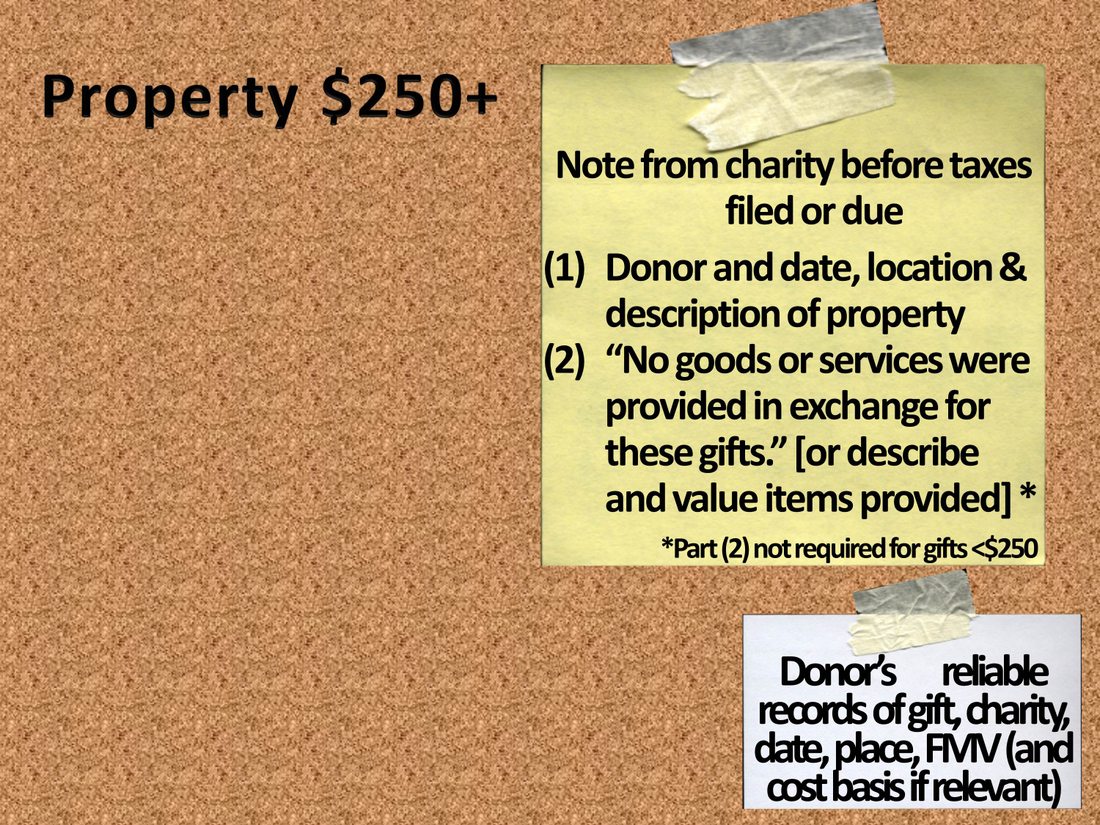
Thus, for gifts of property of $250 or more, the donor must have both a receipt from the charity indicating the donor, the date, the location, and a description of the property along with the phrase "no goods or services were provided in exchange for these gifts," as well as the donor's own reliable records indicating the fair market value of the property (and cost basis if relevant).
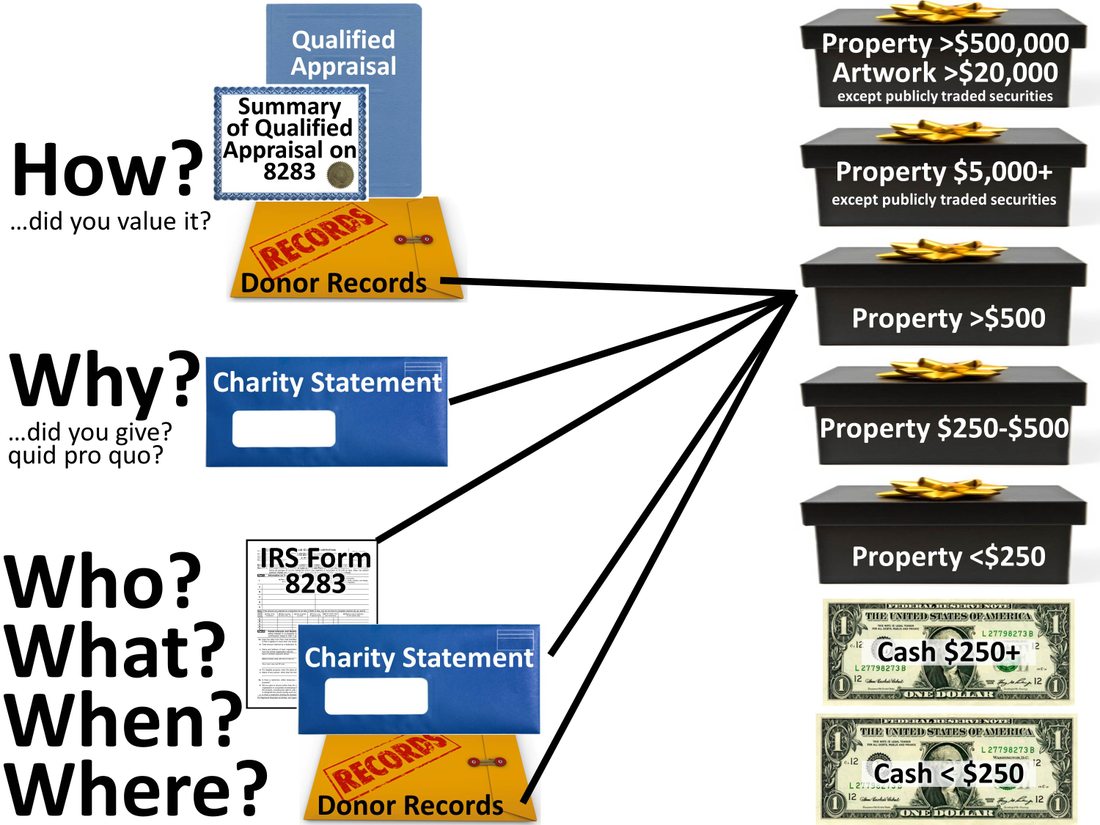
For gifts of property over $500, all of the previous documentation is required in addition to the filing of IRS Form 8283. If the charity sells the item within 3 years of the gift, the charity must file IRS Form 8282. However, this second filing is not required prior to the donor taking the charitable deduction.
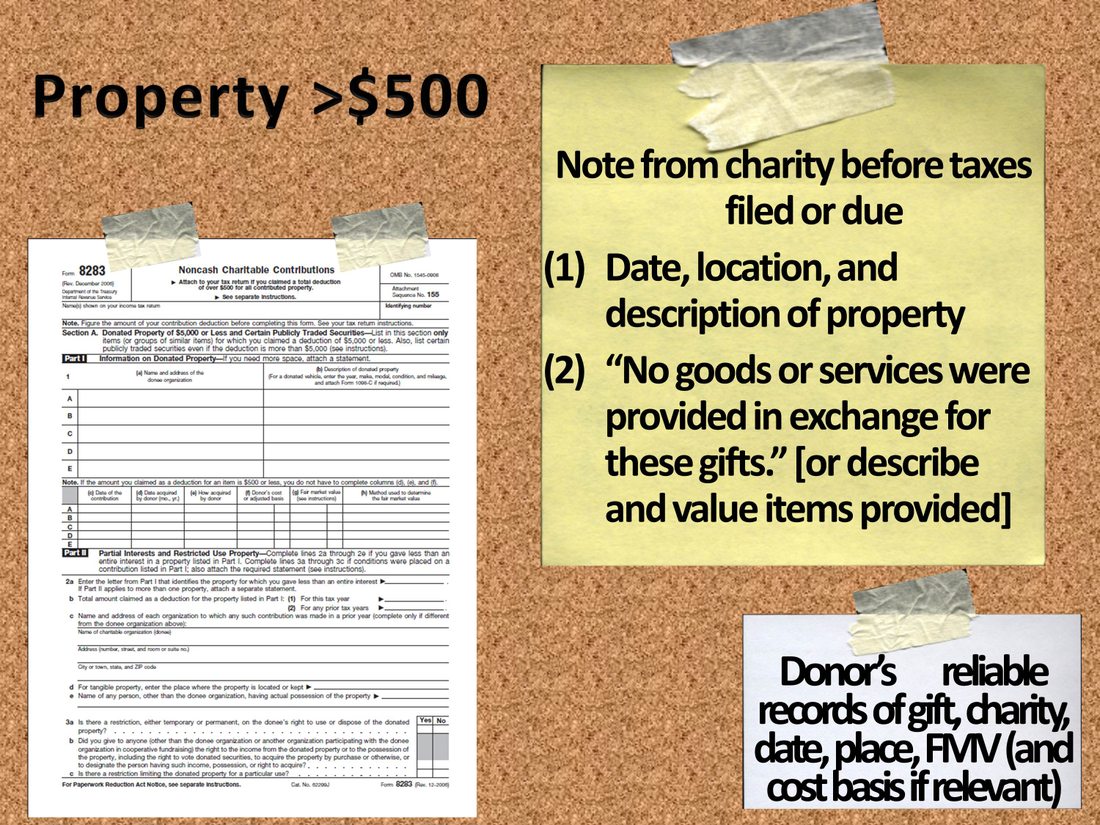
The IRS form 8283 filing is required for all property gifts valued at $500 or more. Note that for property gifts of $500 or more, all potential documentation items are required, excepting only a qualified appraisal, which is a requirement limited to gifts of specific types and amounts of property.
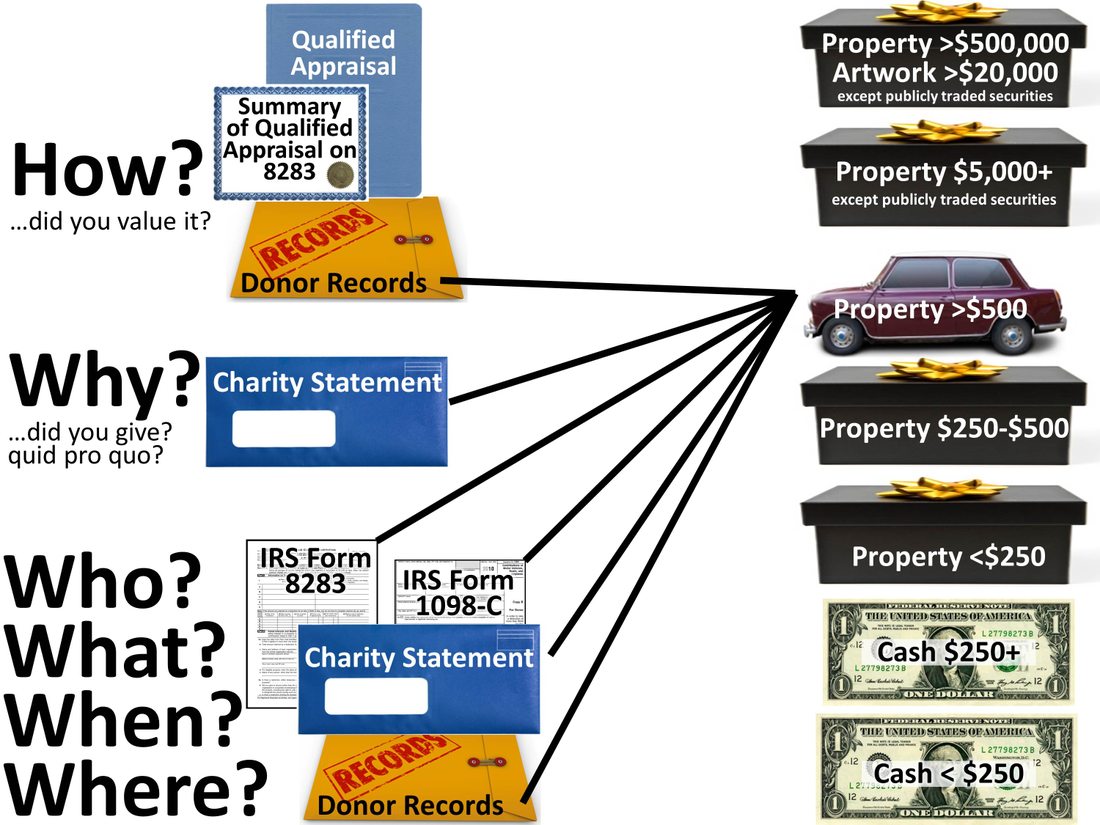
An additional IRS form is required for gifts of property over $500 if the gift was an automobile, boat, or plane. Specifically, these gifts require the filing of IRS form 1098-C by the charity.
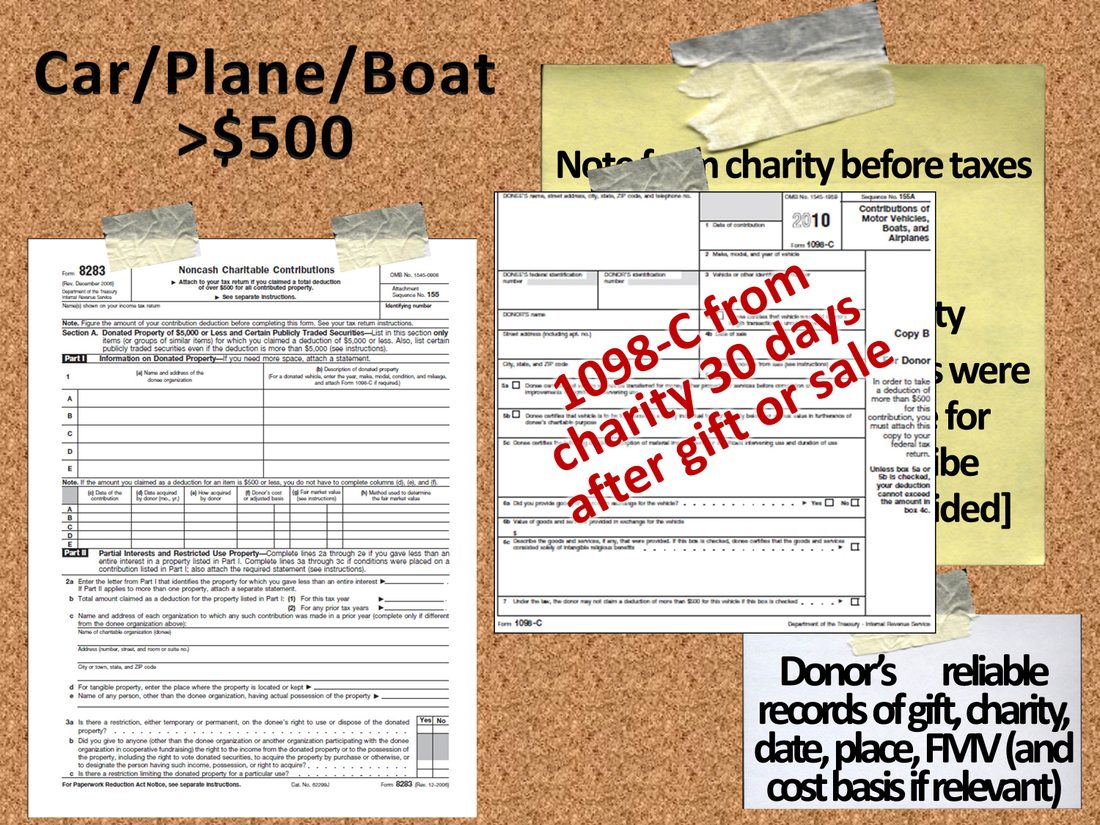
Form 1098-C must come from the charity within 30 days of the gift or the sale. Gifts of automobiles, boats, or planes that are intended to be sold by the charity cannot be valued for tax deduction purposes until after the charity has sold the item. This is because the deduction is limited to the amount the charity receives for the item in the subsequent sale. If, however, the charity intends not to sell the item, but to make use of it in its charitable purposes, then the charity may verify this intent by filing Form 1098-C within 30 days of receiving the gift. (In such cases, the valuation need not wait for the sale of the item.)
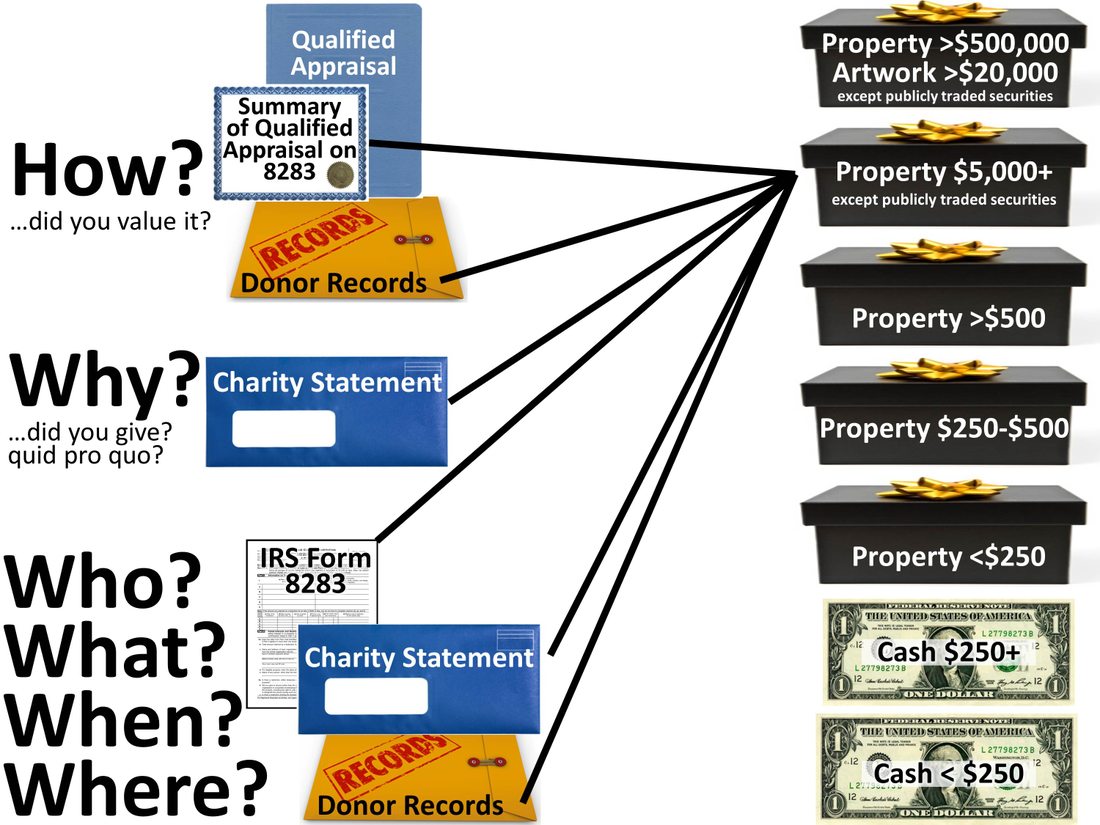
Finally, with gifts of property of $5,000 or more, the donor must also obtain a qualified appraisal and must include a summary of the qualified appraisal in his or her tax return on Form 8283. This qualified appraisal is not required for publicly traded securities. Publicly traded securities are very easy to value and there is relatively little dispute about their valuation at any one point in time because they can be immediately bought or sold at publicly available prices.
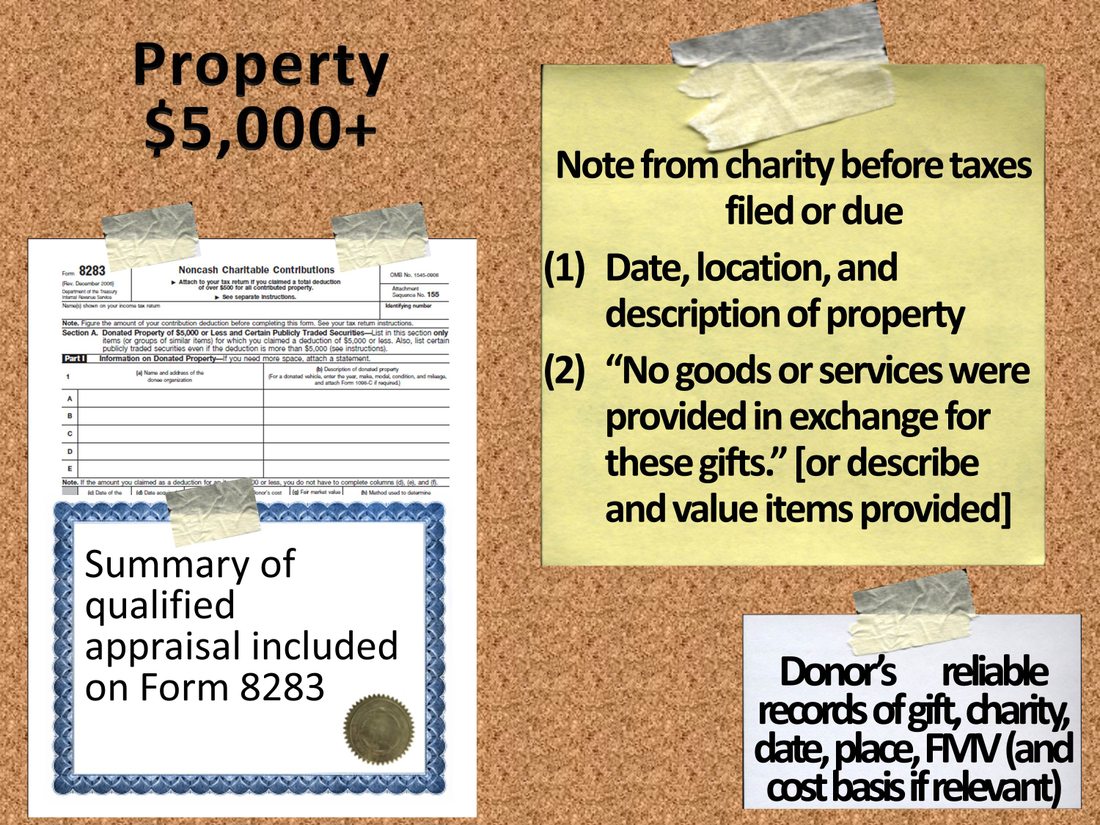
Thus, for gifts of property of $5,000 or more, all of this documentation is required: Charity receipt with gift date, location, and description and quid pro quo statement, donor records of gift, charity, date, location, fair market value (and basis if relevant), and IRS Form 8283 including a summary of a qualified appraisal. If any item is absent, no deduction is allowed.
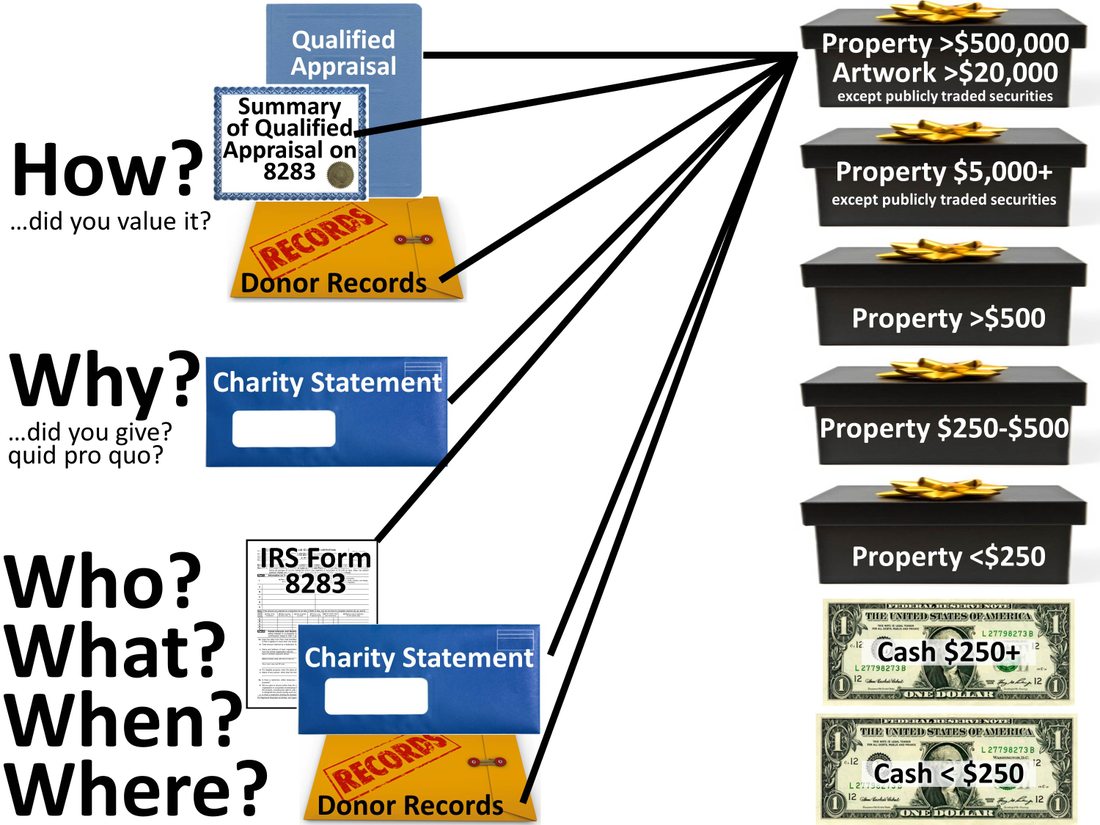
The highest level of documentation is reserved for gifts of property over $500,000 or gifts of artwork over $20,000. As before, publicly traded securities are exempted from the appraisal requirement because their valuation is relatively simple. Note that these are the gifts with the greatest potential for abuse. Gifts of property over $500,000 may be subject to a variety of interpretations of fair market value. And, given their value, such differences of opinion can have a dramatic difference on the payment of taxes. Thus, these large gifts warrant the most careful scrutiny by the IRS.
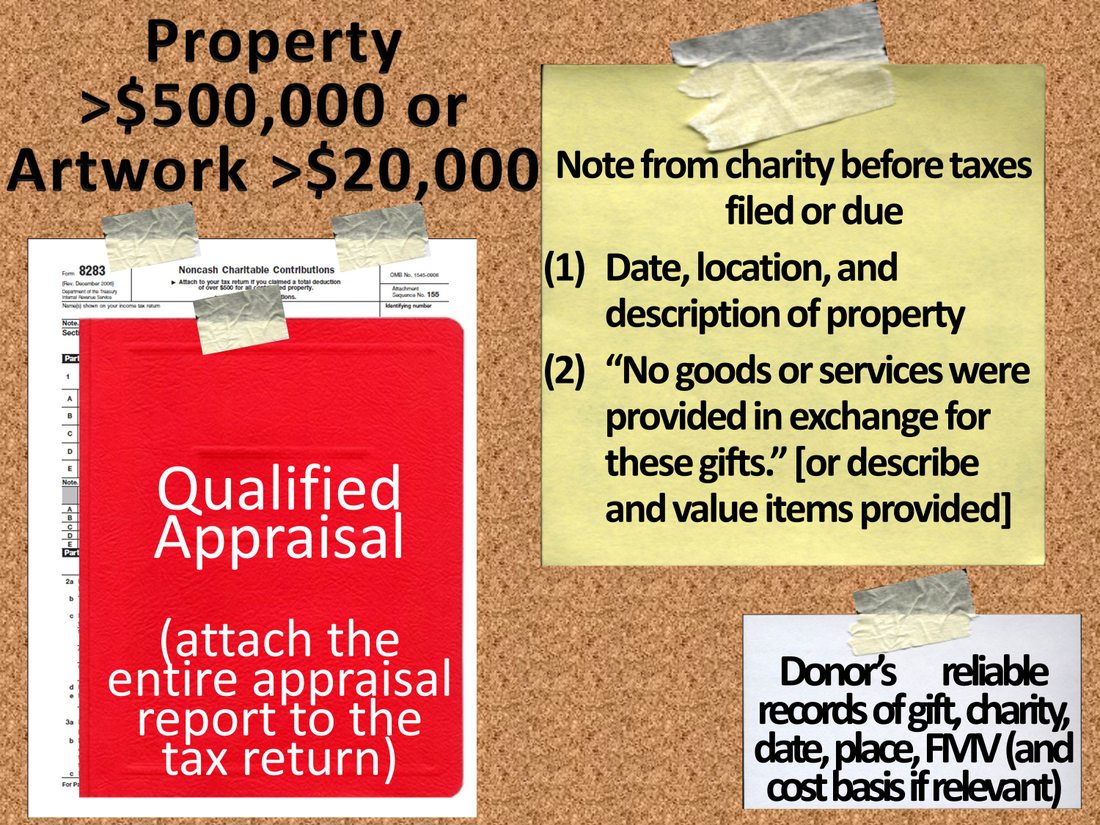
Because these types of gifts will be subject to the highest level of scrutiny, it makes sense that the entire qualified appraisal must be included with the tax return. Not only are very large property gifts included (over $500,000) in this highest documentation level, but even moderately size gifts of art are also included (over $20,000). This reflects the challenges in the valuation of artwork and the consequent opportunities for abuse. Remember that for some taxpayers combining both state and federal income taxes can make deductions worth more than $.50 on the dollar. Thus, if a valuation were made that was more than twice what the donor could actually sell the property for, it becomes more profitable to give rather than sell the property. This potential for over-valuation is much more likely with property, such as artwork, where intrinsic value is difficult to define.
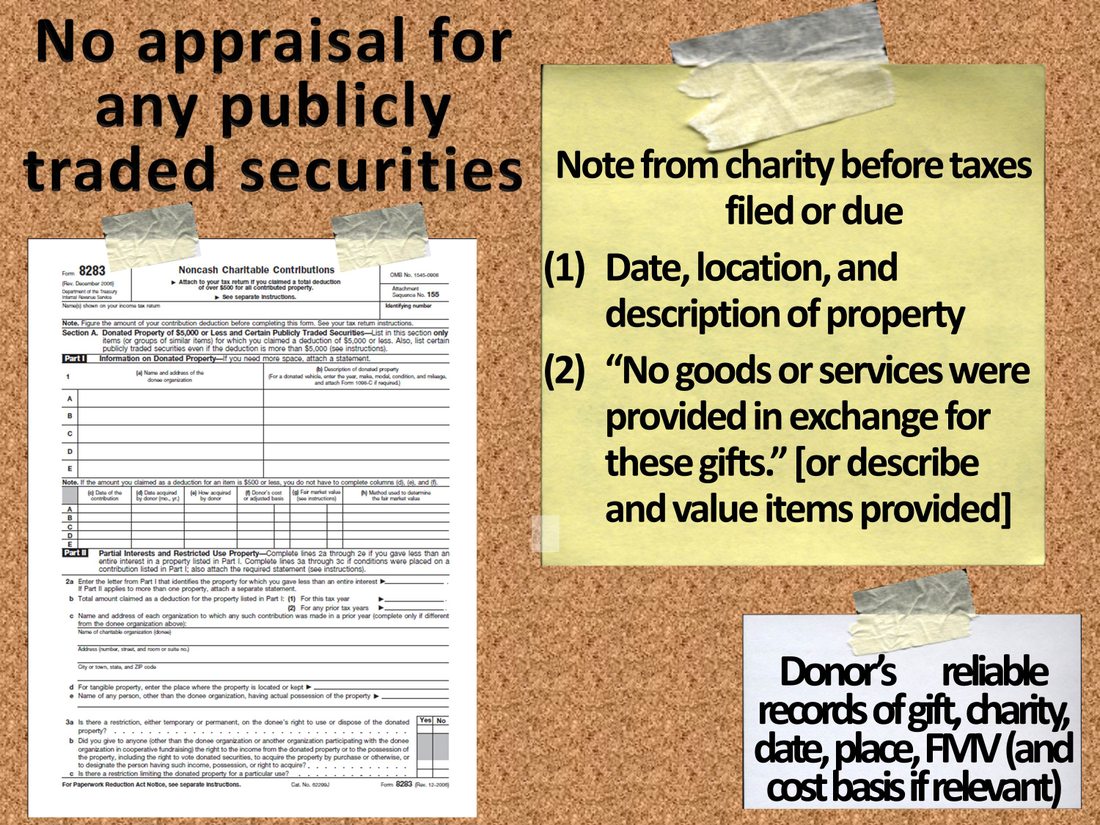
As a reminder, appraisals are not required for gifts of publicly traded securities, regardless of the size of the gift. Thus, a donor could deduct a $10 million gift of Microsoft shares with no appraisal.
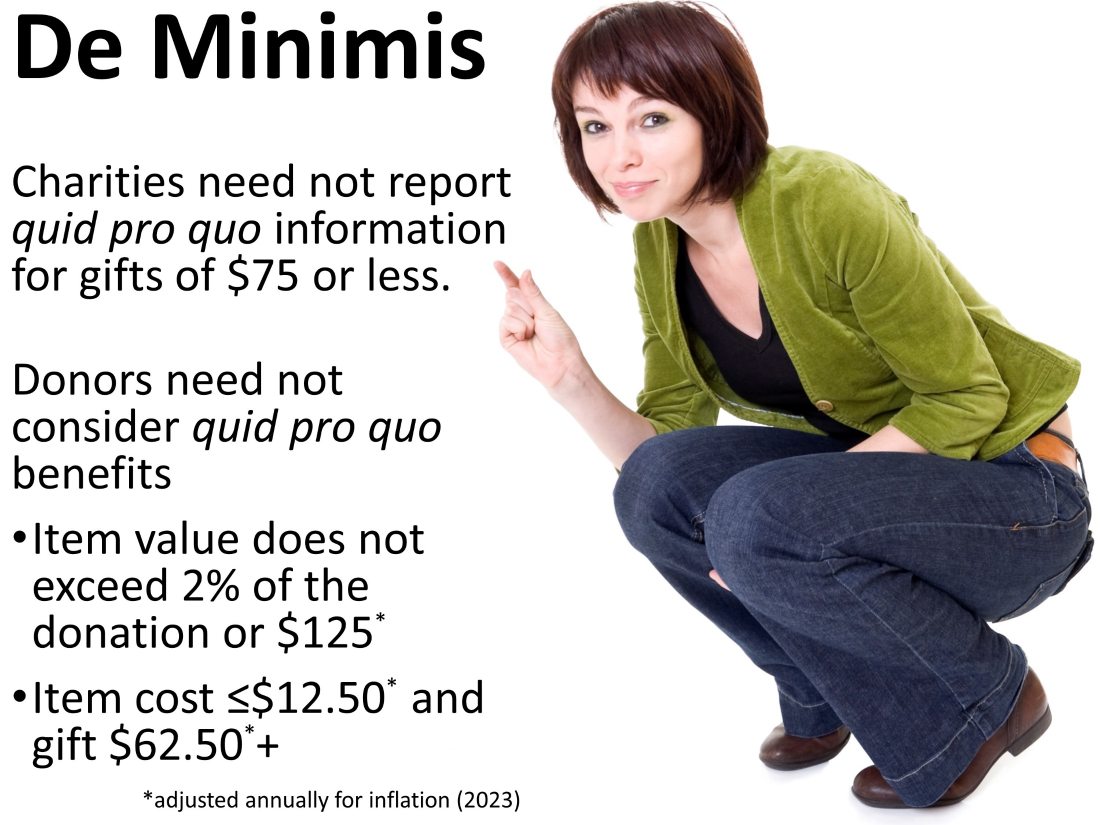
Finally, there are de minimis exceptions to the normal rules for quid pro quo gifts. A quid pro quo gift is one where the donor makes a gift, but also receives something of value in return for the gift. Typically, these scenarios require both that the charity report the value of the item given to the donor and also that the donor reduce his or her deduction by the value of the item received from the charity. Although the charity is not a qualified appraiser, it is required to make a "good faith estimate" of the value of the item. IRS regulations indicate, "The organization may use any reasonable methodology in making a good faith estimate, provided it applies the methodology in good faith."
However, if the gift was $75 or less, the charity is not required to report the quid pro quo part of the transaction (i.e., they do not have to report the cost or value of the item given to the donor). The rule applies only to the charity's reporting requirement.
The donor must still reduce his or her deduction by the value of the item received in exchange for the gift. The donor can ignore the value of the item received by the charity in exchange for the gift only when one of two de minimis exceptions applies to the donor. First, the donor can ignore the value of the item received in exchange for the donation if its value does not exceed 2% of the value of the donation. This exception does not apply to items received that are worth more than $136. (Note that this $136 level is a 2025 inflation-adjusted number that changes every year.) Second, the donor need not consider the value of the item received in exchange for a gift if the cost of the item to the charity was equal to or less than $13.60 so long as the gift made in order to receive the item was at least $68. (As before, these are 2025 numbers that are adjusted annually for inflation.) These de minimis rules are intended to reduce reporting hassles for items of an inconsequential amount.
Although admittedly among some of the least interesting rules related to charitable gift planning, these documentation rules are important. The penalties for violating the rules can be severe and typically there is no opportunity to correct documentation errors after a deduction has been erroneously taken.