Some prior chapters covered topics, such as Charitable Gift Annuities, that are of interest mostly to nonprofits and nonprofit fundraisers. In contrast, private foundations and donor advised funds are more centrally important in the world of financial advisors. Financial advisors are naturally interested in these structures as they allow for compensated financial management and they contain the bulk of managed private charitable wealth. Private foundations are, by far, the largest sophisticated charitable planning instrument as measured by total assets and charitable distributions. Donor advised funds are, by far, the fastest growing charitable planning instrument. Both structures are covered in the same chapter as both share some common characteristics and, in many circumstances, are potential substitutes for each other.
The core purpose of both private foundations and donor advised funds is to hold wealth and distribute grants to public charities. They are, essentially, containers for wealth designated - at some point - to benefit charity. In this chapter, "private foundation" refers to a non-operating private foundation. The adjective "non-operating" points out that, although contributions to private foundations can generate charitable tax deductions, these organizations do not themselves conduct charitable activities. They simply hold wealth and distribute grants to charities that actually conduct charitable operations. Although not common, there are entities known as operating private foundations. These are more similar in function to regular public charitable organizations, are not typically used as a charitable planning vehicle, and will not be discussed in this chapter. Another relatively rare entity is called a "supporting organization." This entity functions similarly to a private foundation, but typically delivers support to a specific public charity. With the increased restrictions on supporting organizations brought about by the Pension Protection Act of 2006, these entities are relatively less attractive, less common, and, consequently, will not be covered in this chapter.
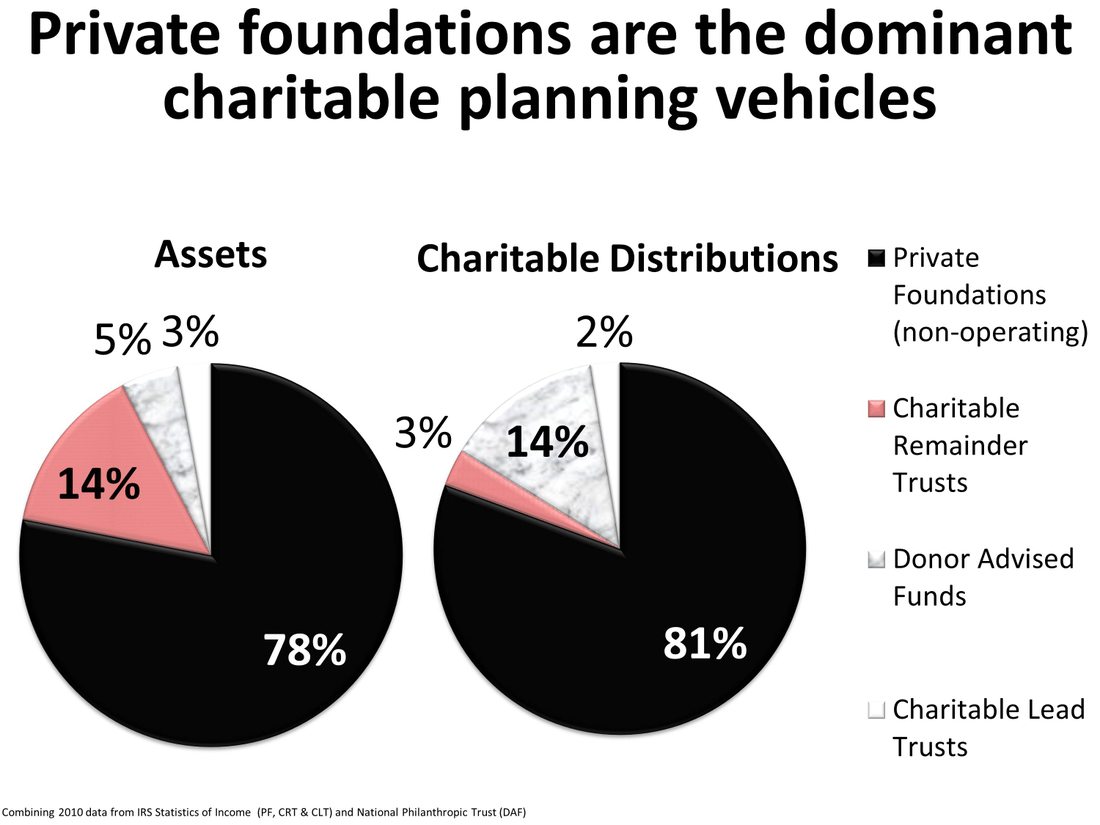
In terms of relative size, private foundations are the "Big Kahuna" of charitable planning. The accompanying chart demonstrates that. Private foundations hold more than four times the assets and make more than four times the charitable distributions of all Charitable Remainder Trusts, Charitable Lead Trusts, and donor advised funds combined. Despite the relatively small share of all assets held by donor advised funds (5%), these funds are responsible for an outsized portion of all charitable distributions (14%). This reflects the frequent use of such funds as a temporary pass-through mechanism, rather than an instrument for long-term wealth holding. Despite this common short-term use, donor advised funds can also be used for long-term, even multi-generational, holding of wealth.
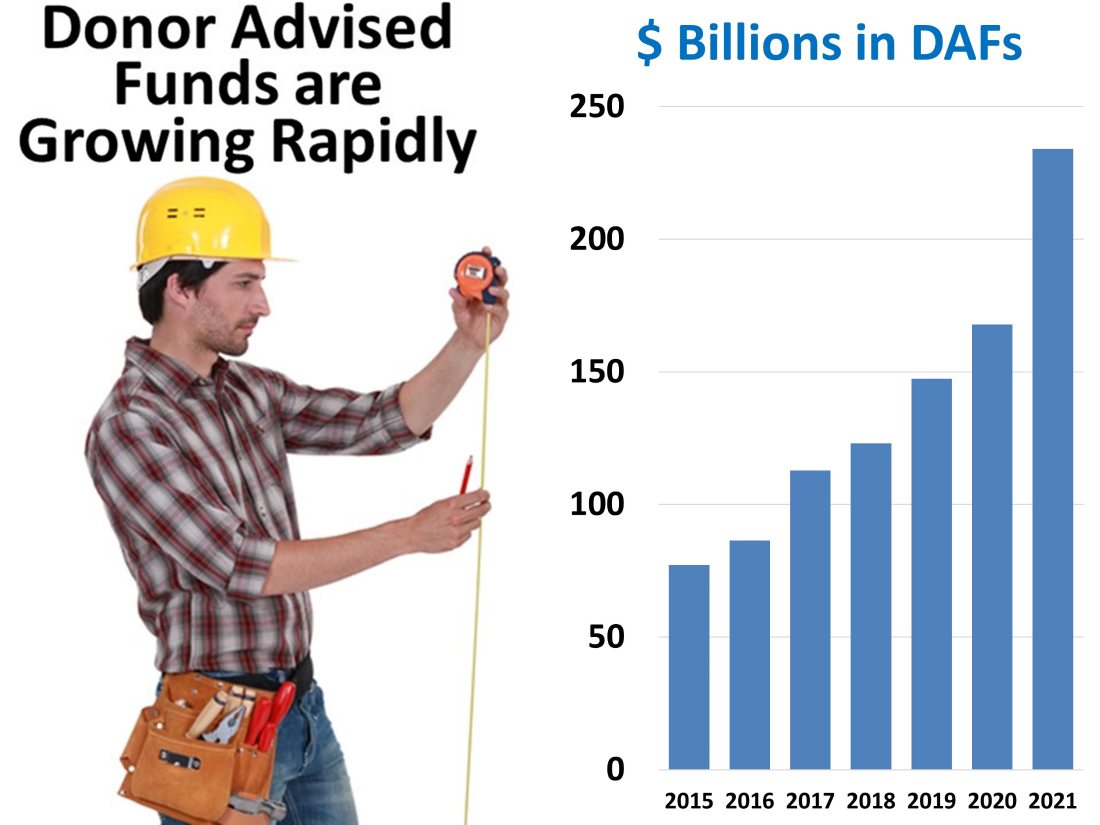
Another reason for interest in donor advised funds is their rapid growth. Donor advised funds have existed since the 1930's. Traditionally, they were operated by community foundations as a way to encourage giving that supported the local community. The dramatic growth in donor advised funds began with the creation of Fidelity Charitable Gift Fund in 1991. For the first time, this provided a nationally available means for donors to establish low-cost accounts where their financial advisors could continue to manage the funds and collect the associated management fees. This brought more financial advisors into the charitable planning arena than ever before. Since then, the dramatic growth in donor advised funds has been driven predominantly by growth in those funds affiliated with financial institutions. The accompanying chart shows the continued dramatic growth of donor advised funds.
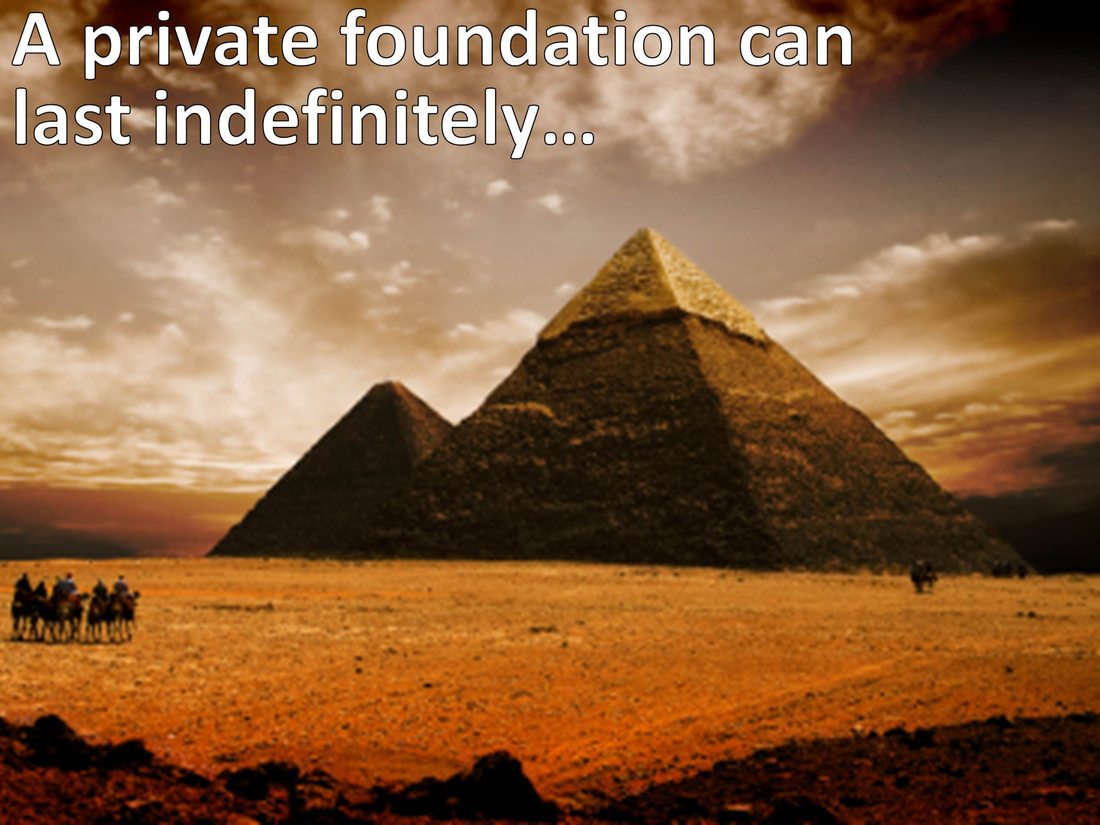
Other charitable planning devices that hold wealth are typically designed to end after a few years or at the death of the donor. Charitable Gift Annuities, Charitable Remainder Trusts and Charitable Lead Trusts rarely exist much beyond the life of the donor, or perhaps the donor and the donor's spouse. Private foundations are different. These entities are often designed to last indefinitely and many have existed for numerous generations. In large part, private foundations are intended to be permanent entities.
The permanence of private foundations can make them particularly psychologically attractive to some donors. A branch of psychology, referred to as terror management theory, rigorously examines the effects of personal mortality reminders. Among other things, these reminders generate a psychological defense expressed as seeking symbolic immortality. Symbolic immortality is the idea that something important about one's self, e.g., one's name, impact, story, family, culture, community, or values, will live beyond one's death. This attraction towards symbolic immortality is particularly important in the context of charitable estate planning, when personal death reminders are particularly strong. (For a more extensive review of the psychology and neuroscience of charitable estate planning see the book, Inside the Mind of the Bequest Donor: A Visual Presentation of the Neuroscience and Psychology of Effective Planned Giving Communication by Russell James, ISBN 978-1484197837.)
The private foundation provides an ideal charitable structure for achieving this psychologically attractive symbolic immortality. The foundation typically bears the name of the founder or the founder's family. Unlike its mortal founder, the private foundation can live indefinitely. For generations after the death of the founding donor, the private foundation can continue to carry the founder's name and will be legally bound by the founder's values and desires. It is necessarily required to continue impacting the world within the parameters established by the founder. In this way, the private foundation can serve as a partial substitute for the deceased founder, indefinitely exhibiting to the public the positive and pro-social aspects of his or her character.
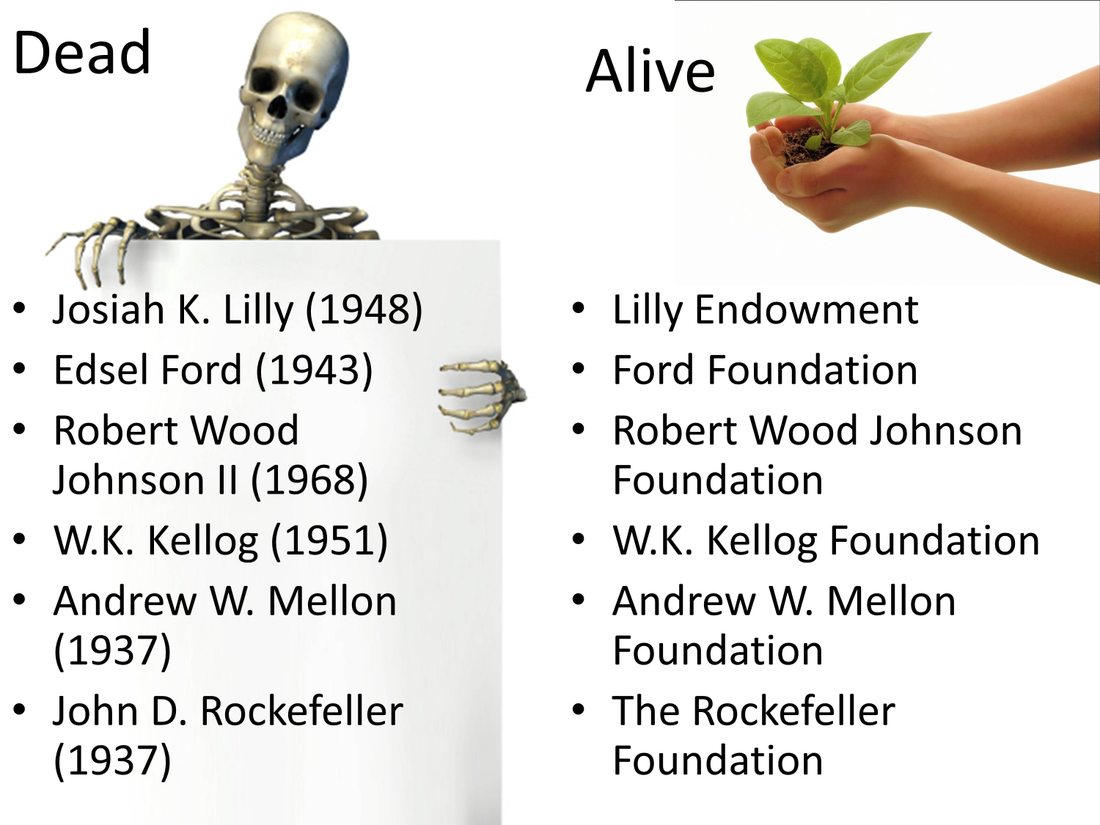
This continuation of the founder's name and ideals is not merely a theoretical idea, but one that can be readily seen in many of today's most important grant-making foundations. Although the founders of these famous foundations may have been deceased for many generations, their name and impact continues to this day. Such symbolic immortality becomes particularly attractive in an estate planning context as the client contemplates his or her personal mortality.
The private foundation's most attractive feature is its permanence. Not only can the foundation last indefinitely, but the rules established by the founding donor can also last indefinitely. Almost all other forms of transfers are subject to rapid dissipation in both finance and purpose. A wealthy business owner may leave behind an important company bearing his or her name, but the company can quickly change names and reject the values established by the founder. Leaving an inheritance to heirs is subject both to substantial taxation and to expenditures reflecting values contrary to the decedent's values. The private foundation offers a unique vehicle to preserve and protect the founder's wealth, name, and values.
Although a private foundation ultimately makes distributions to charitable organizations, it often involves the participation and substantial control of the founder's family both during and after the founder's life. The founder's family can be appointed to have the power to decide how the money will be invested and who (within the limits of the foundation guidelines) will receive distributions. In addition to controlling the wealth (largely undiluted by taxation either at transfer or on subsequent growth) within the parameters of the private foundation's purpose and guidelines, family members can receive benefits such as being reimbursed for their associated travel and expenses as well as being employed for reasonable compensation in some professional and managerial tasks necessary for operation of the foundation. These tangible benefits come in addition to the intangible social benefits (i.e., "soft power") that can accrue to those who - within the parameters of foundation rules - control the investment and distribution of large sums of money.
The private foundation can also serve as a way for the founder to transmit his or her values to later generations. These descendants may be appointed as trustees of the foundation and be given authority to make charitable distributions amongst the causes permitted by the founding donor. For example, a donor who wanted to pass along his love of nature might limit the charitable purposes to supporting nature organizations. Administration of such a foundation would likely increase trustees' involvement with the various related causes and organizations vying for the foundation's grants.
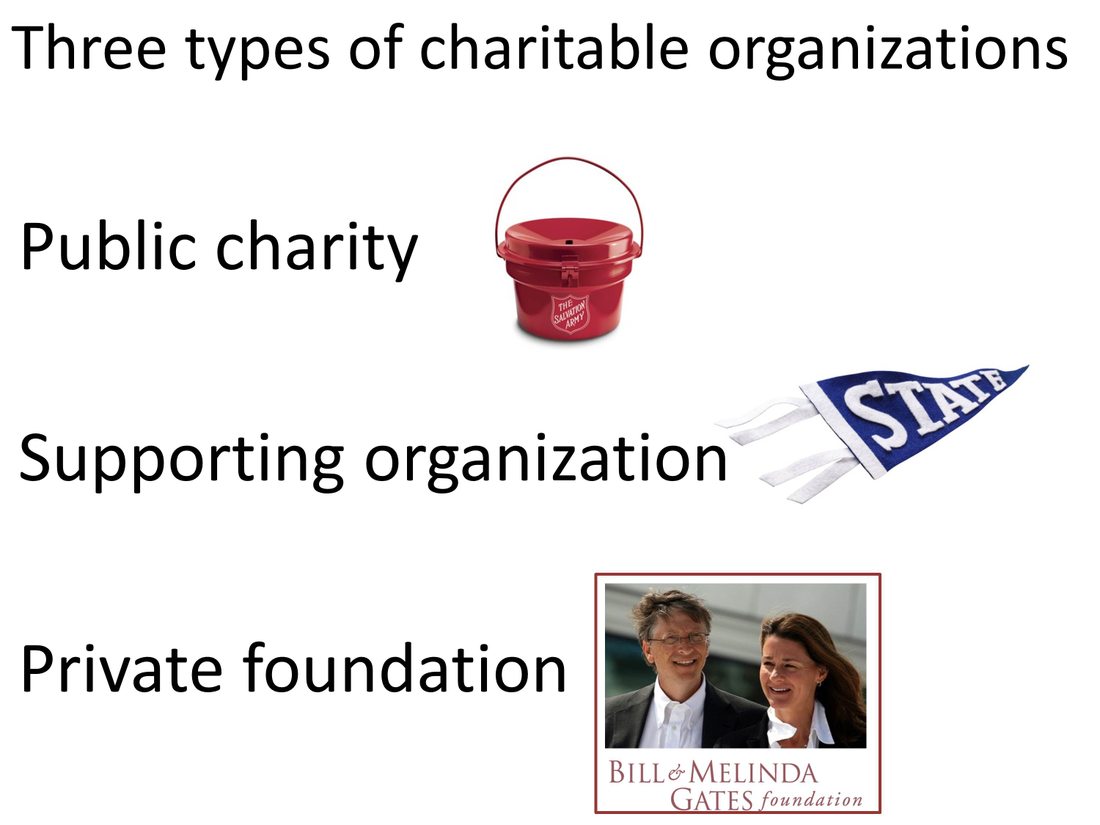
There are three large classes of charitable organizations that can generate charitable tax deductions for donors: public charities, supporting organizations, and private foundations. Due to the relatively rare creation of supporting organizations (wealth-holding entities designed to support a single or single set of public charities), this chapter will focus on public charities and private (non-operating) foundations. Public charities are typically the organizations that actually do charitable work. Private foundations simply hold wealth and distribute grants to these public charities.
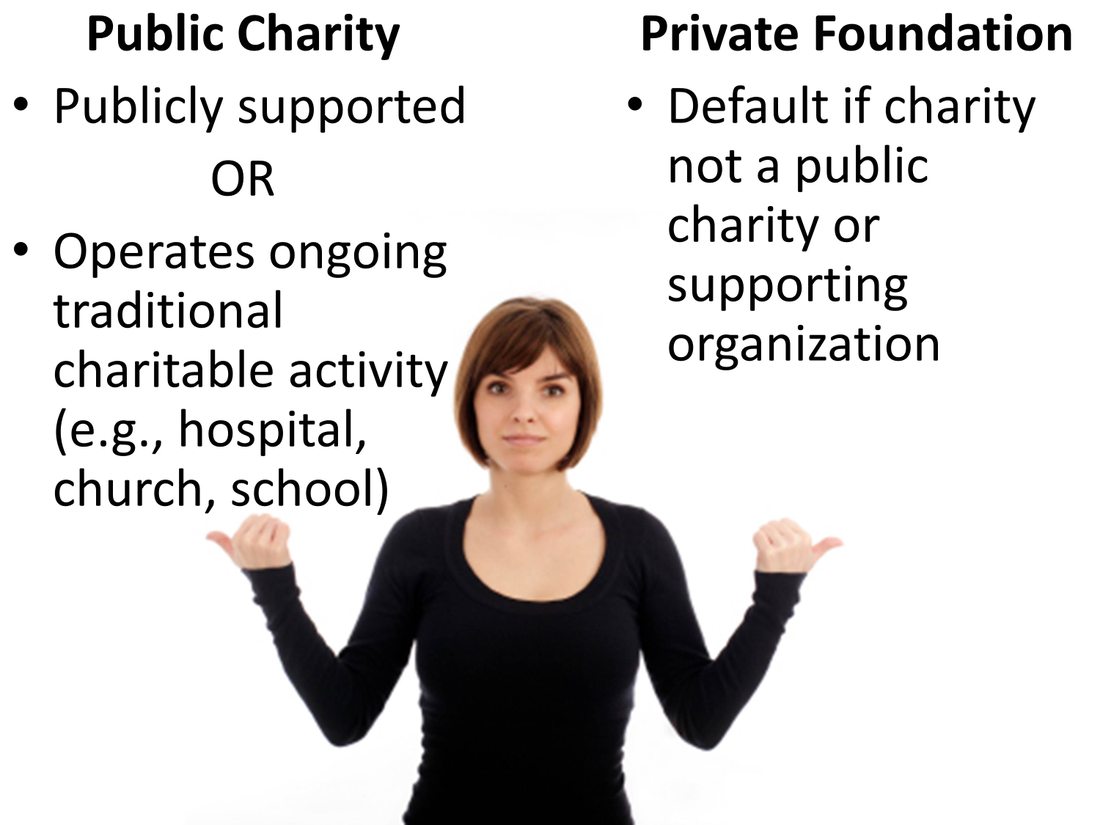
In tax law a charitable organization is, by default, treated as a private foundation. All 501(c)3 charitable organizations not meeting the guidelines for public charities (or supporting organizations) are automatically private foundations. Only if the charitable entity can prove it is a public charity (or supporting organization) will it be classified as such. The two ways in which an organization can prove it is a public charity are by showing that it actually engages in charitable operations (e.g., running a church, hospital, school, or homeless shelter) or by showing that it receives widespread financial support from the public. Although most public charities actually engage in charitable activity, it is possible for grant-making bodies to be public charities if they receive widespread financial support. For example, community foundations and united appeals (such as the United Way) can be public charities even if they do not engage in charitable operations but instead only make grants to other public charities.
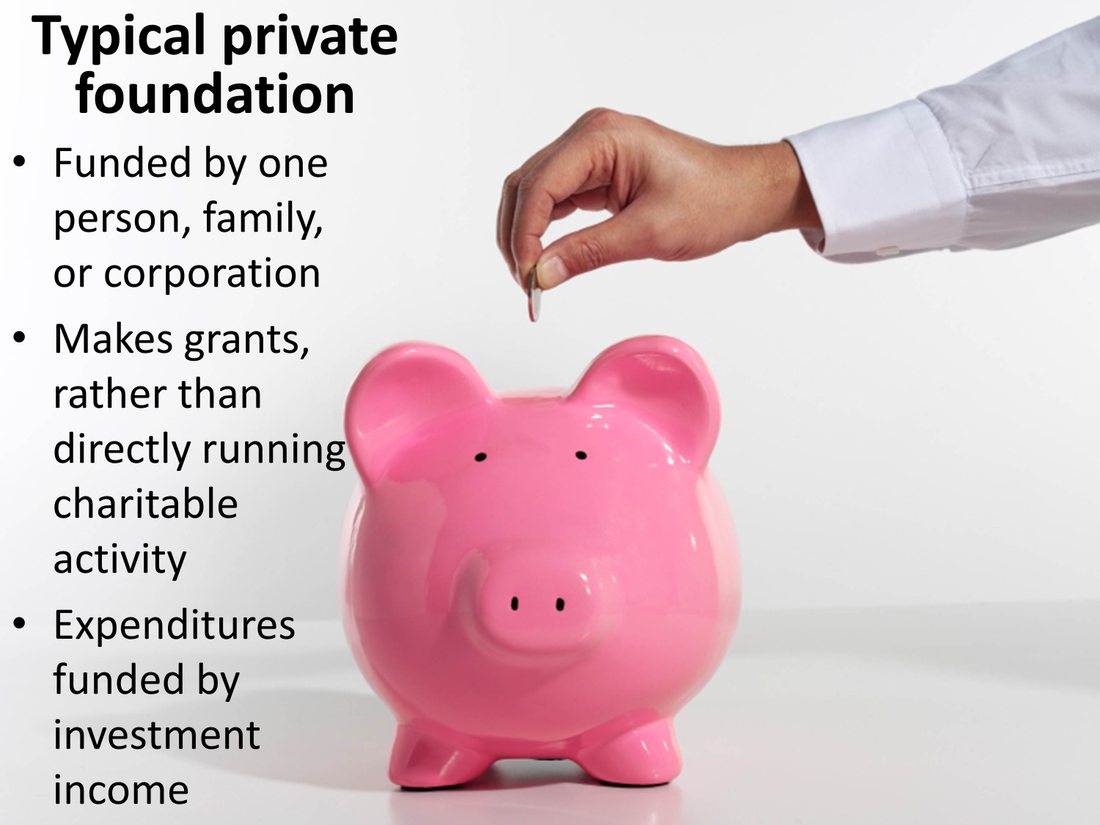
Most private foundations have similar characteristics. They are usually funded by a single person, family, or corporation. They don't do charitable work, but instead make grants to charities. Usually financial returns on their invested assets serve as the source of their charitable grants, rather than ongoing gifts from fundraising. This idea of a pool of assets, set aside by one person, with charitable activity limited to issuing grants funded predominantly from investment income is the classic concept of the private foundation. The ways in which a charitable organization can avoid the default classification as a private foundation largely center on demonstrating a divergence from these classic elements of a private foundation. There are four approved pathways through which a charitable organization can qualify as a public charity.
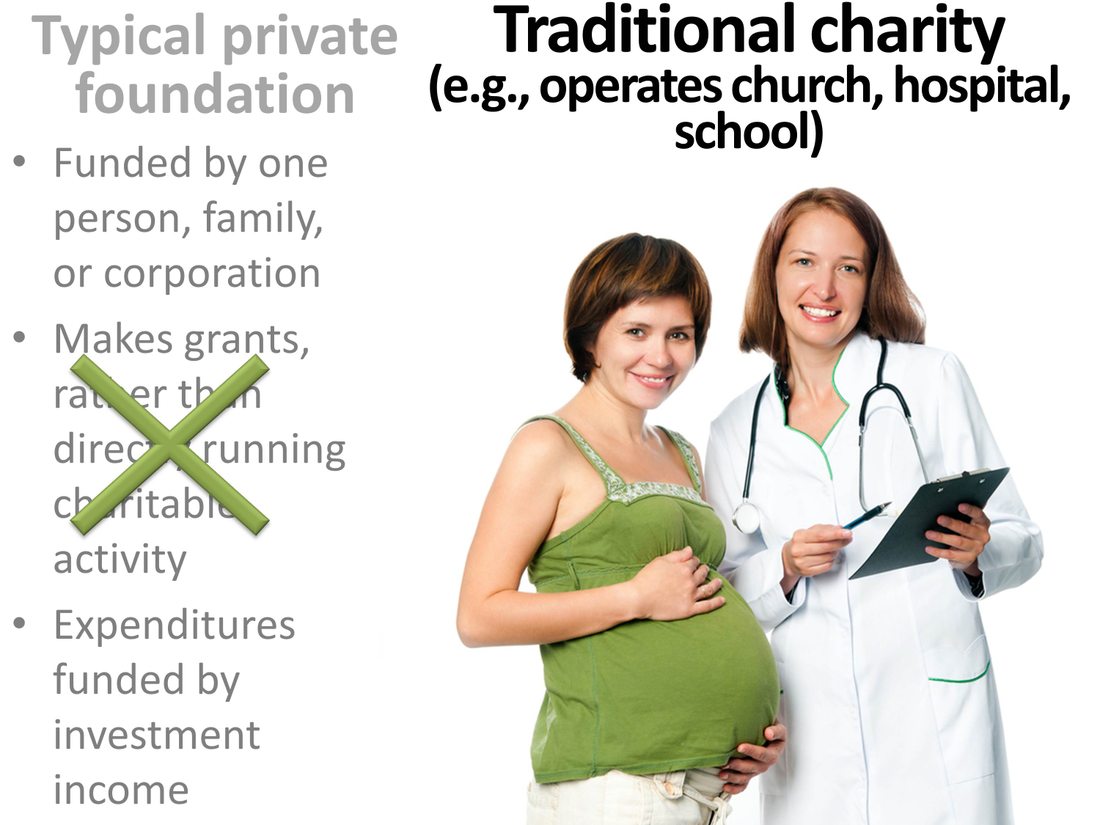
Traditional charities qualify as public charities because they are primarily engaged in the day-to-day operation of delivering charitable services. In sharp contrast to a typical private foundation, these organizations do not simply make grants to others engaged in charitable operations. Churches, hospitals, schools, and other traditional operating charities qualify as public charities rather than private foundations due to the nature of their operations.
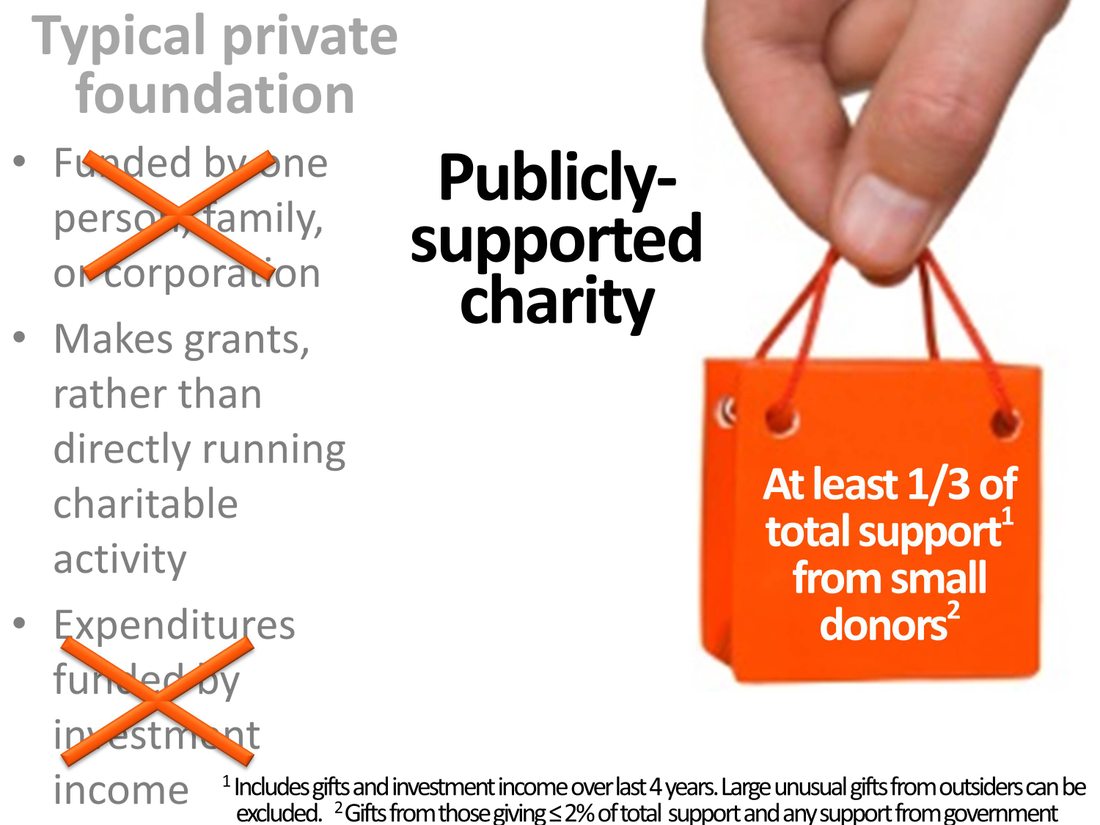
Another way that a charitable entity can be classified as a public charity is by having widespread financial support. Even if the charity is simply making grants and is not directly engaging in charitable operations, widespread financial support will cause it to be a public charity rather than a private foundation. In this first methodology, the concept of widespread financial support is a purely mathematical issue. The test is met if the support from those who individually give 2% or less of the total support (a.k.a. small donors) sums to at least one-third of all support given to the charity. In other words, if there are a lot of small donors who, when combined, are financially important to the organization, then the organization isn't a private foundation. Instead, it is a public charity.
Suppose a grant-making charity received total support of $100,000. If 35 donors gave $1,000 a piece and the charity's founder gave $65,000, this charity would still pass the test for being a public charity, because more than 1/3 of all support came from small donors (those giving 2% or less of the total support).
There are two additions to this rule that prevent the charity from being disqualified due to financial support from government or an unusual large gift from an outside donor. Government support is treated as small donor support (i.e., less than 2% of total support), regardless of how large a share the government support actually constitutes. For example, if a non-operating, grant-making charity had $100,000 of total support consisting of a $65,000 gift from the charity founder and a $35,000 grant from government, the charity would qualify as a public charity. Additionally, unusual large gifts from an outside donor (i.e., not from the organization's founding donor, trustees, managers or their families) can be ignored. Suppose a non-operating, grant-making organization that otherwise would have had total support of $1,000 a piece from 35 donors and $65,000 from the founding donor received an additional one-time $100,000 gift from a wealthy donor unrelated to any of the organization's insiders. If this unusual gift were included in the calculation, it would disqualify the organization from being a public charity, because the small donor support of $35,000 would then constitute only 17.5% of total support. For this reason, such an unusual gift from an outsider can be excluded from the calculation.
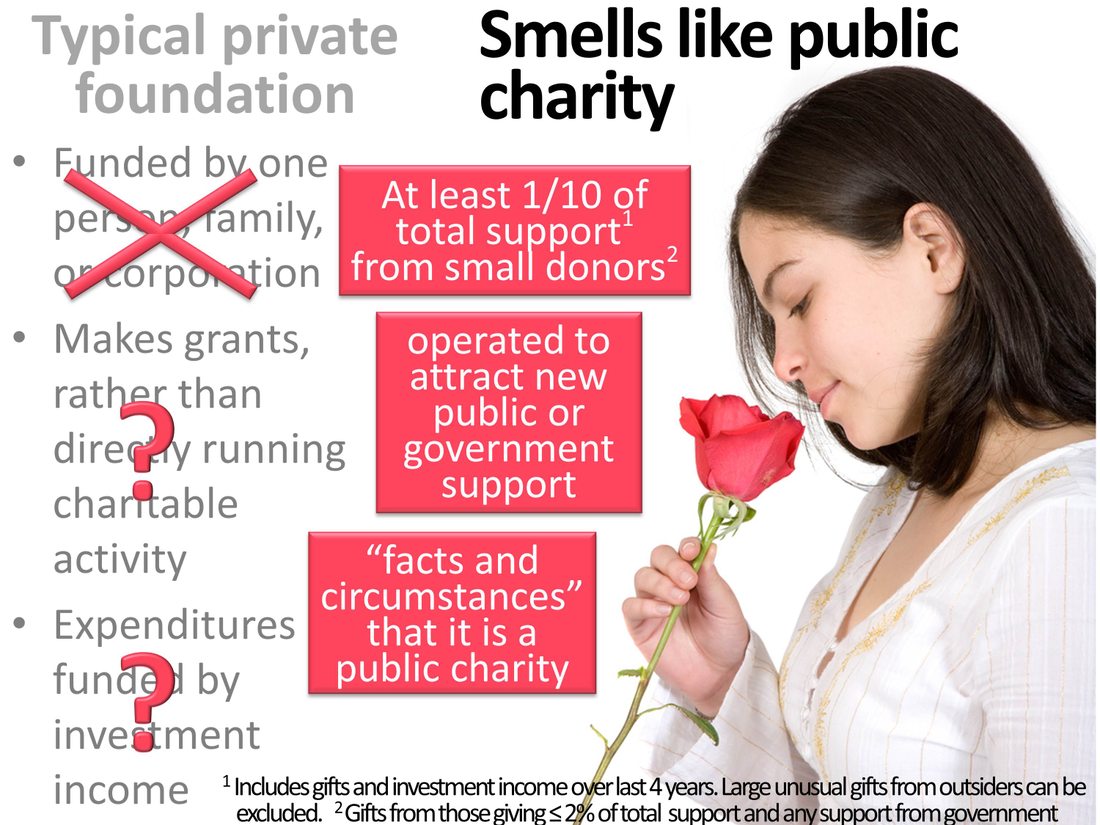
A more subjective rule allows for small donor support (including government support) to constitute as little as 10% of the organization's total support. However, in order to take advantage of this lower limit, the charity must also fulfill two subjective requirements. First, the charity must be operated in such a way as to be intentionally attempting to attract new public or government support. In other words, the charity is not yet at the 1/3 level, but it is at 10% and appears to be working to grow that 10%. Finally, the "facts and circumstances" must suggest that it is appropriate to treat the organization as a public charity. In a sense, a charity (other than a traditional operating charity) with small donor (and government) support between 1/10 and 1/3 of total support is in a "maybe" zone for qualification as a public charity. This subjectivity allows for open consideration of any circumstances that might make the charity appear more like a classic private foundation or more like a public charity. Because of the subjectivity, it may be useful to think of this as a "smell" test asking, "Does this smell more like a private foundation or a public charity?"
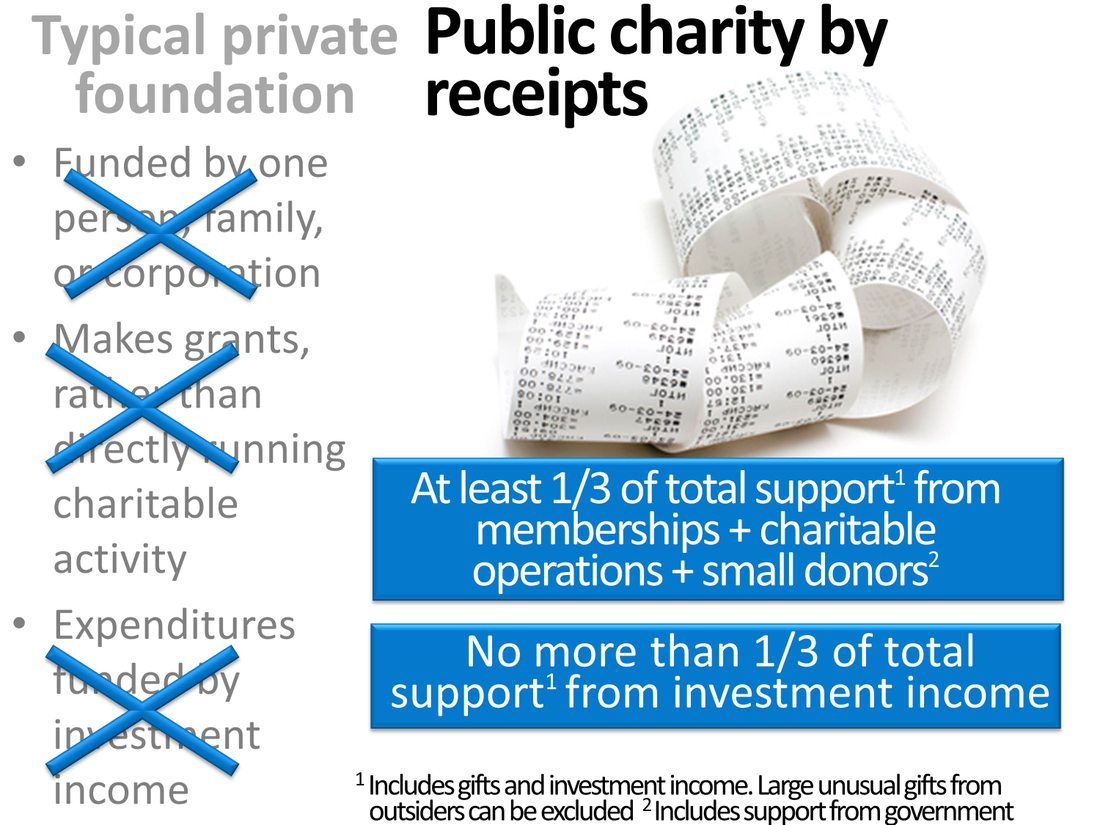
Finally, a charity can qualify as a public charity based upon not only its small donor support, but also its income from memberships and any charitable operations. If these sum to at least 1/3 of total support and the charity receives no more than 1/3 of total support from investment income, then the charity will qualify as a public charity.
For example, if a local parent-teacher association received $10,000 in total income from $4,000 in memberships, $4,000 in bake sale profits, and $2,000 in investment returns, with no donations and no income from charitable operations, the organization would qualify as a public charity. This is because at least 1/3 of total support came from memberships ($4,000, which is 40% of total support), small donations ($0), and income from charitable operations ($0). Additionally, no more than 1/3 of total support came from investment income (in this case $2,000, which is 20% of total support).
If instead, the organization received its $10,000 of total support from $4,000 in memberships and $6,000 in investment returns, then it would not qualify under this rule. This large investment income (more than 1/3 of all support) shades the organization more into the appearance of a private foundation.
A charitable organization can qualify as a public charity through any of these four rules. However, if the charitable organization does not qualify under these rules (nor under rules for supporting organizations), then the default classification as a private foundation remains.
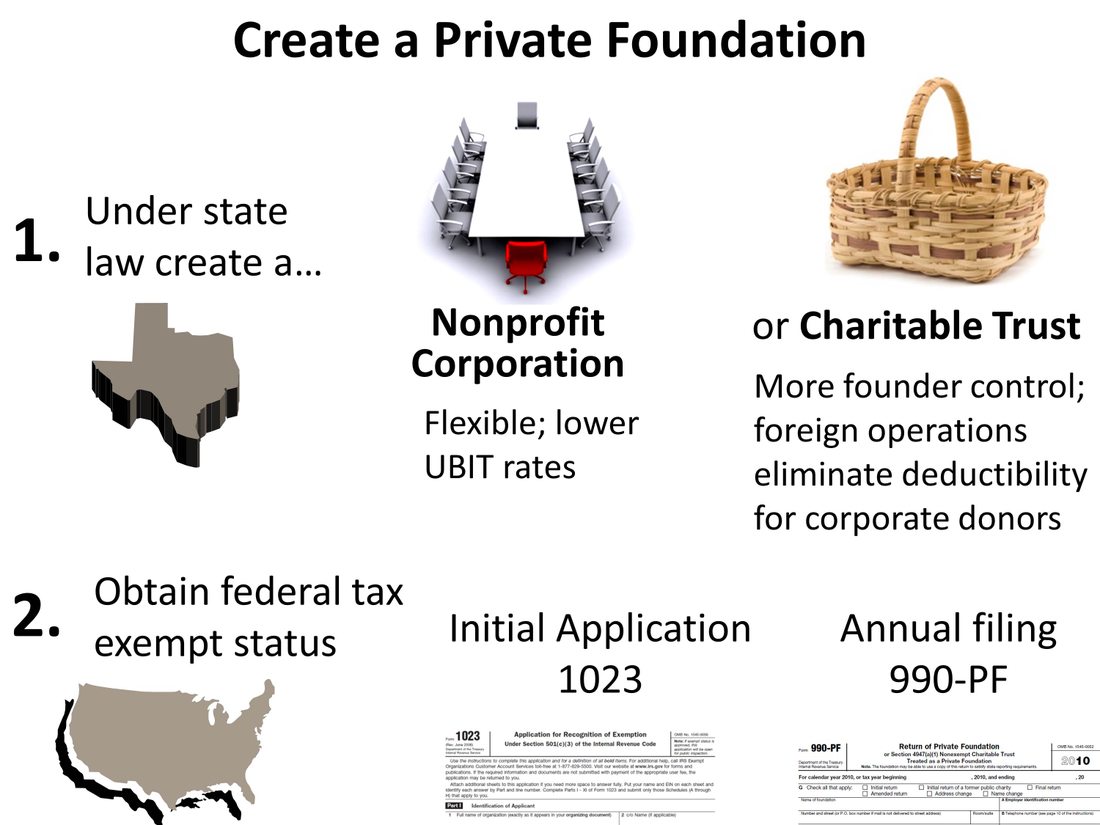
In order to receive tax treatment as a private foundation, the organization must first be brought into existence under state law. A private foundation can be structured as either a nonprofit corporation or a charitable trust. Charitable trusts allow for more founder control in that the trust document can be specific and restrictive as to the permitted activities of the trust. The corporate structure offers flexibility to future directors, allowing amendments that can alter the corporation's goals, structure, and operation. The corporate structure may offer some additional tax benefits, such as lower tax rates for unrelated business income. Additionally, gifts by corporations to a nonprofit trust that makes international grants are not deductible, but gifts by corporations to a nonprofit corporation that makes international grants are deductible. So, if the founder intends for the foundation to both receive gifts from corporations and make grants in other nations, the corporate form will be preferred over the trust form.
Once the foundation organization has been created under state law, it can then seek recognition as a tax-exempt organization for federal tax purposes. This begins with the filing of IRS Form 1023. Granting of this tax exempt status will be retroactive to the date the private foundation was created if Form 1023 is filed within 15 months of the creation date. Once granted, continuing tax exempt status requires the annual filing of IRS Form 990-PF. This process is similar to that required of all nonprofit organizations (except churches), which are required to annually file the IRS Form 990. States differ as to their requirements for getting recognition as a nonprofit organization for state tax purposes, with some accepting the federal recognition and others having their own separate processes.
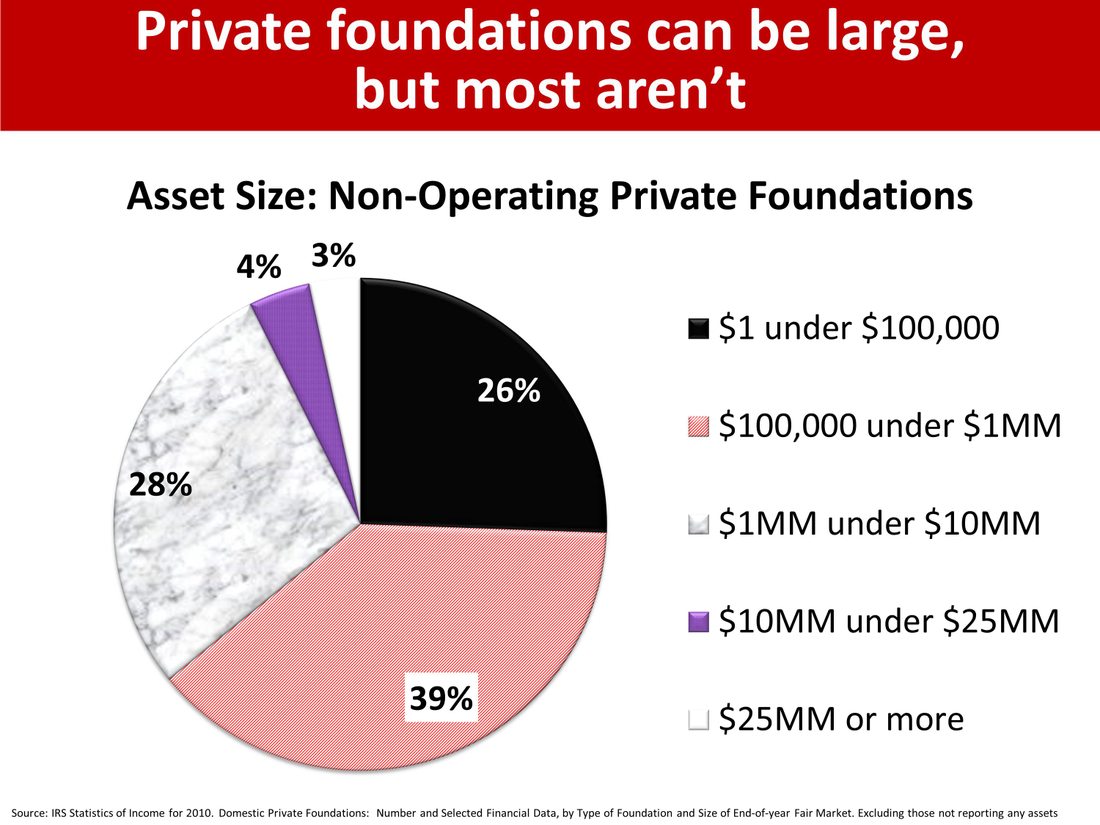
As stand-alone organizations, private foundations require various forms of administration such as accounting, annual tax filings, recordkeeping, and, in the case of corporate foundations, regular annual meetings. Combining this with the cost of creating the initial organization suggests that the hassle might not be justified for relatively small amounts. Nevertheless, of the more than 83,000 non-operating private foundations holding assets in the year 2010, more than one-fourth held less than $100,000, and nearly two-thirds held assets less than one million dollars.
The board of the foundation is typically selected by the founding donor. As a result, it is most common for the foundation creator to select like-minded individuals, usually family members. The selection of family members can serve several purposes. Involving family members in the operation of the board can help to transmit the founder's charitable values. Additionally, travel and expenses to attend board meetings or visit current or potential grantee sites can be reimbursed for board members. Board members may also benefit from the prestige and influence that comes from being an important decision-maker regarding distribution of funds.
There is no set requirement for how a board must function. It is possible to have different voting rights and different terms for different types of board members. Rules for continuation as a board member, especially in the context of a charitable trust, may be as unique as each founder. Although minor children cannot make legal decisions that would bind the organization, they can serve on an advisory "junior board" that considers some types of grants or other issues. This junior board concept can be used to aid in the training of a younger generation of future board members and to justify reimbursement of the travel expenses of such junior members' travel to board meeting locations.
Once a private foundation has been successfully created, the primary guidelines for its operation come from federal tax law. Tax law affects private foundations indirectly, through the deductibility of gifts, and directly, through taxation of investment income and levying of penalties for violations of IRS rules.
Unlike other charitable entities, private foundations do pay taxes on net investment income and capital gains. However, this tax is relatively minimal, at 1.39%. Although private foundations are not completely tax exempt, the burden of a 1.39% tax is relatively minimal.
This tax is paid on net investment income and net capital gains. However, the tax is not paid on any unrelated business income, which is taxed at different rates. Net investment income allows for the reduction of gross investment income by any ordinary and necessary expenses incurred in generating the income (such as investment management fees, real estate management fees, or the share of officer or employee compensation related to investment and investment management).
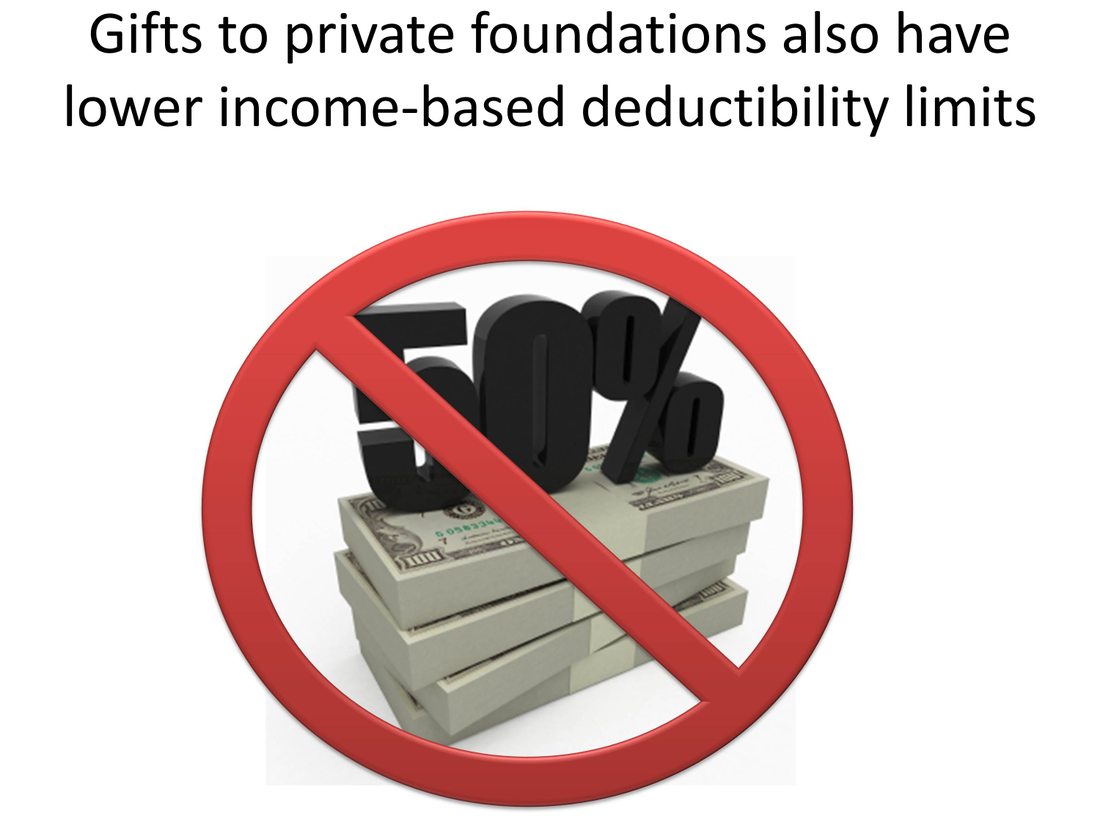
As discussed in the chapter on that topic, gifts to private foundations have lower income limitations for charitable deductions than do gifts to public charities. The highest (60% or 50%) limitations are never available for deductions from gifts to private foundations, which are instead limited to 30% or 20% of adjusted gross income (slightly modified) for individual taxpayers, and 10% of taxable income for corporations. Any deductions from charitable gifts in excess of the maximum percentage of the donor's income cannot be deducted in the year of the gift, but must instead be carried forward until such time as they can be used without causing the total deductions to exceed the relevant limitation. Carryover deductions that cannot be used in the five tax years following the year of the gift will expire.
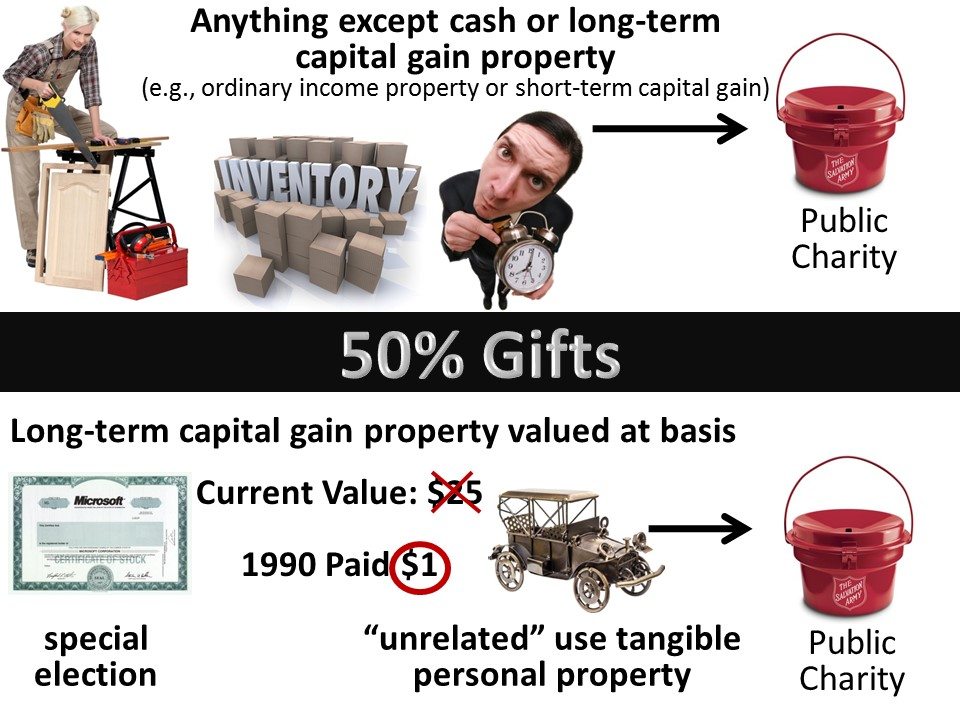
As discussed in a previous chapter, gifts that may be deducted up to 50% or 60% of income are all gifts to public charities, with the highest 60% limit being reserved for gifts of cash to public charities.
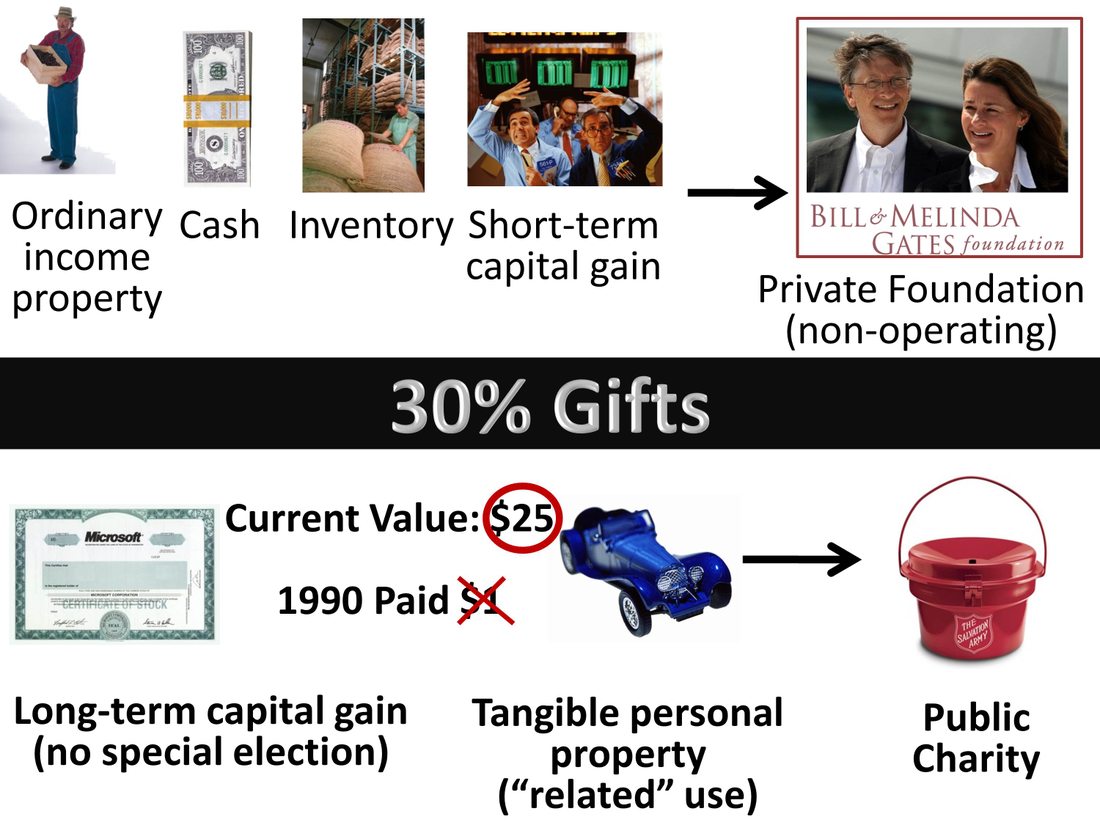
Gifts to private foundations of cash, inventory, short-term capital gain or ordinary income may be deducted up to 30% of the donor's income, with the remainder carried forward.
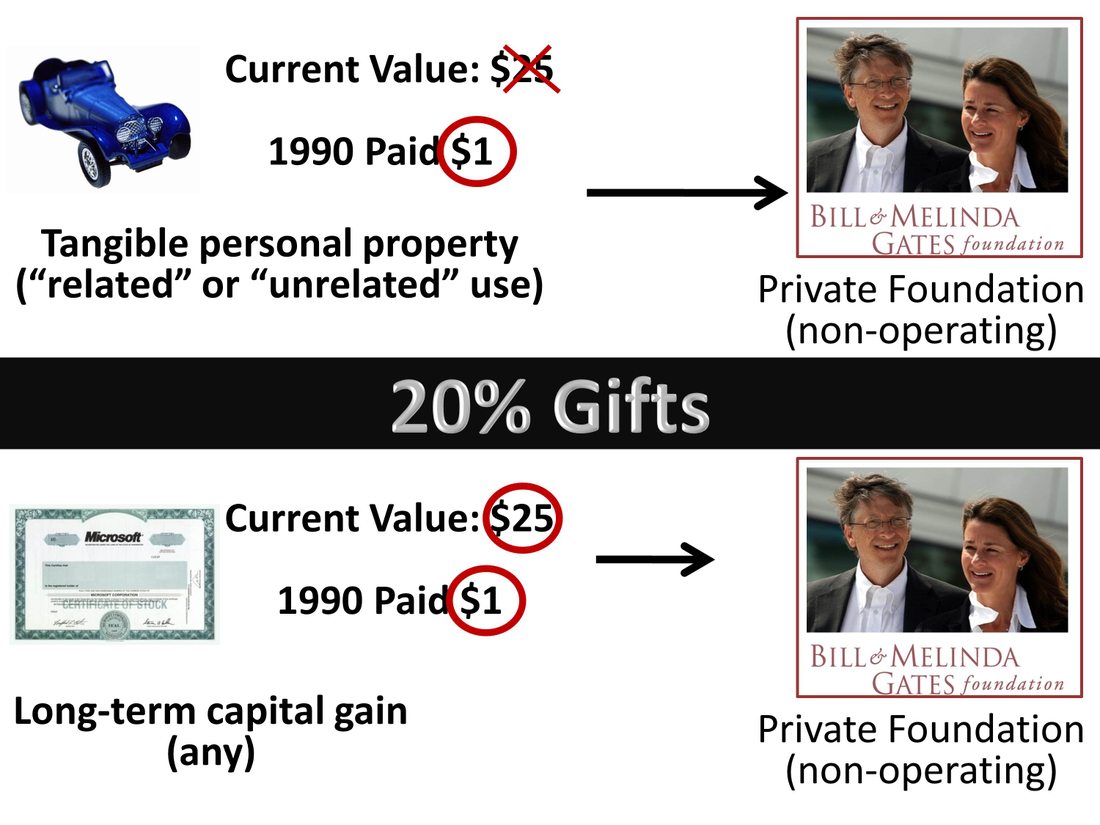
Any gifts of long-term capital gain to a private foundation may be deducted only up to 20% of the donor's income, with the rest carried forward into future years. This is true regardless of whether or not the gift can be valued at fair market value or the lower of basis or fair market value.
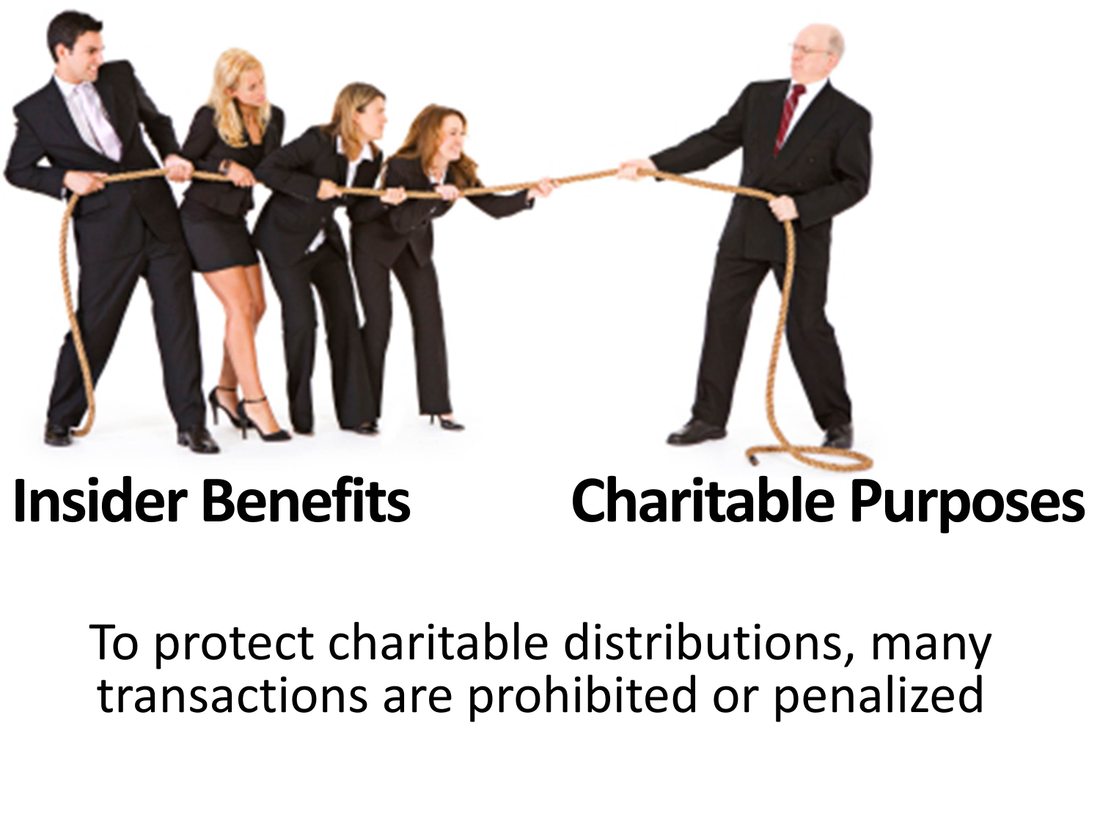
The underlying reason for many of the tax rules for private foundations is the desire to insure that the foundations appropriately pursue a charitable purpose and do not use their resources to provide inappropriate benefits to insiders. Prior to the passage of these rules many private foundations were used in such a way as to provide excessive benefit to those who created and operated the foundations.
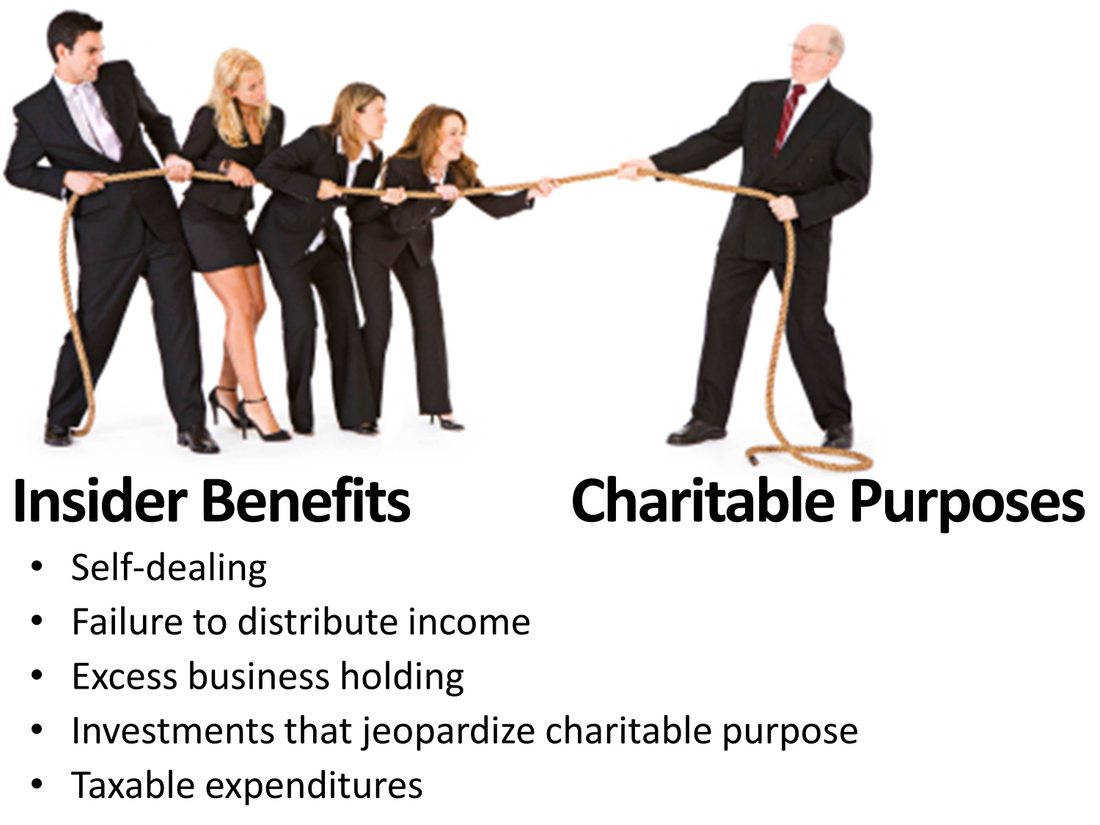
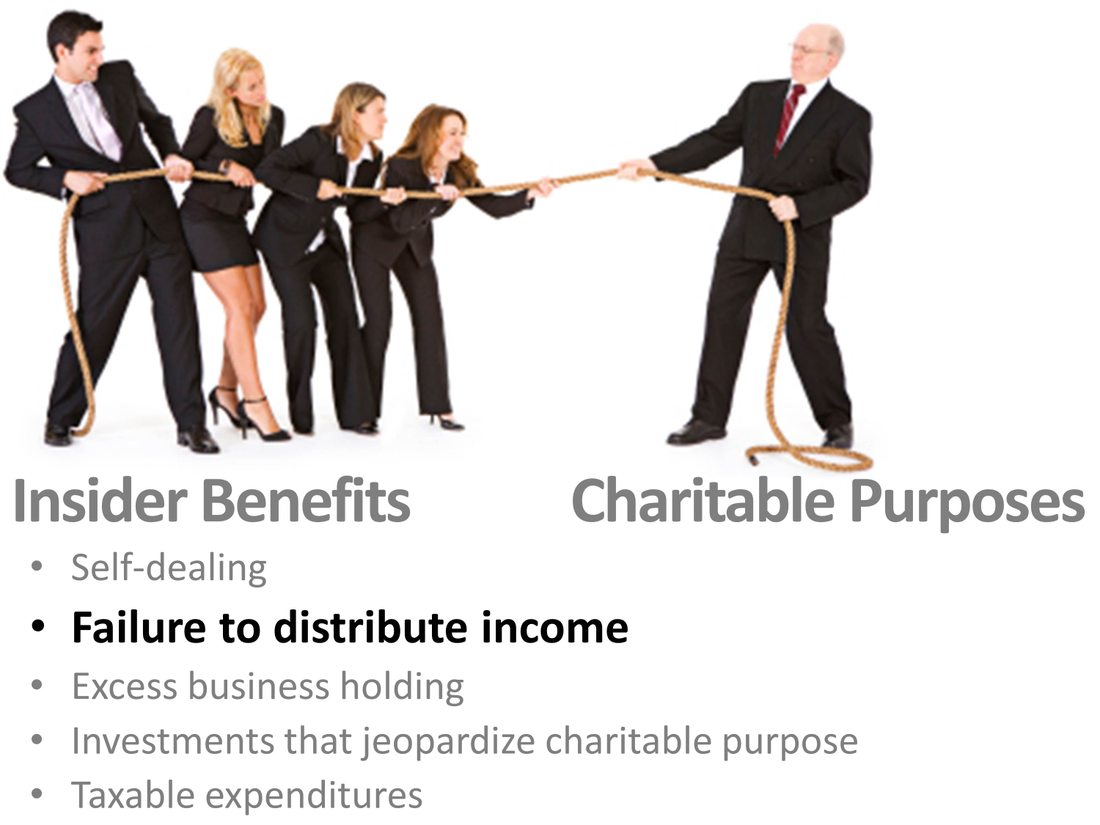
Private foundations receive highly favorable tax treatment for the purpose of encouraging charitable activity. The rules designed to prevent insider benefits and insure that the charitable purposes are being accomplished fall into the five categories of (1) self-dealing, (2) failure to distribute income, (3) excess business holding, (4) jeopardizing investments, and (5) taxable expenditures.
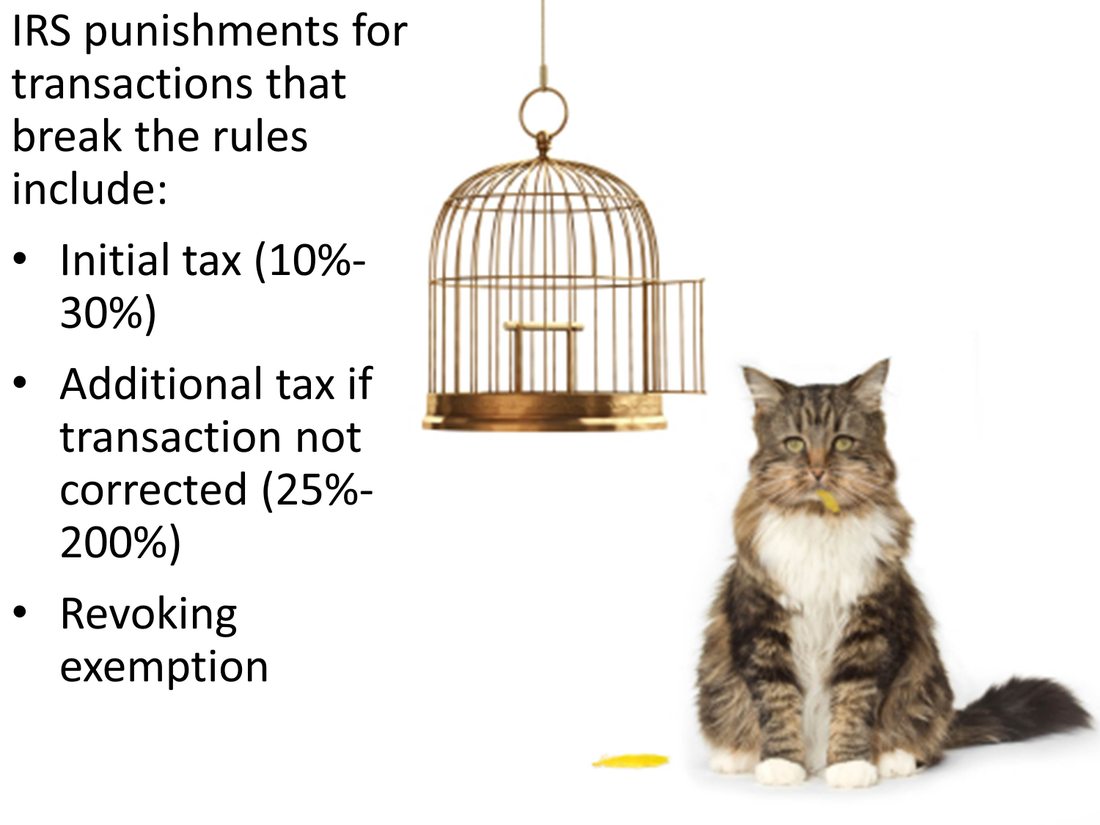
A range of penalties can arise for violating these tax rules, from an initial tax to additional taxes if the violation is not corrected to revocation of the exempt status of the foundation. Previous to this legislation the only penalty was revocation of the tax exempt status. Due to the harshness of the penalty, it was rarely enforced, leading to the need for the current system allowing for intermediate penalties.
As mentioned above, a wide range of rules protects against giving excess benefits to insiders. Enforcement of these rules requires a definition for who is and who is not an insider. The tax code uses the term "disqualified person" to designate a foundation insider.
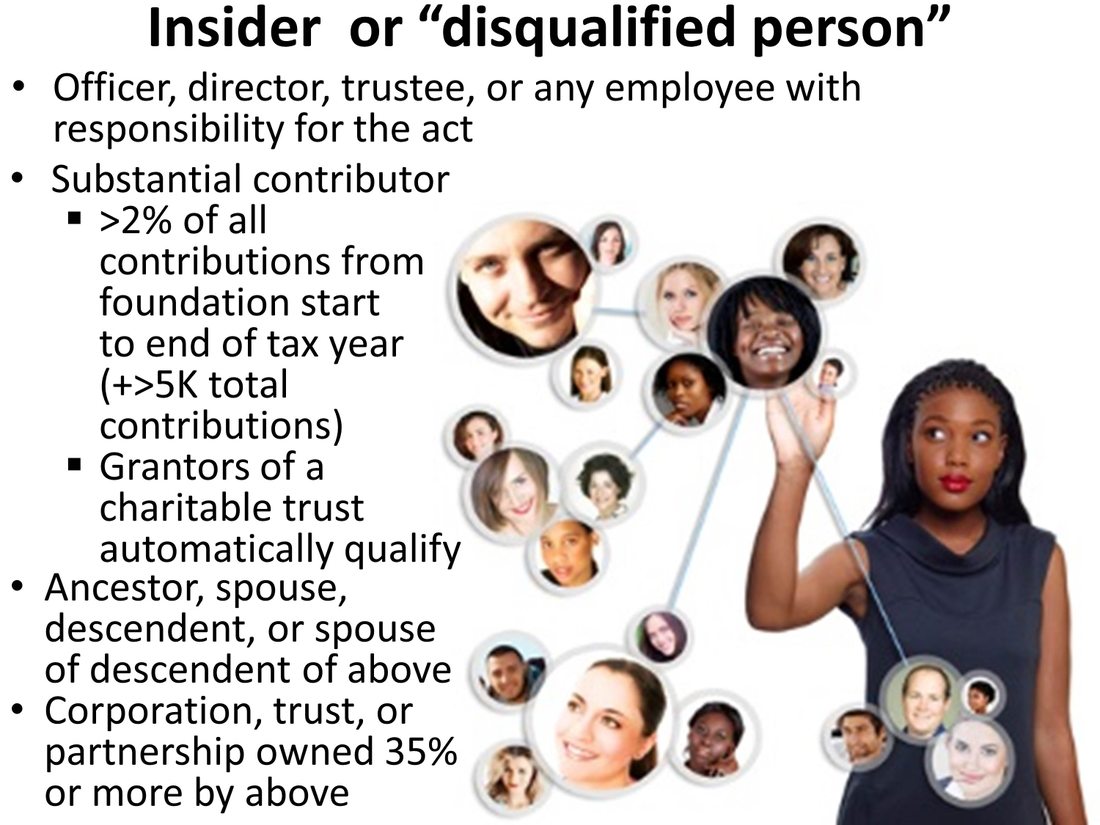
The definition of a disqualified person is, in most respects, extraordinarily broad. Naturally, the people running the foundation are insiders. This includes officers, directors, and trustees of the foundation. However, it can also include any employee of the foundation if the employee has responsibility for the act under consideration as a potential violation of the rules. In addition to those who run the foundation, those who create or significantly support the foundation are also insiders. The original founder (grantor) of a charitable trust is automatically an insider regardless of whether or not he or she is a substantial donor. Additionally, any donor who has given more than 2% of the total contributions ever given to the foundation is also an insider (assuming that the donor's contributions are greater than $5,000 in total).
The designation of "disqualified person" applies not only to these donors or managers, but also to all of their ancestors, descendants, spouses, or spouses of descendants. Curiously, this definition - although broad reaching - does not include the siblings of insiders. Additionally, organizations significantly controlled by disqualified persons are also disqualified persons. Specifically, any corporation, trust, or partnership that is owned or controlled 35% or more by all disqualified persons combined is also a disqualified person. For example, if a corporation is owned 10% by the founding donor's grandson, 10% by the founding donor's grandson's wife and 15% by the mother of an unrelated foundation trustee, then the corporation is itself a disqualified person.
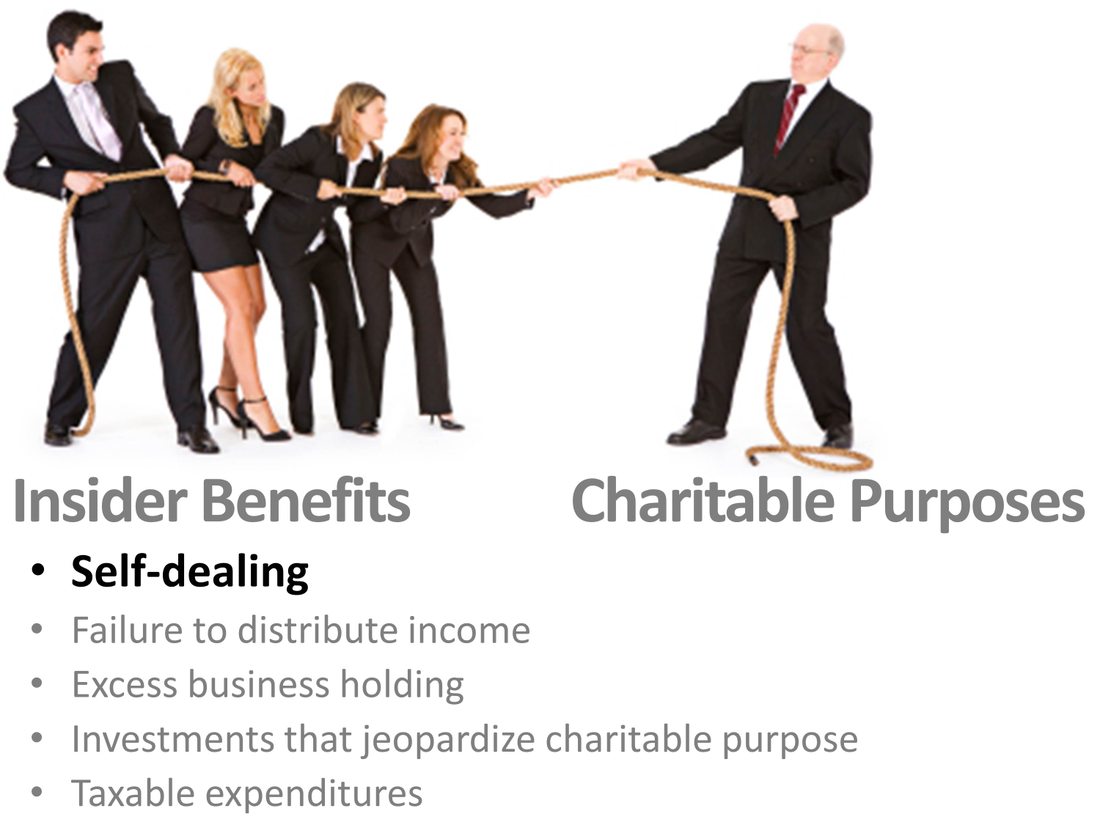
This first set of rules designed to limit insider benefits is a prohibition against self-dealing. Self-dealing rules prohibit most transactions between the private foundation and a disqualified person.
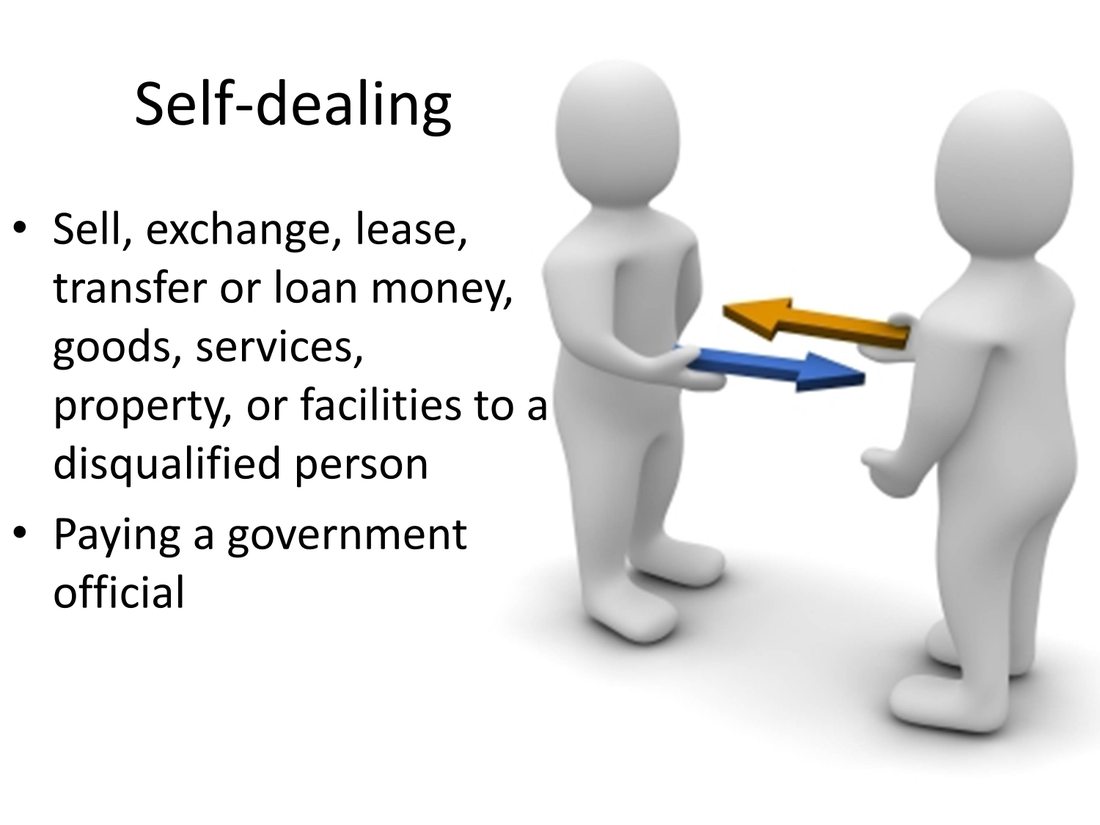
Self-dealing rules prohibit the private foundation from selling, exchanging, leasing, transferring or loaning money, goods, services, property or facilities to a disqualified person. Correspondingly, they also prohibit disqualified persons from selling, exchanging, leasing, transferring or loaning money, goods, services, property or facilities to the private foundation except when this occurs as a free gift. Rather than investigating the propriety of each individual transaction with disqualified persons, this rule simply prohibits all of them.
Prior legislation permitted self-dealing transactions if they were completed under reasonable terms comparable to an "arm's length" transaction. However, this previous rule made enforcement difficult and permitted substantial benefits to insiders. For example, a private foundation might purchase property from an insider for fair market value, but provide benefit by offering the insider a source for an immediate sale, whereas selling in the market could require much time. Or, a private foundation might offer a loan to an insider at market interest rates, but during a time when financial liquidity was tight and other sources of credit were unavailable. None of these transactions are permitted under the current rules, because their relative benefit to the foundation is now irrelevant. All such transactions are simply prohibited.
In addition to the prohibition against transactions with disqualified persons, this section also prohibits transactions with government officials - primarily those with a policymaking role. This rule relates to the core idea that private foundations should not be used for political purposes. Further, an insider could benefit through gaining political influence by using the foundation to influence government officials.

These transactions with disqualified persons are categorically prohibited and this prohibition does not depend upon the relative benefit given to the foundation. For example, a donor could sell a $200,000 property to a public charity for $10,000. Under the bargain sale rules, this would generate a $190,000 deductible charitable gift. However, if the donor completed the identical transaction with a private foundation for which the donor was a disqualified person the transaction would be a prohibited act of self-dealing. The fact that the private foundation received a $190,000 benefit is irrelevant; the exchange is still prohibited.

In an attempt to circumvent this rule against bargain sales, a disqualified person might be tempted to simply take out a mortgage, take the money, and then donate both the property and the mortgage to the private foundation. However, the private foundation's acceptance of the debt incurred by the insider is considered to be a benefit to the insider and, consequently, the transaction is prohibited. As before, this is true regardless of how beneficial the transaction is to the private foundation. Even if the mortgage is less than, say, 10% of the value of the property donated, it is still a prohibited act of self-dealing. This rule has one exception which permits the private foundation to accept a property that an insider has encumbered with debt if the debt is at least ten years old.
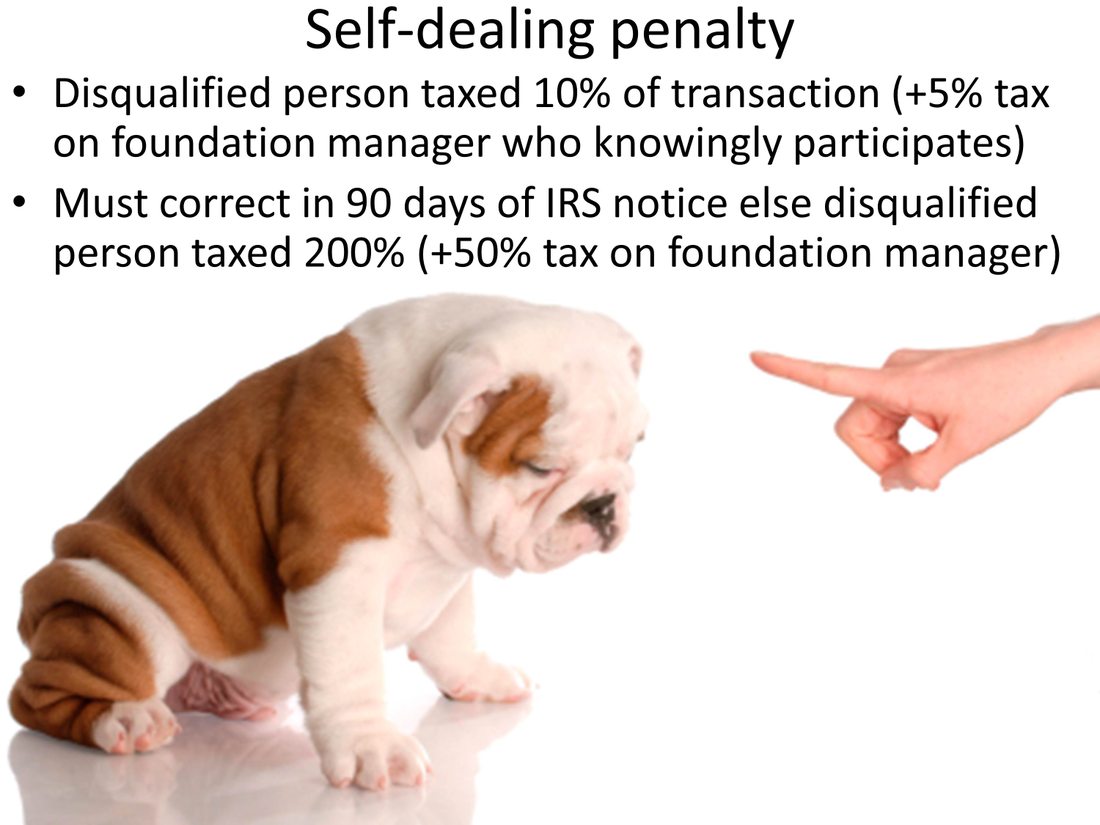
Self-dealing transactions generate a 10% penalty for the disqualified person and an additional 5% penalty for the foundation manager who knowingly participates in such a transaction. (Given the broad definition for disqualified persons, it is possible, for example, that the foundation manager was unaware that the person was a disqualified person.) In addition to this penalty, the transaction must be undone. This correction is required within 90 days of the IRS notice, otherwise the foundation is subject to an additional tax of 200% of the transaction amount, and the foundation manager is subject to an additional tax of 50% of the transaction amount. An excessive degree of self-dealing could, in extreme cases, also lead to the removal of the foundation's tax exempt status.
Despite this blanket prohibition on transactions with insiders, the rules do permit some exceptions. These permitted transactions include, obviously, the ability of disqualified persons to make gifts to the foundation. Thus free gifts (e.g., not bargain sales or debt-encumbered property) of money, property, or the use of money or property are allowed. However, these gifts cannot require the foundation to make any payments back to a disqualified person. For example, a disqualified person cannot give free rent of office space to the charity with the requirement that the foundation must pay the disqualified person for utilities, insurance, or maintenance. A gift of free rent is allowed if such payments are not made to the disqualified person, but are instead made to an outside utility company, insurance company, or maintenance company.
Despite this prohibition on self-dealing, some transactions with benefit to insiders are specifically allowed. In particular, a foundation can hire an insider to perform necessary professional and managerial services so long as the compensation is reasonable. The official term for these permitted services is "personal services," and it includes investment advice, legal services, accounting, tax services, banking, and administrative assistance. This does not include non-professional or non-managerial services such as janitorial work. The compensation for such services must be reasonable. In order to assist foundation managers in knowing and demonstrating what compensation is reasonable, The Council on Foundations publishes the Foundation Management Report giving compensation information for a variety of positions for foundations of different sizes. So long as the payments to insiders are for services necessary for the operation of the charity and fall within these reasonable guidelines, the foundation is allowed to hire these disqualified persons.
In addition to the ability of the foundation to hire and pay reasonable compensation to disqualified persons for necessary professional and managerial services, the foundation may also reimburse the reasonable travel expenses of insiders necessary for the operation of the foundation. For example, reimbursing travel and meal costs for board members to attend a board meeting of the foundation is a commonly accepted foundation expenditure. The foundation may not reimburse expenses for other family members to travel when those family members are not a necessary part of the foundation's activities. So, the travel expenses of a board member's spouse may not be reimbursed unless the spouse is also a board member (or is filling some other necessary function for the foundation). As discussed previously, a private foundation may have a junior board, including minors, which is allowed to make recommendations for grants and gradually learn about foundation management in potential preparation for a future appointment to the regular board. The use of such boards can make the travel of minor children to board meetings a reasonable and necessary expense. In addition to travel to board meetings, travel to investigate current or potential grant recipients is also a commonly accepted activity, and thus reimbursement of reasonable expenses is also appropriate. Some founders have employed these travel reimbursements for necessary board functions as a way to pay for family gatherings in attractive locations.
A wealthy donor may choose to ignore sophisticated planning and simply leave the estate to his or her children (perhaps with some donation to charity). This type of traditional inheritance typically results in dissipation of the family's wealth. The wealth is dissipated first by division among heirs at each generation, leaving smaller and smaller separate amounts. Additionally, the wealth is subject to 40% estate taxes at every generation, further reducing remaining wealth. Beyond this, investment returns in the intervening years are subject to constant annual taxation. All of this dissipation by division and taxation occurs even if every heir in every generation is completely responsible and consumes none of the original inheritance. The likelihood of a spendthrift heir - or one who is attracted to highly risky investments - dramatically increases the likelihood of rapid dissipation. (One national U.S. study showed that 1/3 of all heirs receiving inheritances spend their entire inheritance within a few months. In addition, among all heirs, about half of the typical inheritance has been spent within 12 months. See Zagorsky, J. L. (2012). Do people save or spend their inheritances? Understanding what happens to inherited wealth. Journal of Family and Economic Issues.) The typical pattern of family wealth accumulation and dissipation has generated such common descriptions as "from shirtsleeves to shirtsleeves in three generations," to reflect its temporary nature.
In contrast, a private foundation can provide an excellent means to keep the family's wealth completely intact across many generations and still provide some attractive benefits to heirs. The use of the family foundation means that there is no dissipation by division at each generation, no estate taxes at each generation, no annual taxes on earning and gains (beyond the 1.39% excise tax on net investment income), and no temptation for spendthrift heirs to benefit themselves by consuming all of the assets. Even excessively risky investments are prohibited by tax law. Although some transfers (discussed below) must be made to charitable organizations, these are typically less than the investment income generated by the foundation's assets. Heirs who are involved with the work of the foundation have the benefit of employment (assuming some professional or managerial skills) and travel. Additionally, those controlling significant distribution decisions often enjoy the less documented benefits of this financial power. Managers of recipient nonprofits may be more than happy to provide favors in order to build good relationships with those who make substantial funding decisions. Although such favors cannot be direct transfers to disqualified persons, the ability to subtly influence organizational decisions (including hiring decisions) of recipient nonprofit organizations may be indirectly valuable.
The private foundation offers a means by which a donor's wealth can remain intact, and growing, for indefinite generations serving only the causes the donor has selected and benefitting subsequent generations of managing heirs both directly and indirectly. The donor's financial managers can also benefit substantially by keeping the wealth intact, undivided, and largely untaxed across generations.
Private foundations are, of course, charitable entities. These entities do not engage in charitable activities directly; i.e., these are non-operating private foundations. The charitable nature of a private foundation depends entirely upon its distributions to operating charities. Consequently, a private foundation is required to make a minimum amount of distributions (i.e., gifts or grants) to public charities.
A private foundation is required to distribute at least 5% of all non-charitable net assets (i.e., investment assets) under its control at the end of the tax year. This distribution must be made by the end of the following tax year. Violating this requirement to make charitable distributions is sometimes referred to as a failure to distribute income, although the required distributable amount is based entirely upon the foundation's non-charitable assets. (The term comes from previous legislation when distributions were based, in part, upon income.)
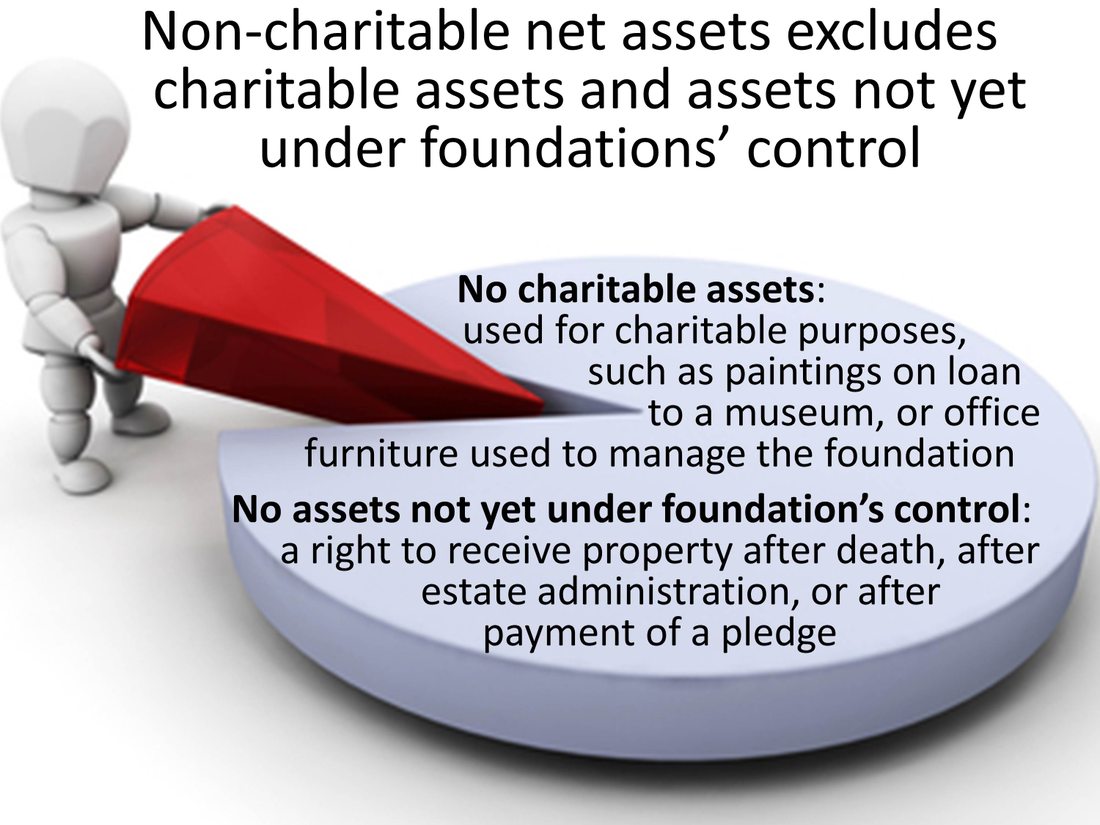
The value of non-charitable net assets is reduced by any debt used by the foundation to purchase investment assets. These assets do not include charitable assets, i.e., assets being used in a charitable operation such as a painting being loaned without charge to a public charity art museum. This charitable exclusion also excludes assets being used by the foundation to carry out its own exempt purposes, but not those being used by the foundation for investment management purposes. (This distinction would require a foundation that owns the building in which it operates to allocate the value between charitable and other functions.) Non-charitable net assets exclude assets that, even though they are booked as assets, are not yet under the control of the foundation such as pledges to make a gift or a remainder interest in real estate.
The 5% required distributable amount is reduced by the taxes paid to the government as the 1.39% net investment income tax or any unrelated business income tax paid by the foundation. There is, however, no reduction in the required distributable amount due to penalty taxes paid for violating any of the private foundation rules discussed in this chapter. (Note that the 1.39% net investment income tax would not lower the 5% minimum payout to 3.61%. The minimum payout is 5% of non-charitable net assets, where the tax is 1.39% of net investment income.)
The 5% requirement does not mean that the entire 5% (less the unrelated business income tax and net investment income tax) must actually be distributed to charity. Any reasonable and necessary administrative expenses incurred for grant-making or fundraising are themselves considered to be charitable expenditures. Thus, the 5% would be reduced by reasonable and necessary expenses for administration costs related to soliciting and evaluating grant applications (such as travel to meet with grant applicants), supervising the use of funds granted (such as travel to review the use of funds), and general administration of the charitable functions of the foundation (such as employee salaries, office rent, utilities, IRS form 990-PF preparation fees, and legal fees related to charitable functions). These expenses do not include any expenses associated with managing the foundation's investments. Due to the reductions for expenses and taxes, the actual amount distributed to public charities may be far less than 5% of non-charitable assets held by the foundation. The limitation is that these operational expenses must be reasonable and necessary to accomplish the charitable functions of the foundation.
The charity receiving the funds cannot be controlled, either directly or indirectly, by the foundation or by any disqualified persons. In this case, control means that any combination of disqualified persons could, working together, require or prevent the recipient charity from making an expenditure. Although disqualified persons may not control the recipient charity, the private foundation is allowed to make a restricted gift which the recipient charity must use for the designated purposes.
It appears (PLR 200009048, 9807030) that the private foundation may also make a qualified distribution to a donor advised fund, even when such fund is advised by disqualified persons. This would be remarkable in that the funds in a private foundation may thereby presumably be kept indefinitely from actual public charitable use. In apparent recognition of this potential, the mandatory annual filings for private foundations (IRS Form 990-PF) added the following disclosure requirement in 2011: Did the foundation make a distribution to a donor-advised fund over which the foundation or a disqualified person had advisory privileges? If "Yes," attach a statement. The statement must report whether the foundation treated the distribution as a qualifying distribution and how the distribution will be used for §170(c)(2) purposes. In other contexts, a private foundation may not make a qualified distribution to a charitable entity that simply holds and distributes funds to other charities such as to another non-operating private foundation or a supporting organization.
The private foundation need not make transfers only as cash gifts to public charities, but may also purchase or improve assets used directly in charitable purposes. This could include assets transferred to a public charity, or assets used by the private foundation for charitable purposes. Thus, the purchase of a building to be used exclusively by the foundation in its charitable purposes (e.g., soliciting and evaluating grant applications and evaluating grant expenditures, but not investment management) is a qualifying distribution.
The general rule is that a non-operating private foundations must make qualifying distributions of at least 5% (reduced by payments for net investment income tax or unrelated business income tax) of its net non-charitable investment assets. However, private foundations are allowed to accumulate funds instead of distributing them as a means of saving up for a later large qualifying distribution in certain cases.
Saving up these charitable distributions is referred to as a "set aside," following the idea that these funds are set aside for future qualifying distributions. This is permitted only if the project would be better accomplished through saving up these distributions than by making them immediately and if the qualifying distributions are made within 60 months of the first set aside. These sets asides are typically used for very large single purchases, such as the purchase or construction of a building.
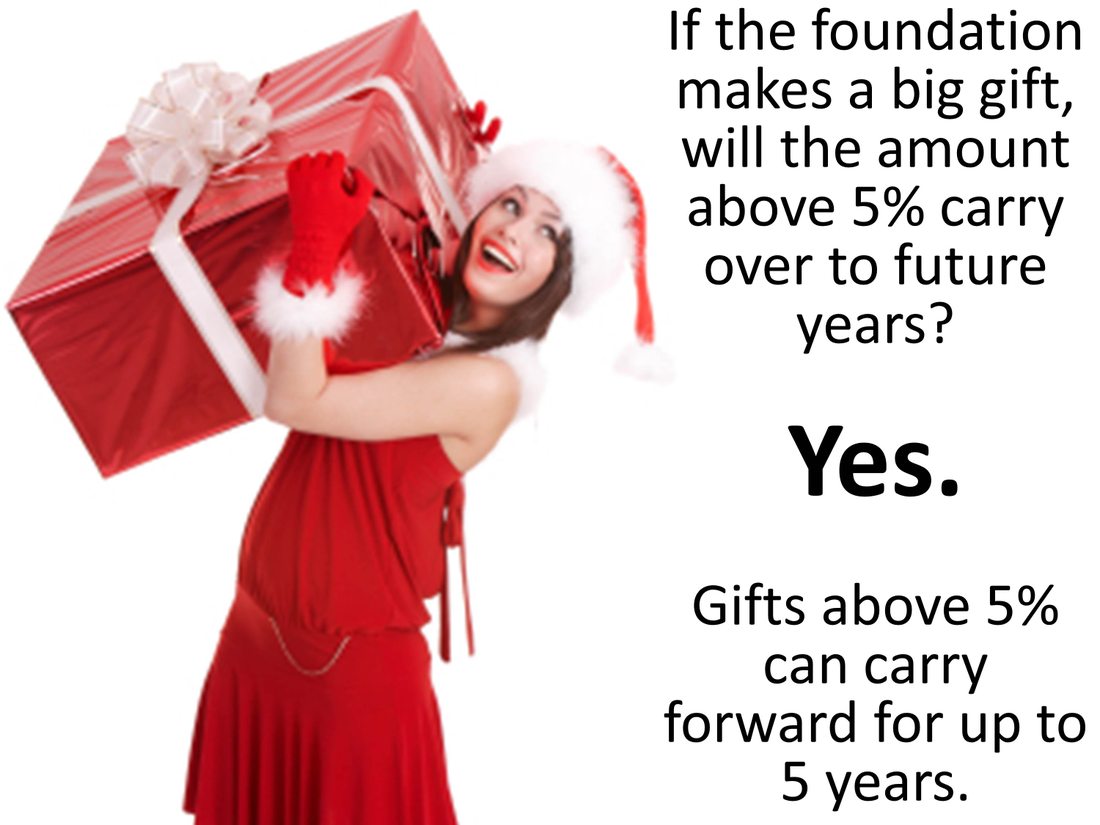
Not only may a nonoperating private foundation save up qualifying distributions through a set aside plan, but it may also do the reverse and make a large qualifying distribution today which will reduce the requirement for future qualifying distributions. Thus, any amount paid by the private foundation in excess of the 5% minimum requirement can be carried over for up to 5 years. During this carry over period, the excess amount can be used to reduce any remaining required qualifying distributions not paid during any year. The carry forward amounts are used much like charitable tax deductions carried forward due to exceeding the income giving limitations in that transfers made during the tax year are counted first and only then can carry forward distributions be used with the oldest non-expired carry forward distributions being used first.
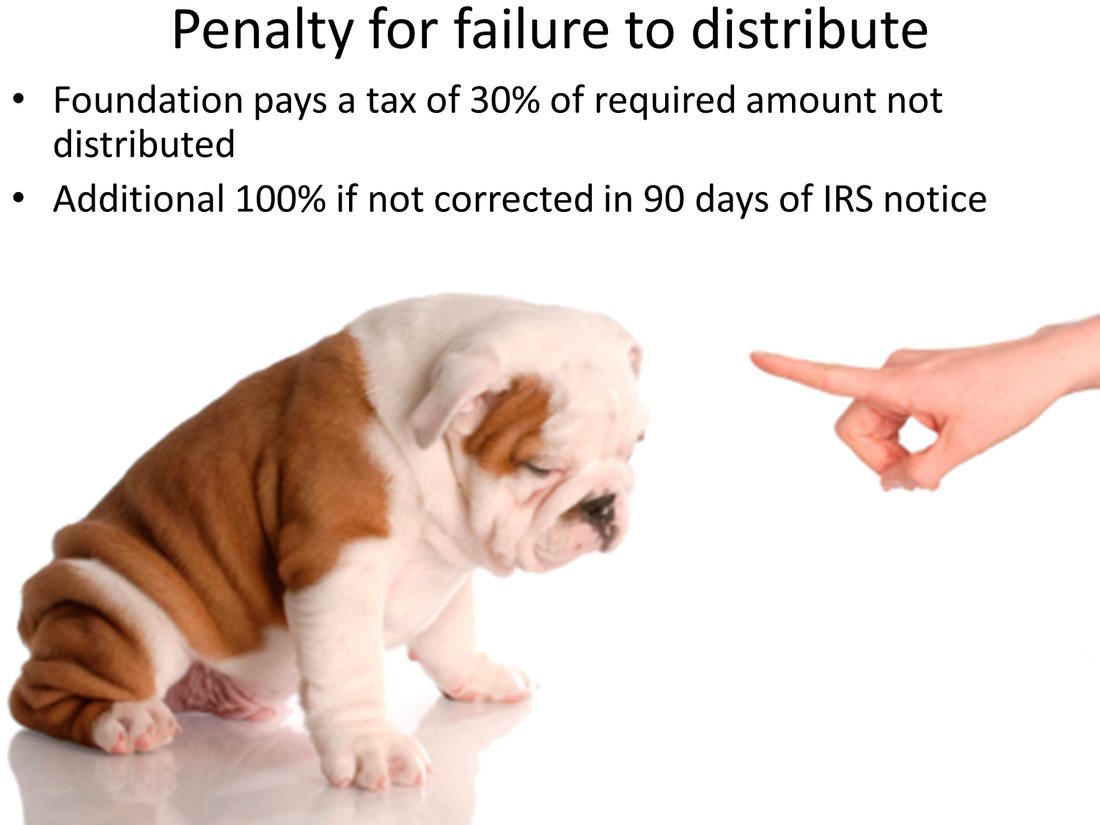
As with the other violations, failure to distribute the minimum required amount to charity results in a tax penalty. The penalty begins at 30% of the undistributed amount. An additional tax of 100% of the undistributed amount is charged if the distribution is not made within 90 days of the IRS notice of the violation. Payment of these penalties does not substitute for the payments to charity. Persistent failure to distribute could result in the revocation of the foundation's tax exempt status.
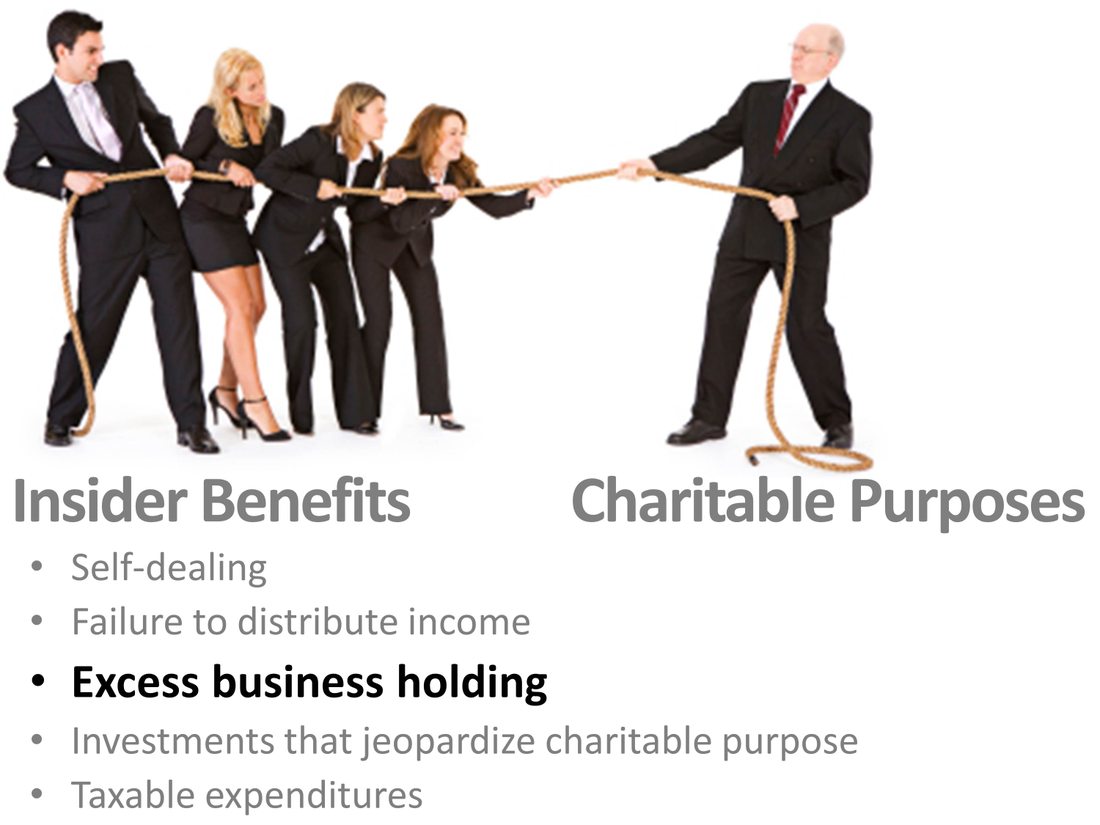
The next type of prohibited transactions is excess business holdings where the private foundation, combined with insiders, holds too large of a share of a business entity.
Prior to the legislation preventing excess business holdings an owner could transfer his or her business into the private foundation, take a tax deduction for the transfer, and still continue to control the business precisely as before with no functional changes. This level of control created a number of opportunities for abuse.
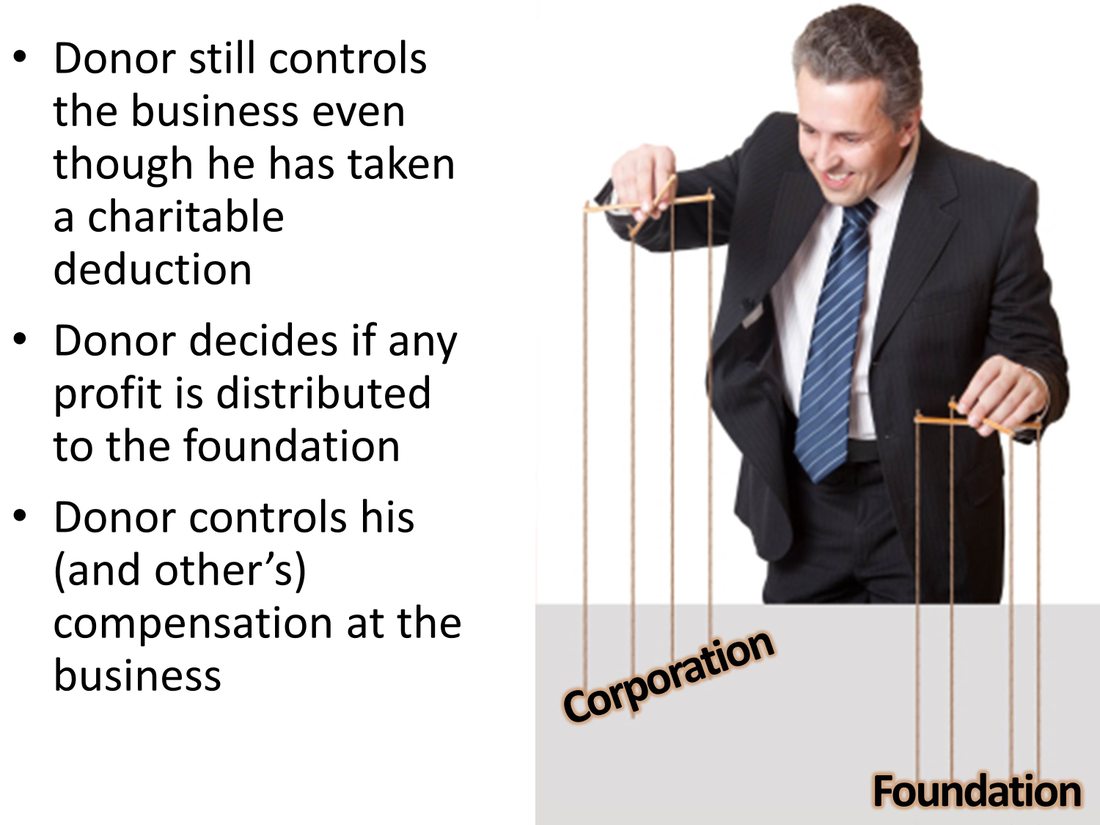
The problems with excessive business holdings come because the donor receives a tax deduction, but continues to control the business. This control means that the donor can decide if any profit is distributed to the foundation, which was particularly important under previous legislation where charitable distributions were based upon income rather than assets. Further, the donor - as controller of the business - would continue to control his own personal compensation as well as all other employees. A donor could thus transfer a business into a foundation, take a large tax deduction, and then extract the value out of the business through salaries paid to the donor and the donor's family members as employees of the business. This payment of salary (or, e.g., "sweetheart" deals benefitting others in exchange for reciprocal treatment in the donor's other non-charitably-owned operations) could be used to cause the company to incur losses, reducing the value of the company, and thus reducing the foundation's required charitable grants based on the company's value. The various schemes for taking a large deduction at transfer and then subtly extracting the value from the company without benefitting the private foundation are nearly limitless, but all are predicated upon the donor being able to control the underlying business entity. Thus, the tax code was changed to eliminate the use of private foundations as a means to control an operating business.
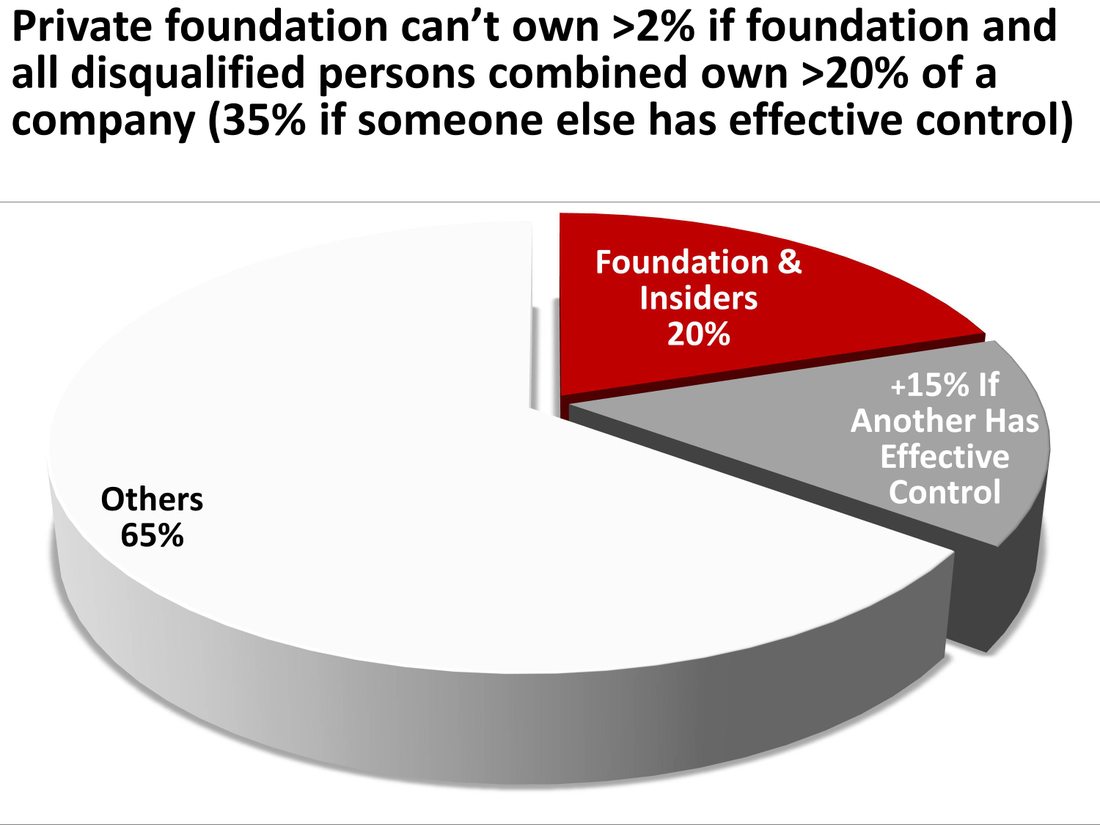
A private foundation is allowed to own up to 2% of a company regardless of the ownership interests of other insiders. Thus, a private foundation could own 2% of a corporation that was otherwise entirely owned by the founding donor. A private foundation may not own more than 2% of a business entity if the foundation and all insiders combined own more than 20% of a business entity. Ownership can refer to voting stock ownership in a corporation, beneficial interests in a trust, or profit interest in a partnership. (Thus, e.g., a private foundation may own 100% of non-voting shares in a corporation where it and all disqualified persons combined own fewer than 20% of the shares.) This permitted ownership percentage will increase to 35% where the foundation can demonstrate that an unrelated person or "cohesive group of third parties" does, in fact, exercise control over the business. In this case, the risk of abuse is likely reduced by the influence of an outside controlling person or group.
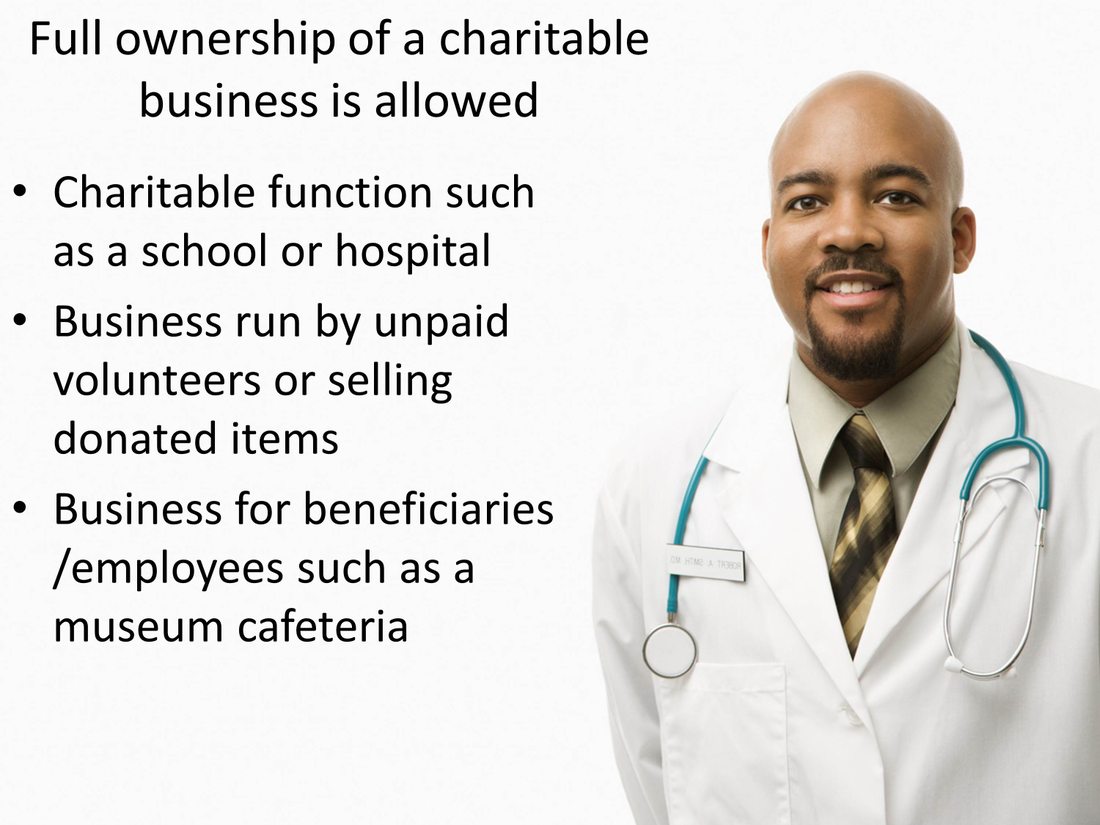
An exception to the prohibition against private foundations controlling a business is allowed when the business entity is engaged in activity directly related to the private foundation's charitable purposes, and not simply earning profits for the foundation's use. Thus, a private foundation could have full control of a school or hospital and thereby further its charitable purposes in education or healthcare. Other allowed businesses include thrift shops selling donated items, a business operated by volunteers, or a business primarily for the convenience of the employees or customers of its charitable business, such as a hospital gift shop or museum cafeteria.
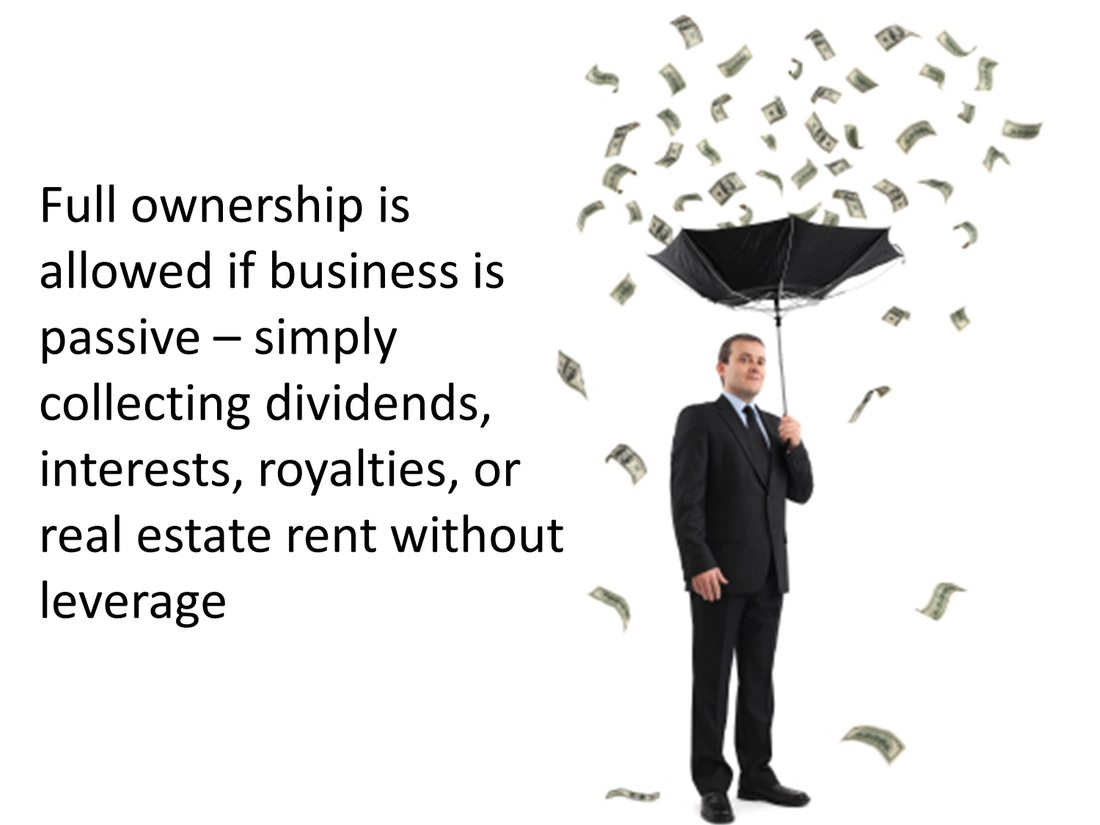
Additionally, a private foundation is allowed to have full ownership of a "passive" business entity that merely collects payments from assets such as dividends from stock holdings, interest from investments, royalties from intellectual property or rent from real estate. So long as this type of income constitutes at least 95% of the business entity's gross income, full ownership of the entity is allowed. Similar to the rules for unrelated business income, borrowing money to purchase real estate will cause such investments to no longer be passive.
The private foundation finding itself in the circumstance of owning excess interest in a business must sell or transfer those interests. This sale must occur within 90 days if the foundation acquired the business interests by purchase or within five years if the foundation receives the business interests by gift. This five year limitation allows time for a business owner to transfer all or part of his or her business to his or her private foundation prior to a sale (thus avoiding the capital gains taxes that would otherwise be due at sale) and still have sufficient time to market and sell the asset, even in a difficult market. Indeed, if the five years is not sufficient to achieve an appropriate sale, the foundation may go through a procedure to request an extension of the time from the IRS, allowing for up to five additional years.
As with other violations, a private foundation having excess business holding is subject to tax penalties. The foundation must pay a tax of 10% of any excess holdings, based upon the highest excess business holdings occurring during the tax year. If the excess business holdings are not removed from the foundation within 90 days of the IRS notice of the violation an additional 200% penalty may be imposed.
In order to preserve the charitable function of the private foundation, the tax code prohibits the foundation from investing in jeopardizing (excessively risky) investments.
Without this restriction, there is a risk that the private foundation's assets could be squandered, thus eliminating any further charitable benefit. In such a case, the taxpayer would have received a large charitable tax deduction, but with no resulting charitable activity. Issuing charitable tax deductions in return for little or no charitable activity violates charitable tax policy principles and, consequently, such risky investments are prohibited.
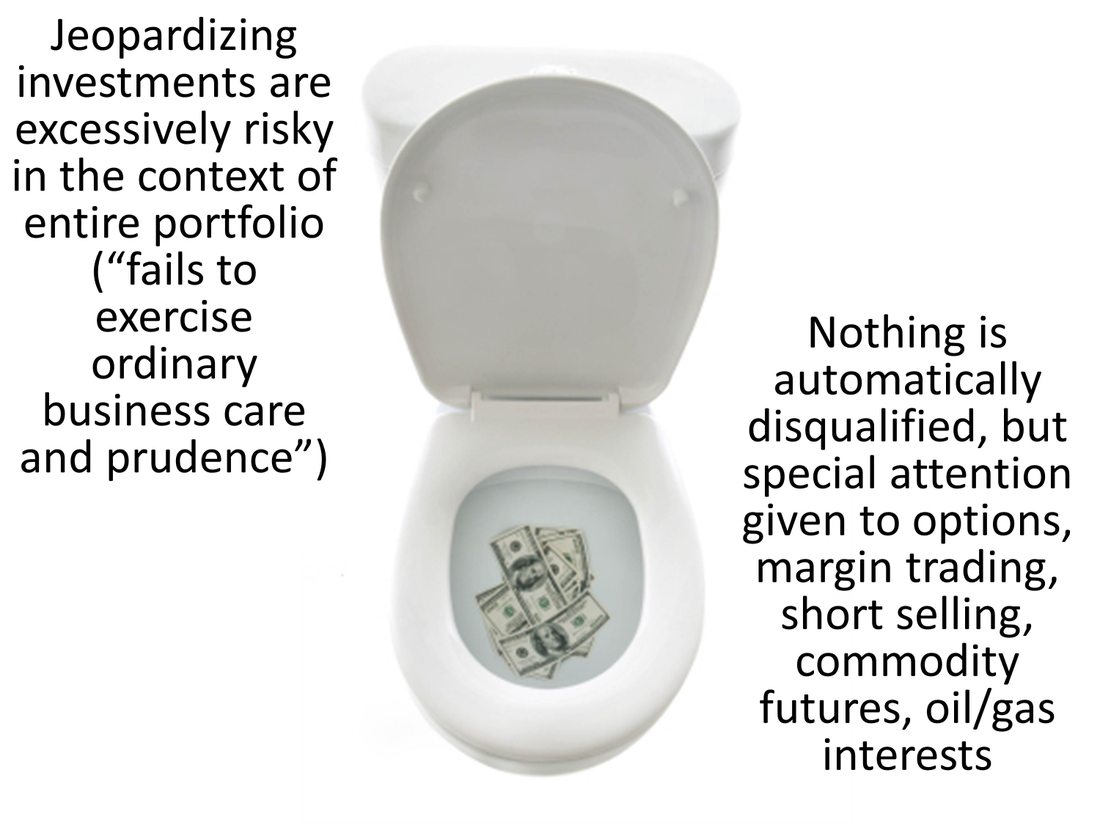
There is no "black and white" rule to determine what a jeopardizing investment is. Instead, it occurs when the manager "fails to exercise ordinary business care and prudence." Although a particular investment may be highly risky, it will be considered in the context of the entire portfolio. For example, the purchase of 60-day out-of-the-money options could be a reasonable part of a hedging strategy taken in the context of other asset holdings, but would clearly be a jeopardizing investment if such options constituted the foundation's entire investment portfolio. Because of the potential for excessive risk, the IRS will pay particular attention to investments in options, margin trading, short selling, commodity futures, and oil and gas interests. Nevertheless, each of these may be a perfectly appropriate investment in the context of the risk profile of the overall investment portfolio.
Because the purpose of the jeopardizing investment rule is to ensure that charitable activity will ultimately occur, rather than the assets being squandered, the rule will not apply to high risk investments that are primarily intended to advance charitable goals. Thus, investments in college loans for needy students or low-income housing may indeed by highly risky, but will not constitute jeopardizing investments. In this case even if the foundation loses its investment, the funds would still have been used to advance charitable purposes and so the underlying tax policy goals would not have been violated.
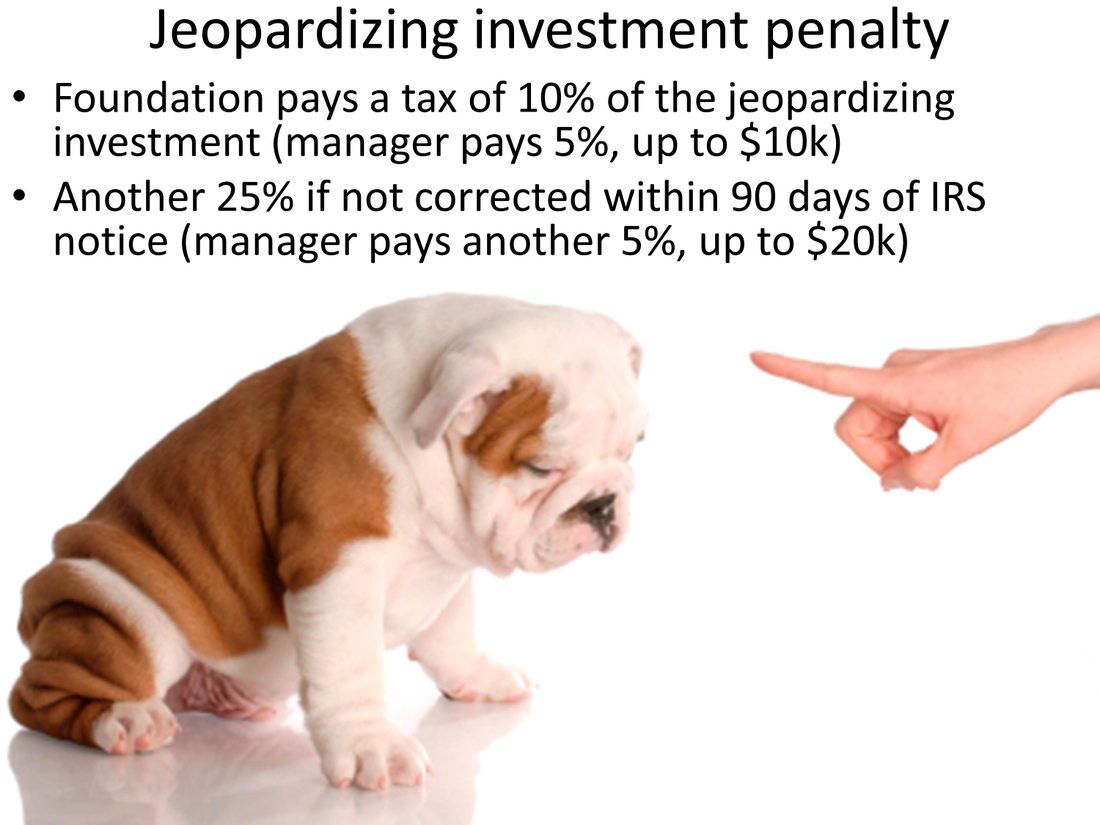
As a penalty for making a jeopardizing investment the foundation must pay a tax of 10% of the amount invested in the jeopardizing investment. Because the foundation manager is directly responsible for managing the foundation's assets, he or she will also be charged a penalty of 5% of the amount invested up to a $10,000 penalty if he or she willingly and knowingly participated in making the investment without any reasonable cause for doing so. As with other violations, an additional tax applies if the violation is not corrected within 90 days of the IRS notice of violation. If the foundation has not divested itself of the jeopardizing investment within this time, the foundation is subject to another tax of 25% of the amount invested in the jeopardizing investment, and the manager may pay an additional 5% of the amount invested up to an additional $20,000 penalty.
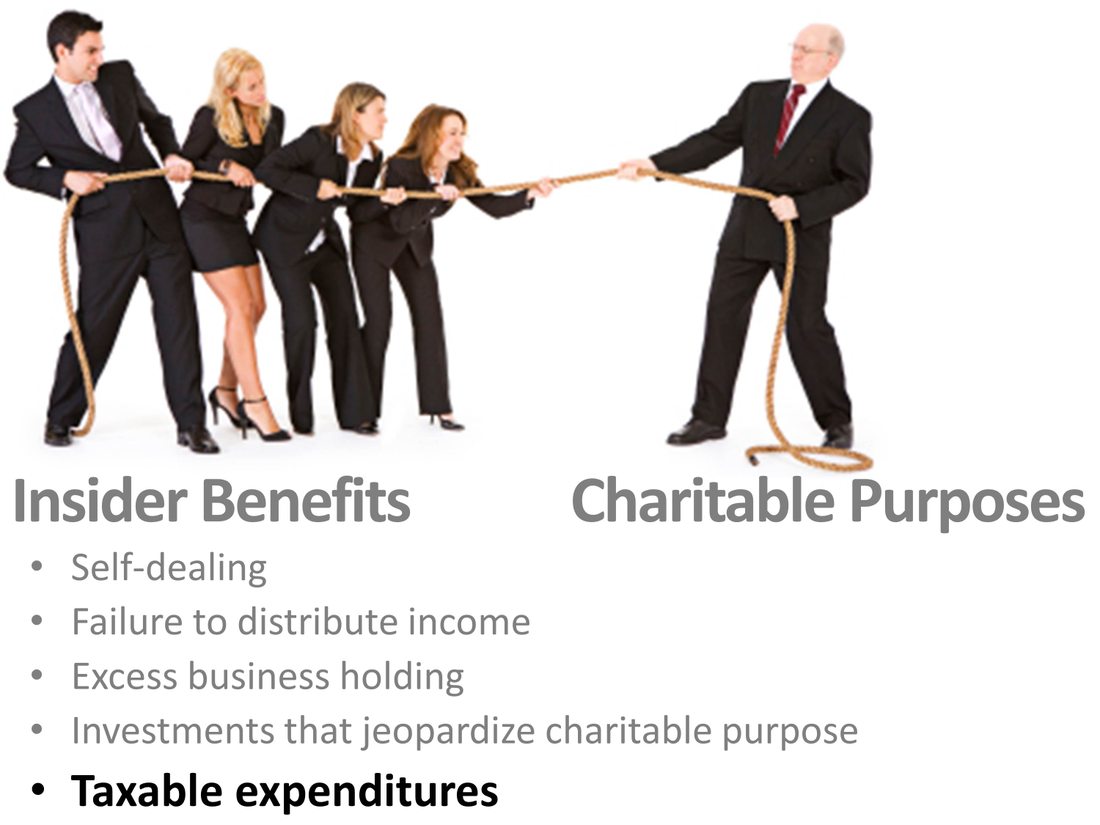
The final way in which the private foundation rules attempt to protect charitable purposes is to prohibit and penalize non-charitable grants from the foundation. These non-charitable grants are referred to as taxable expenditures.
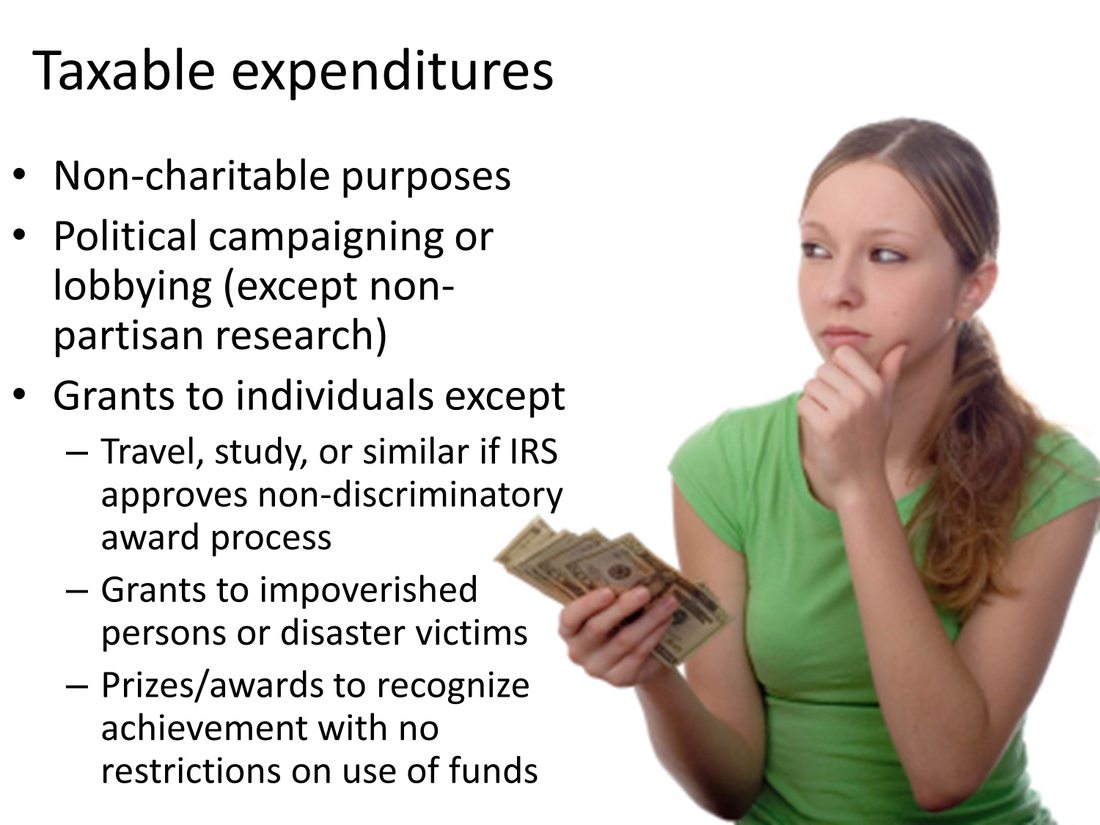
Any grant made by the foundation that does not qualify as an appropriate charitable grant is a prohibited taxable expenditure. This is not a problem for typical grants made to public charities. However, prior to the current law some private foundations were being used to further political campaigns, which is not a charitable purpose. Thus, the use of funds for campaigning and lobbying are now prohibited as taxable expenditures. Non-partisan research is allowed, but there is careful oversight of such activities. For example, support of voter registration drives is not allowed if such drives are limited to specific geographical regions as this may advantage one party or candidate.
Grants to individuals are not charitable gifts, because an individual is not a charity. However, in certain cases a private foundation may fund a grant to individuals for travel, study, or similar purposes. This may be done only with advanced approval of the granting procedures by the IRS. In seeking such approval, the foundation must show that the grant is (1) a scholarship to a nonprofit educational institution, (2) a prize made primarily in recognition of religious, charitable, scientific, educational, artistic, literary, or civic achievement, [note that these awards may be made without prior approval by the IRS if there are no restrictions on or expectations regarding the use of the prize money] or (3) the purpose of the grant is to achieve a specific objective, produce a report or other similar product, or improve or enhance a literary, artistic, musical, scientific, teaching, or other similar capacity, skill, or talent of the grantee. In addition to grants for travel, study, or similar purposes, the foundation may also make grants to impoverished individuals or those who experience catastrophic medical expenses or property loss. These poverty-relief or catastrophe grants do not require advanced approval from the IRS.
Grants made to most charitable entities other than public charities, e.g., private foundations, labor unions, trade associations, fraternal orders, veterans groups, type III non-functionally integrated supporting organizations, or other supporting organizations controlled by a disqualified person, are taxable expenditures. The exception to this rule is that if the private foundation exercises "expenditure responsibility" on grants made to such organizations then the grant is permitted. Expenditure responsibility requires a variety of tasks including a written agreement of the specific charitable tasks the entity will accomplish, segregation of funds, regular reports from the recipient, and special reports to the IRS.
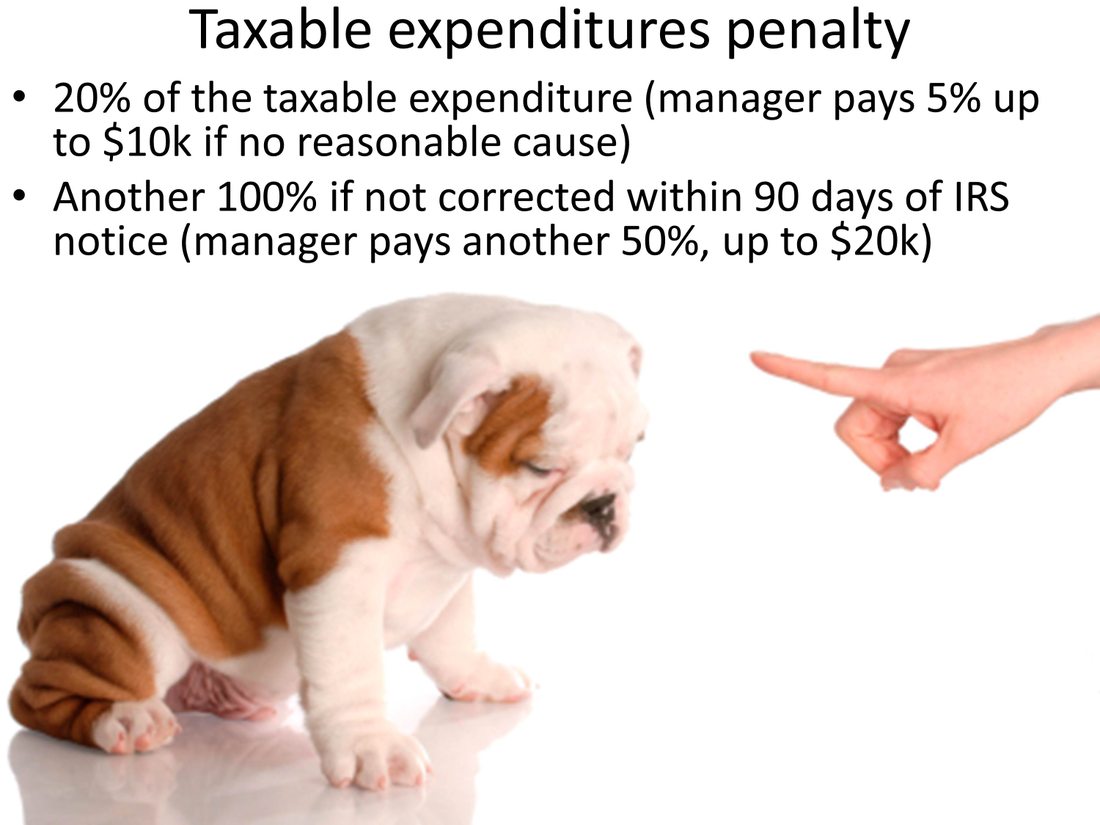
If a private foundation makes grants that do not qualify as appropriate charitable grants it will be penalized initially by a 20% tax on the amount of the taxable expenditure. The foundation manager is subject to a 5% tax, up to a $10,000 maximum, if there was no reasonable cause to believe the expenditure would be appropriate. The foundation must recover the expenditure or, where full recovery is not possible, the foundation must recover as much as possible and take any corrective action directed by the IRS within 90 days of the IRS notice of the violation or the foundation will receive an additional penalty of 100% of the taxable expenditure. Absent such timely correction, the foundation manager may also be penalized another 50% penalty, up to $20,000.
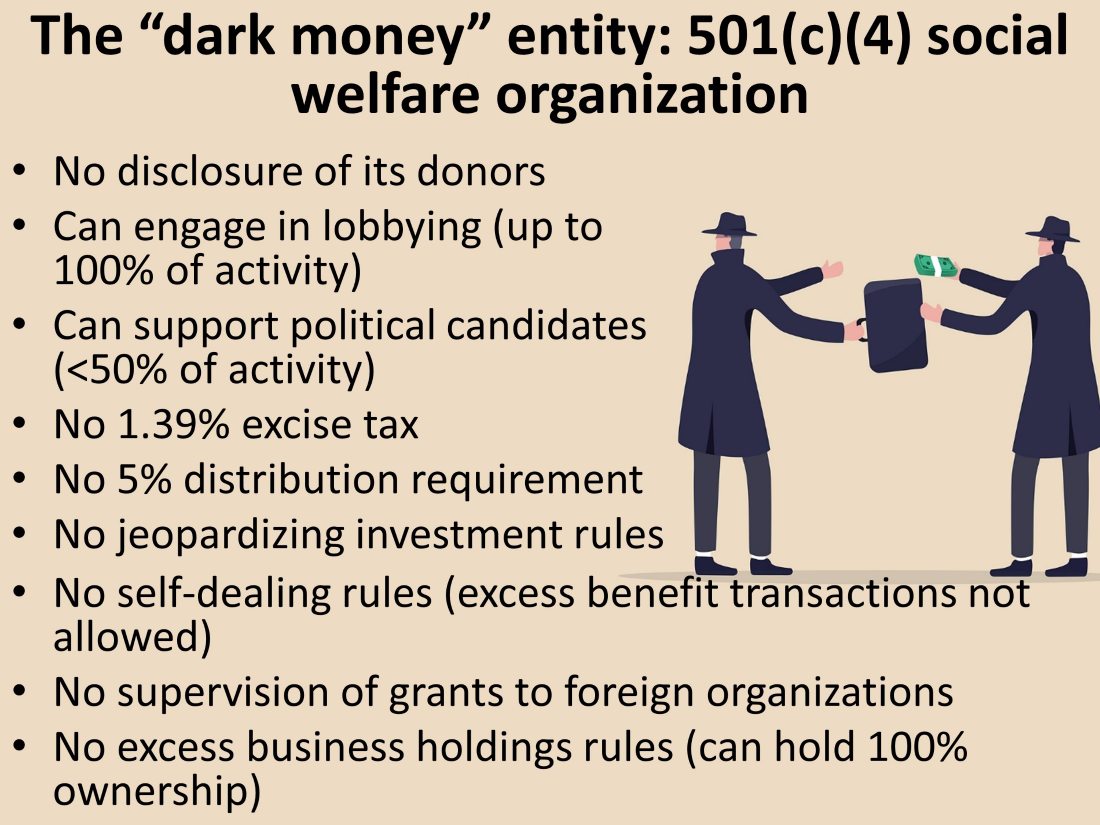
The "dark money" charitable entity. A 501(c)(4) social welfare organization is not subject to private foundation rules. It can engage in lobbying as its primary activity. It can support political candidates - although not as its primary (over 50%) activity. It does not pay the 1.39% excise tax as private foundations do. It has no 5% distribution requirement. It can engage in self-dealing with insiders - although not excess benefit transactions. It is not limited by the jeopardizing investment rules. It need not disclose its donors. It has much more flexibility in making grants to foreign organizations. It is subject to no excess business holdings rules. (Thus, a donor can create a 501(c)(4) that can hold his entire business.)
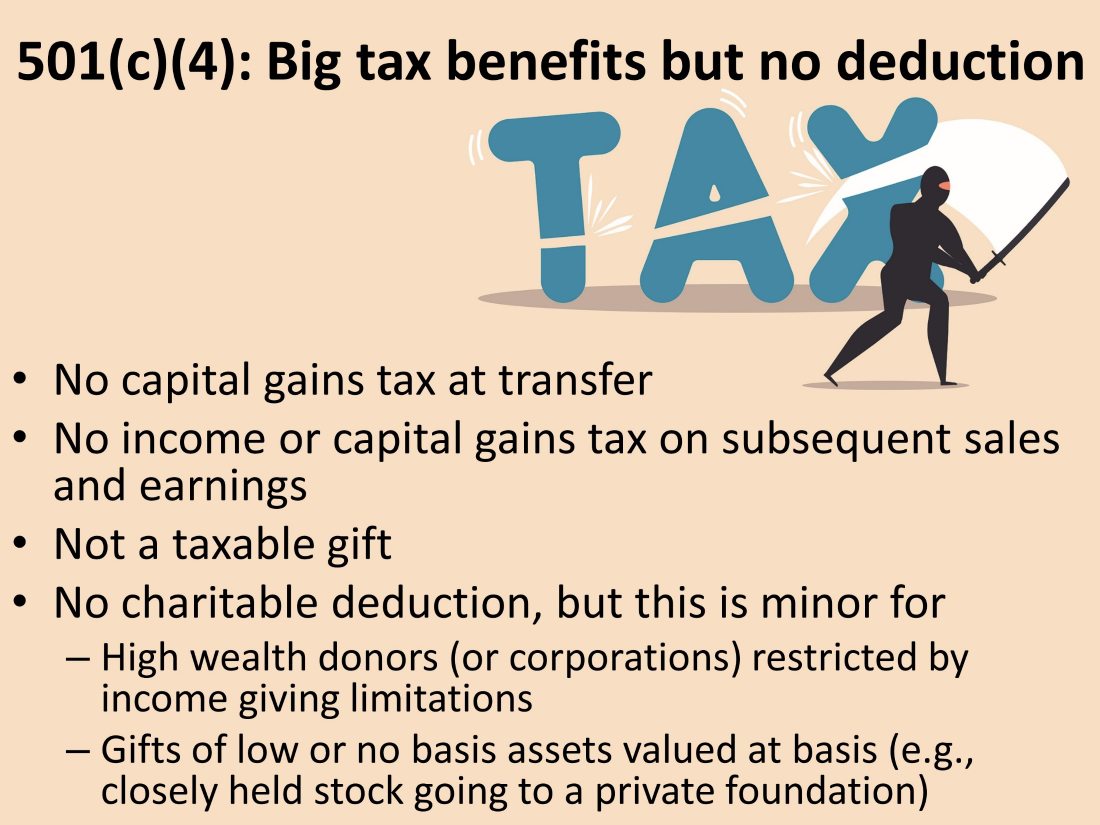
This enormous freedom comes with one penalty. Transfers do not create a charitable deduction. But neither are they taxable gifts. Nor do transfers of appreciated assets create any capital gain recognition. And, as exempt entities, 501(c)(4)'s normally pay no income or capital gains taxes on subsequent sales and earnings. These may be particularly attractive to high wealth business owners (or corporations) who often cannot use charitable tax deductions due to income limitations (see chapter 6). (Any charitable wealth transfers will tend to swamp their often relatively low reportable income.) They may also be attractive to donors considering transferring low or no basis assets to a private foundation if such gifts will be valued at basis rather than fair market value.
The 501(c)(4) alternative tends to be limited to ultra-high net worth donors. For others, the private foundation may be too onerous for other reasons. As briefly summarized above, the rules for establishing and managing a private foundation are extensive. There is, however, an alternative to a private foundation that is much cheaper and easier for the donor. This simple substitute for the private foundation is the donor advised fund.
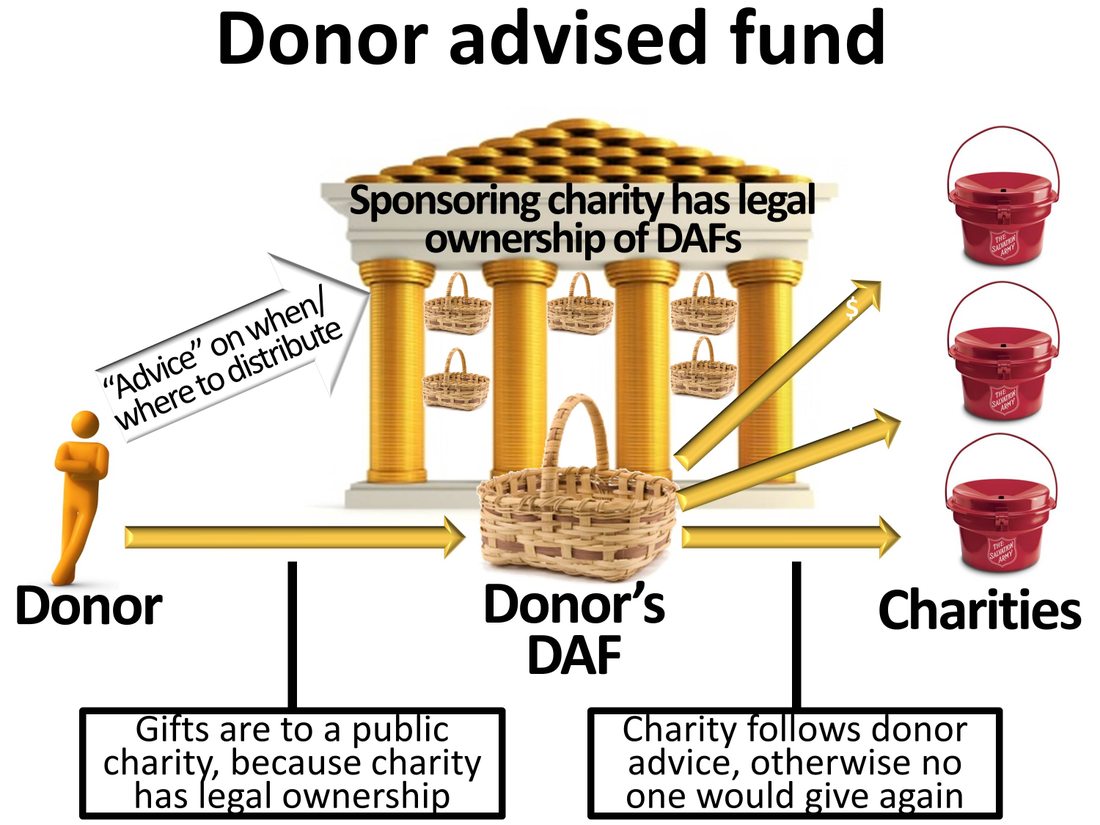
The simple concept of a donor advised fund is that the donor gives money to a public charity which the public charity sets aside in a separate account. The public charity then typically follows the advice of the donor regarding when and where to distribute those segregated funds to other public charities. The charity has legal control of all of the donor advised funds and could choose to ignore the donor's advice. This legal reality does not impact the practical reality that donor advised funds do follow donors' advice (so long as the advice is for legally permissible distributions), because failure to do so would discourage other donors from using the charity for their donor advised funds. Nevertheless, this legal control of the accounts by the public charity owning the donor advised funds means that the donor has made a completed gift to a public charity immediately upon transfer of funds or assets into the donor's account.
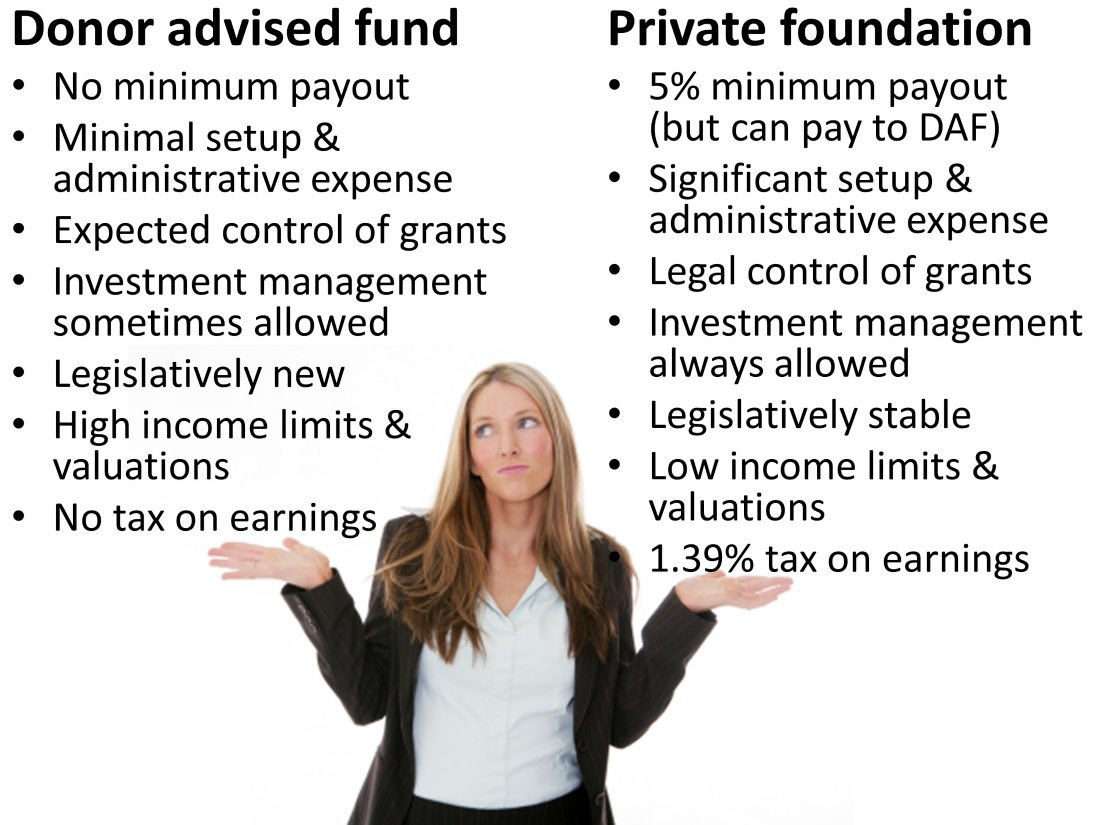
Whether the private foundation or donor advised fund is the best instrument will depend upon the gifts and goals of the donor. Donor advised funds are remarkably simple for the donor to establish. No legal documents need to be specially drafted and there are no annual meetings or required filings. Depending upon the organization, donor advised funds may be started with only $5,000. Annual costs vary with the size of the account, but typically range from 1% to 0.1% of the account value. Donor advised funds meeting certain minimum account sizes (e.g., $250,000), often permit management of assets by the donor's own qualified financial manager and allow for these managers to charge fees to the fund for this management. Large donor advised funds are often comfortable with accepting not just cash, but also complex assets such as privately-held C- and S-corporation stock, limited partnership interests, real estate, and even valuable personal property. Donor advised funds do not expire at the death of the donor. Managing charities typically allow for the appointment of new advisors at death. These new advisors can appoint others during life or at death, indefinitely continuing the passage of control. Further, there are currently no minimum payout requirements for these funds, meaning that no charitable distributions would ever have to occur. Donor advised funds have several tax advantages over private foundations. Gifts to public charities (such as donor advised funds) may have higher valuations and generate deductions that can be used up to a higher percentage of the donor's income than gifts to private foundations. Additionally, donor advised funds are not subject to the 1.39% excise tax on net investment income as are private foundations.
With all of these advantages of the donor advised fund, why would a donor ever use a private foundation? There are several reasons. Private foundations offer a much higher degree of multi-generational control of assets. The founding donor can create legally enforceable trust rules that limit the charitable purposes of the foundation, limit the trust expenditures, and dictate who may - and may not - be trustees and board members. The rules for private foundations are quite old and legislatively stable, suggesting a high likelihood for multi-generational stability. Although donor advised funds are not new, the massive growth of funds from charities affiliated with financial institutions is new, and consequently many of the rules have only been recently established. This legislative newness combined with the complete lack of any enforceable legal rights to control the funds in the donor advised account make donor advised funds a less certain option for long-term planning. Although convenient, donor advised funds lack the ability to directly benefit friends or family members through travel reimbursements and employment in professional and managerial tasks.
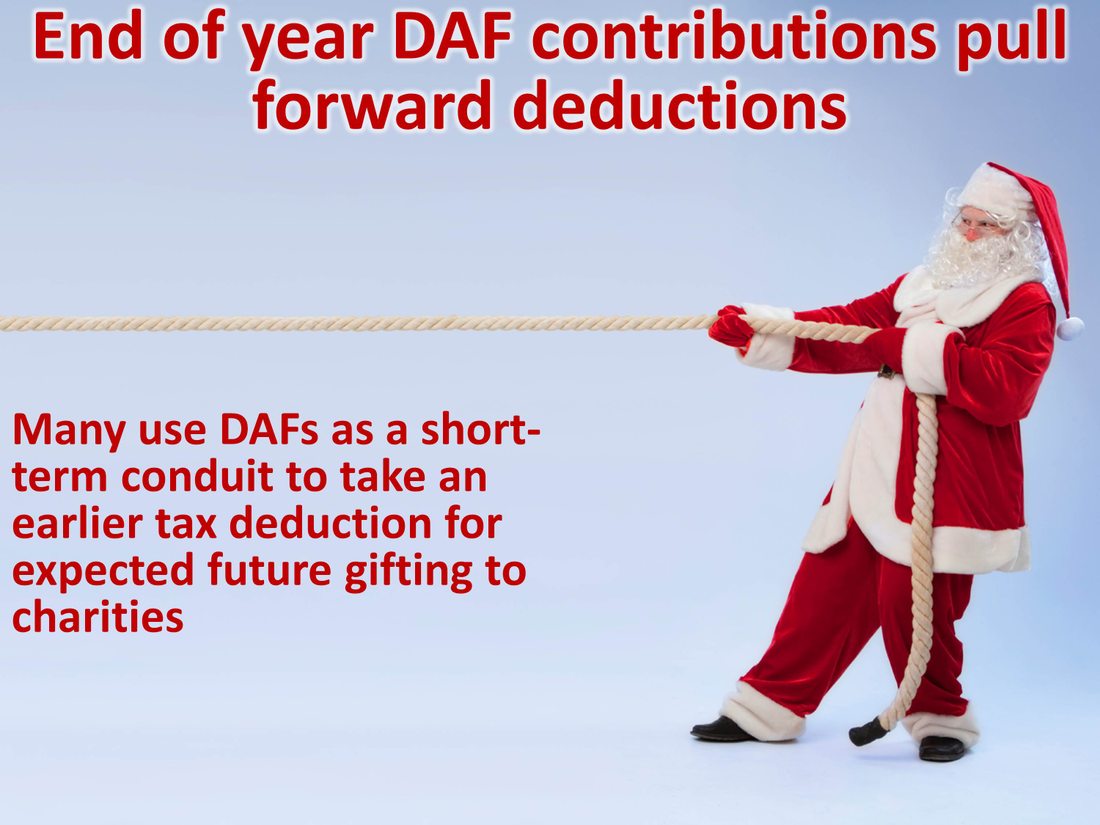
Donor advised funds have a much higher average payout rate than private foundations, reflecting their common use as a short-term place to park charitable funds. It often makes sense for donors to estimate their giving for the upcoming year and then transfer that money to a donor advised fund at the end of December. This allows for the charitable deductions to be taken earlier, even though the ultimate distributions to charities will not take place until the following tax year or later. This type of short-term planning corresponds perfectly with the convenience and simplicity of the donor advised fund. Additionally, if the donor would normally take the standard deduction, it can make sense to select a target year to itemize deductions and pre-fund charitable giving for future years so that the deductions can all be used in the target year.
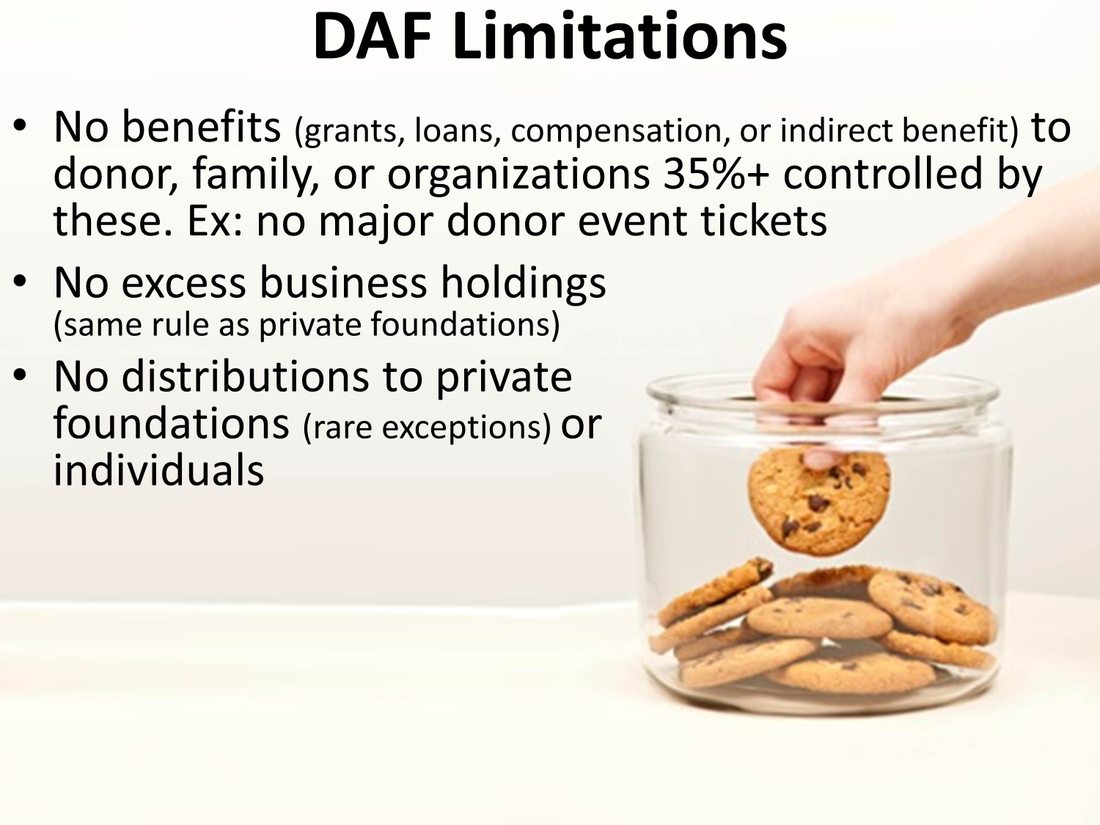
Many of the same type of limitations on private foundations also apply to donor advised funds. For example, there can be no benefits going to the donor, the donor's family, or organizations controlled by either. However, based on IRS Notice 2017-73, grants from a donor advised fund could now be used to fulfill a pledge by the donor to a charity so long as the DAF sponsor does not reference the pledge in the grant letter or check. Nevertheless, grants from a donor advised fund cannot result in the charity giving benefits, such as donor event tickets, to the donor. Donor advised fund grants that generate such benefits are subject to a tax of 125% of the amount of the benefit, payable by either the donor/advisor or the benefit recipient, and a 10% tax on the donor advised fund manager who knowingly made such a transfer (up to $10,000). Donor advised funds are also subject to the same rules preventing excess business holdings as private foundations are. Donor advised funds may make distributions to other donor advised funds. However, donor advised funds may not make distributions to individuals. Donor advised funds may not make distributions to private foundations, unless the managing charity follows the rules for "expenditure responsibility," and even then distributions to a private foundation controlled by the donor or donor's family may result in excess donor control leading to the fund being reclassified as a private foundation. Any distributions to private foundations may also create the opportunity for challenges to the higher deduction taken for a gift to a public charity upon transfer to the donor advised fund, rather than for a gift to a private foundation.
Private foundations and donor advised funds offer opportunities to take an immediate tax deduction for a transfer where the donor and donor's financial advisors can continue to manage the funds for the indefinite future. Once transferred, the funds can grow in a tax-free or tax-minimal environment. Although private foundations are typically used for long-term holding of more significant wealth, and donor advised funds are more commonly used for short-term holding of less significant wealth, finding the best fit will depend upon the specific values and goals of each particular donor.