
Donating retirement assets can result in terrible tax consequences or fantastic tax consequences depending upon the timing and circumstances of the donor. Thus, it is especially important for advisors and fundraisers to have some familiarity with the tax rules associated with such gifts.

Given the inherent complexity in dealing with retirement assets, some might consider simply ignoring these assets as a source of charitable gifts. Rules for traditional IRAs, 401(k) accounts, 403(b) accounts, SIMPLE-IRAs, SEP-IRAs and so forth may seem intimidating. However, retirement assets should not be ignored. This is true in part because the client can experience significantly positive tax consequences from such gifts in certain circumstances.

Aside from these potential tax advantages, retirement assets cannot be ignored because they represent such a large share of all household wealth. More than a third of all household financial assets are held in the form of retirement assets. The share of household net worth held in defined contribution plans like IRAs and 401(k)s has more than tripled in the last 30 years. Thus, neither fundraisers nor advisors should ignore this substantial source of wealth holding.

Retirement assets can be donated during life or at death. The tax consequences are very different for each type of gift, so they will be covered separately. Gifts during life involve more complicated considerations and their advisability depends in part upon the "life stage" of the retirement account.
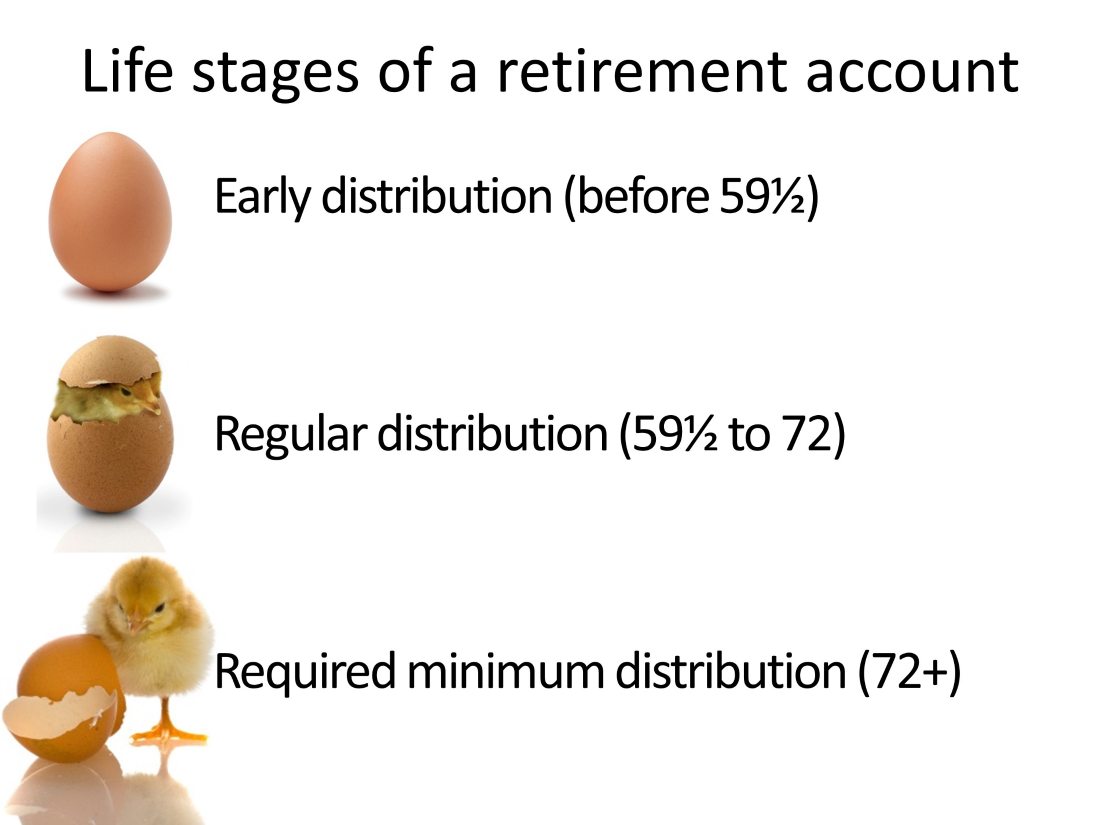
Retirement accounts such as traditional IRAs, 401(k) accounts, and 403(b) accounts have three stages. Each stage corresponds to a different tax consequence of gifting assets from the account. Before the account holder reaches age 59½, distributions will be considered early distributions, and are typically subject to penalties for withdrawal. When the account holder reaches age 59½, these penalties no longer apply. However, as with other distributions from the account, the account holder must pay taxes on these distributions, because the income was not taxed when initially put into the account. Finally, when the account holder reaches age 72, he or she is required to take at least minimum distributions from the accounts each year. These distributions count as taxable income to the donor.
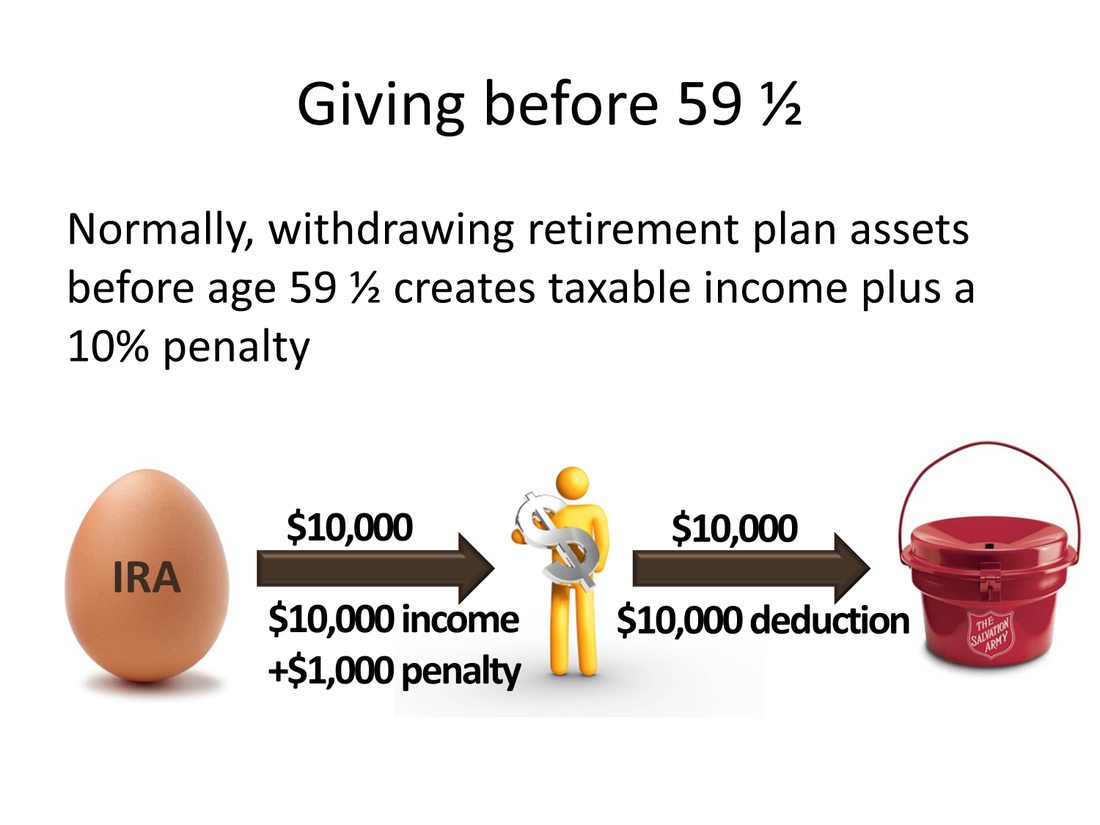
For donors younger than 59½, making gifts from a retirement plan is generally a bad idea. Not only will the withdrawal be considered income to the donor, and thus be subject to taxation, but the donor will also have to pay an additional 10% penalty. This penalty is charged because the donor is withdrawing assets from the account prior to age 59½. The donor may receive a charitable deduction from the gift. This deduction could offset the income charged to the donor as a result of withdrawing the funds. However, this charitable deduction will not offset the 10% penalty charged for early withdraw.
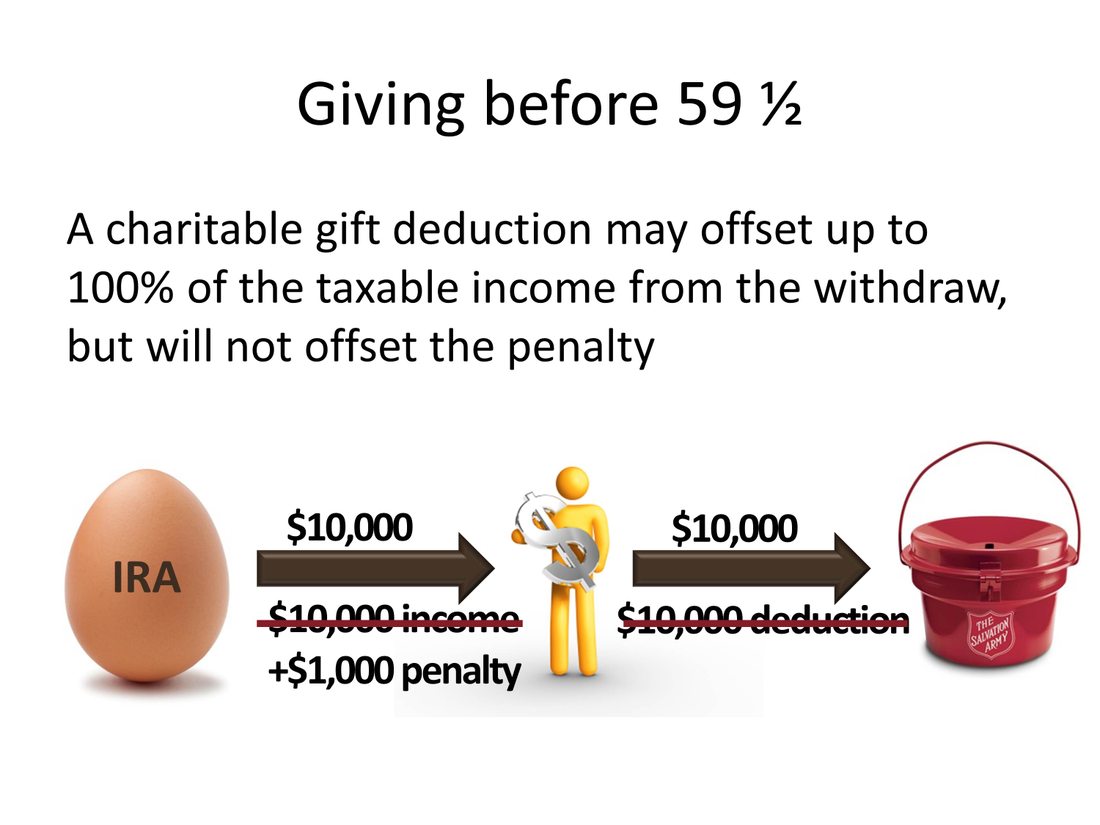
The charitable deduction resulting from the donation will not offset the 10% penalty for the early withdraw. Thus, even in a perfect situation, making a $10,000 gift by withdrawing funds from the retirement account will cost the donor at least $11,000. Beyond this, it is often the case that the charitable deduction may not perfectly offset the effects of the increased income resulting from the withdraw of funds. For example, if the donor was not otherwise an itemizer, the charitable deduction for a $10,000 gift will not reduce income by the full $10,000. Or, if the donor reaches the income limits for deducting charitable gifts, the deduction will be not be available until future years.
Further, the increase in income, even if offset by deductions, may generate other negative tax consequences because certain tax benefits are not available for those whose adjusted gross income falls above specific levels. For example:
. The additional senior deduction of $6,000 phases out beginning at $75,000 (single) and $150,000 (joint).
. The earned income tax credit is reduced for income above certain thresholds. (In 2025 these thresholds were $19,104 for a childless single taxpayer, $50,434, $57,310, or $61,555 for a single taxpayer with 1, 2, or 3 children, $26,214 for childless married taxpayers filing jointly, and $57,554, $64,430, or $68,675 for married taxpayers with 1, 2, or 3 children filing jointly.)
. The adoption credit ($17,280 in 2025) is reduced for those with modified adjusted gross income above the threshold level ($259,190 in 2025).
. The child tax credit ($2,000 for each qualifying child) is reduced by 0.5% for any modified adjusted gross income above the threshold level (in 2025 this was $200,000 for single taxpayers, $400,000 for married taxpayers filing jointly).
. Education tax benefits also phase out after certain income thresholds such as the American Opportunity Credit ($80,000 for single taxpayers, $160,000 for married taxpayers filing jointly), Lifetime Learning Credit ($80,000 for single taxpayers, $160,000 for married taxpayers filing jointly), and deductibility of qualifying student loan interest ($70,000 for single taxpayers, $140,000 for married taxpayers filing jointly).
. Eligibility to make Roth IRA contributions begins to phase out after certain income thresholds (in 2025, $150,000 for single taxpayers, $236,000 for married taxpayers filing jointly), as does deductibility of IRA contributions (in 2025, $79,000 for single taxpayers participating in a workplace plan, $126,000 for participating spouse with married taxpayers filing jointly, $236,000 for non-participating spouse with married taxpayers filing jointly).
For taxpayers affected by these phase-out ranges, the negative tax consequence of the increased income resulting from the retirement account withdraw will not be perfectly offset by the charitable income tax deduction. Additionally, if taxpayers are eligible for other income-based government benefits, the increase in income resulting from the retirement account withdraw may have additional negative consequences.
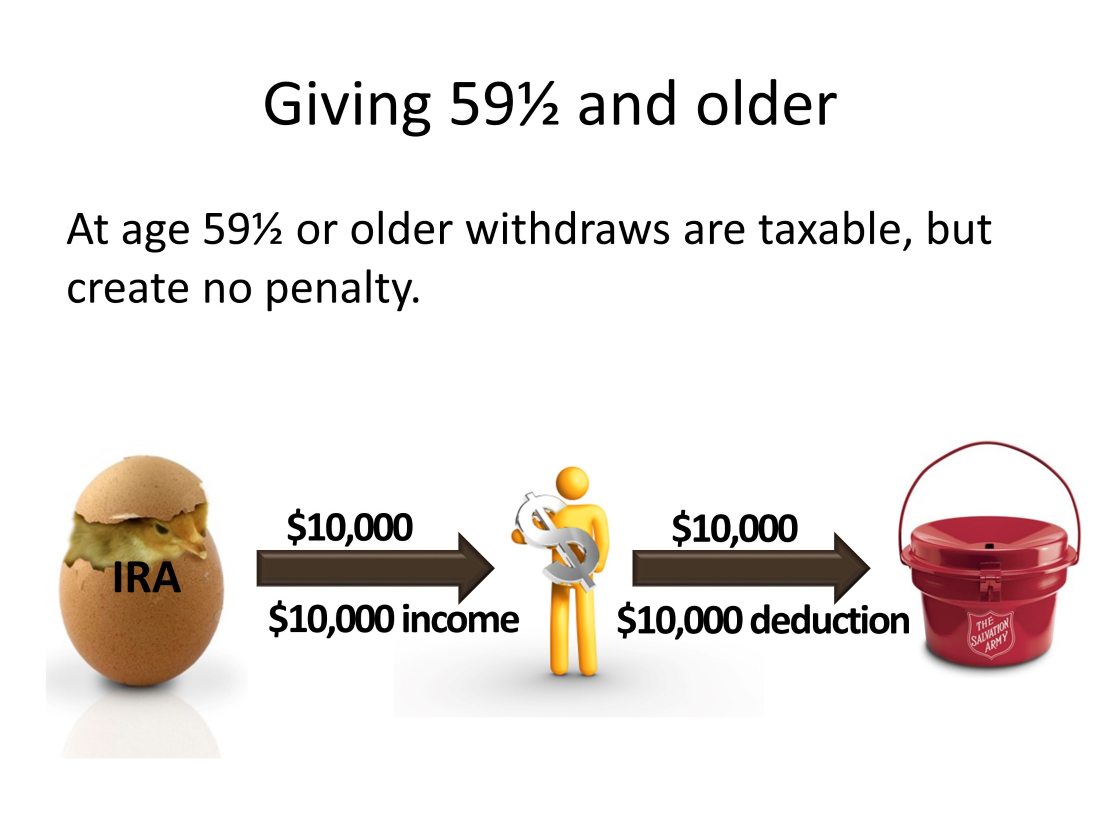
Withdrawals made at age 59½ or after do not generate the 10% penalty as do those made before this age. Consequently, it is possible that the deduction generated by making a corresponding charitable gift could completely offset the effects of the increased income due to a withdrawal from a retirement account. As before, the ability to completely offset the effects of the increased income with the charitable tax deduction depends upon a variety of factors such as the donor's itemization status, the income giving limitations, and whether or not the increased income will have negative effects for the donor in other areas such as income-based phase outs for various tax benefits.
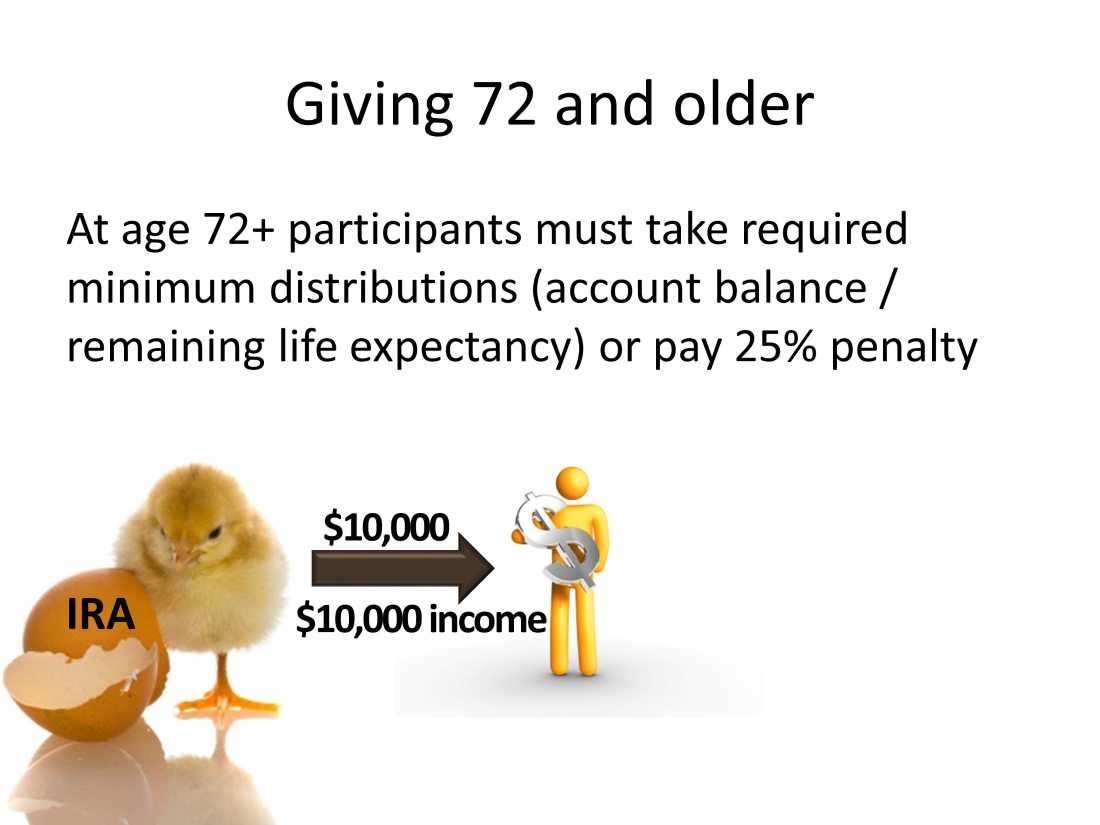
Withdrawals at age 72 or after receive the same tax treatment as those taken at any point at age 59½ or after. The primary difference is that minimum withdrawals are required beginning at age 72. Thus, the account holder cannot simply choose not to take a withdrawal. Instead the account holder must take a minimum withdrawal in the amount of the account balance divided by the remaining years of life expectancy for a typical person of the account holder's age. If the account holder fails to withdraw at least this amount, he or she can be penalized in the amount of 25% of the required minimum distribution.
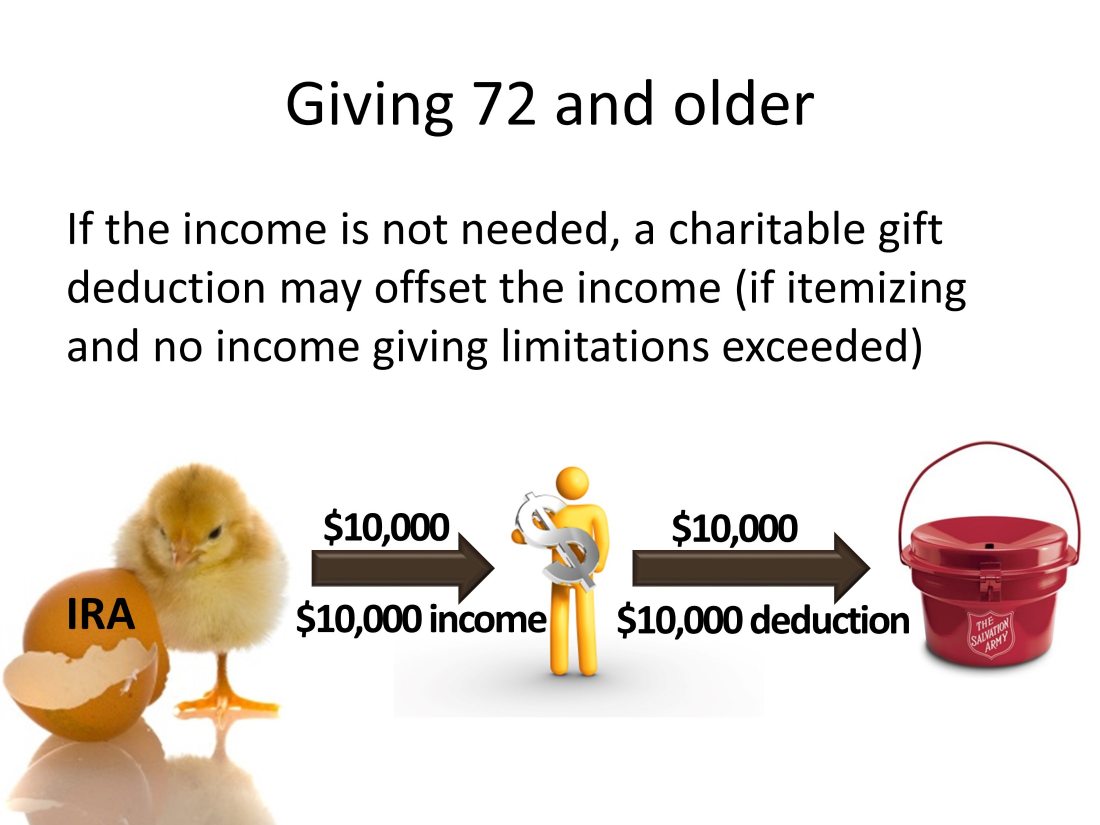
Because the taxpayer is forced to withdraw the required minimum distribution from the retirement account, the negative tax effects from increased income will occur regardless of whether or not a charitable gift is made. The taxpayer cannot simply choose not to take a withdraw. If the taxpayer is forced to withdraw the funds, but does not need them for consumption, a charitable gift may be an ideal use of these funds. The charitable deduction resulting from the gift may entirely (or at least partially) offset the negative tax affects resulting from the increased income due to the required distribution.
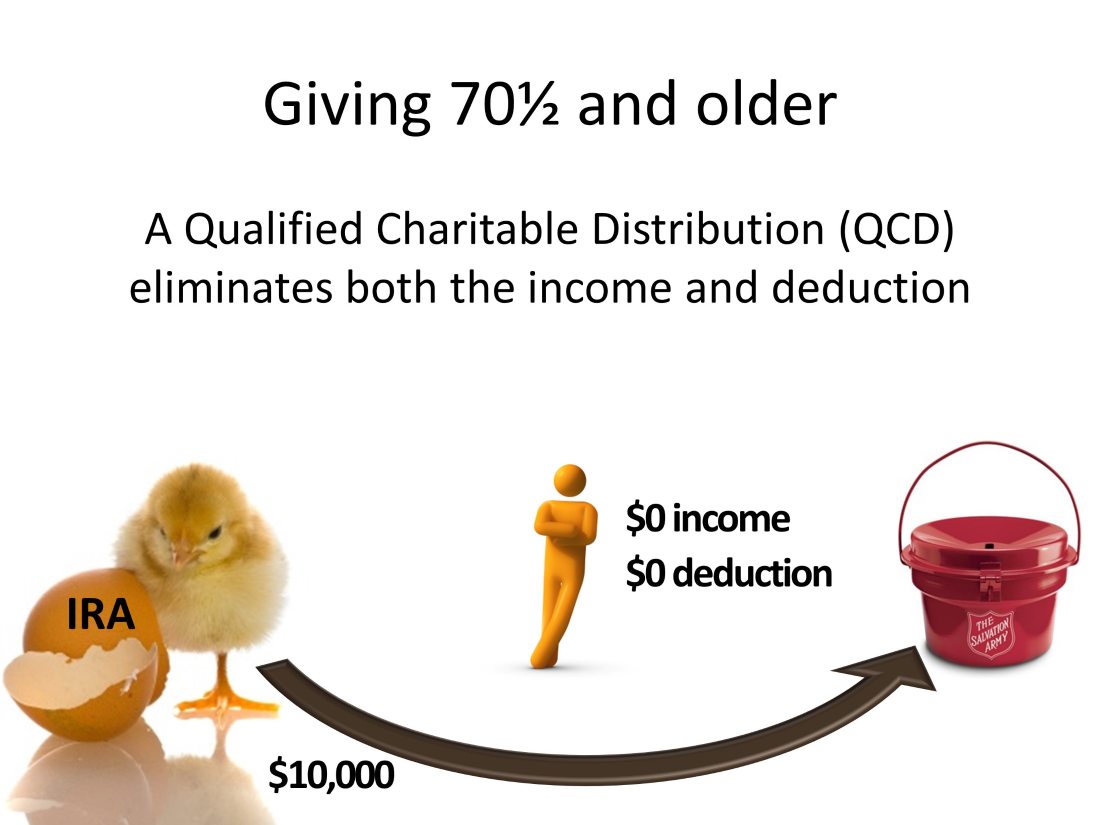
The ideal charitable distribution is a qualified charitable distribution (QCD). This arrangement is ideal because the donor is allowed to make a transfer directly from his or her retirement account to a charity. This transfer does not count as income to the donor, but does reduce the required minimum distribution from the account. The donor receives no deduction, but also has no increase in income. This perfect offset makes this transaction equivalent to the "perfect" withdrawal and gift transaction with a 100% useable tax deduction and no negative effects from the increased income.
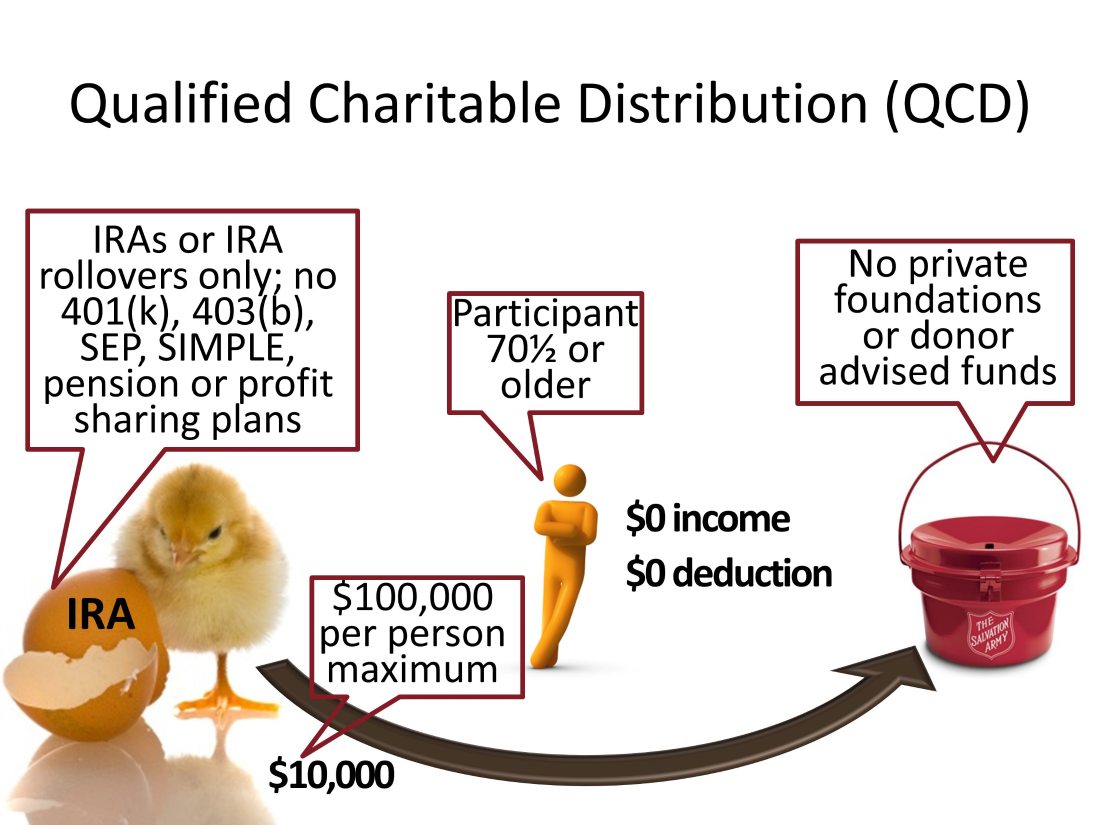
The qualified charitable distribution includes the following limitations. The participant must be 70½ or older (i.e., before RMDs start at 72). The maximum transfer is limited to $100,000. The qualified charitable distributions must be from an IRA or IRA rollover. These are not allowed from 401(k), 403(b), SEP, SIMPLE, pension or profit sharing plans. However, the retired account holder with a 401(k), 403(b), 457 plan, SEP-IRA, or SIMPLE-IRA (assuming it is more than 2 years old) could consider rolling the account over into a traditional IRA rollover to allow for future qualified charitable distributions. This strategy will work only for qualified charitable distributions in future years because any current required minimum distribution from the non-traditional IRA account must be distributed and cannot be rolled over into a traditional IRA. Also, the distribution must go to a public charity (not a private foundation or donor advised fund). The donor may receive no benefits in return for the transfer excepting only that a donor may use these transfers to fulfill a donation pledge to a public charity or make a special one-time transfer for a charitable gift annuity or to a charitable remainder trust as described below.
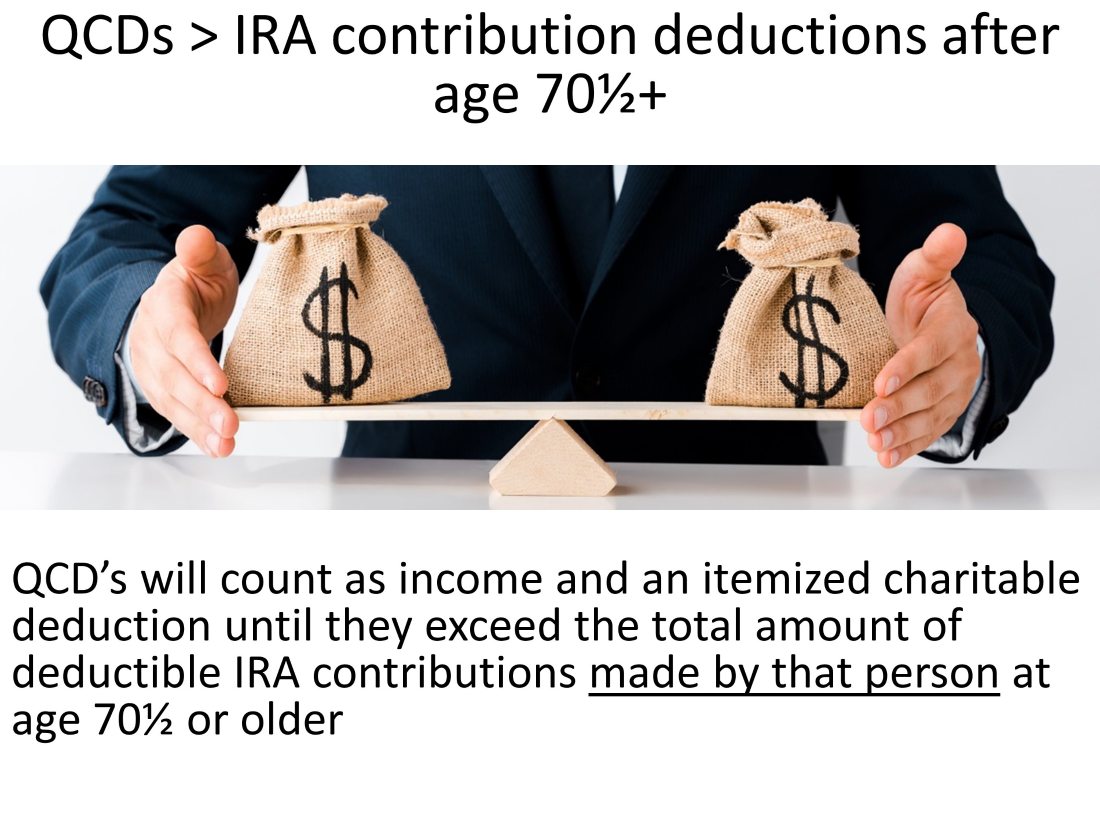
If the donor has taken deductions for making an IRA contribution at age 70½ or older, this may interfere with using a QCD. A QCD will be treated as a normal withdrawal followed by a charitable donation until the total amount of QCDs exceed the total amount of deductible IRA contributions made at age 70½ or older. (Any IRA contributions made before age 70½ have no effect. )
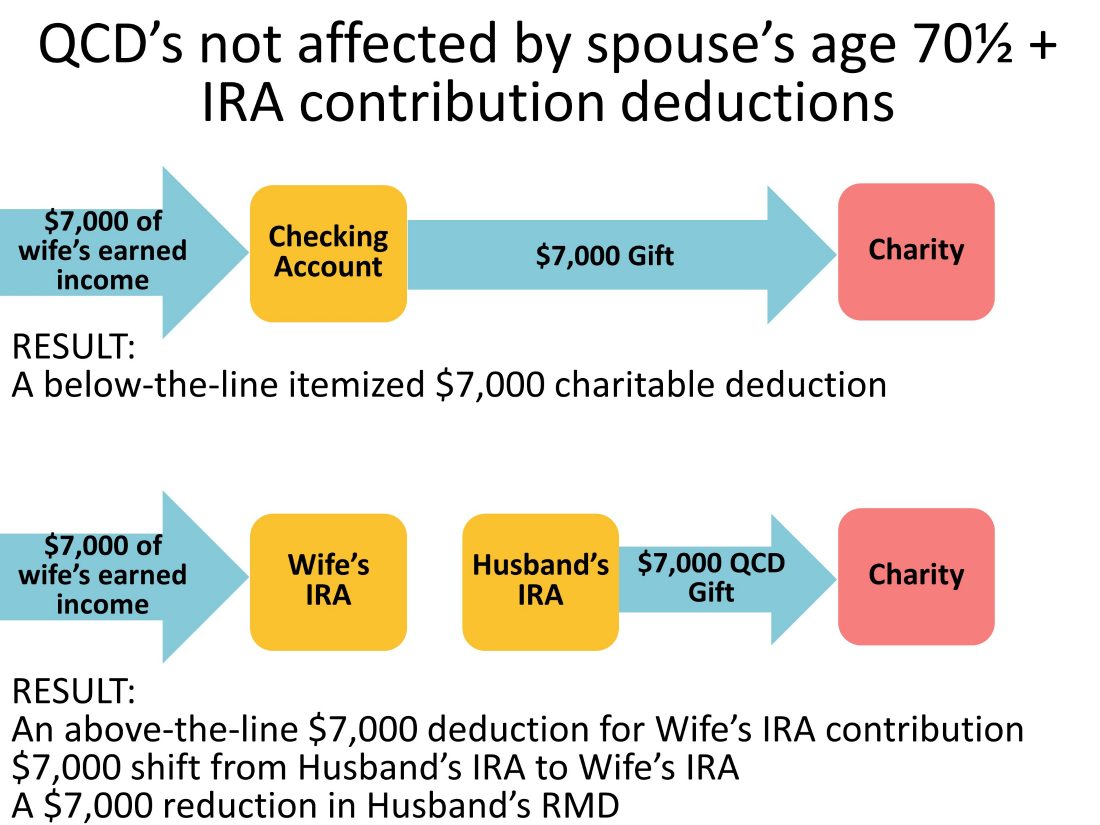
However, QCDs are not affected by IRA contributions made by the donor's spouse. Thus, the donor's spouse could make deductible IRA contributions at any age while at the same time that the donor made QCD donations. If the spouse has earned income but didn't otherwise plan to make an IRA contribution, this creates a planning opportunity. Instead of using the spouse's earned income to make a donation it is usually better to have the spouse make a deductible IRA contribution and have the donor make the donation as a QCD. If the earning spouse makes a donation it creates only an itemized charitable deduction. If the couple is taking the standard deduction, this isn't valuable. However, if the spouse uses those funds to make a deductible contribution to an IRA, that is an above-the-line deduction. It can be used along with the standard deduction. Making the gift as a QCD then lowers one spouse's IRA account, offsetting the increase in the other spouse's account. If the donor is age 72 or older this QCD gift will also lower any required minimum distribtion.
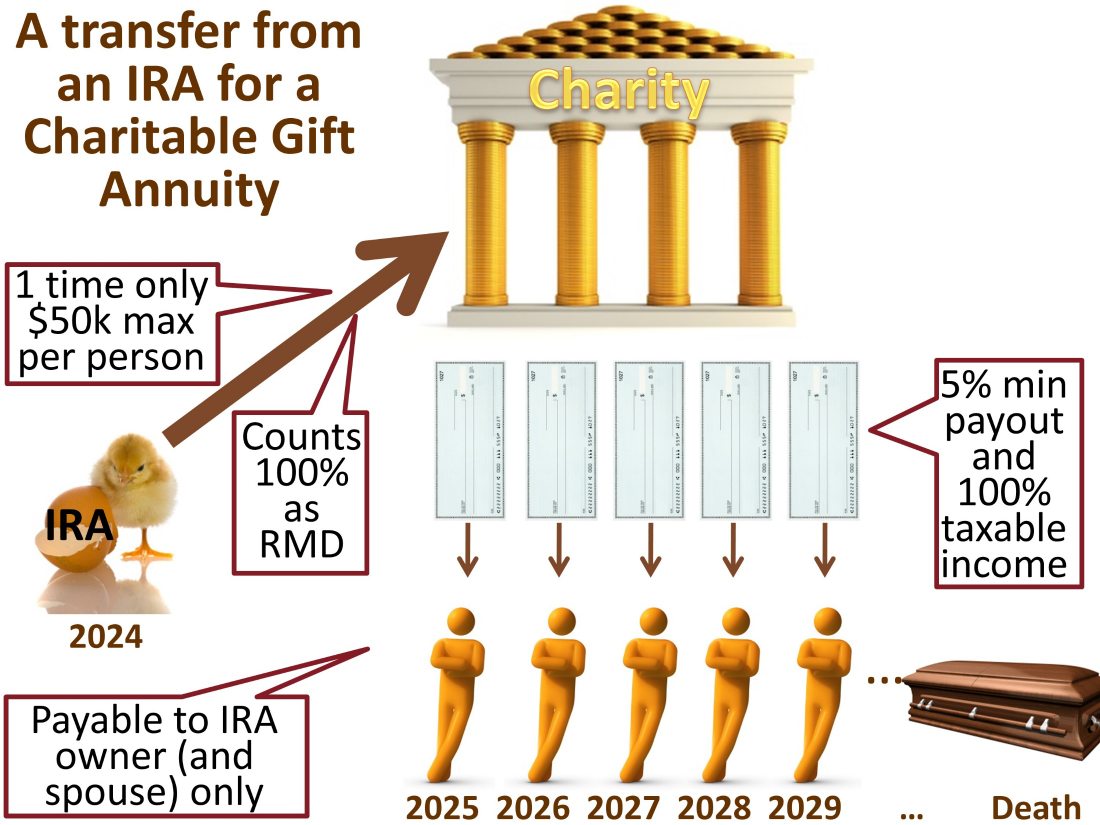
A donor may make a one-time transfer from an IRA or IRA rollover of up to $50,000 to a charity in exchange for a charitable gift annuity (CGA). This transfer will count against any RMDs from the IRA or IRA rollover. This CGA has special requirements. It must pay out at least 5% annually. It can pay only to the account owner or to the owner and the owner's spouse. The contract must not allow the income payments to be assigned. Thus, a donor cannot later decide to give back to the charity by assigning future payments to the charity. These CGAs must be separate contracts - not combined with any previous or future contributions. It is possible to make a similar transfer to a separate charitable remainder trust. However, because these too must be separate entities - not combined with any previous or future contributions - the administrative costs would likely prevent this from being a practical option.
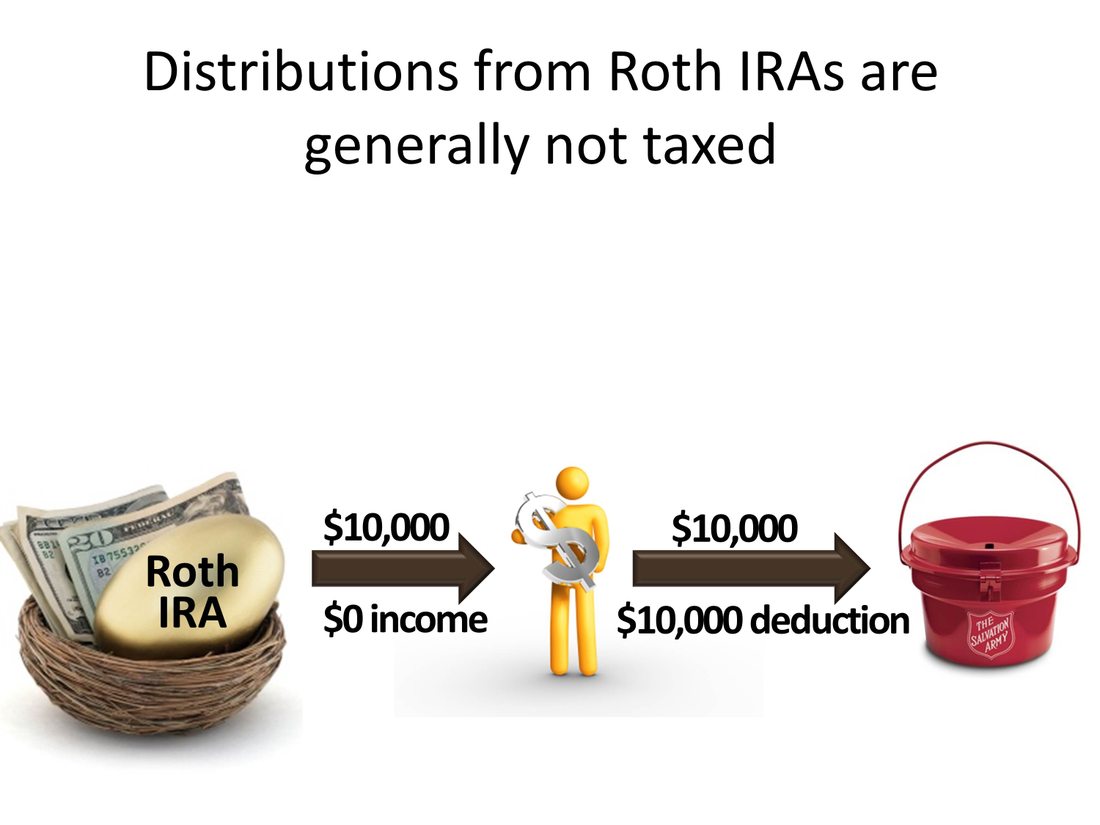
Distributions from Roth IRAs will be tax free in a number of circumstances. First, if the distribution is from the account holder's regular participant contributions to the Roth IRA, there is no taxation or penalties for withdrawing funds. The account holder has already paid taxes on this amount and its contribution into or withdraw from the Roth IRA does not generate any additional taxes or penalties. Any distributions from the Roth IRA are considered to be from the account holder's regular participant contributions until all of these have been distributed. Distributions in excess of the account holder's regular participant contributions will next consist of distributions of any IRA conversions. A conversion occurs when the account holder converts a retirement account such as a traditional IRA into a Roth account. This conversion requires the account holder to pay income taxes on the amount of the converted account. Thus, distributions of such conversions do not generate income taxes because the income taxes on this money have already been paid. However, if the account holder is younger than 59½ and the conversion was less than five years ago, the 10% penalty on early withdraw must still be paid for these conversion assets. (If this rule did not exist, the 10% penalty on early withdrawals from a traditional IRA could be completely avoided by simply converting to a Roth IRA and taking the distribution.) Finally, all remaining distributions will be considered earnings. Distribution of earnings after age 59½ does not generate income taxes or penalties (assuming the distribution occurs at least five years after the account holder funded his first Roth IRA account). However, distributions of earnings before age 59½ typically generate both income taxes and penalties. (The 10% penalty could be avoided from either traditional or Roth IRA accounts if the funds are used for specific allowed purposes, but these do not include making charitable gifts.)
When distributions from Roth IRAs are tax free, they may make a desirable source for charitable gifts. However, this will result in reducing the amount of funds in the Roth IRA and may not correspond with the retirement tax planning strategies of the donor. For example, additional growth in the Roth IRA can be withdrawn without taxation (after age 59½) and reducing IRA assets through gifting eliminates this future tax-free growth on the gifted assets.
Giving from retirement accounts during life often may have negative tax consequences, but in some cases - such as a qualified charitable distribution - may have distinct tax advantages. Charitable giving from traditional retirement accounts at death, in contrast, is almost always more beneficial than giving other types of assets to charity at death.
Traditional retirement account assets are "tax heavy" for heirs. Not only are these assets subject to gift and estate taxation, but they are also subject to income taxation. The money in these traditional accounts has never had income taxes paid on it. Therefore, income taxes must be paid when the funds are withdrawn. This tax burden makes these "tax heavy" assets less desirable for heirs. But, it does not make these assets less desirable for tax-exempt organizations, because these organizations do not pay such taxes. Therefore, it is always to the heirs' advantage (and not to the disadvantage of charities) to make as much of the charitable share of estate assets as possible consist of traditional retirement accounts (i.e., qualified plan money).
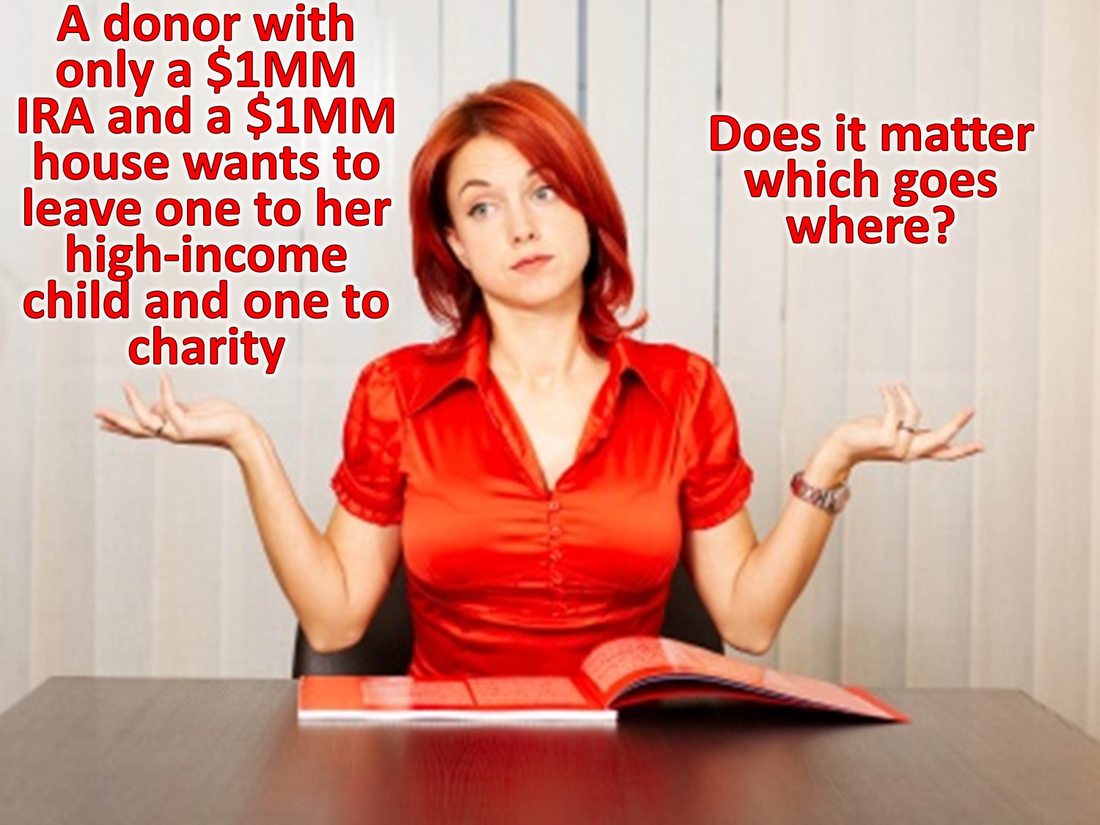
Consider this simple example. A donor has only two assets, a $1 million IRA and a $1 million house. The donor wishes to leave half of her estate to a charity and half to her child. The child earns a high income and is a resident of California. Does it matter which asset the charity inherits and which asset the child inherits?
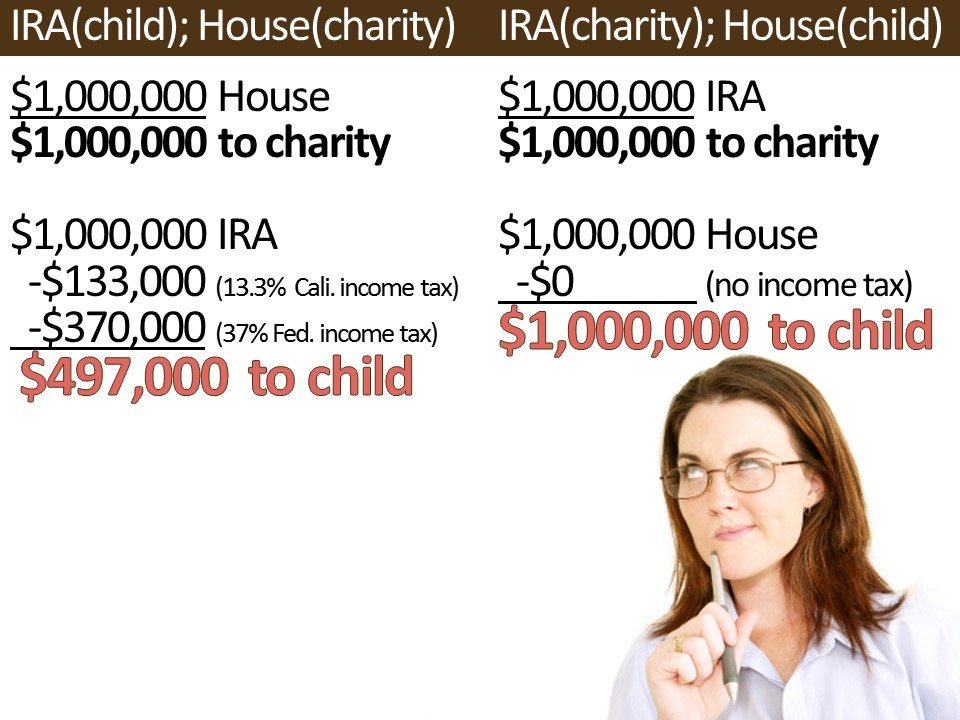
If the child inherits the home, the child will receive the $1,000,000 asset free from any taxation. (There are no estate taxes because the donor's estate is too small.) The child can sell the asset and spend the entire $1,000,000. The results are quite different if the child instead inherits the $1,000,000 traditional IRA. The assets in the IRA have never had income taxes paid on them. Thus, withdraws from the account will be treated as additional income to the child. Assuming the child is paying the highest income tax rates at both the state (California) and federal levels, this leaves slightly less than half of the money available to the child after paying income taxes. Notice that this massive difference in taxation occurs simply by the donor's selection of which asset to give to charity. The difference occurs even though the donor's estate is not subject to estate taxes. Although the difference would be less if the inheriting child were in a lower income tax bracket, it would still be substantial enough to warrant selecting the retirement assets instead of other assets for the charitable estate gift.
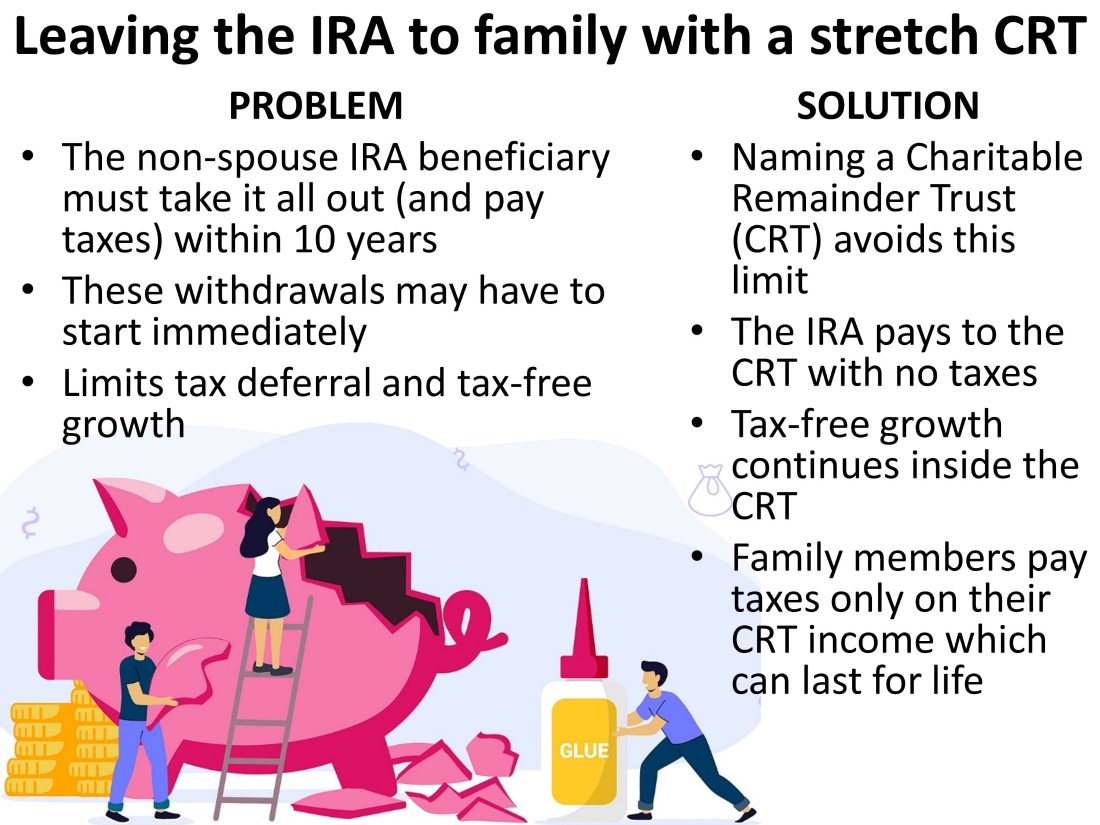
In some cases a client may still wish to leave the IRA (or other qualified plan) to a family member other than a spouse. This money must be taken out of the inherited IRA by the end of the 10th year after death. These withdrawals may have to begin immediately. Such forced withdrawals prevent the tax deferral and tax-free growth that could otherwise occur inside the IRA. For a charitable client, one alternative is to leave the IRA to a Charitable Remainder Trust (CRT). There are no taxes on the transfer to the CRT and no taxes on the growth of investments inside the CRT. The CRT income going to beneficiaries is taxed but this can be spread over one or more lifetimes.
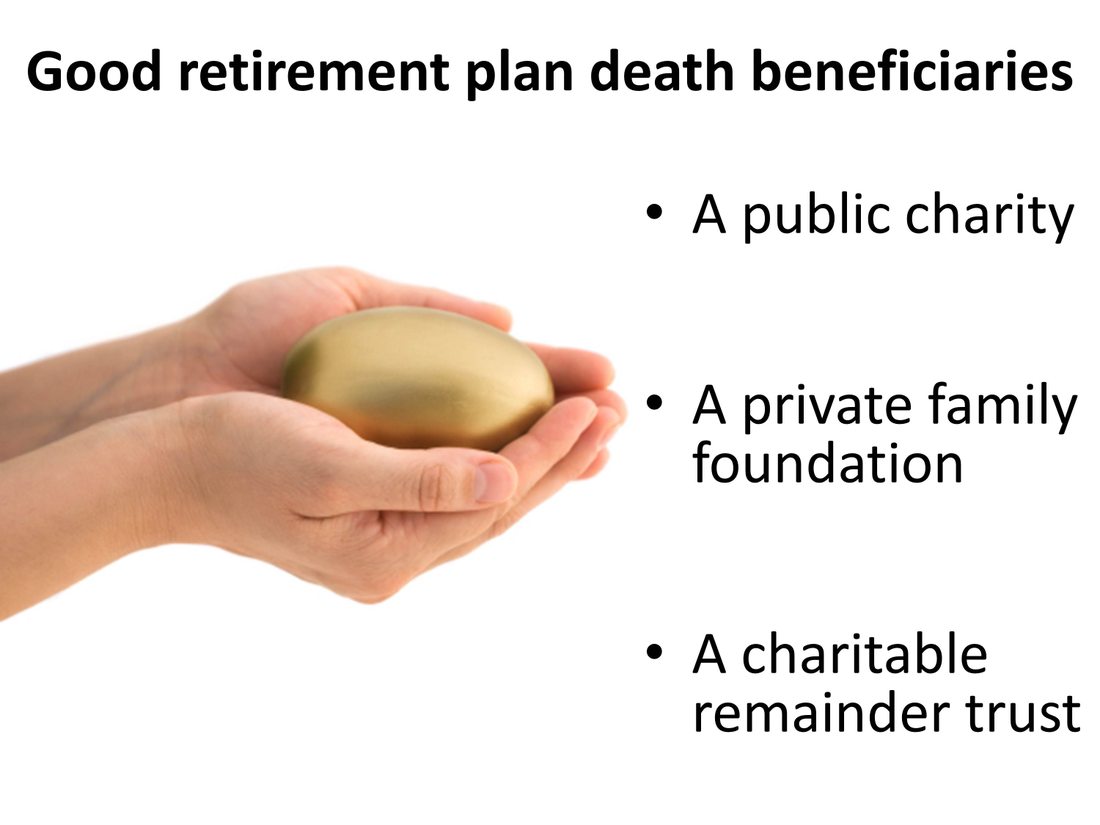
Retirement plan death beneficiaries are typically named in the beneficiary designation of the retirement account. In other words, the donor's will usually does not control the distribution of these assets. (In fact, the will is best thought of as a back-up document in general because it will not control any assets with beneficiary designations or owned in joint ownership with right of survivorship.) Good retirement plan beneficiaries include any public charity and any private foundation.
Charitable Remainder Trusts (which are also charitable entities) may also make good beneficiaries, but with some additional considerations. Ordinary income assets must be paid out first (i.e., Tier 1), prior to paying out any capital gain, non-taxable income or return of principal. Heirs will pay taxes on those assets when received. Another issue also arises regarding a potential income tax deduction if the estate is large. Typically, if a beneficiary inherits an IRD asset, such as an IRA account, the beneficiary is entitled to an itemized income tax deduction in the amount of any estate taxes paid as a result of the transfer of the IRD asset. For example, if Jane inherits a $100,000 IRA account which generated $40,000 of estate taxation (as compared to the estate taxes that would have been owed had the asset not existed), Jane will receive a $40,000 income tax deduction. The idea here is to avoid taxation of dollars that have already been taken by the IRS in estate taxes. In theory, this same deduction applies to the non-charitable portion of the Charitable Remainder Trust. The estate pays estate taxes on the taxable portion of the IRA transfer to the Charitable Remainder Trust (i.e., the present value of the share that will not be going to charity). These are estate taxes paid on IRD and thus generate an income tax deduction. However, this tax deduction is treated as return of principal in the Charitable Remainder Trust, meaning that the deduction will not be distributed to the beneficiary unless all other ordinary income, capital gain income, and exempt income held in the trust is first paid out (see the chapter on Charitable Remainder Trust for Details). The net effect of this is that the income tax deduction resulting from estate taxes paid on IRD will most likely be completely lost.
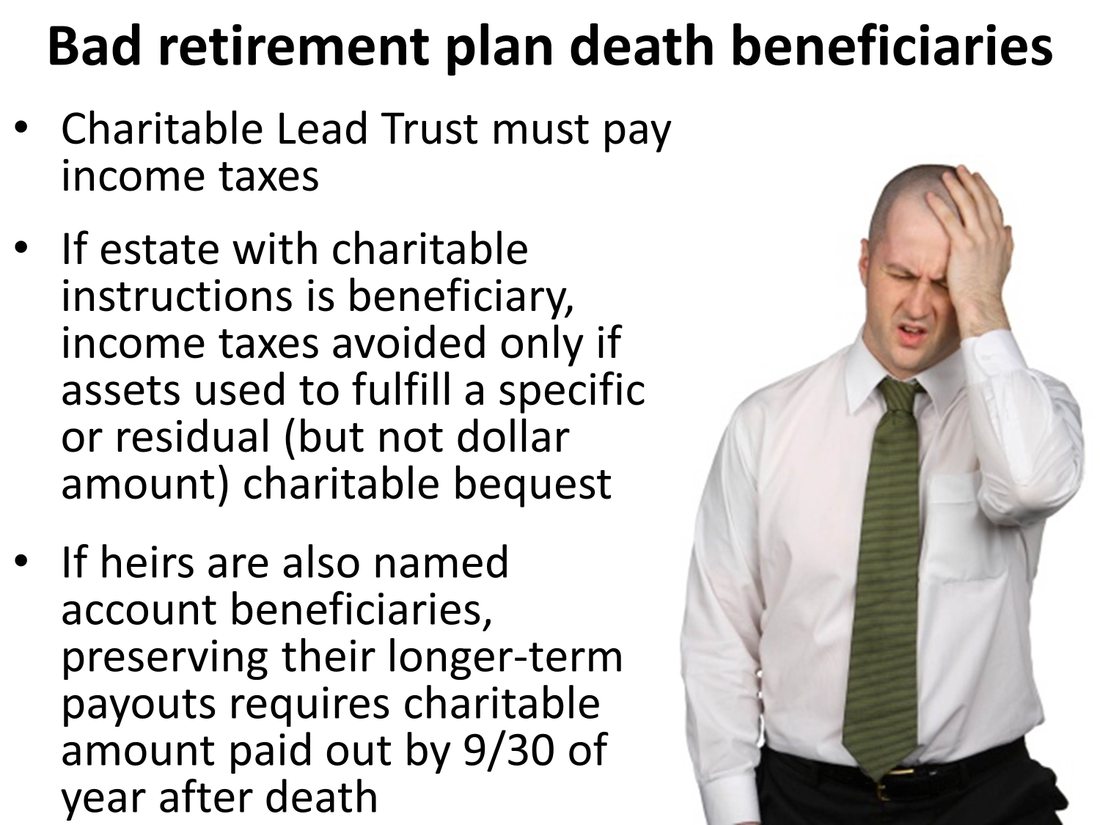
Problems can arise when naming a Charitable Lead Trust as beneficiary of a retirement account. The Charitable Lead Trust is not a tax-exempt entity, thus it must pay income taxes when receiving the retirement account funds, just as any other taxpayer would (although perhaps at higher rates due to the compressed tax schedule of complex trusts).
Naming the estate as beneficiary, even if the estate will make charitable distributions, could result in the estate having to pay the income taxes on the retirement account funds. This can arise if the account holder specifically names the estate as beneficiary or if no beneficiary is named, which will also cause the retirement account to pay to the account holder's estate. Typically, if the estate receives IRD (such as qualified plan money), the estate must pay the income taxes resulting from this IRD. However, this can be avoided if the estate transfers the right to receive the IRD to fulfill a bequest of that specific item or of a share of the remaining estate. In that case the recipient, not the estate, would owe the income taxes on the IRD. If the recipient is a charity, no taxes will be owed. This result is possible if the estate documents allow the executor to distribute assets on a non-pro rata basis (i.e., if the executor can send a disproportionate share of the IRD asset to the charitable beneficiary). However, if the assets are used to fulfill dollar amount charitable bequests (i.e., estate gifts of specific dollar amounts), the estate will still have to pay the income taxes due from the IRD/retirement account asset.
Finally, if the retirement account is to be divided between charitable and non-charitable beneficiaries, the non-charitable beneficiaries have until the end of the next year following the decedent's death to establish separate accounts for the charitable and non-charitable beneficiaries. This is not necessary if the charity's share is completely paid out prior to September 30 of the year following the decedent's death. Creating these separate accounts is important because if the charity is not paid off or separated out, it will reduce the maximum time allowed for the non-charitable beneficiaries to remove the funds (with income taxes being due at the time of removal). These separate accounts may not be possible if the amount designated for charity was listed as a dollar amount, rather than a percentage amount. However, such separation of accounts will not be needed if the administrator simply pays off the entire charitable portion prior to September 30 of the next year following the decedent's death. This complexity can also be avoided if the only other beneficiary is a spouse because a spouse can simply roll over his or her share into his or her separate IRA.
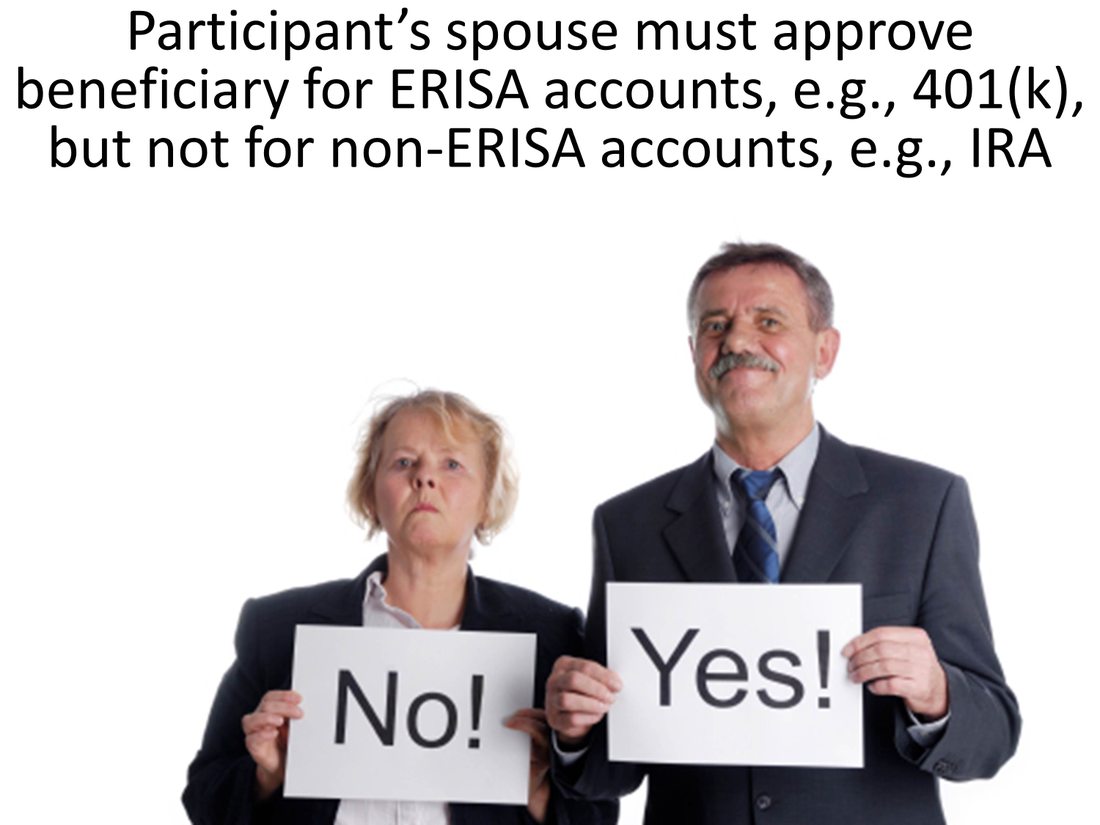
Naming someone other than the spouse as a beneficiary for an ERISA account, such as a 401(k), a SIMPLE IRA, a SEP IRA, an ESOP, or profit sharing plan, requires consent from the spouse. Thus a charity may not be named as a primary beneficiary without the consent of the account holder's spouse. Such consent is not required in a traditional IRA or Roth IRA unless the company managing the accounts decides to add such requirements.
Estate gifts of retirement account assets, of course, require that the accounts have value after the death of the account holder. Thus, traditional pension plans (i.e., defined benefit plans) are not directly relevant for charitable planning purposes because no valuable assets will survive the death of the participant (or, in some cases, the death of the participant and the participant's spouse).
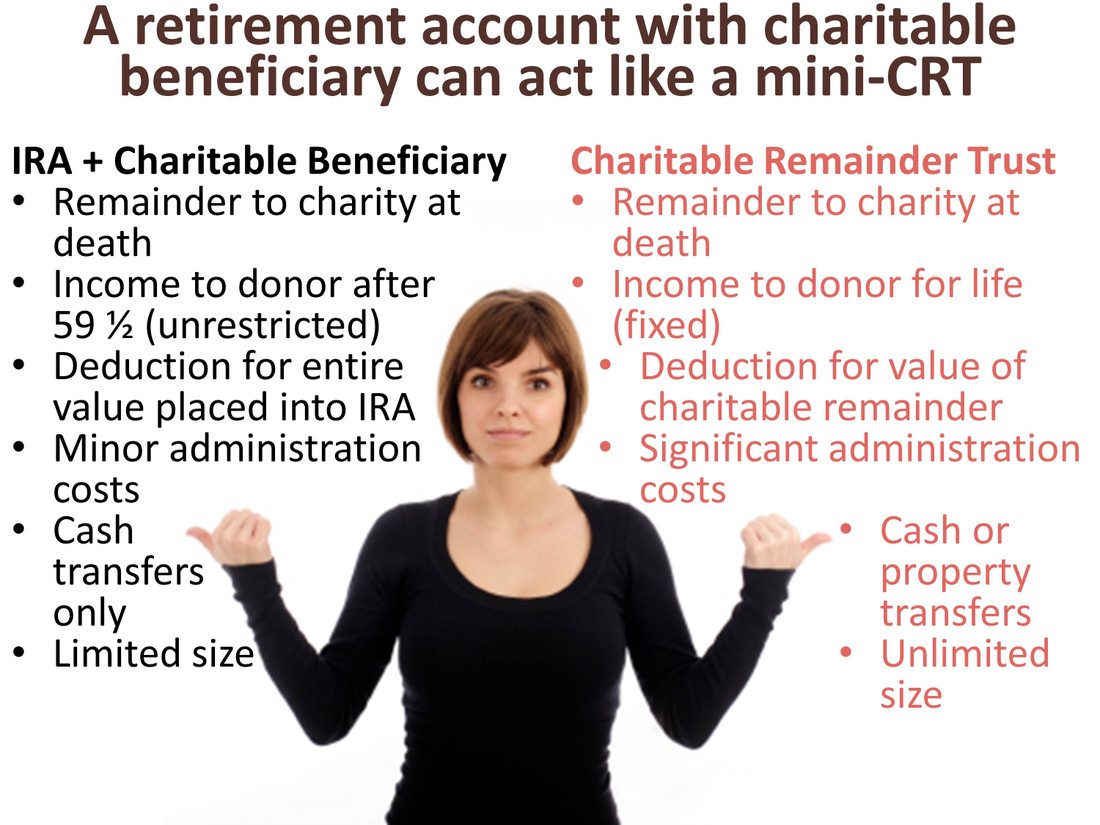
Because of their creation and administrative expenses, Charitable Remainder Trusts are generally reserved for substantial transfers of assets. One way to conceptualize a qualified plan with a charitable beneficiary is like a mini-Charitable Remainder Trust with minimal administrative costs. In both instruments the charity receives the assets at the death of the donor. Both allow tax-free growth of assets and both can provide income to the donor. In the Charitable Remainder Trust the income is fixed for life, whereas the qualified plan provides income at the discretion of the donor (and without a 10% penalty after age 59 ½). The Charitable Remainder Trust reduces income by the share of the transfer representing the present value of the charitable interest. The qualified retirement plan reduces income by the entire amount of the transfer for qualified taxpayers. Of course a retirement account can be funded only with cash and there are limits to the amount of funding allowed. The Charitable Remainder Trust can be of unlimited size and can be funded with appreciated assets and thereby postpone or eliminate the associated capital gains tax. In cases where a donor is attracted to the features of a Charitable Remainder Trust, but where the nature and size of the potential gift does not warrant its use, it may be helpful to consider naming a charity as a qualified plan beneficiary as a type of mini-Charitable Remainder Trust substitute.
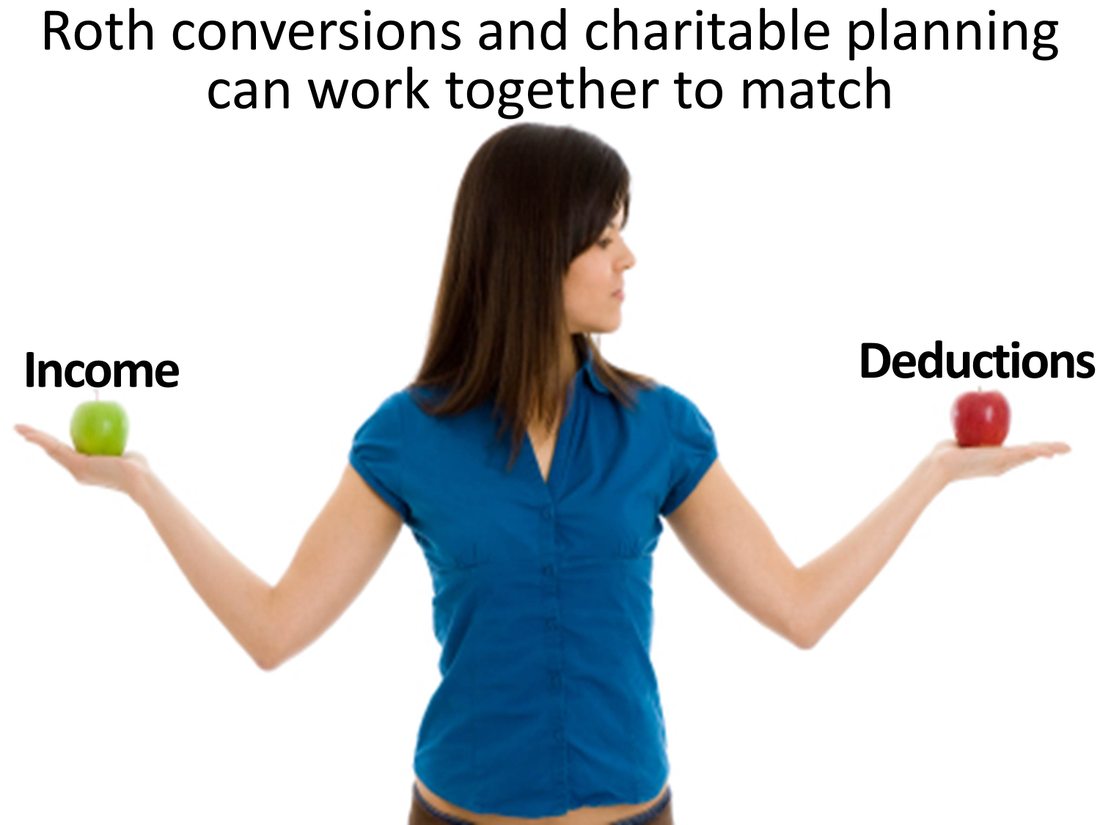
A final area where charitable planning can connect with retirement accounts is in managing the tax consequences of Roth IRA conversions. The goal here is to match a spike in income, caused by a Roth IRA conversion, with a simultaneous spike in charitable deductions.
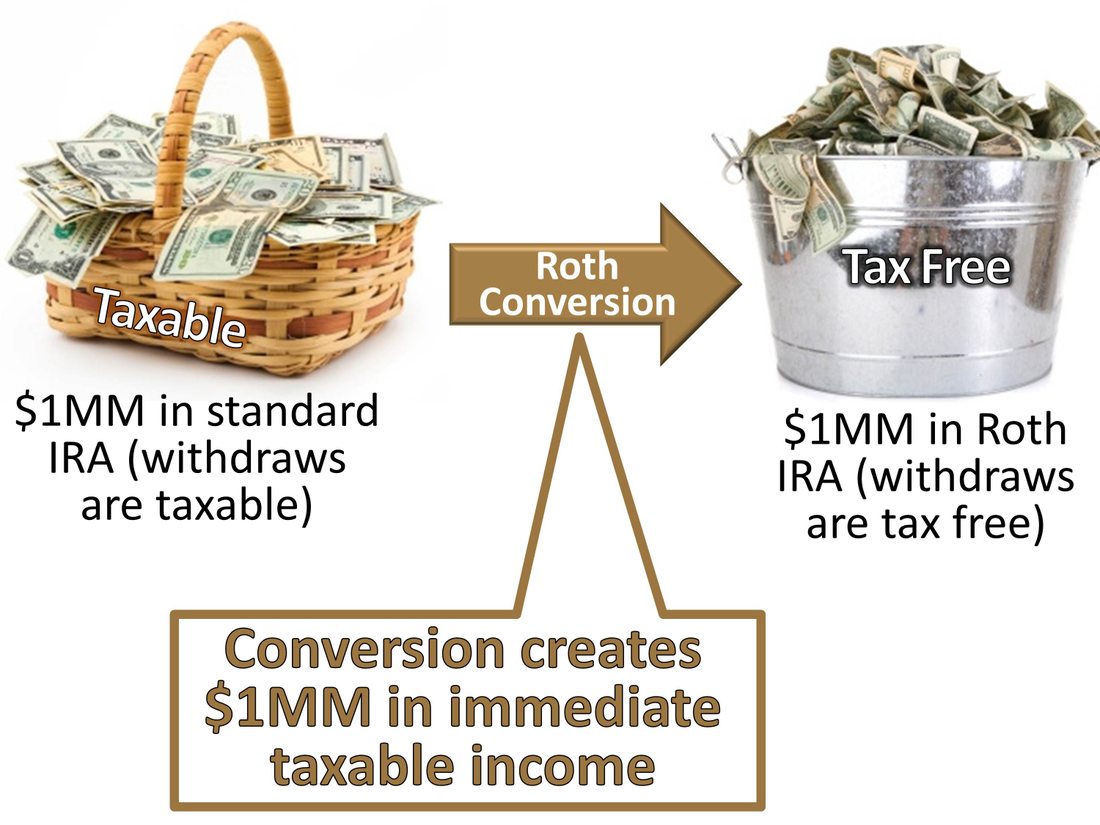
The idea of a Roth conversion is to change a traditional IRA into a Roth IRA. A traditional IRA grows tax free, but income taxes must be paid whenever distributions are taken from the account. In a Roth IRA, taxes are paid on the initial contributions, but no taxes need to be paid when qualified distributions are taken from the account, regardless of whether the distributions were of initial contributions or subsequent growth on those initial contributions. Converting a traditional IRA into a Roth IRA causes the account holder to be charged with income taxes on the amount of conversion less any basis in the traditional IRA. (Basis in a traditional IRA consists of amounts originally contributed with after tax funds, i.e., contributed with no deduction.) In exchange for this tax disadvantage, the account holder gains the ability to take future qualified distributions free from income taxes, whether those distributions are from the converted assets or from subsequent growth on those converted assets. Thus, the extra tax benefit is the income tax free receipt of future growth on the Roth IRA assets. Although acquiring the benefits from such a conversion may make perfect sense in the context of an overall retirement plan, it can generate a substantial immediate spike in taxable income. Because there are no limits on the amount of an IRA that can be converted to a Roth IRA, the amount of this spike in income can be dramatic relative to the account holder's normal income.

This spike in income may make the account holder particularly interested in generating income tax deductions. First, this may be true because the increased income resulting from the Roth IRA conversion may temporarily push the account holder into a higher income tax bracket. Thus, deductions taken in the year of the conversion will be more valuable than deductions taken in a later year. (The value of a deduction is the amount of the deduction multiplied by the taxpayer's marginal tax rate. Therefore, a higher tax rate makes the deductions more valuable.) Additionally, the taxpayer may wish to pursue a larger conversion but may not have enough cash to pay for the resulting tax consequences. Deductions could reduce the costs of the tax consequences of the Roth conversion, allowing the cash-limited account holder to convert a larger amount into the Roth account.
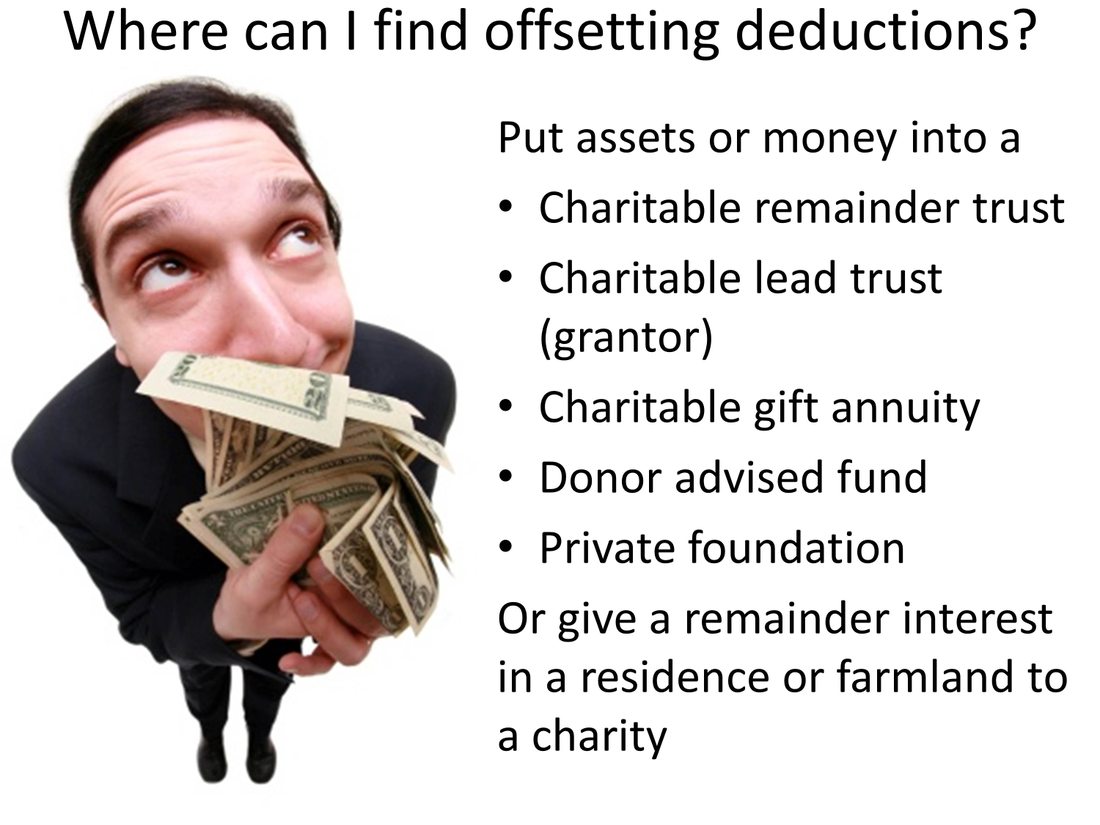
Of course, much of charitable planning is designed to provide creative ways to generate charitable income tax deductions, making charitable planning a natural fit with Roth IRA conversion. Thus, a donor might move assets or cash into a Charitable Remainder Trust, grantor Charitable Lead Trust, Charitable Gift Annuity, donor advised fund or private foundation. Such charitable planning may permit a large immediate deduction even where the donor does not wish to sell the underlying asset (such as with a Charitable Remainder Trust, grantor Charitable Lead Trust, or Private Foundation), or where the donor wishes to receive income from the underlying asset (such as with a Charitable Remainder Trust or Charitable Gift Annuity), or where the donor wishes to receive the asset back after a period of time (such as with a grantor Charitable Lead Trust). Finally, the donor who has neither the cash nor the desire to transfer assets in order to generate a charitable income tax deduction may consider gifting a remainder interest in a personal residence or farmland. This gifting of the inheritance rights to the property generates an immediate, potentially very large, deduction with no requirement for immediate cash or loss of income from or use of the underlying real estate.
Of course, the use of charitable deductions is not unlimited and depending on the gift type and the recipient type such deductions are limited to 20%, 30%, or 50% of income. Thus, charitable deductions cannot completely offset a spike in income of unlimited size. However, the ability to reduce income by up to 50% is still a potentially powerful tool. When these income limitations are exceeded, charitable deductions can be carried forward into future years. However, after five additional years these deductions will expire.
A donor may have substantial charitable deductions that, due perhaps to a large transfer of assets, exceed the income giving limitations for one year or even for all five carryover years. Especially in cases where these deductions would otherwise expire, there may be interest in pulling income from future years, so that the deductions can be used.
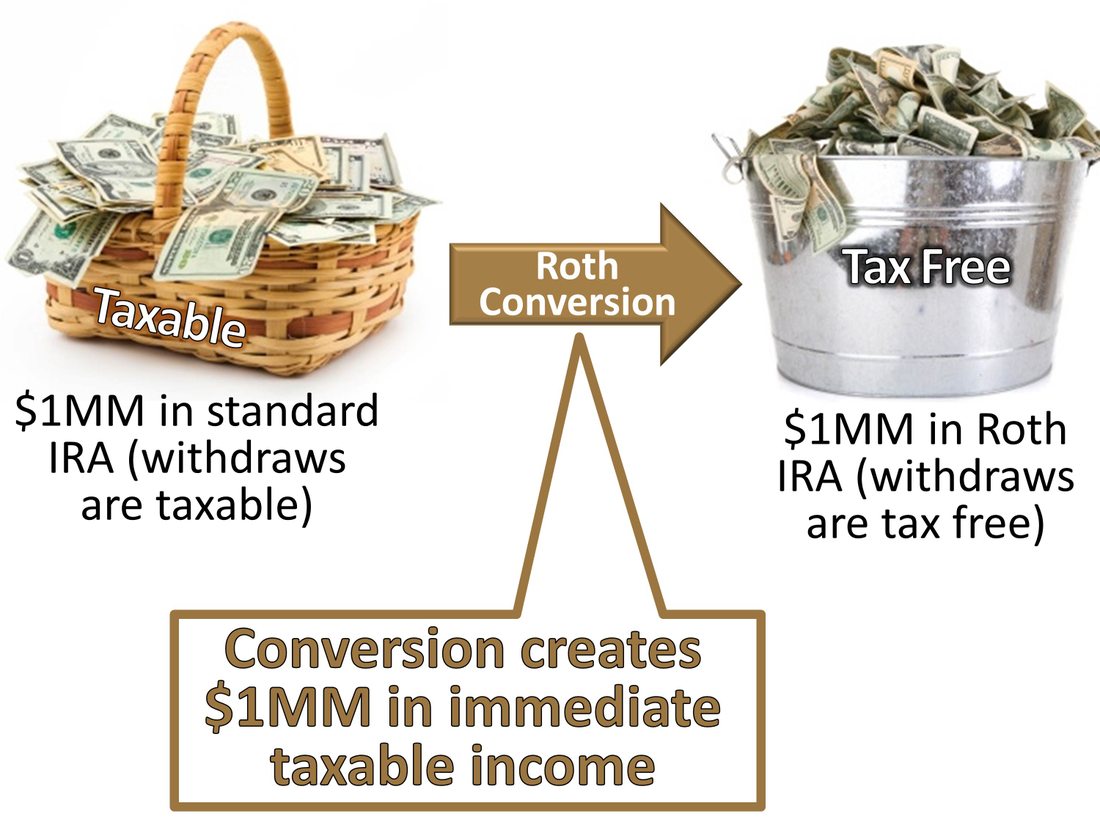
A perfect way to accomplish the task of pulling income back from future years is to convert some funds from a traditional IRA into a Roth IRA. The conversion results in pre-paying taxes that would otherwise be due later and subsequently allows for tax-free growth following the conversion. Consequently, paying taxes for the conversion can be a wise investment. This investment is made all the more beneficial if it can be partially paid for with charitable tax deductions that, otherwise, would have expired unused.
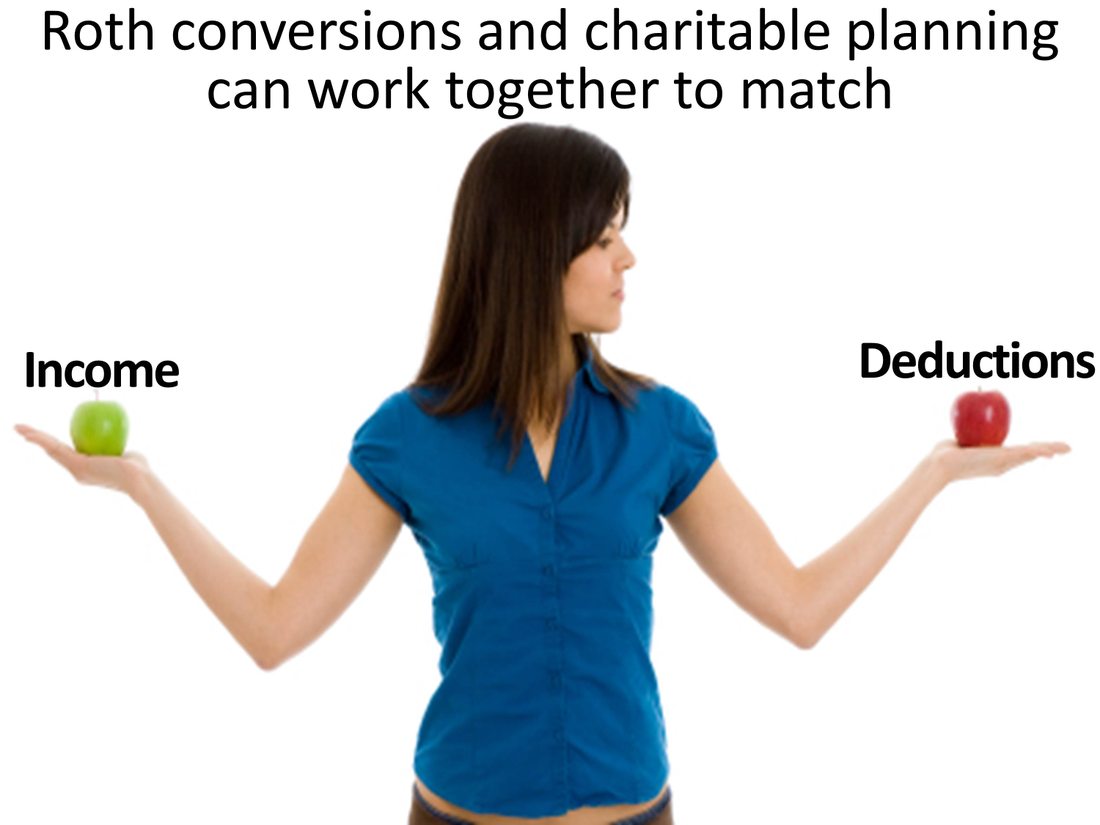
In this way Roth conversions and charitable deductions can work together to help match income with deductions. When income is temporarily high, due to any cause including a Roth conversion, charitable deductions become temporarily more valuable due to higher marginal tax rates. The use of charitable deductions can reduce the immediate tax costs associated with a Roth conversion. When excessive charitable deductions might otherwise go unused due to income limitations, a Roth conversion can provide the temporary spike in income that allows for the deductions to be used.

Working with retirement assets is important simply because of the magnitude of household wealth held in such instruments. Additionally, it is useful to have a basic understanding of the options because the results from charitable giving from such funds can have tax consequences ranging from absolutely awful to absolutely wonderful. The well advised donor will successfully avoid the former and embrace the latter.