
Sophisticated planned giving can be intimidating for professional fundraisers, financial advisors, and donors. It seemingly offers complex terms, complex calculations, and the risk of serious penalties if done incorrectly. It is no wonder that many simply turn away from the field to stick to the easier approaches they already know. Yet, this fear leads to enormous lost opportunities for the donor, the fundraiser, and the financial advisor. This book is intended to make the concepts of planned giving friendlier and more intuitive. When advisors and fundraisers understand the core capabilities of planned giving, they can provide dramatically increased value to their clients, donors, and nonprofit organizations. That starts not with mastering the vast complexity possible in planned giving, but with understanding the underlying simplicity common to almost all of planned giving.
Planned giving and simplicity don't normally go together. The perception of planned giving is that it can be enormously complex. This perception is accurate. Planned giving transactions can be among the most complex transactions. They can involve Charitable Remainder Trusts, foundations, Charitable Lead Trusts, capital gains taxes, income taxes, estate taxes, gift taxes, special business entities, a four-tiered income accounting system, life insurance, arcane documentation requirements, and more. When facing this forest of rules and regulations, it makes perfect sense that many simply throw up their hands and retreat. Yes, planned giving can become quite complicated. Yet, amidst this forest of details, a core simplicity motivates nearly all planned giving transactions.
Behind all of the complexity lies this simplicity. Gift planning can do two things. Fundraisers should use it for two main reasons. Financial advisors should use it for two different main reasons. That's it. If you remember these sets of two, you will understand the basic what and why of planned giving.

It's not that complicated. Gift planning can do two things, lower taxes and trade a gift for income. Regardless of how massively complex a planned giving transaction can become, it will do only these two things. If you understand this simple reality, you understand what planned giving structures can accomplish.
So, if planned giving can only do these two things, why do we need an entire book - indeed many, many books most of which are far more sophisticated than this one - to cover planned giving? It is true that planned giving can only do two things (lower taxes and trade a gift for income), but there are a wide variety of ways in which these two things can be accomplished.
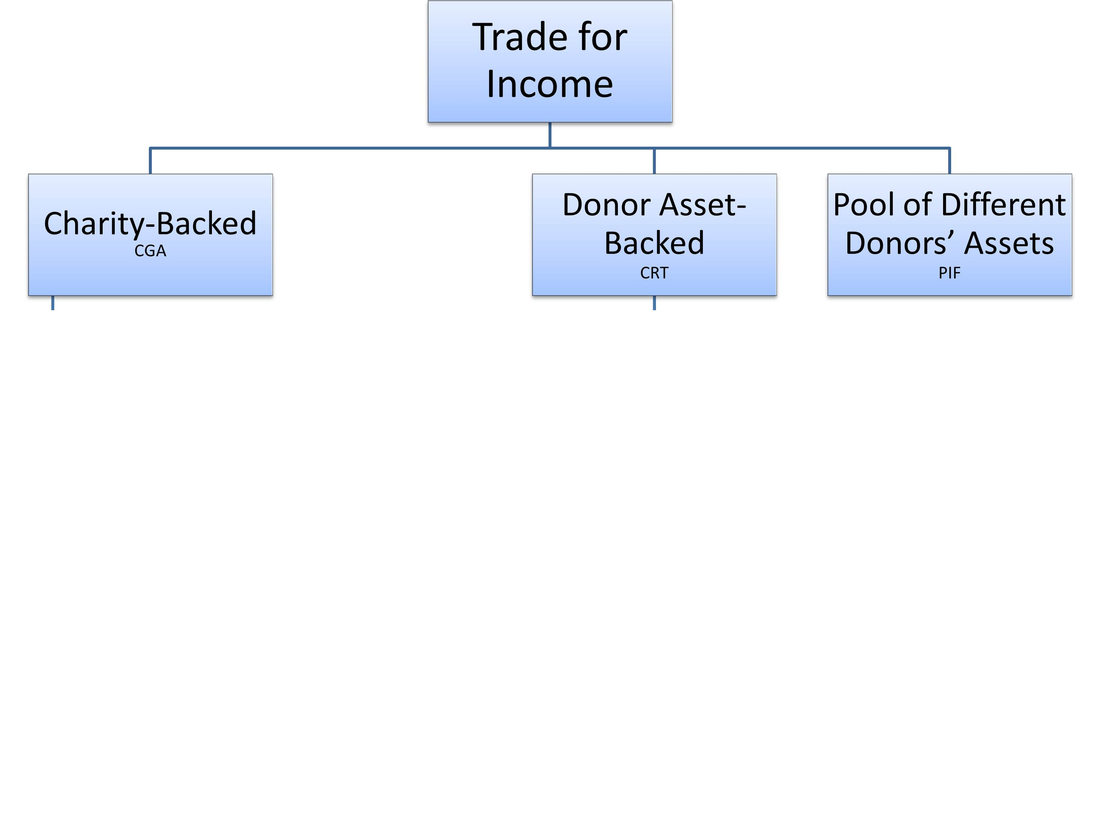
Let's begin with trading a gift for income. The first question to answer is, "Where should the income come from?" Does the donor want the income payments to come from, and be guaranteed by, the charity? If so, then she would consider a Charitable Gift Annuity (CGA). Does the donor instead want the income payments to come from, and be backed by, the assets contributed by the donor? If so, then she would consider a Charitable Remainder Trust (CRT). Perhaps the donor would prefer to have the income payments come from, and be backed by, a large pool of assets contributed by many donors. If so, then she might consider the, relatively rare, Pooled Income Fund (PIF). Instead of having one option (trading a gift for income, yes or no), the donor now has three options. The menu of options does not stop with these three choices.
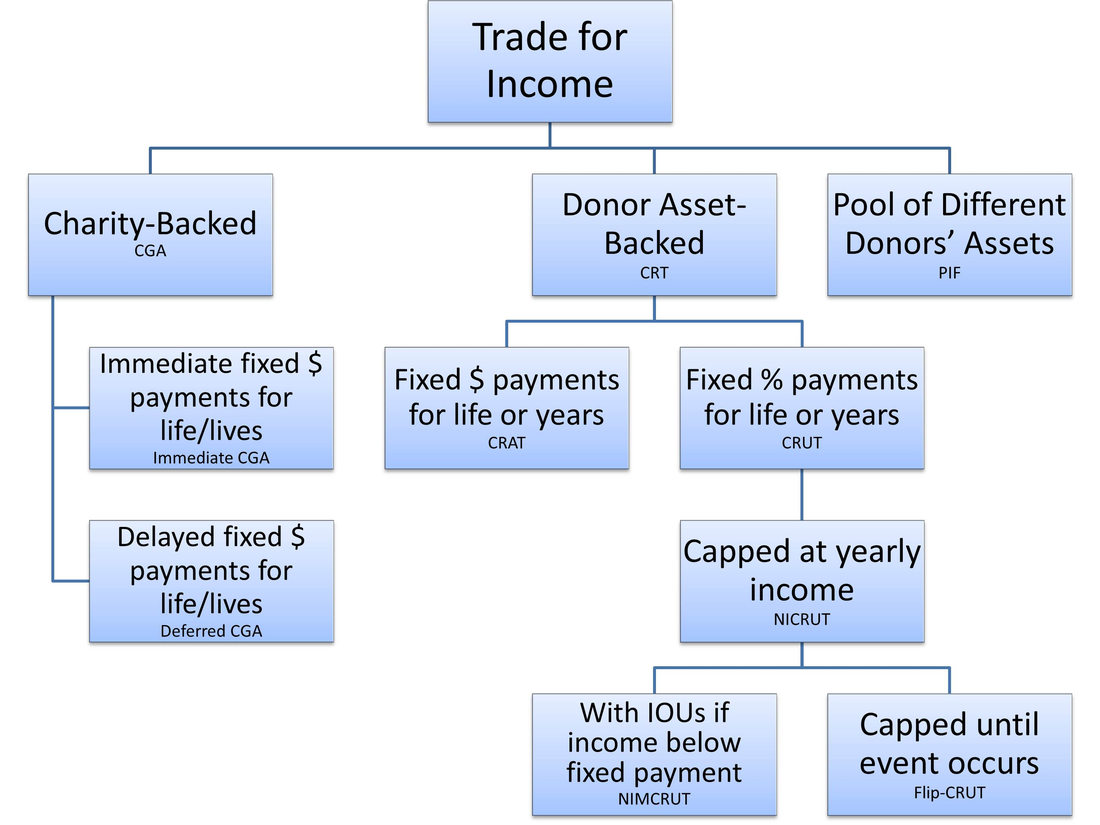
First, the donor can choose where the income payments should come from. Next, the donor can choose what kind of payments she would prefer. If the payments are coming from the charity, she can choose to take fixed dollar payments for one or two lives where the payments begin immediately following the gift. This is the standard Charitable Gift Annuity. The donor may instead prefer to delay the start of the payments until some future point, such as retirement. This is a deferred Charitable Gift Annuity.
If the payments come from a Charitable Remainder Trust holding the donor's assets, there are even more options for the income. Just as with a Charitable Gift Annuity, a Charitable Remainder Trust can make fixed dollar payments for life or multiple lives. Alternatively, the Charitable Remainder Trust can make fixed dollar payments for a set period, up to 20 years. Or, the Charitable Remainder Trust can pay a fixed percentage of its assets, either for one or more lives or for up to 20 years. This means that if the value of the assets in the Charitable Remainder Trust increases or decreases, so do the payments. This may be attractive as a way to combat the effects of inflation through investment performance, especially because the donor often can continue to manage or select the manager of the assets. In yet another variation, called a Net Income Charitable Remainder Unitrust or NICRUT, the payments may be capped at the income received from the trust investments. This may be helpful to prevent a forced sale when the trust holds only assets that generate no income. Even this alternative has two additional variations. In the Net Income with Make-up Charitable Remainder Unitrust (NIMCRUT), any payments reduced due to low income in one year can be made-up in later years when income is high. Finally, the flip-CRUT combines two types of Charitable Remainder Trusts, starting as a NIMCRUT or NICRUT and then "flipping" to a standard CRUT upon the occurrence of an event such as the donor reaching retirement age or the sale of a difficult-to-market asset. Through creative asset management, this can allow the assets to grow rapidly with no taxation or payouts until the donor desires to start receiving them at some later point.
Thus, what starts as a simple concept - trading a gift for income - quickly becomes cluttered due to the many options available. Instead of throwing up our hands when faced with the alphabet soup of CGA, deferred CGA, CRAT, CRUT, NICRUT, NIMCRUT, and flip-CRUT, the key is to remember that there is just one core idea - trading a gift for income. Beyond this, the options are simply variations available to better match the desires of the donor.
The second thing gift planning can do is lower taxes. Lowering taxes can be great for the donor (gifts are cheaper), great for the advisor (providing serious value to the client and reducing the tax bite on assets under management), and great for the charity (making bigger gifts more affordable). But, lowering taxes can be a complicated process. In fact, most of the complexity in planned giving comes from tax laws and, consequently, most of this book deals with tax law. Determining the best way to lower taxes first depends upon which type of taxes the donor is interested in lowering. Planned giving can lower capital gains taxes, income taxes, and estate taxes, but the techniques differ depending upon which tax is the focus.
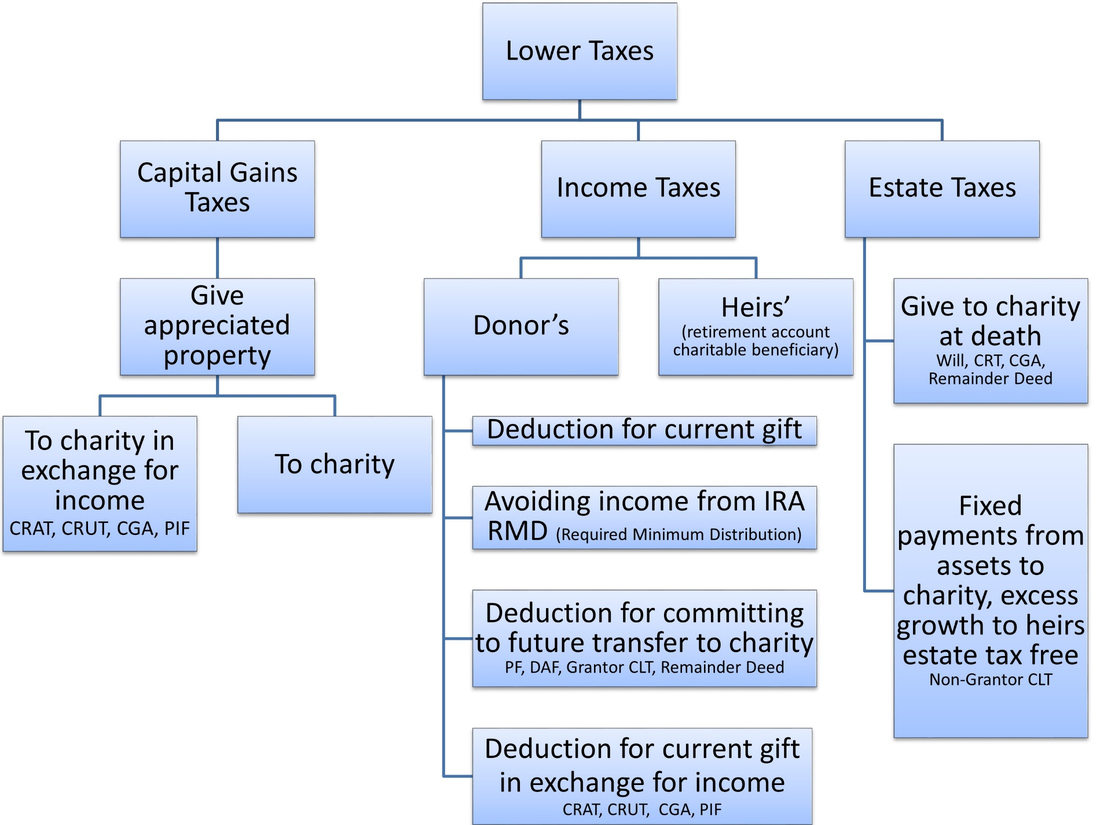
Lowering capital gains taxes occurs when the donor gives appreciated property, rather than cash, to the charity. Because the charity - and not the donor - sells the appreciated property, no taxes are paid. The donor can either give the property to the charity or give the property to the charity in exchange for income - with all of the options available as discussed above.
Lowering income taxes can occur in a number of ways. In the simplest form, the donor can take an income tax deduction for making a charitable gift of money or property. A donor age 70½ or older can transfer funds directly to a charity from an IRA or IRA rollover. Giving these pre-tax dollars thereby avoids all taxation. For those 72 or older these Qualified Charitable Distributions also count against Required Minimum Distributions. Also, there are several methods by which a donor can take an immediate income tax deduction in exchange for a transfer that will not be received by the charity for many years, often not until after the death of the donor. These strategies include the Charitable Remainder Trust, the retained life estate in a home or farmland, the private foundation, the donor advised fund, and the grantor Charitable Lead Trust. Additionally, the donor can still receive an income tax deduction when making a charitable gift in exchange for income, such as with a Charitable Remainder Annuity Trust (CRAT), Charitable Remainder Unitrust (CRUT), Charitable Gift Annuity (CGA), or Pooled Income Fund (PIF). Not only can charitable giving lower income taxes for the donor, it can also lower income taxes for the donor's heirs. When deciding which assets to leave to charity at death, the donor may choose to leave money in traditional retirement accounts (IRAs, 401-Ks) to charity. If the heirs receive these funds, they must pay income taxes when they withdraw the funds. Charities, in contrast, do not pay income taxes. Thus, wise planning leaves the tax-heavy assets to charity. This reduces the income taxes that would otherwise be owed by the heirs without diminishing the charity's share.
Charitable planning can also lower estate taxes. Money or property left to charity at death is not subject to estate taxes. Thus, money or property left to charity through a will, beneficiary designation, Charitable Remainder Trust, or remainder interest deed will escape estate taxes. The Charitable Remainder Trust may also be combined with an Irrevocable Life Insurance Trust structured in such a way as to avoid estate taxation on life insurance received by the heirs. A non-grantor Charitable Lead Trust allows the donor to pass any growth above the §7520 interest rate to heirs without gift or estate taxation.
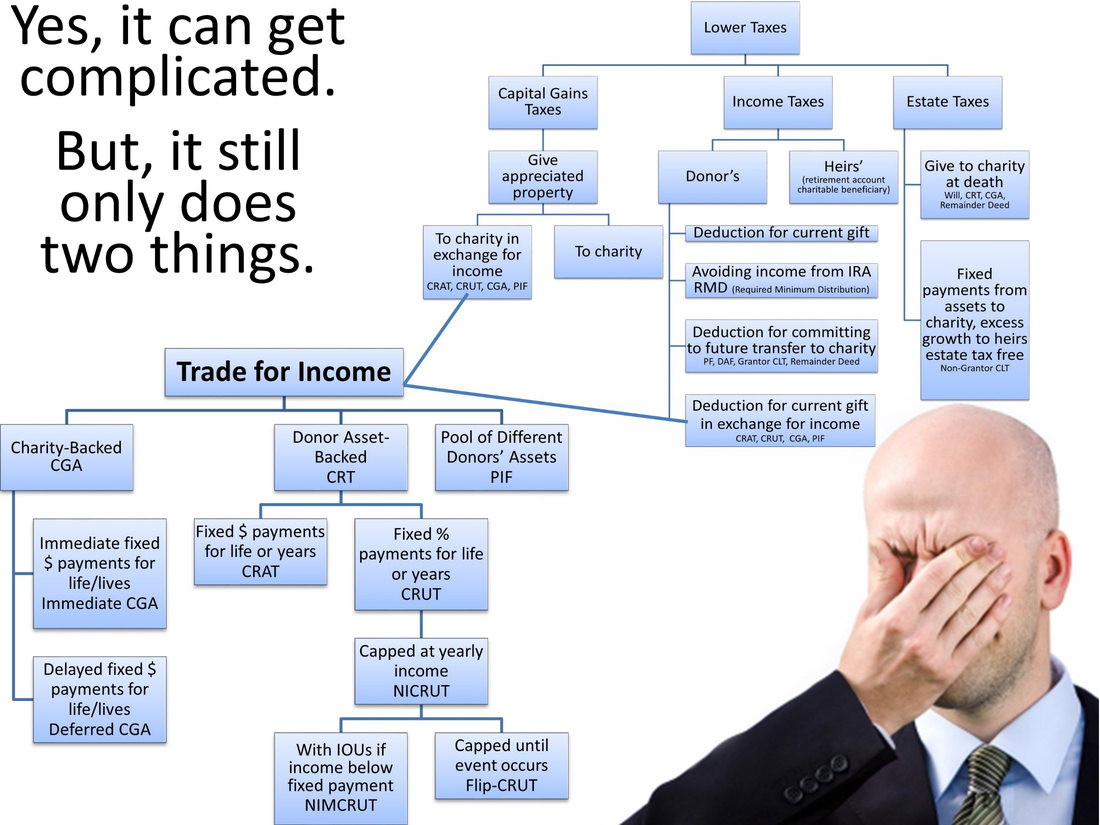
Of course, lowering taxes can be combined with the techniques of trading gifts for income. Stacking the methods creates highly complex transactions. For example, the donor could transfer highly appreciated corporate shares into a Charitable Remainder Unitrust paying 6% of all trust assets per year to the donor and the donor's spouse for life with payments limited to income (with makeup provisions) until the shares are sold, with part of the value of the income tax deduction and payments being used to fund an Irrevocable Life Insurance Trust to provide estate tax free inheritance to the children, where the Charitable Remainder Trust, at the death of the surviving spouse, transfers all remaining assets to the donor's private family foundation managed by the donor's children and grandchildren. Yes, charitable planning can get complicated. But, underneath this frightening mess of acronyms, trusts, foundations, and law, the basic concept is still the same. Planned giving can do two things - lower taxes and trade a gift for income. That's it.
Planned giving can do two things, lower taxes and trade a gift for income. That's nice, but it doesn't necessarily explain why a fundraiser should know about planned giving. Planned giving has a real impact on nonprofits only when it leads to larger gifts. These larger gifts don't come simply because a gift might be slightly cheaper due to a tax benefit. Instead, they come from two sources - asking for assets instead of cash, and addressing the donor's other financial concerns.

For the fundraiser, the simplest approach is to ask for cash. Getting the donor to write a check is clean and quick. Beyond sending an appropriate gift receipt, it requires no knowledge of taxes, investments, finance, or law. These gifts of cash are the big red "easy" button for fundraiser and donors. So, why learn all of this planned giving stuff? Because when fundraisers ask for cash, they are asking small.
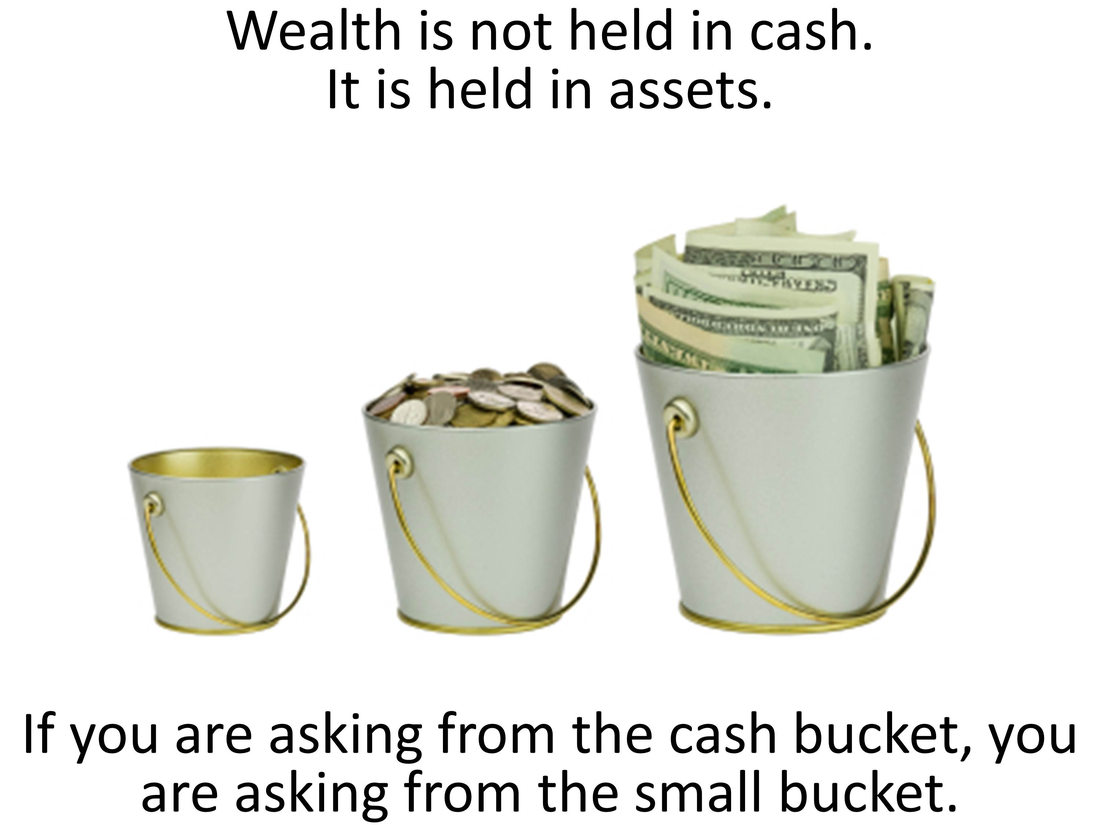
This doesn't mean that a fundraiser can't ask for a big check. It means that when the fundraiser asks for cash, regardless of the size of the request, he or she is asking for money out of the cash "bucket," and the cash bucket is the smallest bucket. Significant wealth is not held in cash; it is held in assets. Asking for cash is normally viewed as asking from the "disposable income bucket" not the "wealth bucket." Changing this reference point can dramatically change the potential gift size.
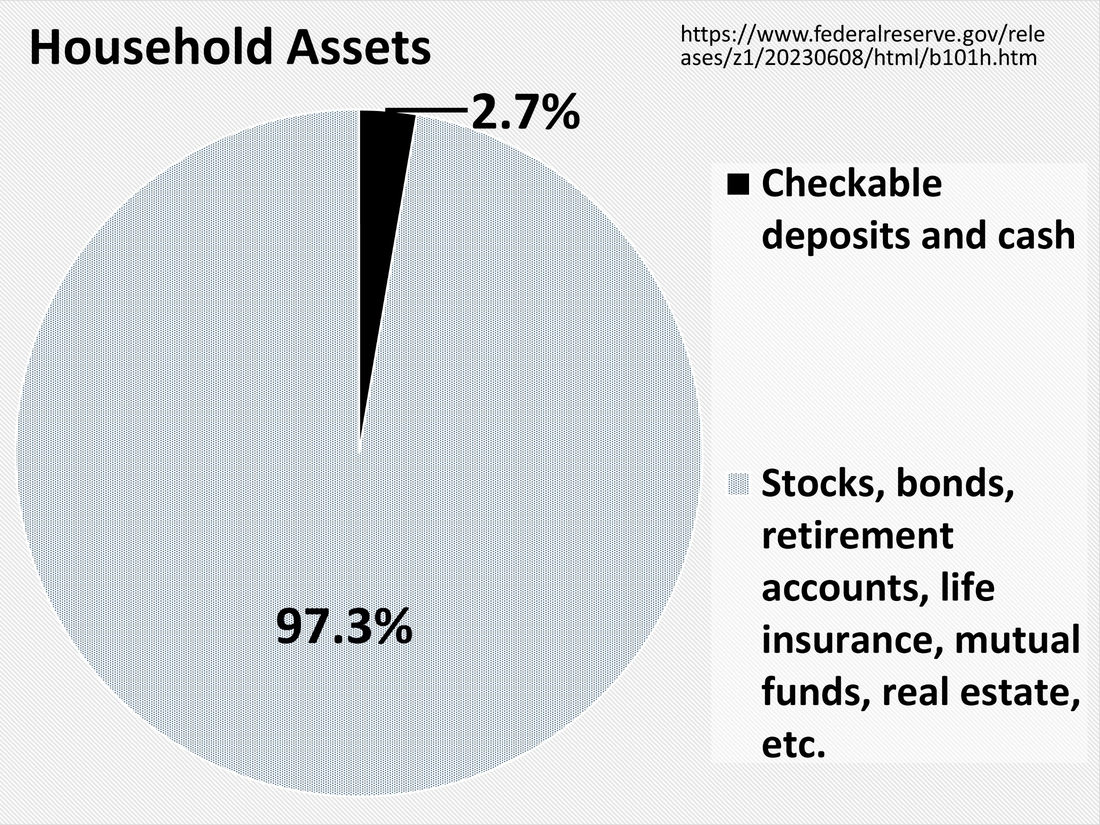
Only a tiny fraction of household assets are held in a form that is accessible by simply writing a check. Wealth is held in other forms and these forms are much less accessible. This lack of access may come from the difficulty in easily selling all or part of the asset, from legal barriers, or from negative tax consequences resulting from a sale. It is certainly easier for the fundraiser to ignore this less accessible wealth and simply concentrate on the less than 3% of household assets held in cash. Taking the easy route means that the fundraiser will always be asking from the small bucket. Without changing this perspective, neither the fundraiser nor the donor will be focused on the possibility of those truly transformational gifts of wealth that inevitably come from non-cash assets.

A more obvious way in which planned giving can generate more charitable gifts is by addressing the barriers that prevent donors from making larger gifts. In conversation, this is frequently phrased as, "I wish I could do more, but..." Whatever follows this introductory line often reveals the primary barrier preventing the donor from making the desired gift. Most commonly, these barriers to giving relate to other financial obligations. This is where planned giving's power to trade a gift for income becomes especially relevant.
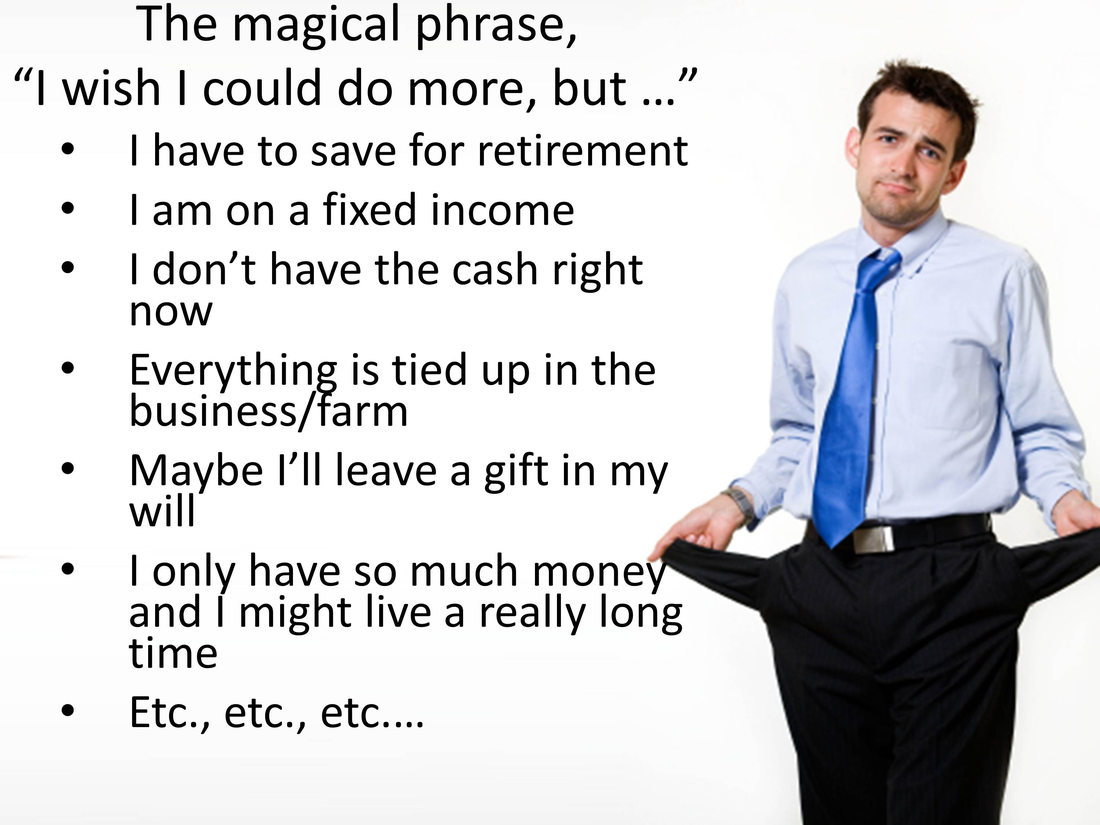
The exact nature of the barrier to further giving will vary from donor to donor. Often the barrier will relate to the need for income. For example, the donor may feel pressed to save for retirement. In such cases, a deferred Charitable Gift Annuity or Charitable Remainder Trust might be of interest. A donor indicating the barrier of being on a fixed income may lead to the opportunity to suggest gifting assets in exchange for additional income, thus permitting a gift and addressing the financial limitation. Of course, a fundraiser who is asking only for cash would never think to consider asking for assets, much less asking for assets in a way that generates income for the donor. One of the most common concerns among older donors is the risk of outliving their assets. The Charitable Gift Annuity is a solution directly intended to address this concern by trading a gift for guaranteed lifetime income.
Those with substantial wealth may also have limited cash due to the wealth being tied up in a farm or business. Such assets may appear inaccessible to the donor, given the substantial capital gains tax that would be due at their sale. The informed fundraiser can point out the variety of ways in which such assets can be sold without the need to pay capital gains taxes in a charitable transaction that generates income for the donor. Even if the donor is not immediately interested in such a transaction, simply making sure that the donor knows such options are possible before the sale of the business is an important first step.
A donor's concern for immediate income may lead him to postpone a gift and instead consider putting a gift in his will. Such a result is perfectly acceptable, but it may also bring up opportunities to discuss converting the gift at death from a revocable gift to an irrevocable one. This conversion not only secures the gift for the charity, but also can generate substantial tax benefits to the donor through methods such as a retained life estate gift in a home or farm, a Charitable Remainder Trust, or even a Charitable Gift Annuity.
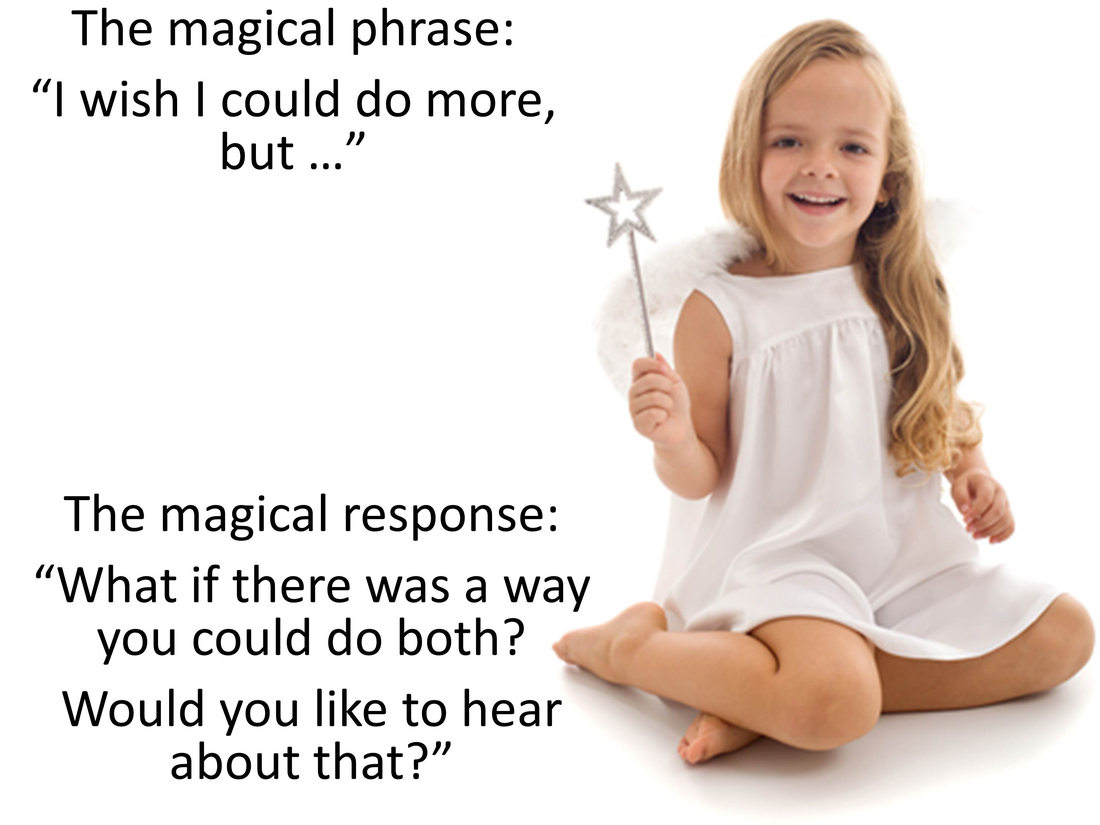
For the well-informed fundraiser, the magical phrase beginning with, "I wish I could do more, but..." should spark a wide range of possible solutions and suggestions. Getting the opportunity to inform the donor about these can be as simple as asking, "What if there was a way you could do both? Would you like to hear about that?" This simple form of appreciative inquiry identifies when the donor might truly be interested in learning. This also avoids the sense that the fundraiser is aggressively pushing the donor. Instead, the fundraiser is simply serving in the role of an informed advisor, available whenever the donor so desires.

This book will review a wide variety of planned giving methods that involve transfers of assets rather than cash. Before diving into that complexity, let's look at a simple example of how a fundraiser can effectively shift from asking for cash to asking for assets. This doesn't involve trusts, annuities, foundations, or legal documents. Yet it allows the fundraiser to start asking for assets instead of cash in a way that can generate enormous benefit to the donor.
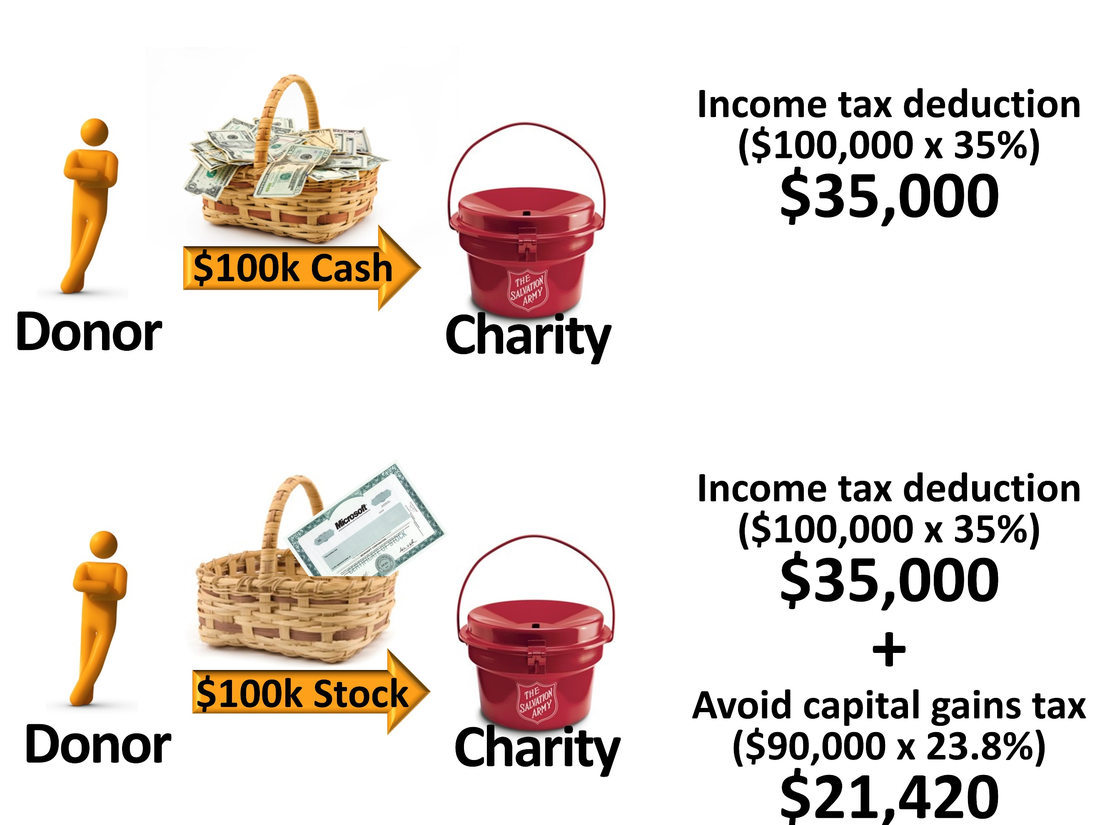
Suppose a donor is interested in giving $100,000 cash. (It could be any significant amount, but this is a nice even dollar figure.) Of course, most fundraisers will respond to such a possibility by simply encouraging the cash gift and then thanking the donor. But, for the fundraiser who understands a little bit of planned giving, this offer opens up the possibility to both benefit the donor and shift the donor's mindset towards the concept of giving assets rather than cash. For the itemizing donor at the top tax rate without other restrictions, the cash gift could create a federal tax benefit of 35% of the value of the gift - in this case, $35,000. Suppose the donor also holds $100,000 of highly appreciated publicly traded stock. Maybe the donor purchased 10,000 shares at $1 per share and they are now worth $10 per share. This appreciation is great for the donor, but it also carries with it a tax burden. At the moment he sells those shares, the donor will owe a tax bill of 23.8% on every dollar of appreciation. In other words, a sale of the shares will cost the donor 23.8% X $90,000 ($90,000 is the amount of increase in value from $10,000 to $100,000), or $21,240. There is no way for the donor to convert this $100,000 in appreciated stock into $100,000 of cash without paying the IRS $21,420.
Now there is. If the donor decides to give the shares of publicly traded stock to the charity and keep the $100,000 in cash, the donor ends up with $100,000 in cash and no tax liability. The charity receives the $100,000 in shares and immediately sells them. Because the charity is a nonprofit organization, it pays no taxes on this sale. After the sale, the charity ends up with the same amount of cash as it would have if it had simply accepted the check. Additionally, the donor is able to keep the $100,000 in cash he was initially going to give to the charity, thus converting the shares to cash without paying any taxes. In this case, the donor is still able to take the full $100,000 income tax deduction for the gift of stock. Thus, the donor gets the double benefit of a tax deduction plus avoidance of the capital gains tax.
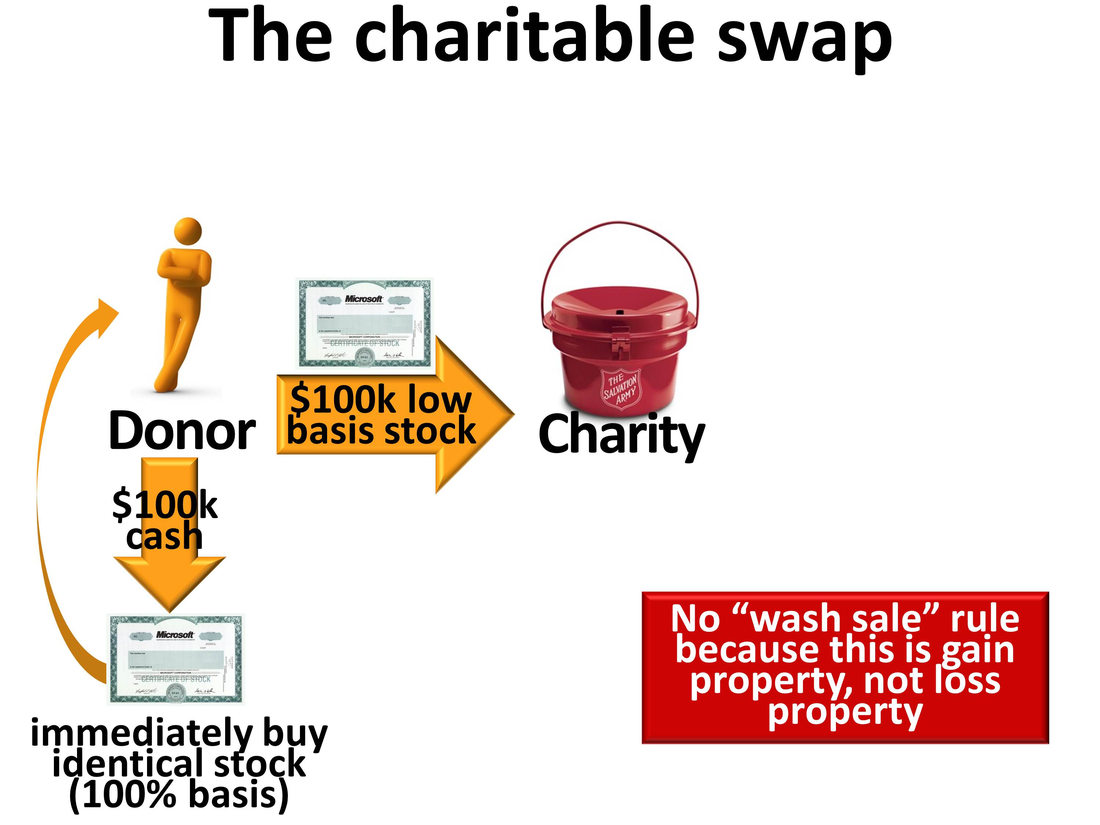
Although the tax consequences are beneficial, it appears to require the donor to have a simultaneous desire to make a gift and to change his investment portfolio. This is not true. The donor can maintain precisely the same portfolio before and after the transaction. Instead of giving $100,000 of cash, the donor gives $100,000 in appreciated stock and then immediately uses the cash to purchase $100,000 in new shares of the stock. As a result, the donor's investment portfolio doesn't change, except that the new shares were purchased for $100,000 instead of $10,000. This is a fantastic result for the donor because whenever the donor does decide to sell the shares, his capital gain (or loss) will now be based on this much higher purchase price. If the donor decides later to sell these new shares when the price was still $100,000, he will owe no capital gains taxes. If the donor had kept the original shares and then decided to sell them later when the price was $100,000, he would have owed $21,420 in capital gains taxes ($90,000 appreciation X 23.8%). This "charitable swap" of gifting shares and purchasing replacement shares can be completed on the same day. There is no rule requiring waiting as with the "wash sale" rule, because these shares are appreciated. The "wash sale" rule applies only to shares that have gone down in value. The "wash sale" rule should never be a concern in a charitable transaction because depreciated investments should never be given to charity. Instead, they should be sold in order to get the tax benefit of the loss. After the sale, then the proceeds from the sale can be donated if desired.
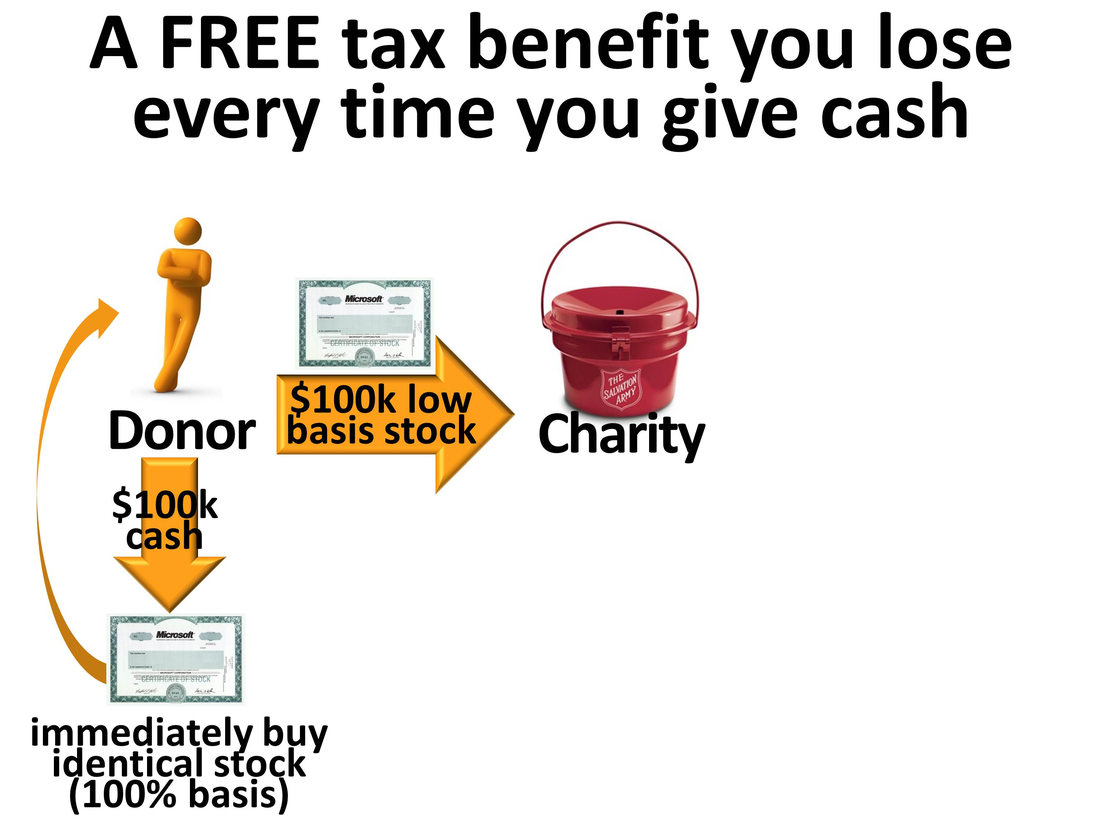
Some fundraisers may react to this highly beneficial transaction with indifference. If the fundraiser's job is simply to ask for cash, then alerting donors to these hidden tax benefits is just not in their job description. From this perspective, the donor's financial welfare is of no concern to the fundraiser. This cavalier attitude of intentional incompetence is not only bad for the donor; it is also bad for the nonprofit. A fundraiser who wants to encourage large, transformational gifts must shift the donor's perspective from giving cash ("giving from the little bucket") to giving assets ("giving from the big bucket"). On the surface, it may not seem like a tremendous win for the charity to convert a $100,000 cash gift into a $100,000 stock gift. But psychologically, it is a great achievement. Now, when the donor prepares to sell a highly appreciated asset, this special tax benefit may arise in his mind. Gifting is no longer associated just with spare cash, but now comes to mind whenever assets are moved. Understanding the tax benefits of gifting, rather than selling, appreciated assets opens up the entire world of sophisticated planned giving. This same technique will be employed repeatedly in various transactions involving Charitable Remainder Trusts and Charitable Gift Annuities. There the donor not only avoids the capital gains tax but also receives income based on the full, untaxed amount of the gifted asset. This starts with a shift in the donor's mindset from giving cash to giving assets.
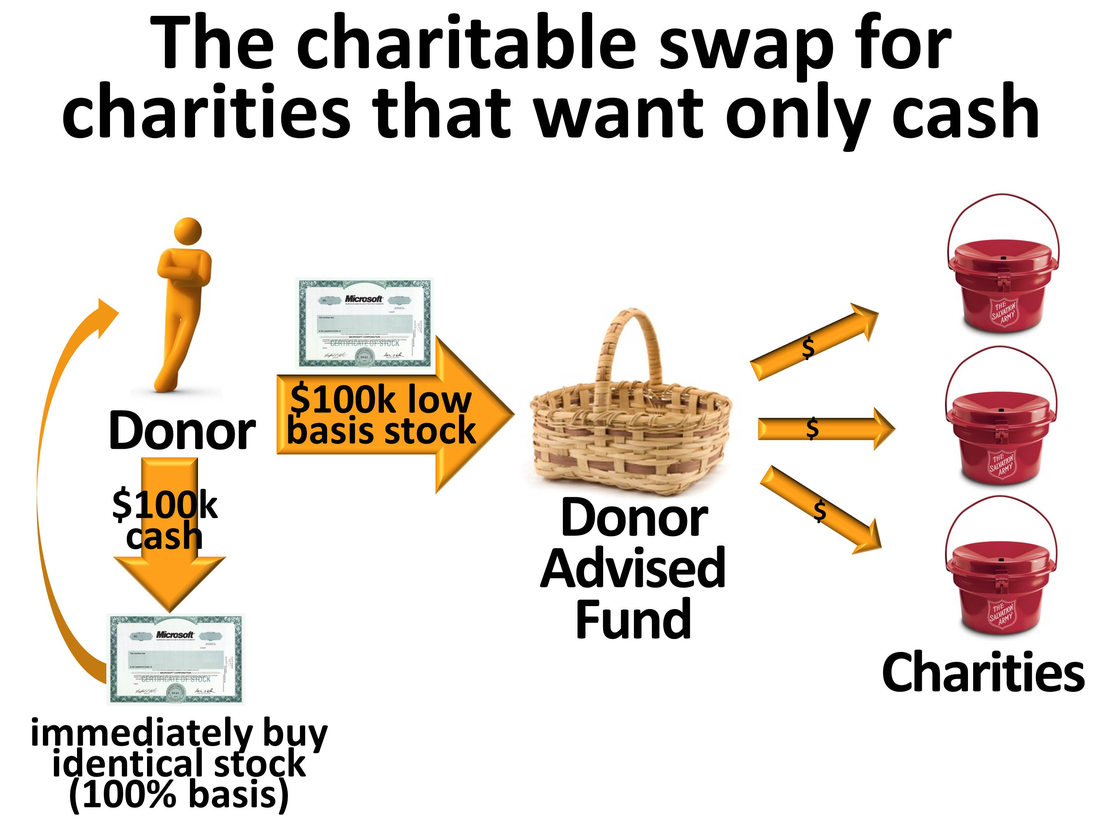
What about the donor who wants to give to a very small charity that doesn't accept shares of stock? No problem. Even if the charity doesn't know how to deal with gifts of stock, the donor can complete this transaction using a donor advised fund. The donor gifts the shares to a donor advised fund at a financial institution or community foundation. This transfer to a donor advised fund creates an immediate income tax deduction. The donor then directs the donor advised fund to sell the shares and write a check to the charity. The charity receives only the cash and never has to deal with the securities, but the donor still receives the tax benefit. The rest of the transaction can occur as before with the donor using the cash he would have gifted to the charity to purchase replacement shares of the stock.
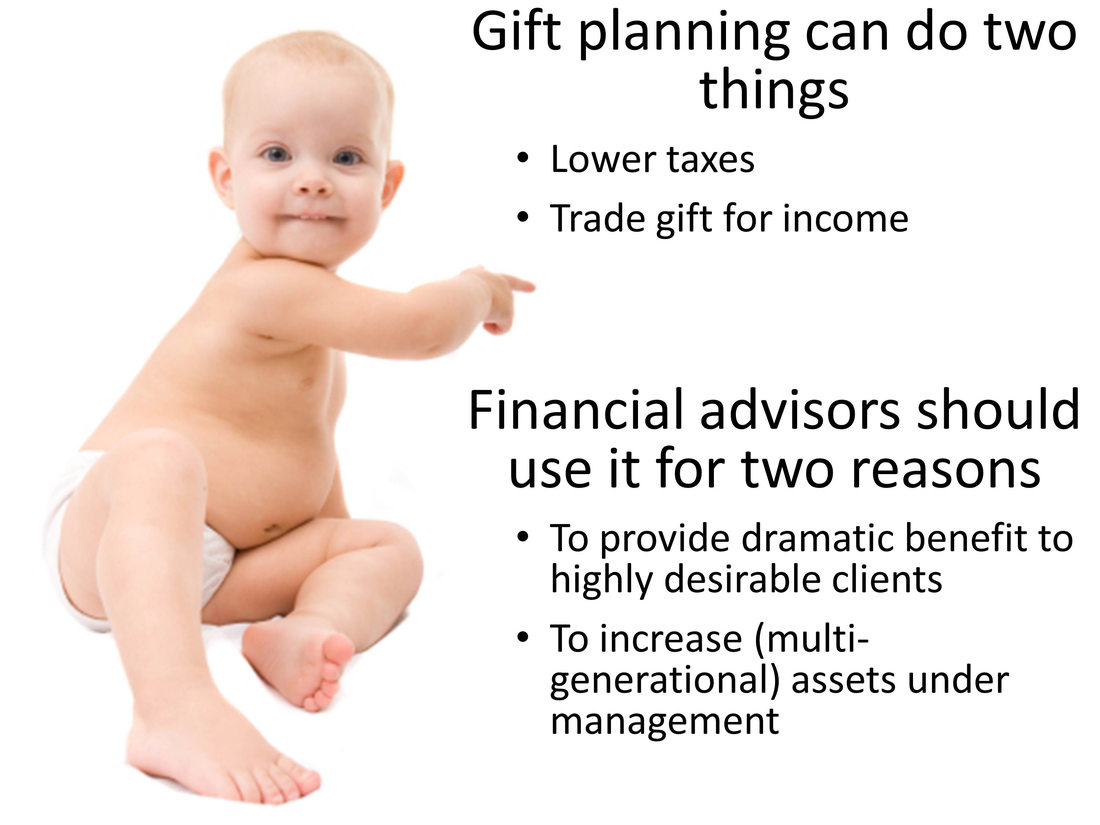
To this point, we have been looking at planned giving from the perspective of the fundraiser and the nonprofit organization. However, planned giving can be useful not just for fundraisers, but also for financial advisors. Some financial advisors may sell life insurance products in which case the variety of transactions involving life insurance, discussed in later chapters, will be of direct interest. Even for those financial advisors who are compensated solely as a percentage of assets under management, understanding charitable planning can be an important proficiency. Well informed financial advisors can become more attractive to clients with significant charitable interests by providing dramatic planning benefits. Such clients are often those with substantial wealth, making them particularly attractive for the financial advisor. Additionally, a variety of charitable planning techniques, such as Charitable Remainder Trusts, private foundations, and donor advised funds, allow advisors to continue to manage the funds within the charitable instrument, sometimes for multiple generations. In many cases, these funds are undiminished by the effects of capital gains taxes, income taxes on earnings, estate taxes and division among heirs, resulting in greater assets under management.
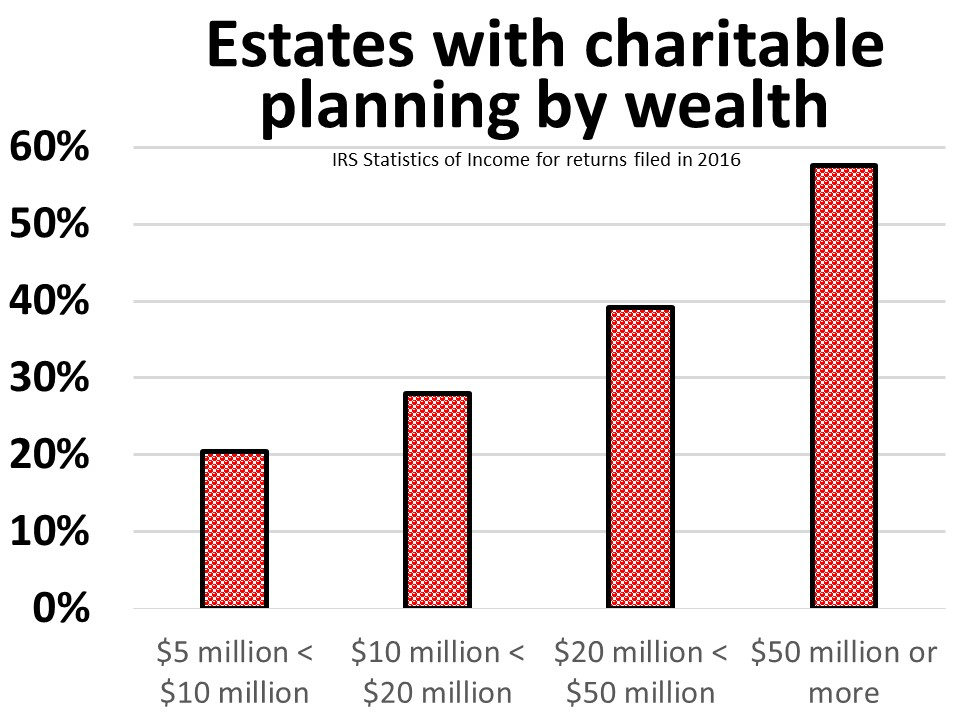
Charitable planning expertise can be particularly useful for financial advisors who wish to work with wealthier clients. As wealth increases, the tendency to engage in charitable planning also increases. Thus, this body of knowledge is particularly useful in attracting and benefitting the higher wealth clients that are often sought after by financial advisors. A financial advisor might use this knowledge as a means of marketing his or her services. This can be done formally through the offering of seminars, perhaps to the significant donors or board members of a local charity. It can also be done informally through conversations. Simply learning that a person has made a significant gift (often easily identified by various donor recognition levels) can lead to a conversation over whether the gift was of cash or appreciated securities. This leads to an explanation of the relative benefits of gifting appreciated securities through the "charitable swap" technique. Providing such value to prospective clients can be a good first step to establishing a relationship as an advisor.
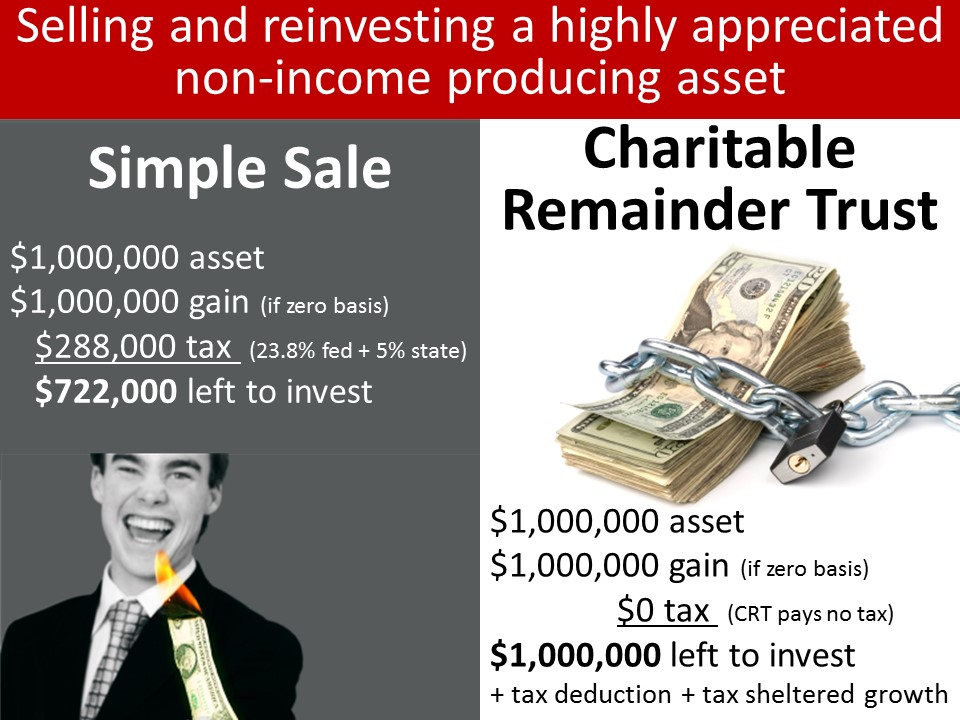
Helping clients to take advantage of the tax benefits available through charitable planning can benefit financial advisors not only by demonstrating the value of their advice to clients, but also by increasing the client's assets under management. Take the example of a client who holds a highly appreciated asset that generates little or no income. Such occurrences are quite frequent as those who build significant wealth often do so by owning relatively illiquid businesses or properties. At some point, the client may wish to convert this non-income producing asset to an income-generating asset. The standard approach to such a conversion is to simply sell the asset and use the proceeds to purchase another asset that generates more income. However, if the client already has interest in leaving a charitable gift at death, this may not be the best approach. Instead of selling the asset and paying the resulting capital gains taxes, the client could transfer the asset to a Charitable Remainder Trust, allow the trust to sell the asset, and then receive payments for life from the trust with the remainder going to a charity at death. This charitable approach not only avoids the capital gain taxes (the Charitable Remainder Trust is a charitable entity and thus pays no taxes upon the sale of the appreciated asset), but also generates an immediate income tax deduction. Such dual tax benefits can significantly increase the amount of funds available to be managed by the financial advisor. During the client's life, the financial advisor can manage the funds in the Charitable Remainder Trust, subject to the advisor's normal management fees. Further, the charitable recipient at the client's death could be the client's own private family foundation or donor advised fund, with assets also managed by the same advisor.
Taking the example of a $1,000,000 asset with no basis, the traditional "sell and reinvest" strategy would net $722,000 in the typical state with a 5% state capital gains net tax. (The federal tax deduction for payment of state taxes usually provides little or no help because of the $10,000 cap and high standard deductions.) In a higher taxation state such as California, such a sale may result in only $629,000 left to invest ($1,000,000 gain subject to 13.3% top rate in California and 23.8% top federal rate). Contrast this with the Charitable Remainder Trust where the entire $1,000,000 remains after the sale, available to be invested and managed by the financial advisor. Additionally, such a transaction will generate an income tax deduction of at least $100,000, increasing the assets under management outside of the Charitable Remainder Trust by reducing tax payments. Depending upon the state income tax rates, this tax deduction may be worth nearly $50,000 or even more. Thus, charitable planning results in assets under management of $1,050,000 or more instead of only $722,000 or even $629,000. Clearly, this is no small difference for the client and the advisor.
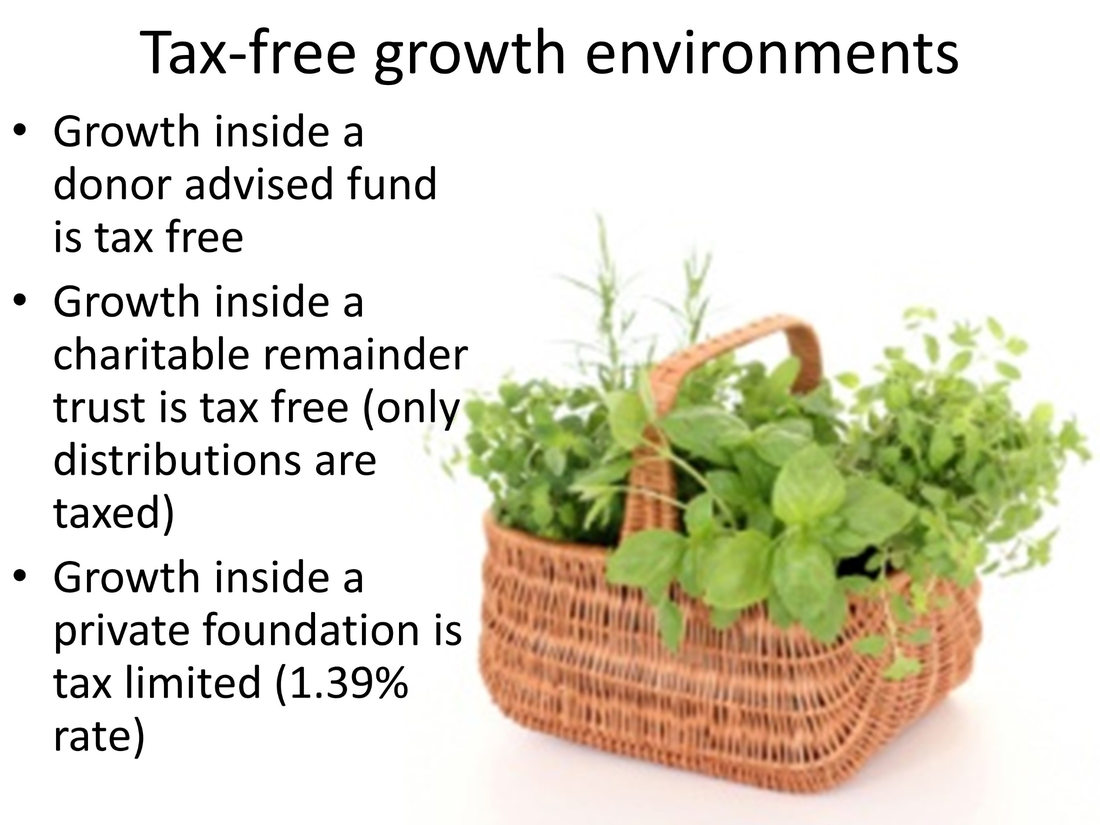
Charitable planning can increase assets under management by avoiding capital gains taxes and generating income tax benefits. It also does so by providing for tax-free growth environments. Over time, investments that grow without taxation will accumulate much more rapidly than their regularly taxed counterparts, leading to greater assets under management. A simple version of such tax-free growth is available with a donor advised fund. Money transferred to a donor advised fund must eventually be given to a charity - although at present there are no time restrictions on when this would occur. In the meantime, the financial advisor can take fees for managing the funds and the funds can grow without taxation because the account is a charitable account. Similarly, Charitable Remainder Trusts pay no taxes on investment income. (Like a traditional IRA, taxation occurs only when funds are paid out from Charitable Remainder Trust.) Assets within a private foundation do not grow entirely tax free, but the tax rate is only 1.39%, making them almost tax free.
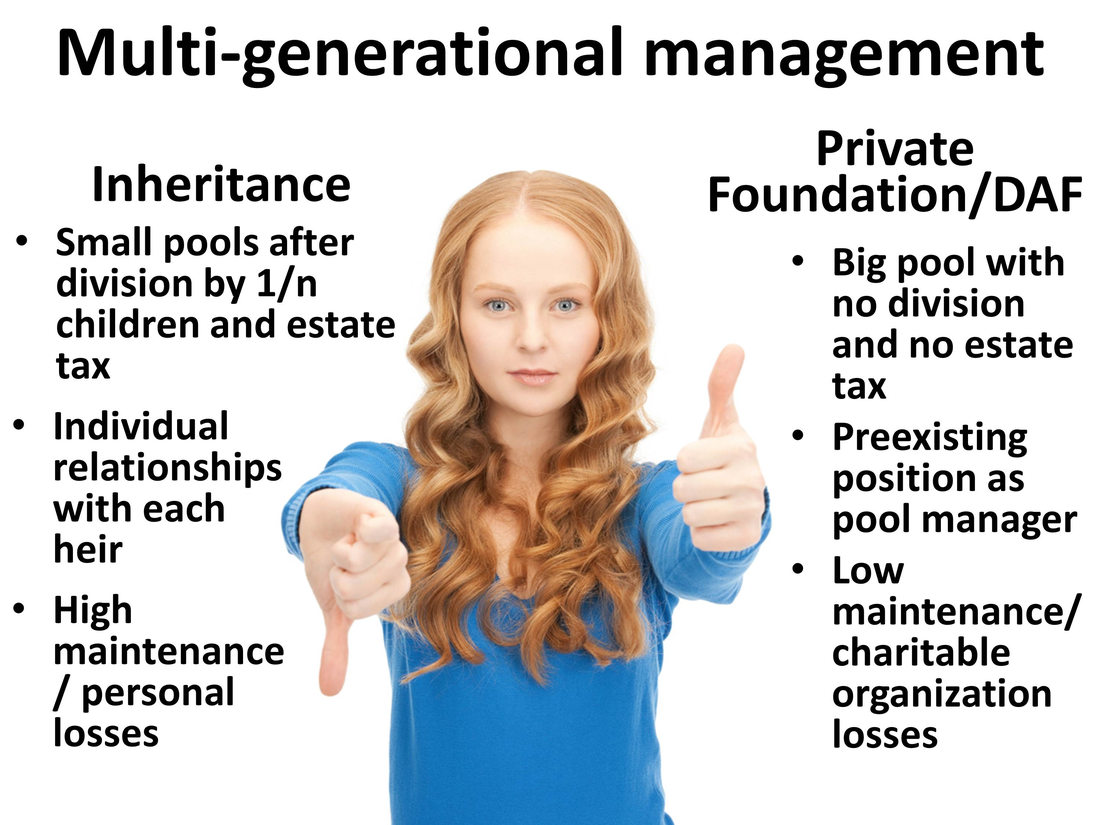
Creating multi-generational charitable entities, such as private foundations, can also increase the length of time that a particular financial advising firm will be able to manage the funds. In the typical estate scenario, the death of the client results in the loss of all assets under management. First, the wealth is reduced through estate taxation and then it is divided into smaller pools corresponding to the number of heirs. This creates a situation where the advisor either cannot or would prefer not to continue as the asset manager. Continuing to manage the assets would require having relationships with each of the heirs stronger than those of their other potential financial advisors. Even if such connections were possible, the advisor is faced with managing more relationships for smaller pools of money. At a minimum, the time commitment and hassle for the financial advisor is significantly multiplied. Realistically, the funds will likely leave the advisor's management upon the death of the client.
However, if the client had established - during life and through estate planning - a permanent charitable entity, the advisor is in a much stronger position. The charitable pool of funds is undiminished by either estate taxation or division among heirs. The advisor's existing role as charitable asset manager places him or her in a strong position to continue in that role after the death of the client. Rather than having to be the top choice for each individual heir, the advisor need only be acceptable to the majority of those appointed by the deceased client. Further, managing charitable funds is often easier than managing personal accounts. Losses to the charitable entity tend to be less personally distressing than losses in one's own investments. Such a dispassionate management scenario often reduces the amount of personal coaching and "hand-holding" necessary during inevitable market fluctuations. This makes charitable asset management that much easier for the financial advisor.

This book will explore a wide variety of charitable planning techniques. The tax and financial consequences of many of these techniques can become quite complex. There is no need to despair in the face of such seemingly unending minutia. Instead, remember the simple secrets to planned giving. Planned giving can do two things, reduce taxes and trade a gift for income. Fundraisers should use it for two main reasons, to ask from the big bucket of assets, rather than the small bucket of cash, and to work with donors who say the magic phrase, "I wish I could do more, but..." Financial advisors should use it for two different main reasons, to provide dramatic benefit to highly desirable clients, and to increase multi-generational assets under management.