As we begin to look at some of the underlying psychological constructs related to bequest decision-making, it is worthwhile to point out that each of these concepts will ultimately relate to concrete, practical, fundraising approaches. For those who do not have interest in psychological theory in and of itself, this area is still relevant simply because of its later practical usefulness. In later chapters, we will also spend time understanding and analyzing neuroimaging results. This was probably not the type of reading you intended to do when taking a position dealing with planned giving or estate planning. But, it turns out that understanding these processes is useful for developing practical applications in fundraising and estate planning. Hopefully based upon those assurances, you will have some level of willingness to jump into the deep end of the pool!
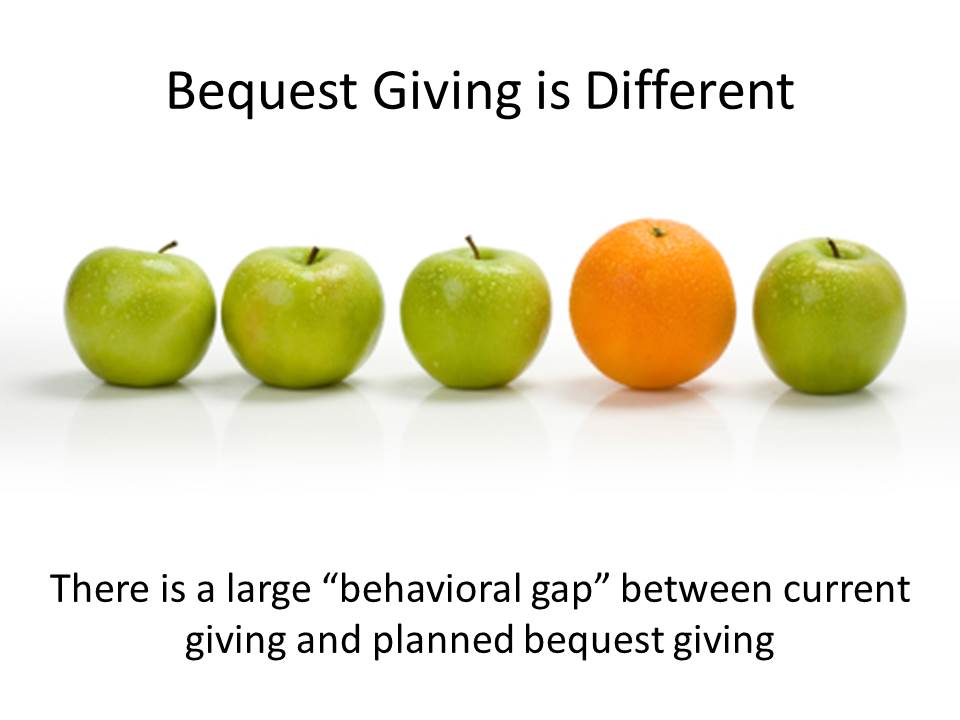
Let’s begin with a basic statement that is fundamentally important for all of our subsequent explorations of this field. Bequest giving is different. As I have spent the last many years engaged in academic research related to current charitable giving and bequest giving it has become more and more real to me that this statement is fundamentally true. Bequest giving is a very different animal. And we will explore the details of just how different it is.
Nevertheless, we can begin with the undeniable reality that there is a massive behavioral gap between current giving activity and planned bequest giving activity. If these two types of giving were driven by the same underlying motivations, then we would see similar levels of participation. But, we do not. Current giving is an enormously widespread behavior. People give to charities and charitable causes week after week, month after month, year after year. Approximately 80% of Americans engage in this behavior each year. And yet only about 5% to 6% of the population transfers dollars to charity at death. Thus, we begin with a massive observable difference in how people behave regarding these two methodologies of transferring dollars to charity.
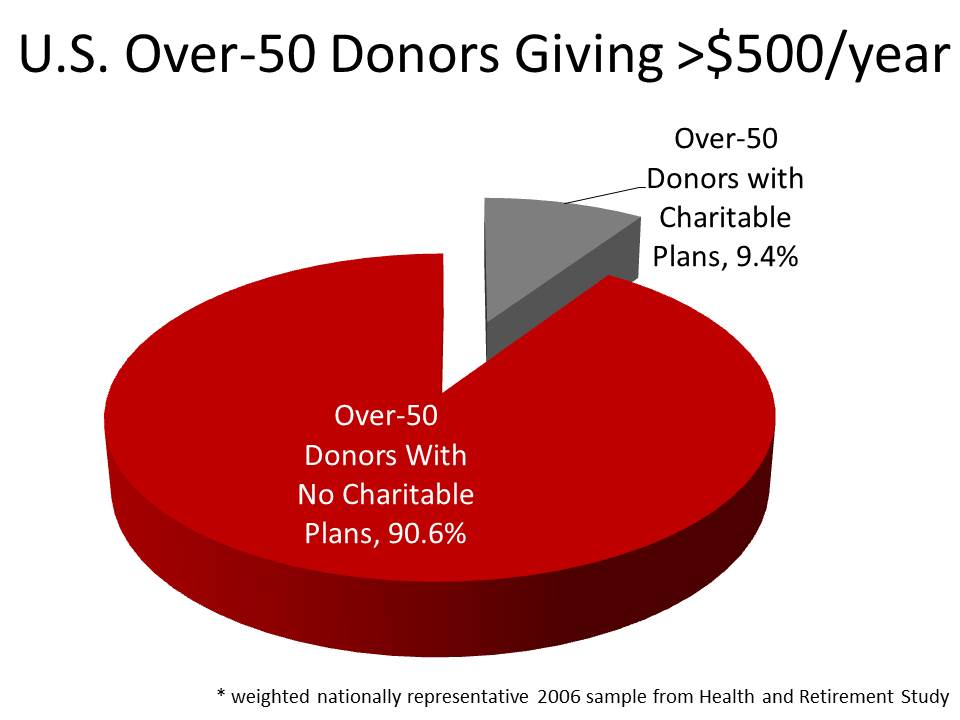
Even among those who make regular, substantial gifts to charity, the vast majority will leave no charitable transfers at death. We can think of this from a positive perspective or a negative perspective. On the negative side the current reality means that for approximately 90% of donors, when they die their death will simply result in the termination of an income stream to the charity with no offsetting charitable bequest. Given the dramatic aging of the population, this suggests the unpleasant possibility of charitable income falling off a cliff as this massive population group ages and dies. Such a prospect cannot be attractive to any charity dependent upon their support.
Conversely, the lack of charitable bequest planning among donors also presents an enormous untapped opportunity. The bequest giving dollars we are currently seeing represent less than 10% of supporting donors. Thus, if we were able to bring bequest giving participation to the same levels seen in current giving participation, we would create a nine-fold increase in the number of donors leaving gifts at death. This means that understanding the mechanisms underlying charitable bequest donation decision-making has enormous potential benefit.

As we begin to explore the differences between bequest giving and current charitable giving, a clear distinction with bequest giving is the substantial barriers to action. It is not that people conceptually have any opposition to the idea of estate planning. However, peoples’ actual observed behavior suggests that there are substantial barriers. These barriers to engaging in estate planning are not necessarily external. For example, it is relatively easy to purchase a fill-in-the-blank will document from an office supply store, or even simpler to download one for little or no cost from the Internet. And although these do-it-yourself wills are not as complete or appropriate as a professionally prepared customized document, they are clearly preferable to no planning at all.
Nevertheless, despite the relative ease and simplicity of completing basic estate planning, engaging in estate planning itself is perhaps the largest barrier to charitable bequest planning. The primary cause of the lack of planning may not be external but internal. There is something about the decision mechanisms involved in the estate planning process that creates a cognitive or emotional barrier for the majority of humans.
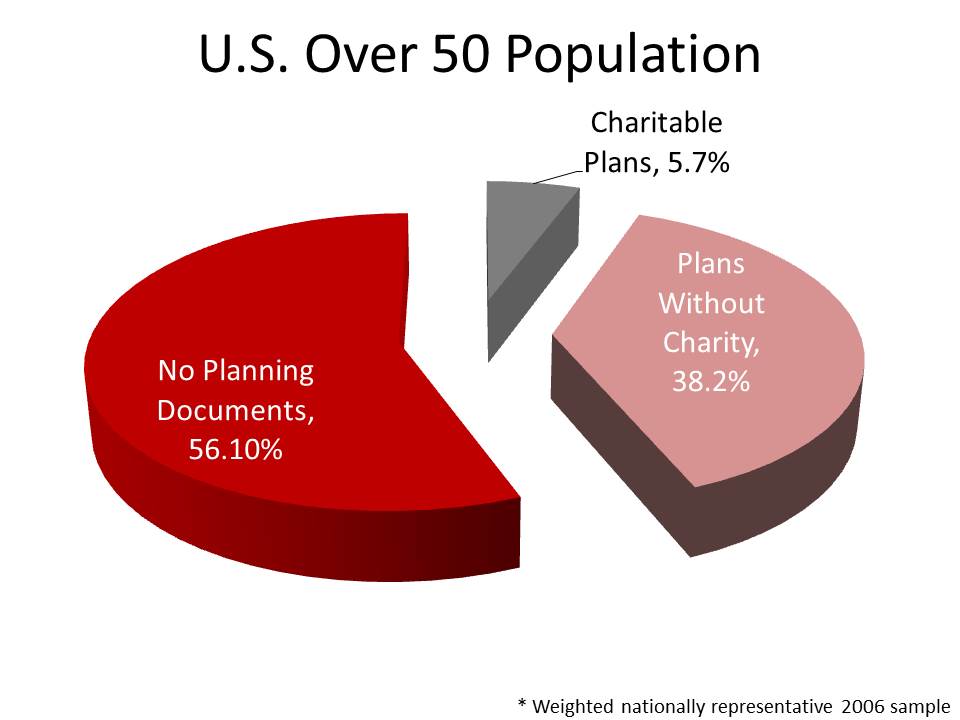
As we look at these nationally representative statistics from 2006, it gives us an understanding of just how much inaction is a barrier to bequest giving. About 6% of those over 50 have included charitable beneficiaries in their plans. About 38% of those over 50 either have not been asked or have been asked and said “no” to the question of including a charity during their planning process. But, most adults over the age of 50 do not have a charitable plan because they simply have no plan. Indeed, they cannot have a charitable plan because there are no planning documents.
The widespread reality of failing to plan does not reflect a conceptual opposition to the idea of planning as a good thing. In many surveys people will indicate a high rate of intention to eventually complete an estate plan (see, e.g., Planned Giving in the United State 2000: A Survey of Donors by the National Committee on Planned Giving). Very few have any objections to planning as an appropriate strategy. But it seems that this behavior is subject to infinite postponement. It is not that people believe cognitively that planning is a bad idea. Quite the opposite. People agree with the need for planning and even state intentions to, at some point, complete planning. Nevertheless, the actual estate planning behavior suggests that there is some additional barrier beyond purely rational mechanisms.
If we want to uncover the source of this extra-rational barrier behind the gap between cognitive assent to the appropriateness of estate planning and actual behavior in engaging in estate planning, we need to think about what is different about bequest decisions as compared with other legal, financial, and social decisions that we make during life. Clearly, there must be some unique characteristic of bequest decision-making that differentiates it from other kinds of decisions. There must be some distinction that causes engaging in bequest decision-making to be especially aversive or unpleasant.
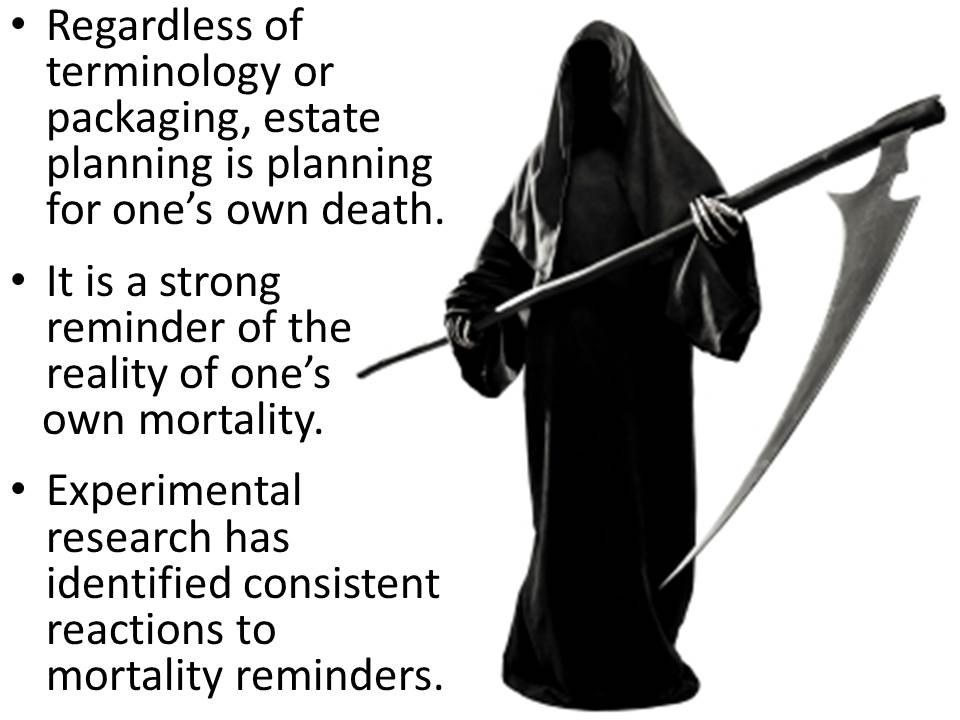
It should not be a shock that the key distinctive characteristic of bequest decision-making that differentiates it from any number of financial, legal, and family decisions we make every day has to do with the reality of our own personal mortality. What is different about estate planning as compared with other types of financial planning is that estate planning is planning for one’s own death. We can package it however we want, but ultimately estate planning asks people to engage in an extended contemplation of their own personal mortality. Very few other financial, legal, or family decisions require this type of extended mortality contemplation. Thus we might expect that this focus on personal mortality relates to the hesitancy to engage in or complete the estate planning process.
Although bequest decision-making has not been the topic of substantial academic research, it turns out to be related to a field in which much research has been completed. Specifically, there is a branch of psychology, labeled as “terror management theory,” which focuses on the effects of contemplating one’s own mortality. This contemplation of one’s own mortality is referred to as mortality salience. Salience refers to the idea that something is being brought to our attention and our focus. Thus, “mortality salience” refers to an increased focus and attention being paid to the reality of one’s own earthly mortality.
This line of experimental psychology research is potentially quite beneficial to those interested in understanding bequest decision-making. The intention of the researchers was not specifically related to understanding estate planning. Indeed, their purposes have more to do with understanding deep psychological constructs of the human personality. But, the experimental results produced by this line of research are often directly applicable to the bequest decision-making environment. Fundamentally, this is because the bequest decision-making environment has a high level of mortality salience. It is this mortality salience that distinguishes bequest decision-making from all other forms of financial, legal, and family-related decision making. Thus, although the original researchers purposes may have been quite different, the ultimate experimental results are directly applicable to our question of interest, which is understanding the mind of the bequest donor. Consequently, we will spend time investigating the key findings of this area of experimental psychological research.