As we begin this exploration of some of the latest research findings in this field, I think it’s worthwhile to deal with one of the initial questions or objections to taking such an in-depth look at this topic. Most presentations in this field focus on a list of tips and techniques on how to accomplish different goals. There is certainly great value in learning what is being done by different people at different places. However, I think it is particularly important in this field to gain a greater understanding of the underlying dynamics of how decisions are made.
Aside from the normal justifications used for a research-based methodology, I think it is particularly important in this area of charitable giving to have a research-based understanding of the processes. In other areas of fundraising or charitable giving, it is relatively easy to measure which approaches work and which approaches don’t work. I can readily send out two different mailings to similar audiences and quickly measure the financial effectiveness of one mailing compared to the other. The world of current giving and fundraising provides an excellent environment in which we can conduct experiments naturally. Such experiments are relatively easy to add to the regular fundraising process.
In some ways this can make theory less relevant for other kinds of fundraising. Knowing the mechanisms of why different approaches work may not be as critical, so long as we can continue to experiment and test to ensure that what we are doing continues to work well. This is not to say that a research-based approach in fundraising in other areas is not helpful. Indeed, I’ve spent many years researching current giving as well and I believe that such research can be helpful. But, this is simply to point out that we can accomplish a lot in traditional “current giving” fundraising simply by experimenting and seeing the actual dollars raised as a result of those different experiments.
This happy circumstance is unfortunately not the case in the area of charitable bequest planning. In traditional charitable bequest planning, we do not have a series of gifts made year after year, but rather we have only one gift. Consequently, we cannot experiment with the same person over time and get actual dollars-in-the-door results to concretely prove which approaches are most effective. We could run an experiment on two comparable groups, just as with traditional fundraising. And, we could measure the results of those experiments. However, the “results” may take 40 years or more to come back. Consequently, the traditional trial-and-error approaches that work so well in other areas of fundraising are of relatively little value in this field. The time lags are far too long. (Certainly the time lags are far longer than the typical number of years spent at one institution by the typical planned giving officer.)
One unfortunate side effect of this environment is that ineffective approaches or ideas can become common practice for many years. Because the delay between the actions of a fundraiser attempting to encourage charitable bequests and the actual dollars received is so great, it is very difficult to change ideas that are strongly held. It also means that this segment of the industry often has an unfortunate appetite for fantasy, ranging from the way gifts are counted to absurd predictions of future transfers.
However, I believe that to the extent we can understand the mechanisms underlying why these decisions are made, and the processes by which they are made, we can dramatically improve our ability to encourage charitable bequests. And for those who care about actual long-term success in accomplishing the goals of the donor and the institution, this knowledge can become a powerful tool.
To the extent that we can improve our understanding of these processes, it gives us a set of tools far more powerful than even the best listing of tips and techniques. Even assuming that the tips and techniques we learn from others’ war stories are actually effective strategies, there are often limitations to the use of these “war stories” for our own situations. Some approaches work well for one charity in one location, but would not work at all for another charity in another location. A deep understanding helps us to avoid inappropriately applying strategies from other times and other organizations, and it helps us to modify our own strategies to more effectively influence these underlying decision-making process. The reality of this field of fundraising is that brute force trial-and-error, which can work quite effectively in other areas, simply will not work in bequest giving. I just takes too long to find out what worked and what didn’t work.
Someone may argue that we could measure when bequest plans are made. This is certainly true and it can be an appropriate strategy. However, we all know that a bequest plan made is not a dollar in the door. Bequest plans made can be bequest plans changed. Further, most organizations find that the bulk of all bequest dollars received come from donors who had not directly involved the charity in their estate planning processes. A substantial amount of charitable bequest dollars come from those who had not even been donors to the organization.
Consequently, we are somewhat working in the dark in this field of encouraging charitable bequest giving. Even what we are able to learn from the donors we work with directly is still knowledge about a revocable document. Ultimately, we have no concrete knowledge about a charitable bequest until the actual post-death transfer is made. Those who point to their rigorous process for documenting planned charitable bequests are conceptually in the situation of arguing that we can be more effective in nailing Jell-O to a wall if we use a heavy, 10-pound nail, than if we simply use a thumbtack. Either way, it is still nailing Jell-O to a wall. No level of documentation is going to change the reality that the documents are revocable. And thus, ultimately, we are left with the unfortunate reality that we simply do not know about the presence or amount of a charitable bequest until after the person has died. Because the ultimate results take so long before they are seen, it becomes particularly important to have a scientific basis for our marketing approaches.
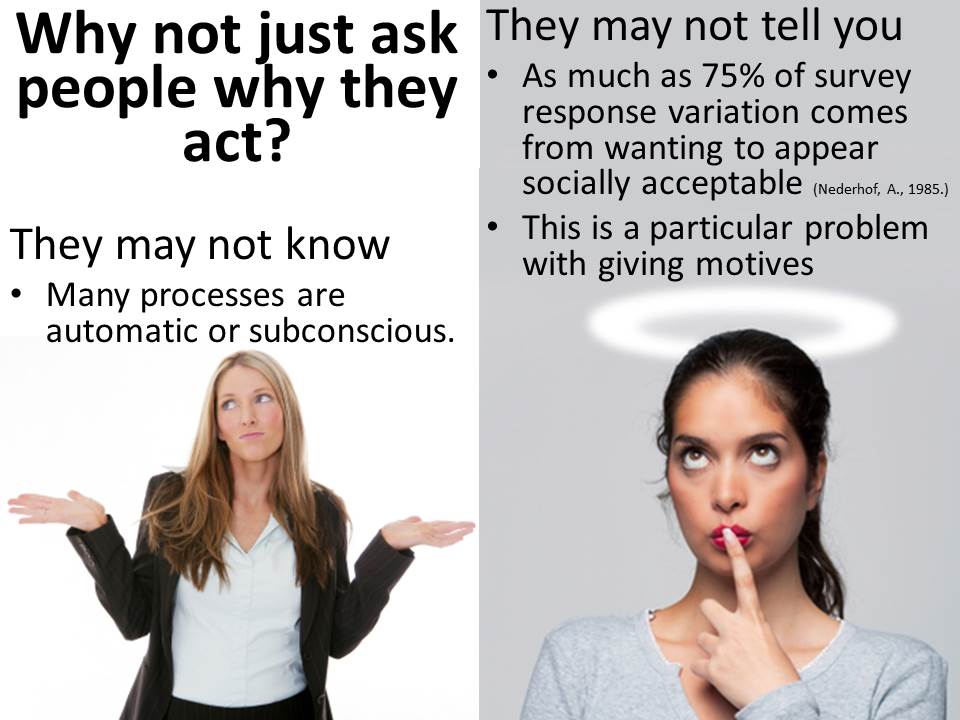
Having attempted to justify the need for a deep understanding of the processes involved in charitable bequest planning, we can now consider how we should best go about improving our understanding. Rather than using psychological theory, experiment, and neuroimaging, it is perfectly reasonable to ask, “Why don’t we simply ask people why they do things?” This is, in fact, a very appropriate methodology. Later, we will use results from these type of approaches as a point of comparison with the experimental and neuroimaging results. However, simply asking people why they do what they do does not always give us a complete picture of what’s really happening.
To begin with, people may simply not know the answer to the question. We don’t always know why, precisely, we do the things that we do in life. Many of the processes that we use in making decisions and living our lives are automatic or subconscious. Consequently, we don’t go through a rational, cognitive, step-by-step process prior to every choice.
Even when we actually engage in higher rational processing, it doesn’t mean that this process ultimately drives the behavior. In neuroscience, one of the characteristics of these rational, higher cognitive, parts of the brain is that these processes are much slower than other, more deeply seated neural processes (such as emotion, fear, pain, etc.). Consequently, the higher rational parts of the brain often engage in post hoc rationalizations and justifications, rather than being the actual drivers of decision-making prior to the decision. This means that when we ask people for explanations of behaviors caused by automatic or subconscious processes, we are likely to get a series of after-the-fact rationalizations. Although typically plausible, these explanations may have absolutely nothing to do with the real underlying processes that actually caused the behavior.
This problem is compounded by the widespread effects of social acceptability bias. When people are asked about explanations for their past or future behavior, they are likely to provide answers with a high level of social acceptability. In other words, people tend to see themselves and their motives in the best possible light. People may be quite willing to attribute negative motivations to others, but not to themselves. Consequently, people tend to create a “halo effect” when describing their own future intentions, or their reasons for past or future behavior. In some circumstances, this bias can limit the usefulness of responses provided by individuals about why they do what they do.
This social desirability bias is especially problematic in an area such as charitable giving. Charitable giving is viewed as being a pro-social activity, and any explanations that de-emphasize this aspect will tend to be disregarded when describing personal motivations. Thus, we see repeated surveys indicating that tax benefits are not self-reported motivators for charitable giving, but simultaneously see clear evidence of the power of such benefits to dramatically alter actual giving behavior. This challenge of social acceptability bias suggests that we sometimes must go beyond simply listening to the socially acceptable answers that people might give regarding their motivations. Instead, we must consider that as one point of information to be compared against other sources of understanding. Ultimately, the goal is to actually develop a potentially deeper understanding of the underlying neural and psycho-social constructs that drive this behavior.