This chapter examines charitable gifts of partial interests in property. The topic of this chapter may initially appear not as interesting or relevant as some of the chapters covering well-known specific charitable planning techniques. However, gifts of partial interests (specifically retained partial interest gifts where the donor keeps some rights in property and gives other rights in the same property to the charity) are a fundamental concept that will be used again and again in advanced techniques. For example, Charitable Remainder Trusts, Charitable Lead Trusts, gifts of remainder interests (with retained life estates) in homes and farmland, and even qualified conservation easement gifts are all forms of partial interest gifts where the donor retains some rights in the property given to charity. Although this chapter does not address the specifics of such gifts (which are covered in their own chapters), this chapter provides a brief theoretical foundation of how and why partial interest gifts, such as these, are sometimes allowed and sometimes disallowed. Additionally, this chapter also covers some specific gifting techniques that, while relatively straightforward, may be useful in a variety of circumstances.
So, let's begin with a definition. What is a retained partial interest gift? A retained partial interest gift occurs when a donor gives a charity some rights to an item of property, but simultaneously keeps some other rights in the property. Notice that what is being divided here is not the property itself (such as taking the tire off of a car), but rather the legal rights to the property. In the law, property ownership represents a bundle of rights. These rights can be kept together where one person owns all of them, or these rights can be divided where different people own different rights. For example, the tenant in an apartment has certain rights, such as the right to use the property for residential purposes so long as the rent is paid. However, the owner of the apartment building also has rights in the apartment property, such as the right to take possession of the apartment at the end of the lease period. A retained partial interest gift occurs whenever a donor splits types of ownership rights and gives some of them to charity while retaining others.
An example of splitting the rights between the donor and a charity would occur if the donor gave ownership of an automobile to a charity, but retained the right to use the automobile for one year. Given that the charity has received some rights (i.e., ownership in one year), is it reasonable to allow an immediate tax deduction for this transfer?
Another example of a partial interest gift reverses the previous situation by giving the charity the right to use the property for one year, after which the donor has full ownership rights. Given that the charity has received some rights (i.e., the right to use the property for one year), is it reasonable to allow a tax deduction for this transfer?
Another example of a partial interest gift would be a transfer of land to a charity where the donor keeps all rights to extract minerals from the land. Once again, the donor has retained some types of rights and the charity has received different types of rights in an item of property. Given that the charity has received some types of rights (i.e., the ownership of the land, except for mineral rights), should a tax deduction be allowed for this transfer?
The general rule is that the donor cannot keep ownership rights in gifted property and still deduct the gifts. There are some very important specific exceptions to this general rule that we will examine in detail later. However, if none of these specific exceptions apply, the partial interest gift with retained rights will not generate a deduction.
For example, if the donor gives the title to a car to a charity, but retains the right to use it for one year, there is no immediate charitable income tax deduction. This is a partial interest gift with retained rights because the donor retains rights to the gifted property. This gift does not qualify for any of the special exceptions to the general rule against deductions for such partial interest gifts, so there is no immediate income tax deduction.
The emphasis is on there being no immediate tax deduction because the donor could later transfer the remaining rights to the charity or the donor's rights could expire. In either case, the transfer to charity would no longer be a retained partial interest gift because the donor would no longer have any retained rights. At that point, the transfer would become a completed gift not involving any retained interests and would therefore be deductible. So, in this example, after one year - when the donor's rights expire - then the gift of the vehicle would be complete and could be deducted based upon its value at that time.
Similarly, allowing the charity to use property does not generate a deduction when the donor still retains underlying ownership of the property. Because the donor is retaining rights in the gifted property, this is a retained partial interest gift. Because none of the special exceptions apply to this partial interest gift it, therefore, will generate no deduction. Thus, allowing the charity the rent-free use of a building when the donor retains ownership rights to the building will generate no charitable tax deduction.
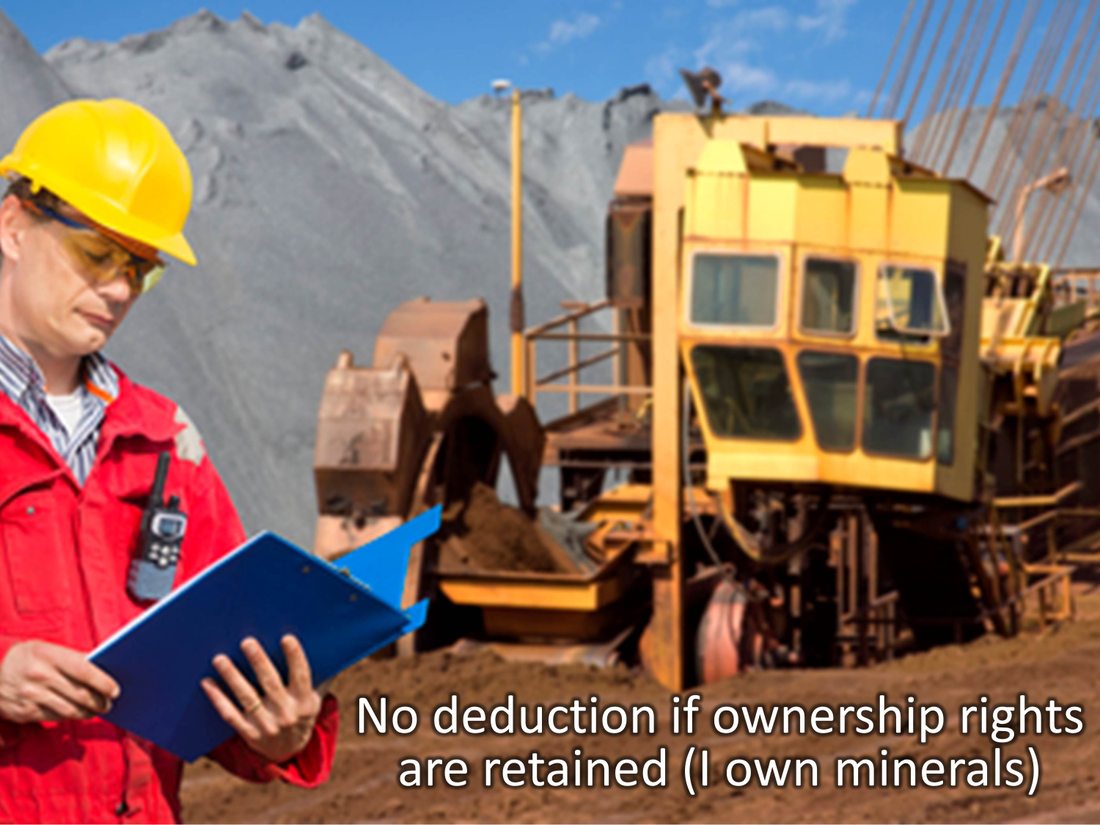
As a final example, transferring ownership of land to a charity, but retaining the mineral rights also generates no charitable income tax deductions for the donor. The donor has given some rights in the property, but retained some other types of rights in the same property, making this a retained partial interest gift. Because this transfer does not qualify for any of the special exceptions, the general rule (that partial interest gifts are not deductible) will apply.
These are all examples of the general rule (which has some very important exceptions) that donors may not keep some rights in the property and still deduct a transfer of other rights to a charity. Notice that this rule applies to retaining rights in the same property that was given to the charity. For example, it does not prevent a deduction for giving a specific 10-acre tract to charity from a 1,000 acre farm. In that case, the donor retains no rights to the 10-acre tract given to the charity, but retains rights only in the 990 acres not transferred to the charity. Similarly, a donor could give the steering wheel of an automobile to charity and keep the rest of the car. This would not be a partial interest gift because the donor retains no rights to the specific item of property (the steering wheel) given to the charity.

We have been examining cases where the general rule against deductions for partial interest charitable transfers applies. But, why do we have such a rule in the first place? Why not simply allow deductions for the fair market value of any partial interests transferred to the charity?

The problem with partial interest gifts is that the donor may be able to manipulate the property to get more value for the donor's share and less value for the charity's share. The charity may not complain about such manipulation because it is still getting some value, which is better than nothing. However, because the charity is getting less value than that assumed by the calculation of the tax deduction, this violates tax policy goals. How might a donor manipulate the property to reduce the charity's share if such partial interest gifts with retained interests were deductible? Let's look at a few examples.
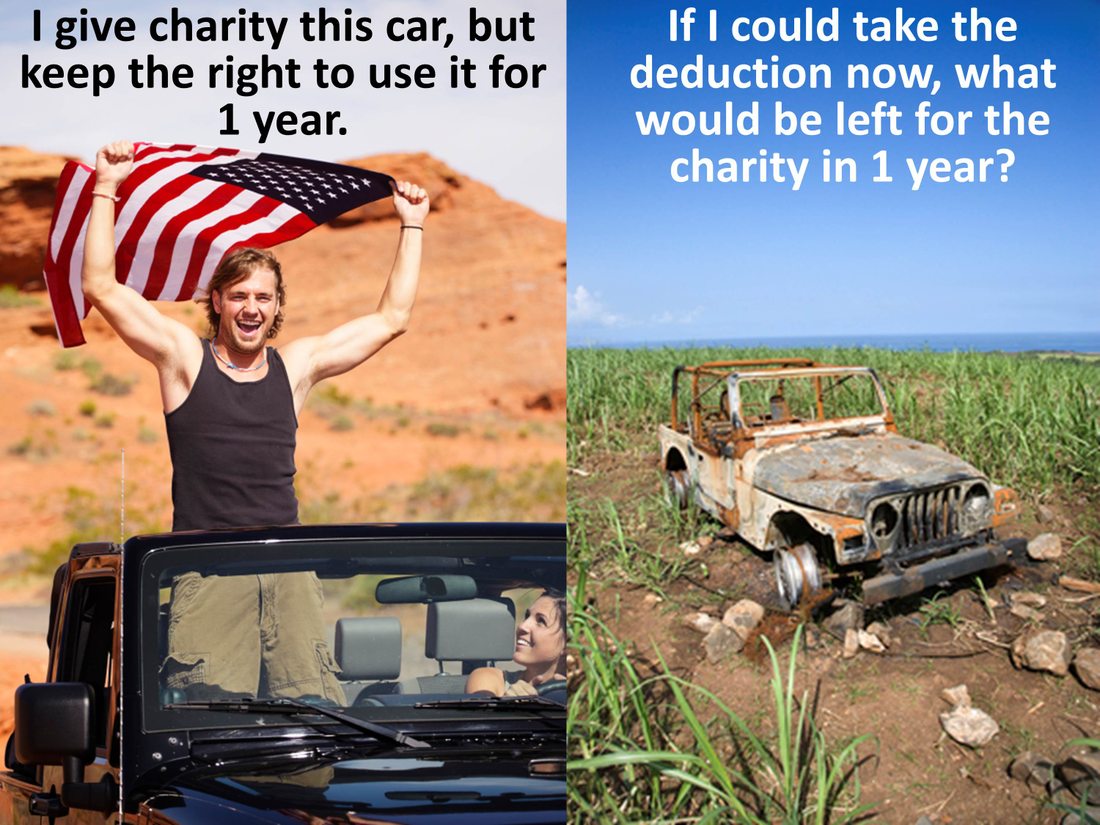
Suppose a donor could transfer an automobile to charity, retain the right to use the automobile for one year, and still deduct the value of the automobile subtracting only one year of projected depreciation. Could the donor use the automobile in such a way that the charity would receive very little value at the end of the year? Yes. Thus, the donor could receive a tax deduction based upon a much higher value than that actually transferred to the charity. To avoid this problem, such partial interest gifts do not generate a tax deduction.
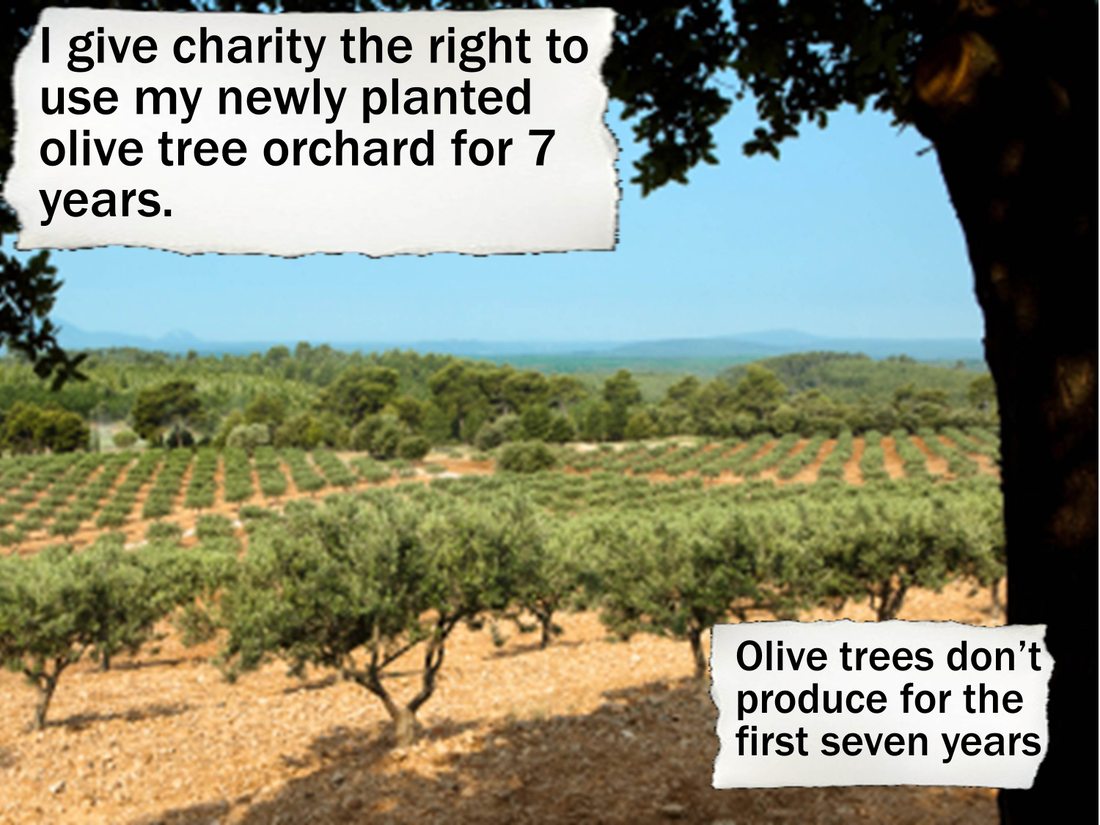
Or, let's reverse the situation and give the charity the right to use the property while the donor retains ownership at the end of the use. Suppose a donor gives a charity the right to use his newly planted olive tree orchard for seven years. What if the donor was allowed to deduct the fair market rental value for farmland? In this case the land produces nothing for the first seven years. (Newly planted olive trees do not produce until after seven years.) A cooperative charity would not disturb the olive trees, allowing the owner to deduct the gift of a right which has no real value. Thus, once again, the donor would receive a tax deduction based upon a much higher value than that actually transferred to charity if this prohibition against partial interest deductions were not in place.

As a final example, let's suppose that a donor gave $2 million worth of stock in his corporation to a charity, but retained the right to repurchase the stock for $2 million any time in the next three years. This is a retained partial interest gift, because the donor is retaining some rights in the property gifted to charity. Were it not for the prohibition against deductions for such partial interest gifts, the donor could deduct $2 million. (This is logical because the charity receives $2 million of property and the right to repurchase the property requires a $2 million transfer.) How could such a transaction be abusive of the tax code? Suppose that the corporation's only product was a new cancer drug that would be either approved or rejected by the FDA in three years. If approved the $2 million of stock would be worth $200 million. If rejected, the $2 million of stock would be worth zero dollars. If the partial interest charitable gift were deductible, the donor could guarantee a $2 million deduction - worth nearly $1 million in reduced tax payments depending upon the donor's income and state of residence - and still retain the repurchase rights to capture the potential $198 million gain. Even if the donor had no charitable interests, the charitable gift risk scenario (outcomes of $1 million benefit plus a possible $198 million benefit) could be preferable to the non-charitable risk scenario (outcomes of $0 benefit plus a possible $200 million benefit). Because of the partial interest rule this transaction would generate no immediate charitable deduction. If the donor's right to repurchase expired, then, at that point, the gift would be completed, because the donor would have no retained rights in the stock. But, the deduction would be based upon the value of the stock at the time that the retained interests expired, not at the time of the initial transaction, thus eliminating the opportunity for changing the donor's risk scenario.
These examples all serve to explain why the general rule prohibits donors from keeping some rights to a gift of property and still deducting the value of the partial interests gifted to charity. Understanding this underlying principle also helps to explain why the tax code allows for certain exceptions to the general rule. Specifically, these exceptions are cases in which the opportunities to abuse the charitable tax deduction have been largely eliminated.
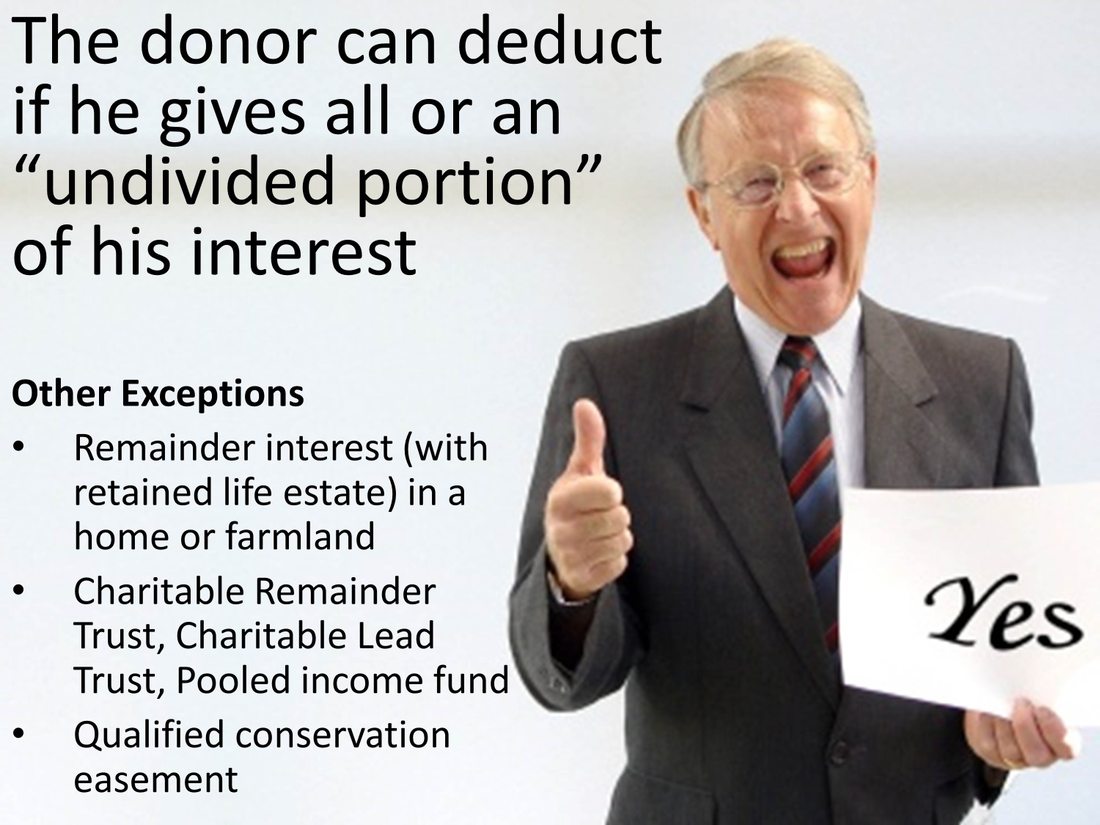
One of the exceptions to the general rule against deducting gifts of partial interests is that the donor can deduct if he or she gives all of an "undivided portion" of his or her ownership interests. We will be exploring this exception in the rest of this chapter. Other notable exceptions to the general rule against deductions for partial interest gifts with retained interests include remainder interests (with retained life estate) in a personal residence or farmland, Charitable Remainder Trusts, Charitable Lead Trusts, Pooled Income Funds, and qualified conservation easements. These other exceptions will be addressed in other chapters.
Why are partial interest gifts allowed if the donor gives all or an "undivided portion" of his or her interests? The underlying reason why partial interest gifts do not generally create a deduction is because of the potential for the donor to subsequently increase the value of his retained interests while reducing the value of the charity's interests. This type of behavior is not a risk when the donor gives all or an "undivided portion" of his or her interests.
If the donor gives away all of his interests, he has retained nothing which could be increased in value at the expense of the charity's interests. For example, if the donor owned only the mineral rights to a piece of land, he could deduct the gift of those mineral rights to a charity. In contrast, no deduction would be allowed if the donor retained ownership in the surface rights of the land, because the donor would not have given away all of his interests in the property. Thus, it is not the giving of partial interests to a charity that makes the gift nondeductible. Rather, it is the simultaneous retention of some interests by the donor that makes the gift nondeductible.
However, the donor may retain rights to the property, if the donor gives an "undivided portion" of ALL of the rights owned by the donor. In this case, the donor gives a percentage (say, for example, 10%) of all of his rights in the property to the charity. There is no opportunity for the donor to increase the value of his rights while decreasing the value of the charity's rights, because the donor and the charity have identical types of rights (although perhaps with a different percentage ownership of those otherwise identical rights). Because the donor and the charity have identical types of rights, thus eliminating the risk of abuse, the retained interest by the donor will not prevent a charitable deduction. This difference between divided and undivided shares may be, at first, difficult to conceptualize. So, let's look at an analogy that may help to clarify this distinction.
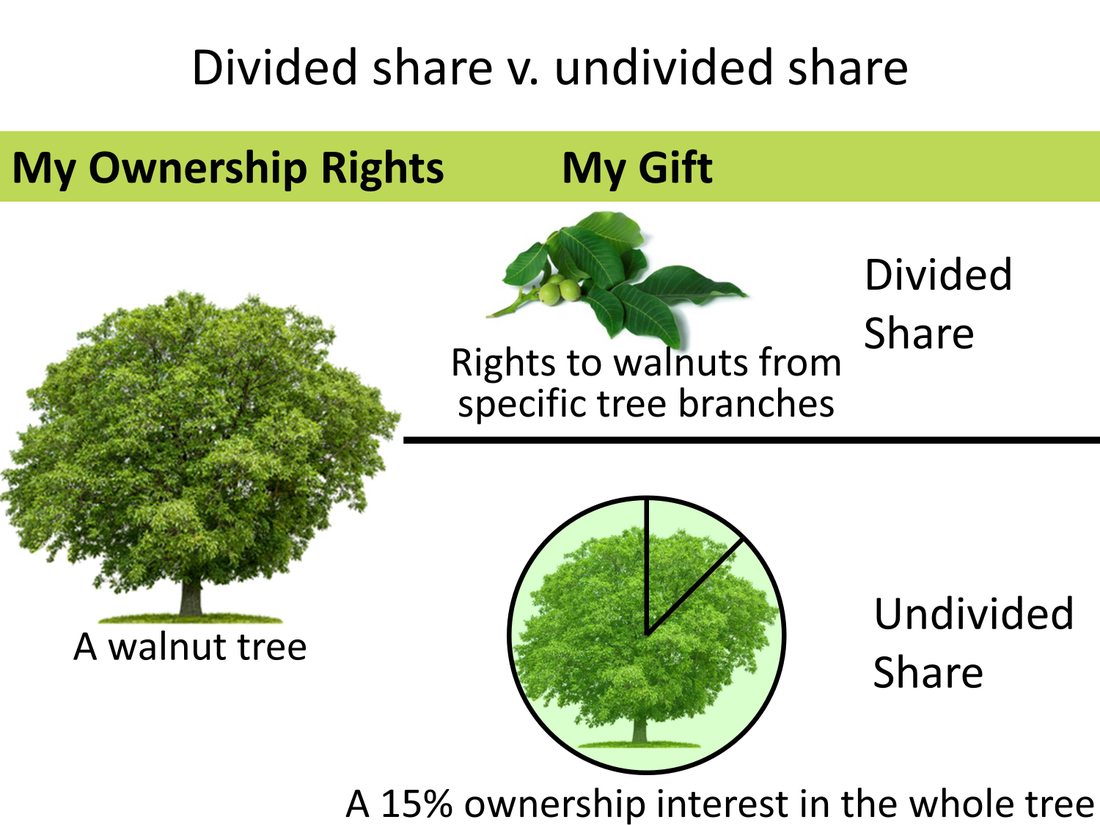
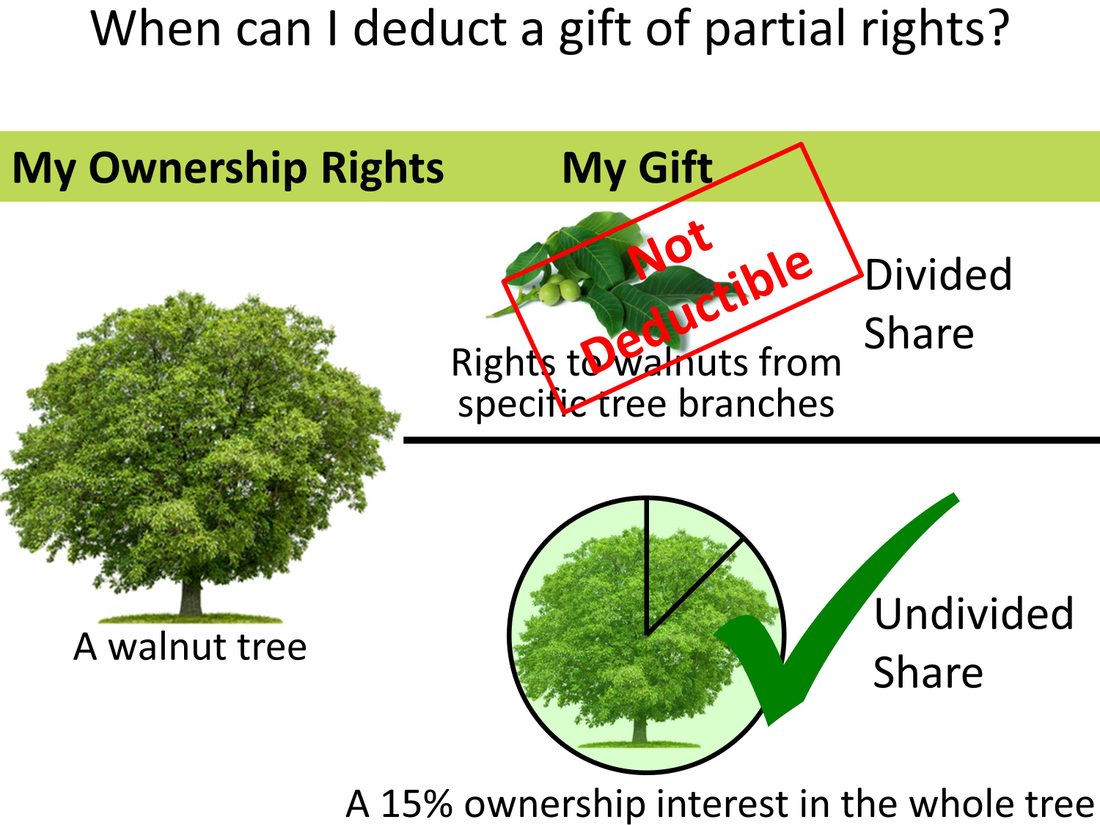
Suppose that a donor owns a walnut tree. Walnut trees are valuable both for their wood and for the walnuts that they produce each year. Suppose the donor wants to make a partial interest gift, giving something to the charity and keeping something for himself. The donor could designate a specific branch and give the charity the rights to collect the walnuts from that specific branch. This is a divided share gift (i.e., the donor is dividing the tree and giving the charity rights to the walnuts from a specific branch of the tree.) Alternatively, the donor could give a 15% ownership interest in the whole tree to the charity. This would give the charity the rights to 15% of any walnuts collected, 15% of the price of any wood sold from the tree, and the right to force the sale of the tree. This would be an "undivided share" gift, because the donor has gifted a share of every type of right he owns in the entire tree.
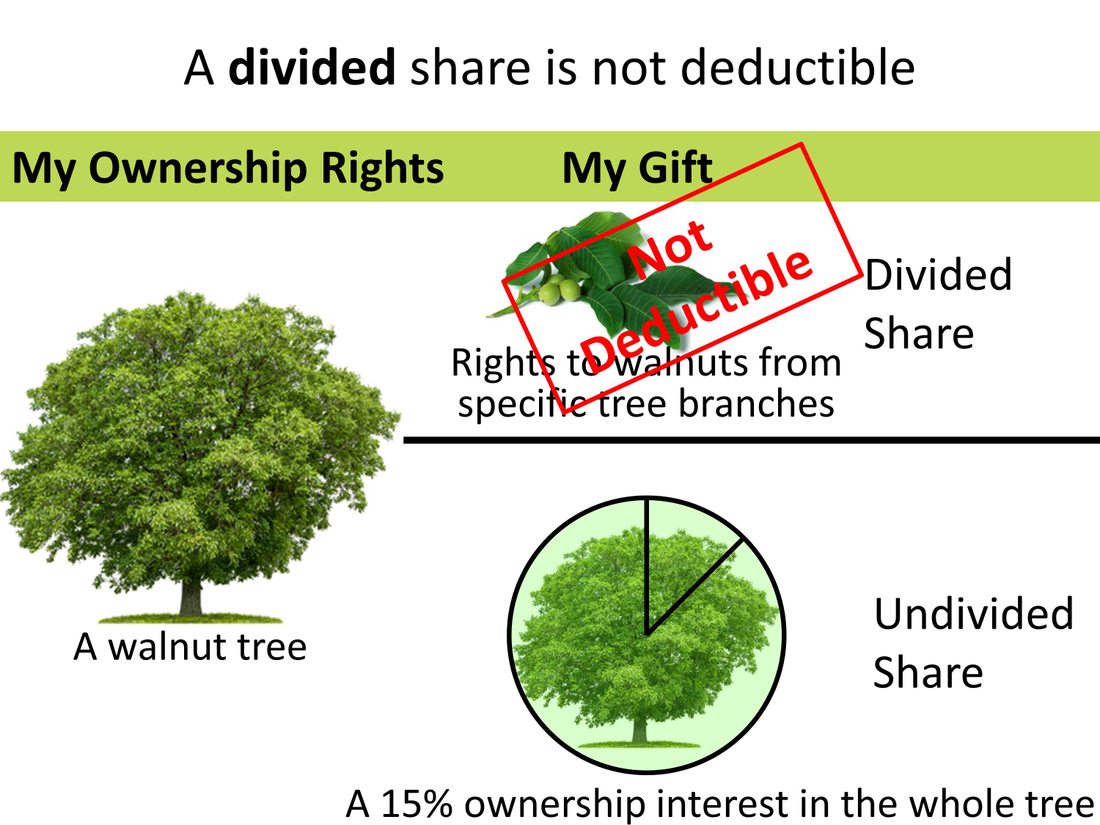
A "divided share" gift is not deductible. Divided share gifts provide the opportunity for the donor to subsequently reduce the value of the charity's share relative to the donor's share. For example, the donor might designate that the charity receives all of the walnuts from a particular branch. But, then at some later time the donor might cut off that branch so that it no longer produced walnuts. By doing this, the donor could increase production for the rest of the tree (which the donor still owns) by leaving the roots to more strongly support the donor's remaining portion of the tree. This opportunity for reducing the value of the charity's share relative to the donor's share is essentially the same logic that makes such divided share gifts non-deductible where no special exception applies.
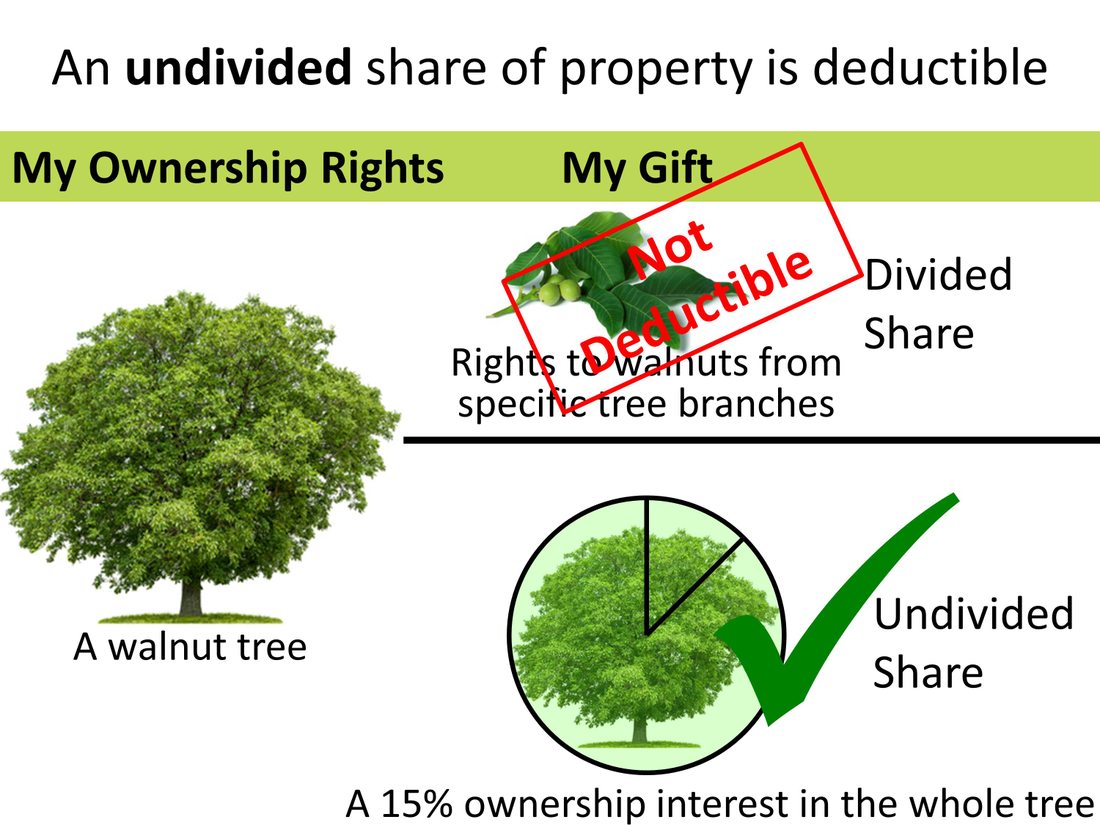
In contrast, an "undivided share" gift is deductible. When the donor gives a 15% ownership interest in the whole tree, this gives the charity the rights to 15% of any walnuts collected, 15% of the price of any wood sold from the tree, and the right to force the sale of the tree. There is no way for the donor to increase the value of his retained ownership rights relative to the rights given to the charity. If the donor cuts off a branch, both the donor (85%) and the charity (15%) own that branch as well as the remaining tree. Anything that decreases the value of the charity's interests also decreases the value of the donor's interest in exact proportion to their ownership percentages. Because there is no opportunity for abuse, this type of "undivided share" gift does generate a taxable deduction. Let's now examine some different examples of gifts to determine if they are divided share gifts (not deductible) or undivided share gifts (deductible).
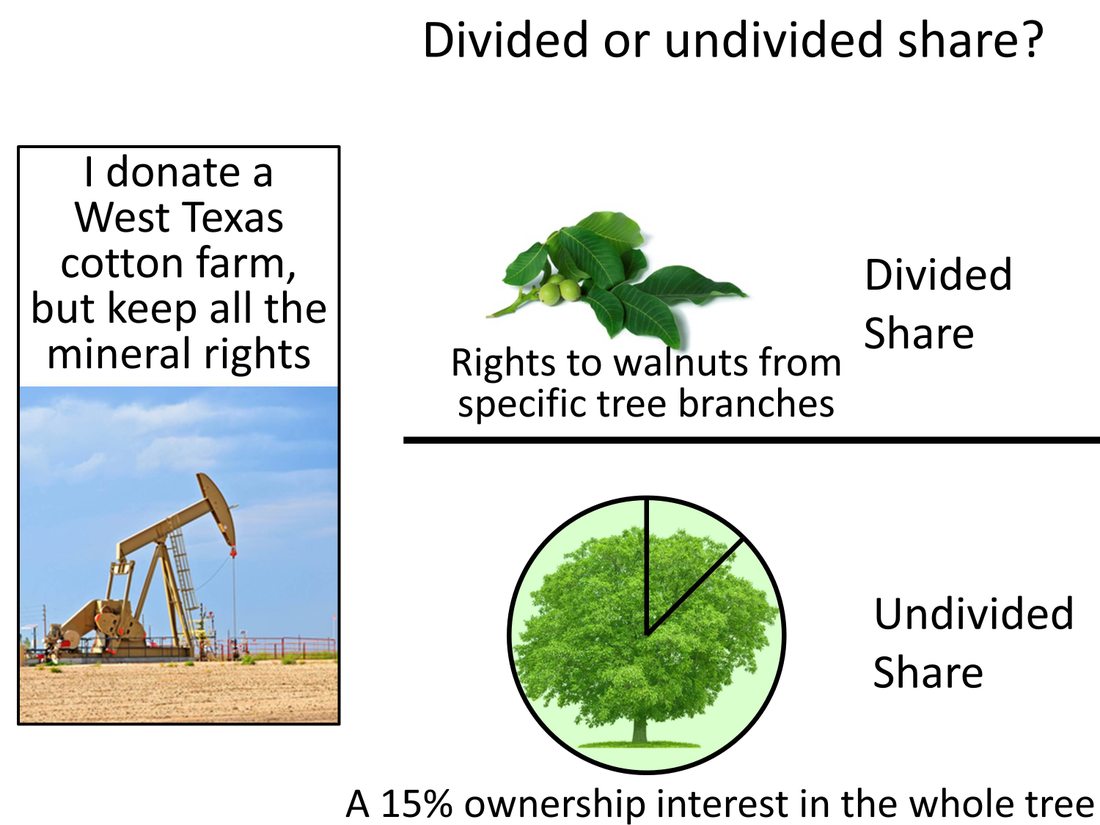
Suppose a donor gives a West Texas cotton farm to a charity, but keeps for himself all of the mineral rights to that farm. Is that a gift of an undivided share in all of the rights owned by the donor, or a gift of a divided share giving only specific kinds of rights to the charity? To use our original analogy, is this gift more similar to giving shared ownership in the whole tree (i.e., all types of rights) or more like giving rights only to specific branches (i.e., giving only specific types of rights, but keeping other types of rights)?
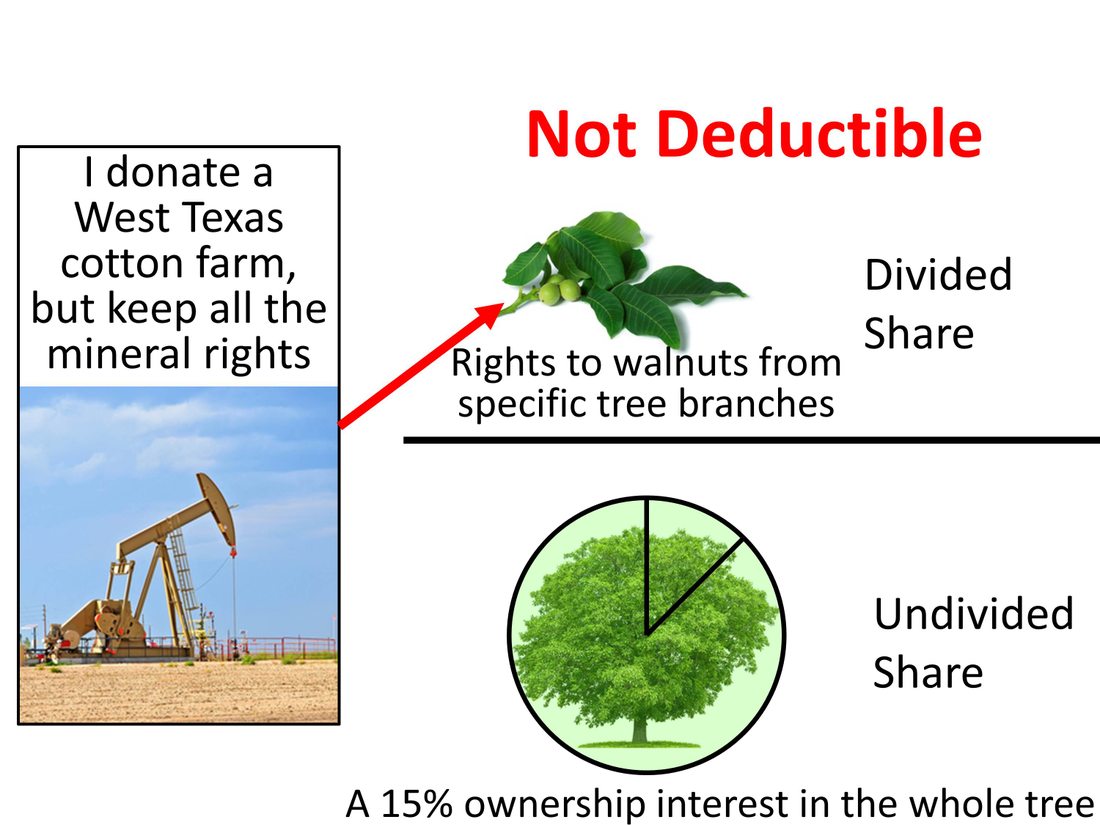
Here, the donor is making a charitable gift of a divided share. The donor is not sharing all of the different types of rights, but is instead keeping some types of rights entirely for himself. It may be that, to return to the tree analogy, the donor is giving rights to walnuts from a large majority of the tree branches. (In other words, the value of what the donor is giving may be worth more than the value of what the donor is keeping.) Nevertheless, this is still not sharing ownership in the entire tree (i.e., the charity is receiving an interest in only some types of rights, but is excluded from other types of rights which the donor is keeping).
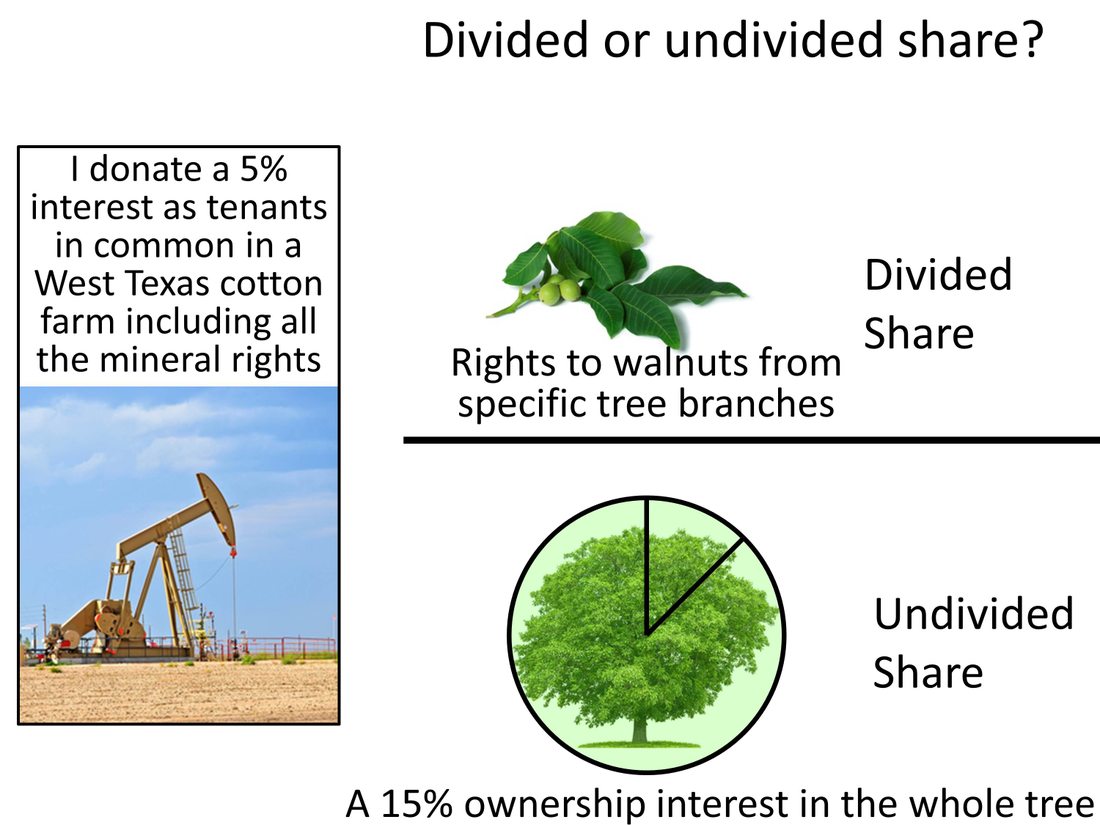
Suppose, however, a donor gives a 5% ownership interest, as tenants in common, in a West Texas cotton farm, including all mineral rights. (The "tenants in common" ownership form differs from the "joint tenants" ownership form in that if one "joint tenant" dies, the remaining "joint tenants" receive the deceased tenant's ownership share, whereas if one "tenant in common" dies, the other "tenants in common" have no automatic inheritance rights.) Is this a gift of an undivided share in all of the rights owned by the donor, or a gift of a divided share giving only specific kinds of rights to the charity while keeping other types of rights for the donor?
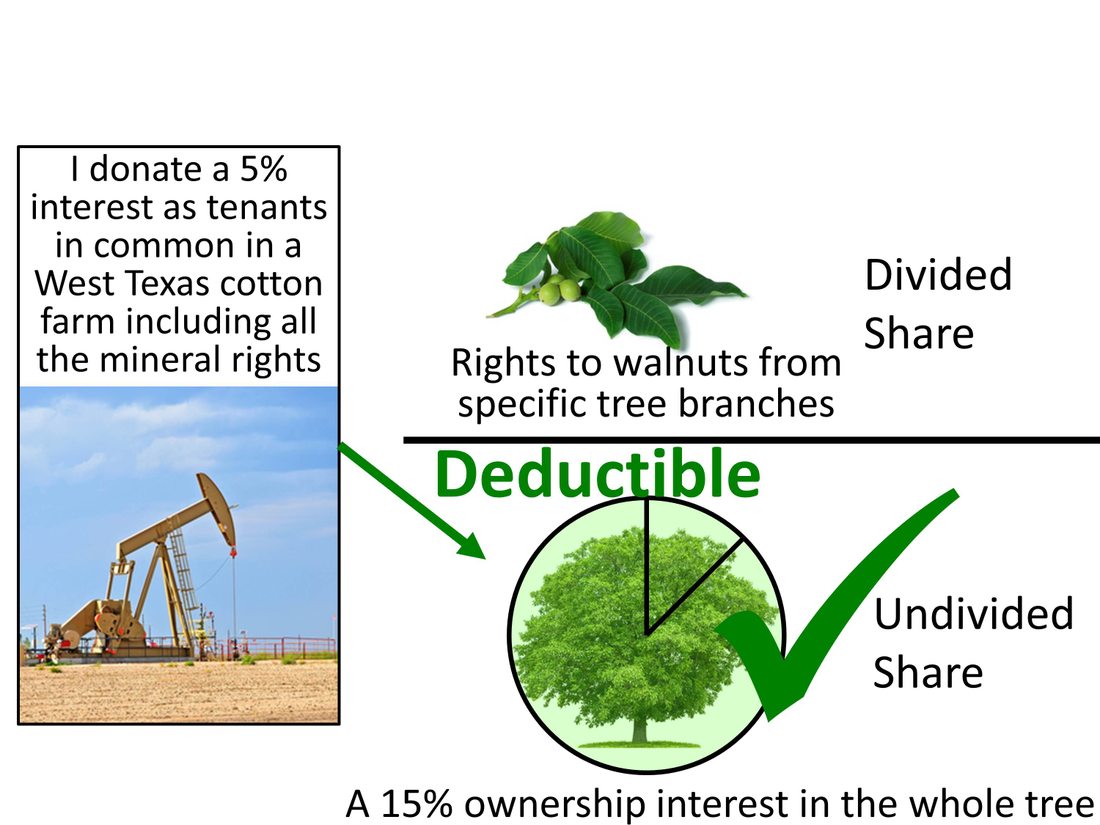
Here, the donor is sharing a portion of all types of rights owned in the property. Consequently, this is a gift of an undivided share (i.e., it is similar to giving a percentage ownership in the entire "tree"). Because it is a gift of an undivided share, it is a deductible gift.
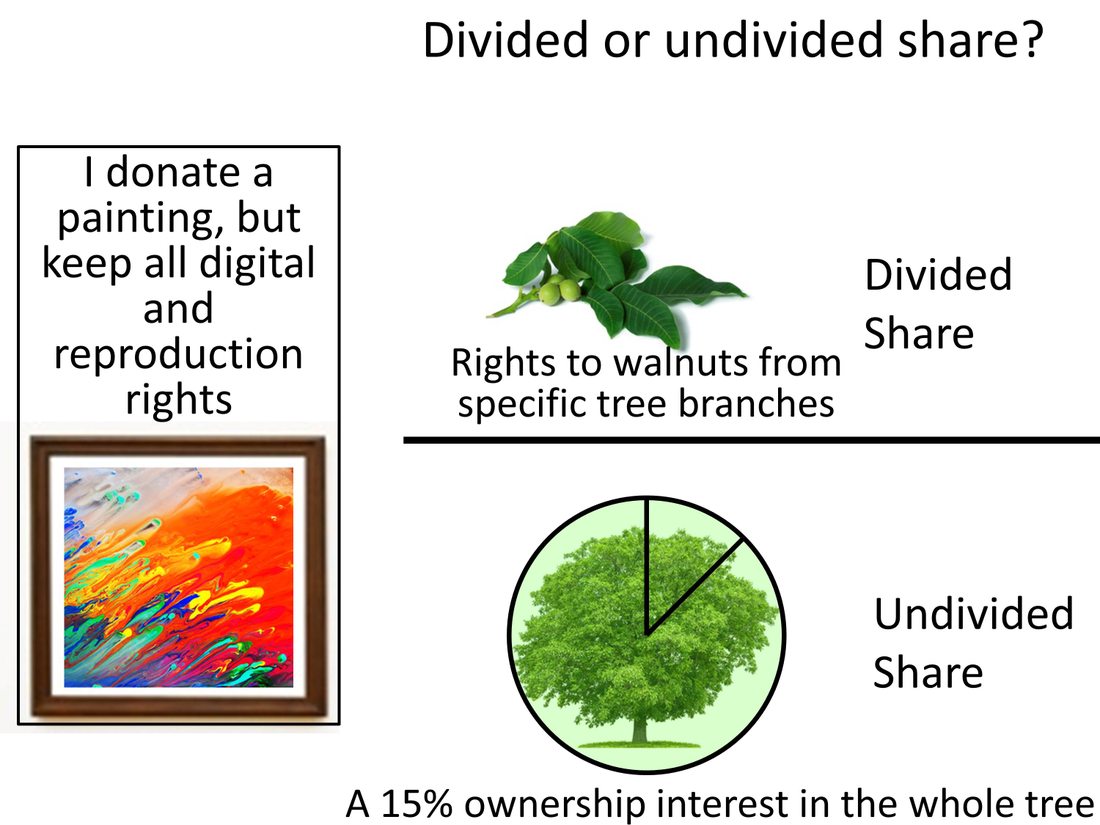
Suppose a donor gives a painting to a museum for it to own and hang in its gallery. However, the donor keeps for himself all of the digital and reproduction rights of the painting. (The donor plans to sell prints and online images of the painting even after the donation of the painting itself.) Is this a gift of a divided or an undivided share? In other words, does the charity receive only specific kinds of rights or a share of all rights owned by the donor?
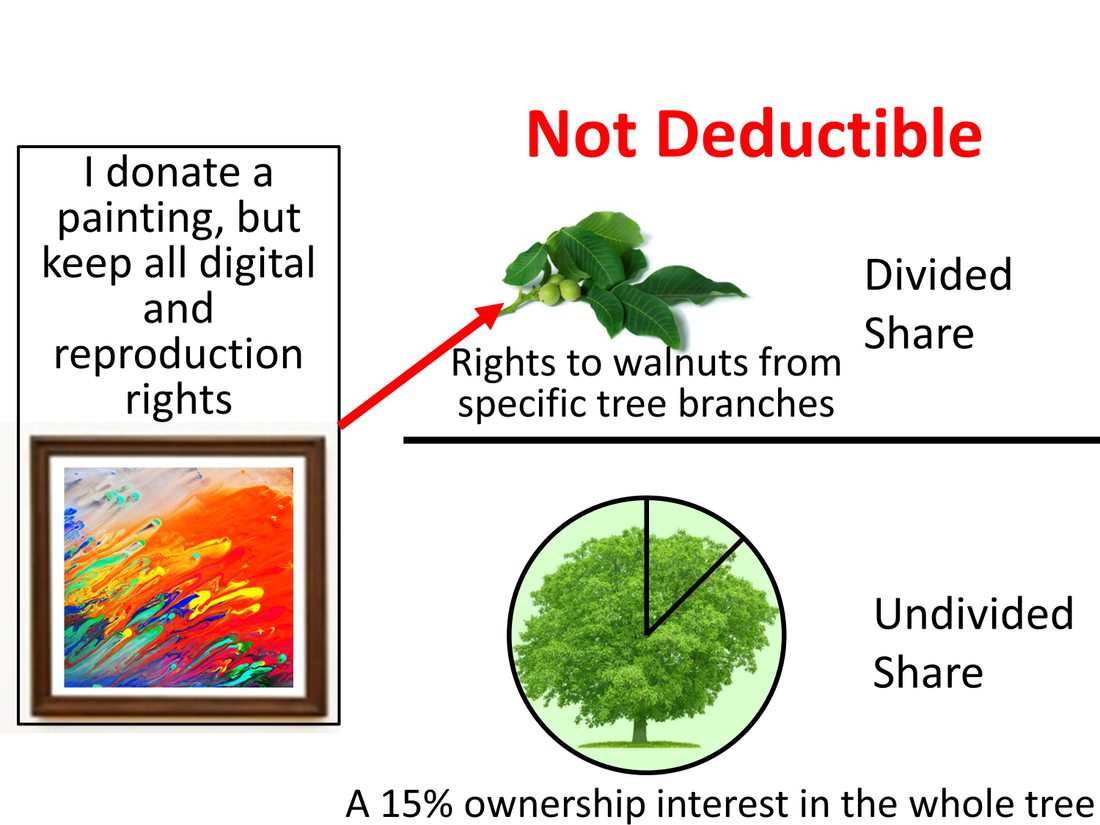
This gift is a gift of a divided share in the property and is therefore not deductible. The donor is keeping all of certain types of rights for himself. To return to the tree analogy, there are some "branches of the tree" in which the charity has rights and other "branches of the tree" in which the charity will have no rights.
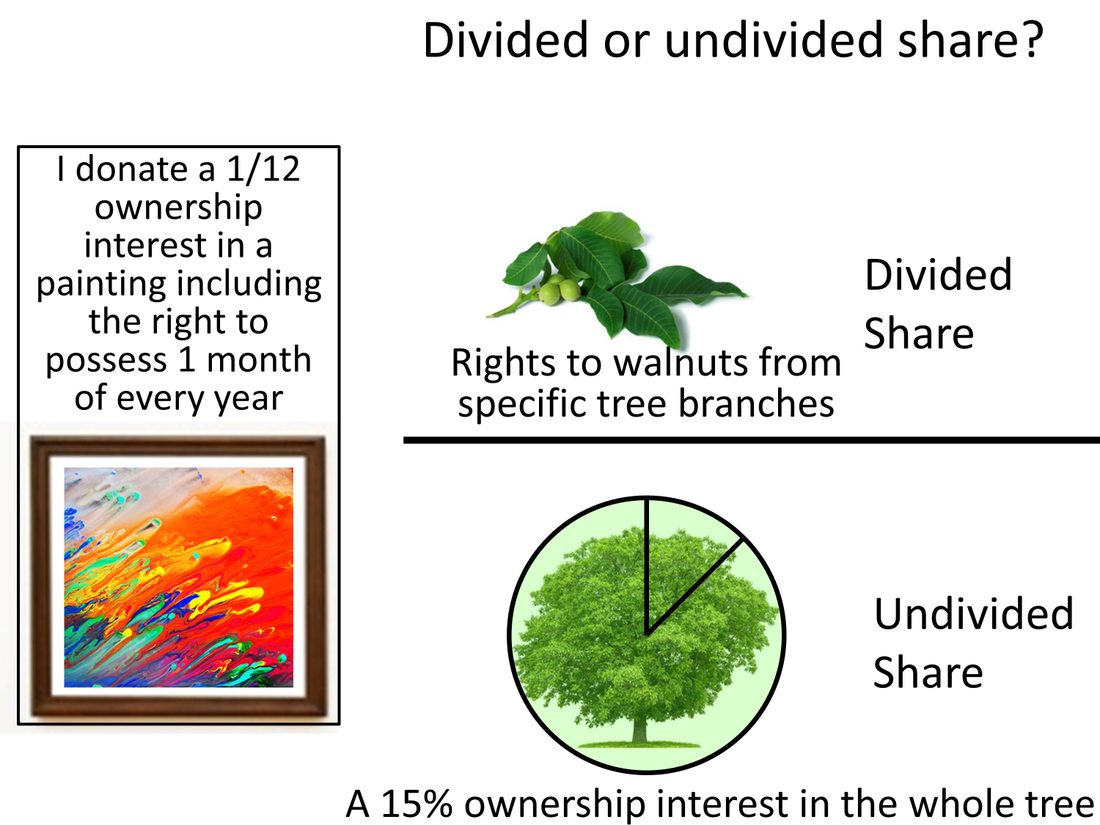
Now suppose that the donor gives a 1/12 ownership interest in all rights to a painting. This gift includes the right for the charity to possess the painting for one month out of every year. It also includes 1/12 of all other ownership rights owned by the donor in the painting. Is this a gift of a divided share (not deductible) or an undivided share (deductible)?
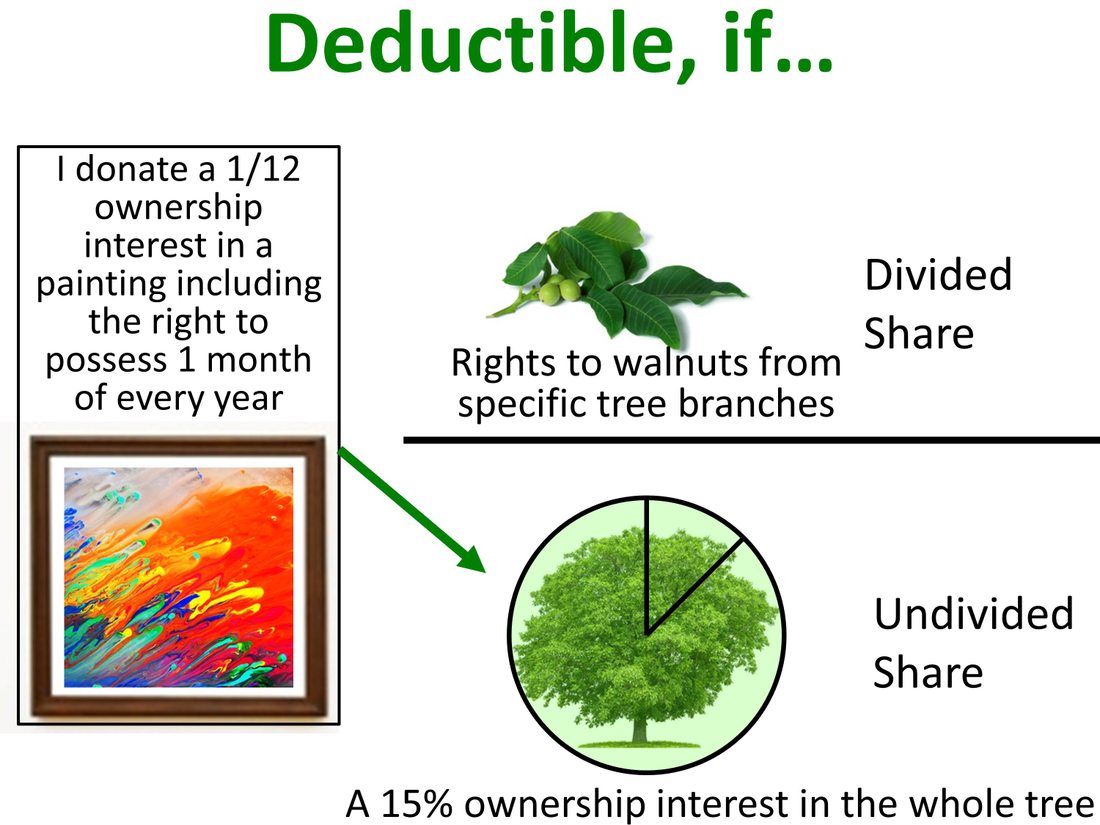
Because the charity receives a share of all of the rights owned by the donor, this is a gift of an undivided share. Such gifts of undivided shares are generally deductible. However, here we have a special rule that applies only to these kinds of fractional shares in tangible personal property. The reason for this special rule was because of the popularity of these fractional interest undivided share gifts of artwork. A donor might have a large art collection, which he displays in his home on a rotating basis. Instead of rotating the artwork into his basement, the donor could rotate the artwork into an art museum by donating a fractional ownership interest. In this way, the donor's use of the property does not functionally change, yet, the donor can obtain a substantial charitable tax deduction. This type of gift clearly meets the general rules for a deductible gift of an undivided share of property. However, there was some concern about the overuse of this type of charitable deduction, which resulted in some special rules.
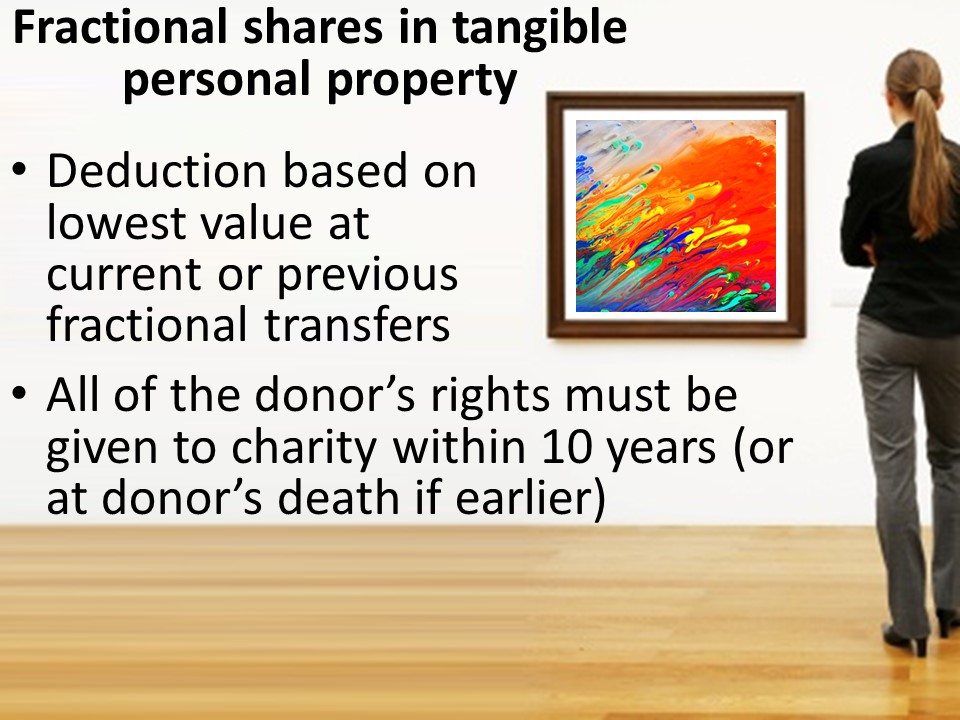
In order to deduct the gift of a fractional share in tangible personal property, the donor must be in the process of contributing the entire ownership of the tangible personal property to the charity. Specifically, all of the donor's rights must be given to charity within 10 years of the initial deduction for the first fractional share gift. Additionally, the donor must arrange his estate in such a way that if he dies prior to the end of the 10-year deadline then the charity will receive all remaining rights to the tangible personal property. Although this example is of artwork, the rule applies to all forms of tangible personal property, such as gifts of a fractional interest in an automobile, an antique, jewelry or other collectible item.
The amount of the deduction will be based upon the lesser of the value of the property during the year of transfer of a fractional interest or the value of the property during any previous year of transfer of a fractional interest. Thus, if the property increases in value after the initial gift of a fractional interest, the donor will not benefit from this increase in value. Although these rules reduce the attractiveness of gifts of fractional shares in tangible personal property, they do still allow for the deduction under these special circumstances.
Given that these rules must be followed over a 10 year period of time, it is reasonable to ask what happens if the donor fails to transfer the rest of his interest to charity within the 10 year time? Or, similarly, what happens if the donor dies prior to the end of the 10 year period, and the estate does not give the remaining interest to the charity?
Violating the rules for gifts of fractional shares in tangible personal property results in recapture. Specifically, all previous deductions are now counted as ordinary income. The donor must pay the taxes on this ordinary income, plus interest, plus a 10% penalty on the taxes owed. The result of recapture is sufficiently unpleasant to deter taxpayers from taking this deduction without completing the ultimate transfer of all rights to the charity within 10 years.
We have seen how a donor who retains specific types of interests in property and gives other types of interests to charity makes a nondeductible gift of a divided share in property. However, is there a case in which a donor may contribute less than the complete ownership rights (i.e., a partial interest) to the property and still deduct the gift?
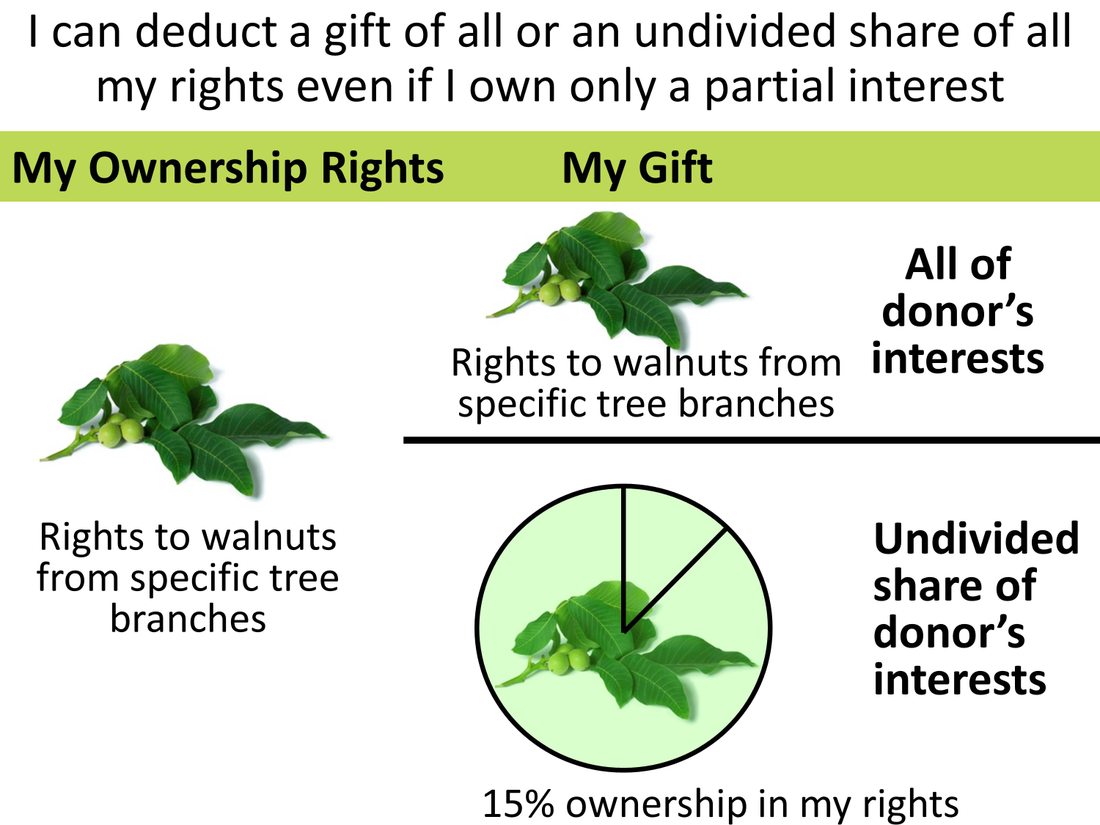
The donor is allowed to deduct the gift of a partial interest in property if the donor does not retain some other type of interest different from the type of interest given to the charity. So, to return to the walnut tree analogy, suppose that the donor does not own a walnut tree, but instead owns only the rights to walnuts from specific tree branches. The donor may contribute all of his rights in the specific tree branches to a charity and receive an income tax deduction.
Why is the donor allowed to deduct such a gift of partial interests to a charity? The reason for the prohibition against partial interest gifts to a charity where the donor retains some different type of right is to prevent the donor from increasing the value of his retained interest while decreasing the value of the interest held by the charity. In this case, if the donor gives everything that he owns (or a share of everything that he owns), then there is no risk of the donor increasing the value of the type of right that he has retained and simultaneously decreasing the value of the type of right that the charity owns. If the donor gives everything that he owns, he is retaining no rights in the property, thus eliminating the risk of this conflict. Similarly, if the donor gives a share of all of the interests he owns (even if he only owns partial interests), there is no way for the donor to increase the value of his interests while decreasing the value of the interests given to the charity. Consequently, these transfers are deductible.
Suppose a donor gives farmland to a charity. However, the donor never owned the mineral rights to the land. Thus, the donor is giving a partial interest in the land to a charity. Is this gift deductible?
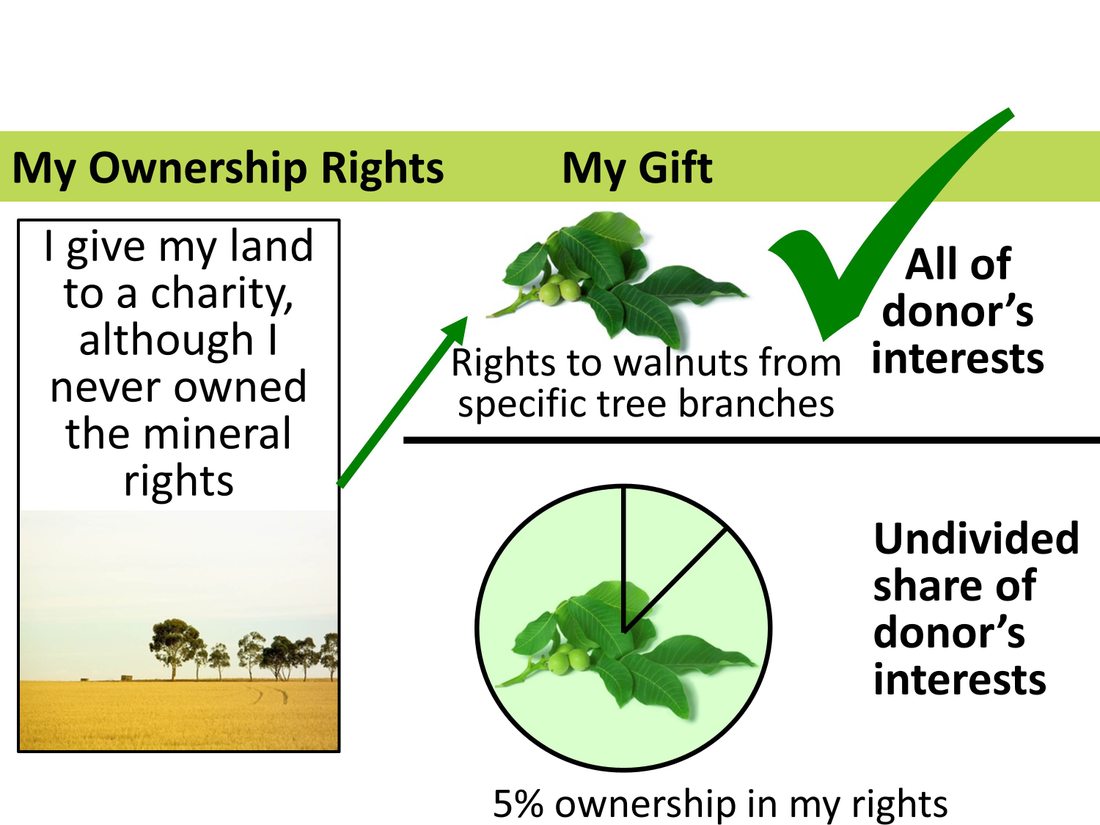
This gift is deductible because the donor is giving all of the rights he owns to the property. Whenever the donor gives all of the donor's interests in the property, there is no retained interest and consequently the gift may be deducted.
Suppose instead of giving the farmland to a charity, the donor gives a 5% interest in the farmland to the charity. As before, the donor never owned the mineral rights to the land. Is this a deductible gift?
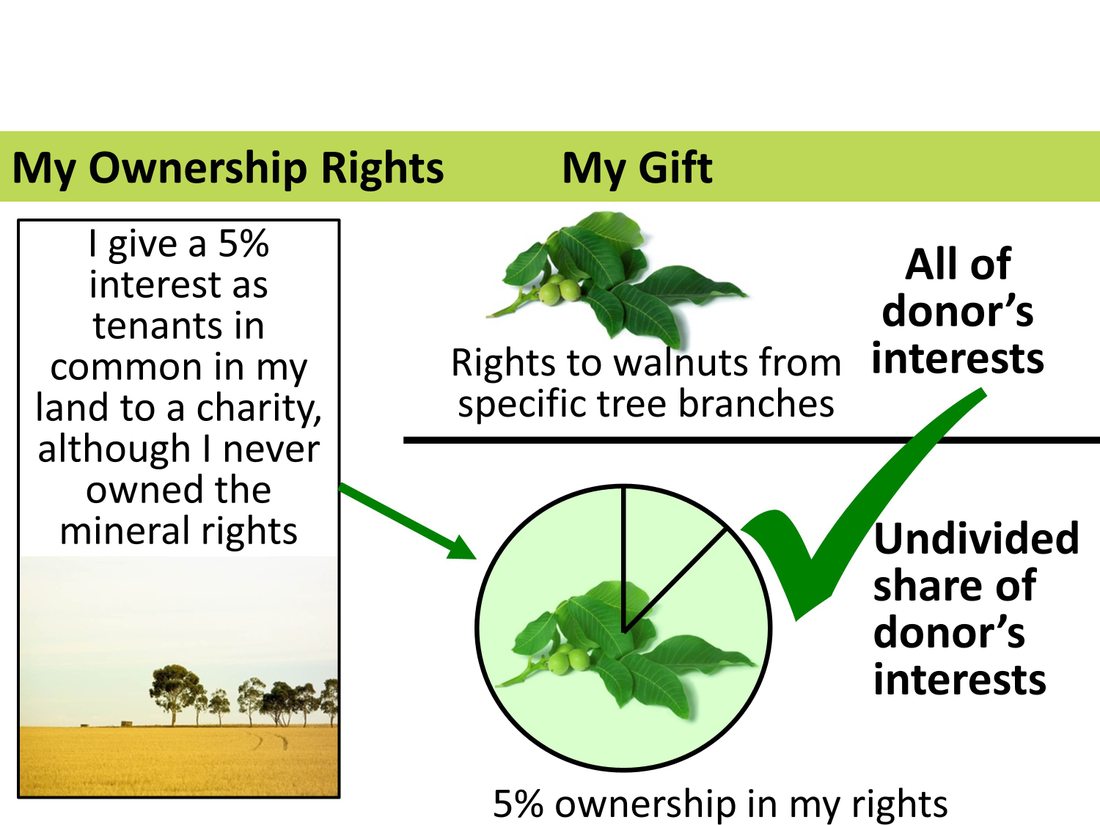
This is a transfer of an undivided share of all of the donor's interests in the property. Consequently, this is a deductible gift. The donor is not retaining any types of rights different from the types of rights given to the charity (although the exact ownership percentages differ).
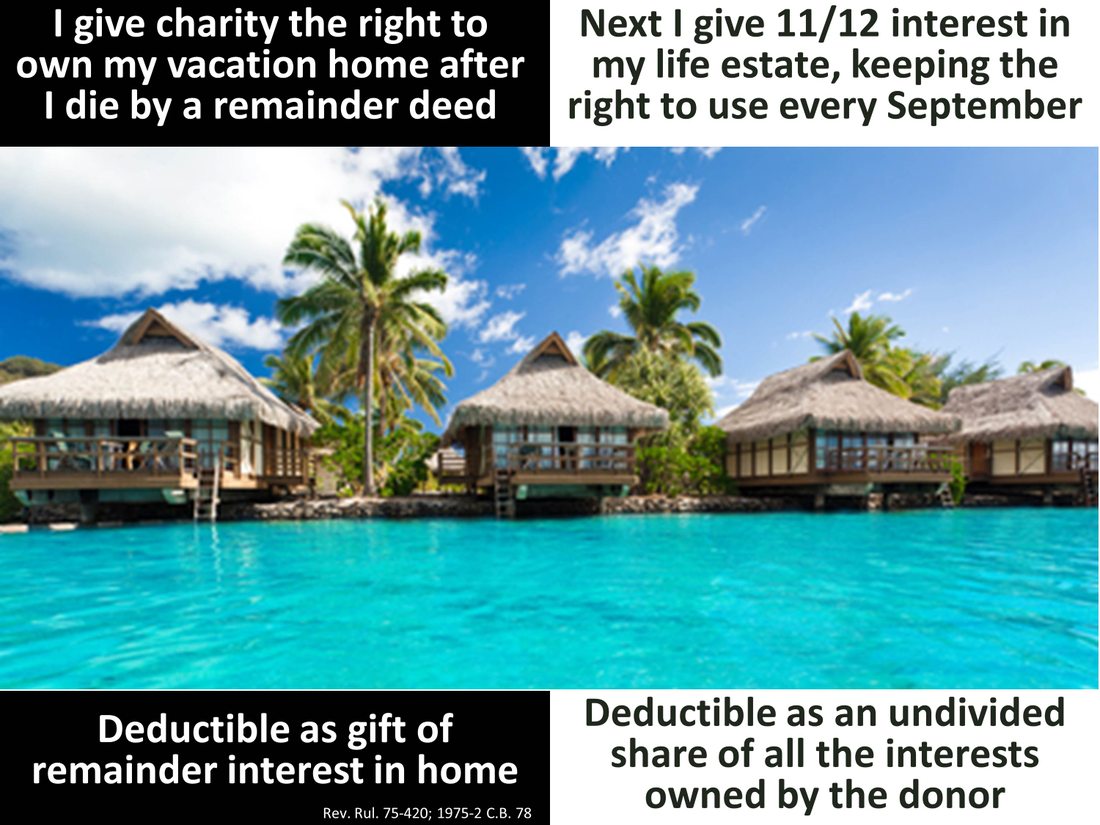
This next transaction shows how these rules can be combined to generate creative and useful transactions. In this case, the donor begins by giving the charity the right to own his vacation home after he dies using a remainder deed (the remainder interest). The donor retains the right to use the property for the rest of his life (the life estate).
Although dealt with in a separate chapter, remainder interest gifts in a personal residence (with a retained life estate) are deductible as a specific exception to the general rule against deductions of partial interest gifts where the donor retains different types of interests. The total ownership rights to a property consist of the life estate (right to use during life) and the remainder interest (right to own after death).
After this transaction, the donor's only remaining interest in the property is the right to use it for the remainder of his life. This right to use is called a life estate. The donor then gives an 11/12 interest in his life estate, keeping the right to use the property for one month out of the year. This gift is deductible because it is an undivided interest in all of the rights still owned by the donor. Through this series of transactions, the donor has been able to transfer and deduct all rights to the property, excepting only the lifetime right to use the vacation home for one month of the year. Depending upon the donor's age, this type of transaction could easily result in deductions of 95% or more of the value of the property. If the donor's use of the property had been to occupy it for only one month out of the year anyway, this massive deduction comes without changing the donor's lifetime use of the property.
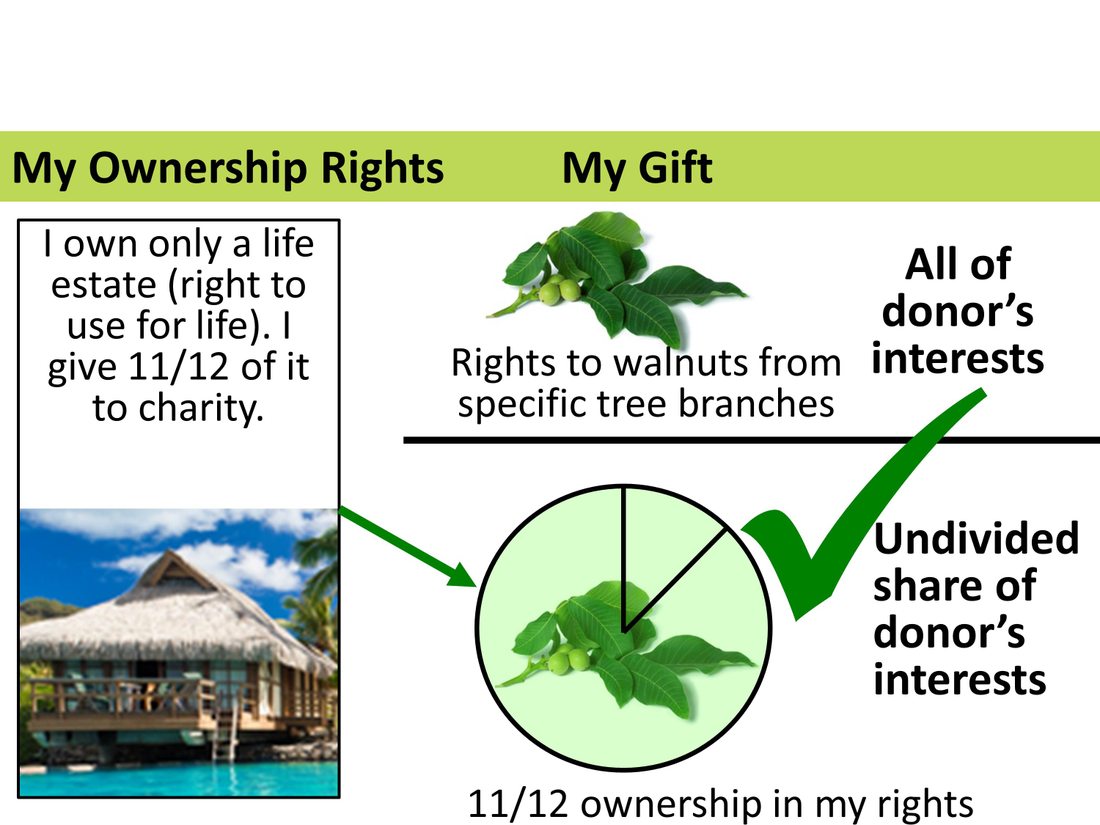
Note that if the donor had given an 11/12 interest in a life estate to the charity before giving the remainder interest, this would not have been a deductible gift. In that case, the donor would have been retaining a different type of right (the remainder interest), than the type of right given to the charity (a life estate). And, there are no special exceptions for gifting life estates as there are for gifting remainder interests. But, because the donor did not make the gift of the 11/12 interest in a life estate until after his only interest in the property was a life estate, the transfer is deductible. At that point, the donor is giving an undivided share of all of the donor's interests, because the donor's only remaining interest is a life estate in the property.
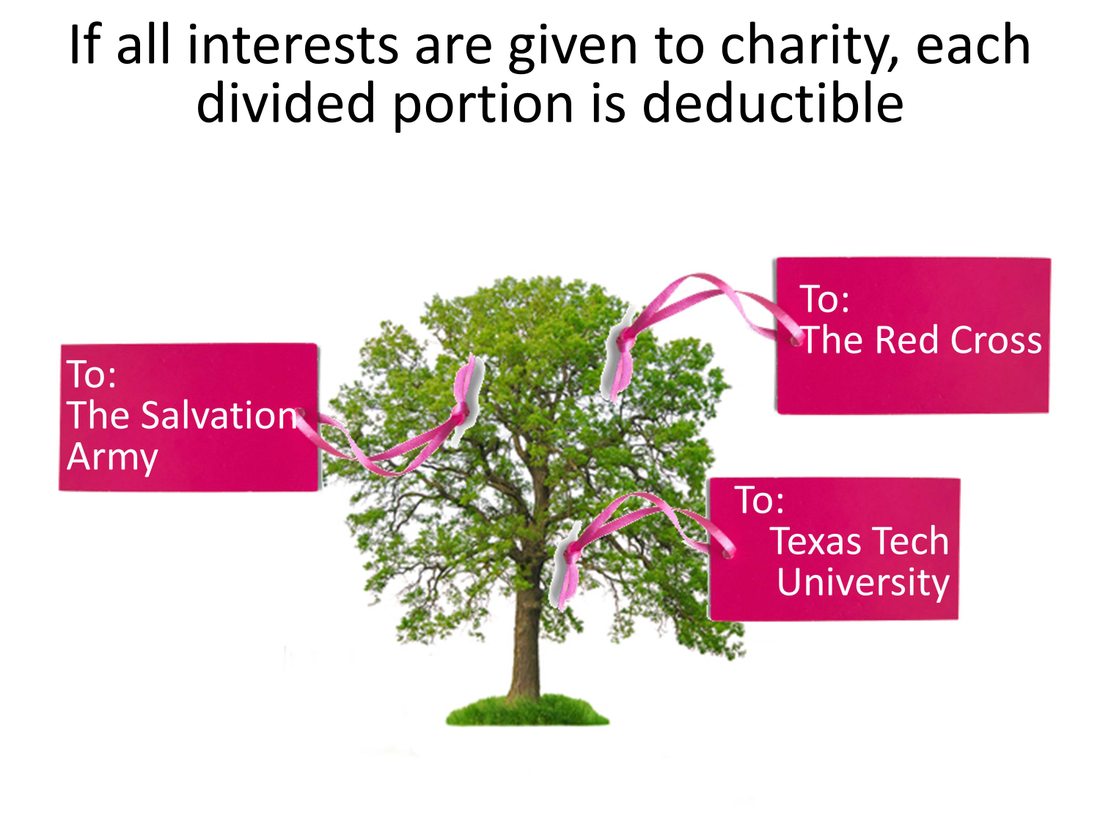
Partial interest gifts are also allowed if all of the donor's interests are transferred to different charities. As before, the concern is not with deducting the transfer of a partial interest to a charity, the concern is in allowing this deduction when the donor simultaneously retains different types of rights to the property. Such a concern does not apply here, because the donor keeps nothing for himself. It is thus perfectly acceptable to give a variety of different partial interest gifts to different charities when the donor retains no rights to the property.
As an example of this, if a donor were to give underlying ownership of farmland to the Red Cross, but give the mineral rights in the farmland to the Salvation Army and also give rent-free use of the property for 10 years to his local church, this would constitute a deductible gift of all the donor's interests in the farmland. Consequently, the donor could deduct the full value of the farmland, even though the ownership rights were split among multiple charities.
The bottom line result is that donors will get no deduction if they keep any type of rights that are different from the type of rights given to the charity. In other words, the donor must give or share all of his rights, or there is no deduction. The specific exceptions to this general rule (Charitable Remainder Trusts, Charitable Lead Trusts, Pooled Income Funds, remainder interest with retained life estates in homes or farmland, and qualified conservation easements) will be addressed in other chapters.
As we end this chapter, it might be useful to note that gifts of partial interests in property through the designated exceptions constitute the bulk of all planned giving structures. Allowing a donor to make a transfer to charity, but still keep some rights in the property is a technique which can allow the donor to make a charitable impact even in cases where he or she still has some needs from the property. This splitting of rights can create a fundamental benefit of planned giving: showing a donor who says, "I wish I could do more, but..." that it is possible to both benefit the charity and accomplish the donor's other financial goals, even when traditional outright gifts are not feasible.