Although we left behind neuroimaging results in the previous chapter, we will continue to explore results from other experiments in this chapter using a very different methodology. Again following the idea of triangulation, we want to take results from the psychological experimental literature and results from our neuroimaging to develop effective marketing interventions to change the attitudes and behaviors of potential donors. Ultimately, if the previous theoretical musings cannot generate marketing messages that impact behavior, then even if they might be of interest to academics, they won’t help those who are practicing in planned giving.
And so, in this section we will attempt to test some interventions consistent with the findings from experimental psychology and neuroimaging to see if these have any effect on bequest giving intentions. And further, we will explore the relative effectiveness of several different messages on charitable bequest giving attitudes. This is the first place where we test behavioral interventions to see if there are practical implications of what we have so far been exploring only in the theoretical and neuroimaging realm. So let’s get started.
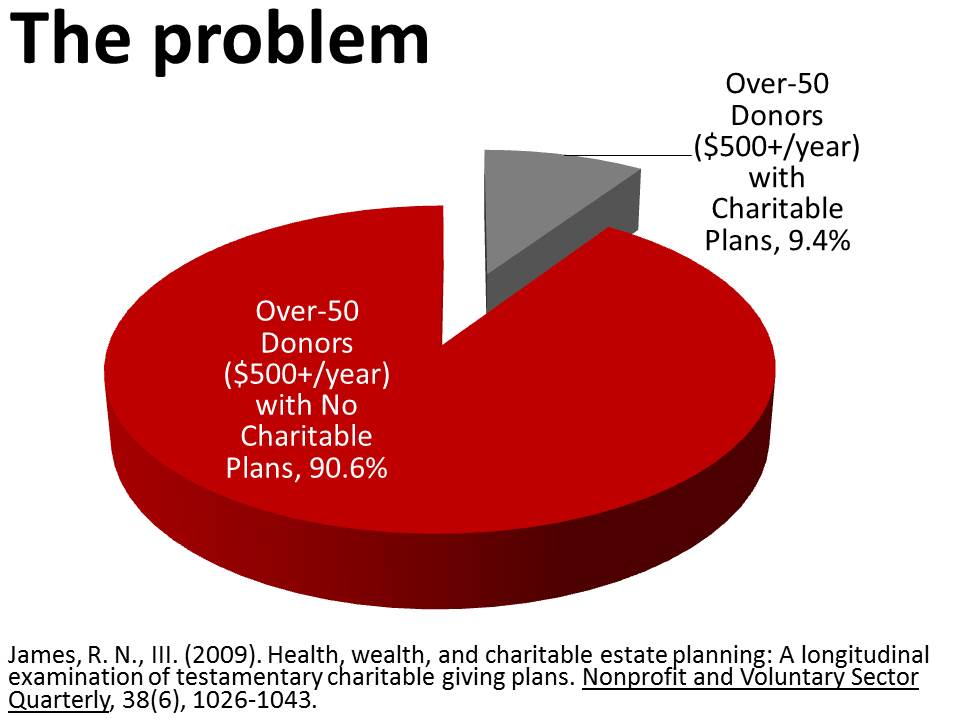
The fundamental problem is the same that we have discussed throughout this text. The problem is that we have a gap. That gap is the difference between the percentage of people who engage in regular substantial charitable giving (which is a high percentage) and the percentage of people who engage in charitable bequest planning (which is a very low percentage).
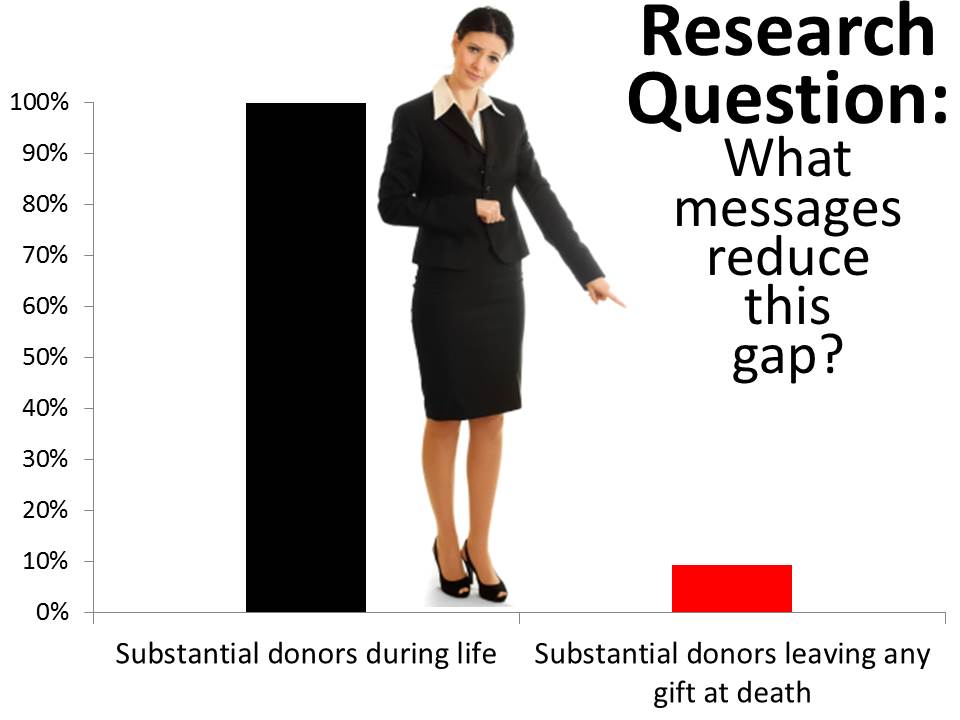
So the bottom line, pragmatic question comes down to this simple idea: what can we do to reduce the gap? Specifically, what kind of marketing messages can we use that will most effectively help us to reduce this gap. Notice we are not concerned so much about how to get people to care more about charitable organizations. Although that’s an important question, that’s a question for fundraising and development in general the question of greatest interest for us is how do we reduce the gap between people who are willing to give currently and people who are willing to include a charity in their bequest planning.
The reason were not particularly concerned with how to develop an initial interest in charitable giving is that the gap is so massive that if we were able to simply close the gap between current giving and bequest giving participation, we would increase bequest giving participation by more than tenfold. Consequently, we are focused, not on how to make people like charities, but rather on how to eliminate the gap between their current giving behavior and their bequest giving behavior. (Perhaps at some point in the future if we are able to eliminate this gap in practice and achieve a more than tenfold increase in participation rates in charitable bequest giving, then we can turn our attention to the question of how we might best increase the level of connection to the charitable cause in general!)
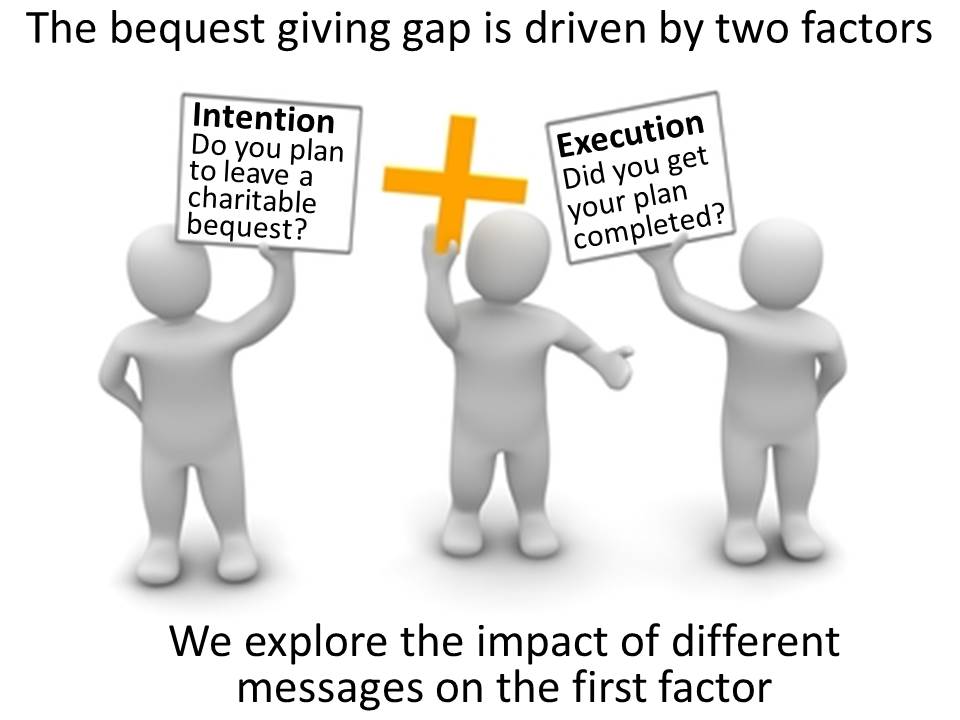
The bequest gap is driven by two different factors. First is the issue of intention. In other words, “Do you plan to leave a charitable bequest?” Second is the issue of execution, that is, “Did you get the plan completed?” In this particular set of experiments, we looked only at the intention topic. Consequently, this was not exploring a complete solution. If we are able to change people’s intentions such that they plan to complete a charitable bequest, that is a major step. But, a plan to complete a charitable bequest is, of course, not a completed charitable plan. But, it is a necessary prerequisite. There is no reason to explore how to encourage execution if the person has no intention to leave a charitable plan to begin with. This particular subcomponent of the gap is a necessary hurdle that we must be able to get over, but it is not a sufficient hurdle to produce the final results.
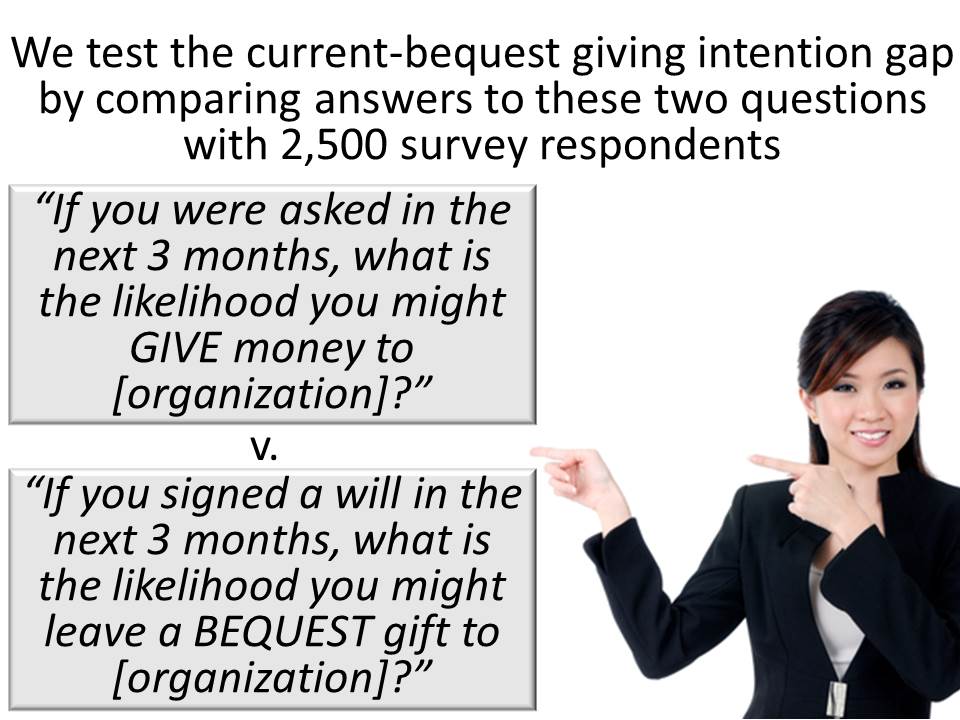
We explored the current giving and bequest giving intention gap by asking two questions with regard to an extremely wide range of organizations. The first question is, “If you were asked in the next three months, what is the likelihood you might give money to… [the particular organization]?” We then compared the response to this question with the response to the question, “If you signed a will in the next three months, what is the likelihood you might leave a bequest gifts to …[that same organization]?” These intention questions were the same intention questions that were used in the neuroimaging experiment. We used the same questions, except in this case we took them out of the scanner and put them out into the real world to see if we could alter the gap between current giving and bequest giving intentions.
In our first set of surveys, we tested a total of six different interventions using approximately 2,500 survey respondents. These interventions were tested using five different surveys, which included different combinations of these interventions. This resulted in about 500 participants for each survey type, because the 2,500 participants were randomly assigned to receive one of the five different surveys. Different surveys used different interventions and so we were able to compare different marketing interventions across the different randomly assigned groups.
Surveys responses were collected from an online survey service. Respondents were paid to complete the survey, and were required to be U.S. residents. Several mechanisms were used to ensure that the respondents were paying close attention to the questions. For example, the opening question was a simple, large font question of “How often do you take surveys” with five options. Above this question was a large paragraph of small font type which included, in the middle of the paragraph, special instructions regarding how to answer this question (by clicking the “no response” button), and a special phrase to enter into the accompanying text box. Those who did not click the correct button and enter the special phrase were kicked out of the survey and not allowed to take it. In total, approximately a third of those who started the survey were kicked out at this point for not paying attention to the details of the questions. There were also other hidden instructions included in the remaining parts of the survey.
Additionally, other mechanisms were used, such as employing minimum times before subsequent questions could be answered. These minimum time requirements meant that the participants could not move on to the next page until they had spent a sufficient amount of time contemplating the previous questions. These were all mechanisms attempting to make sure that the answers were thoughtful answers and did not come from respondents trying to rush through the survey.
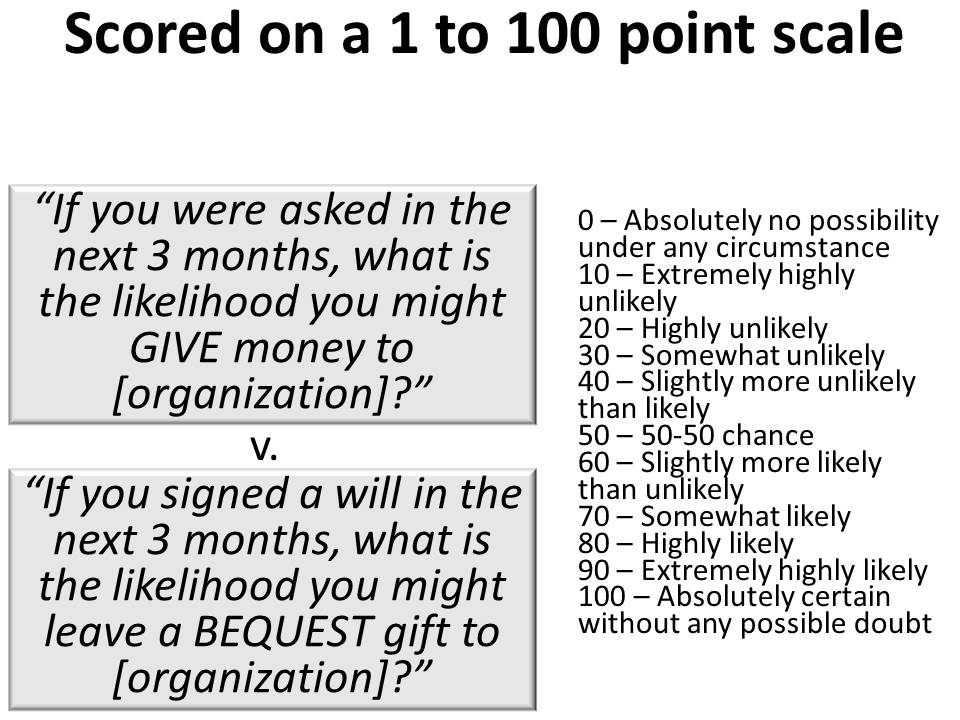
One difference from the questions presented in the scanner was that participants had a much wide range of responses available in the online survey. In the scanner experiments, there were only four different levels of agreement. The online survey used 100 different levels of agreement, varying from 0 “absolutely no possibility under any circumstances” to 100 “absolutely certain without any possible doubt.” Responses were provided by using a slider bar, which respondents could click and drag from 0 on the left to 100 on the right. The selected number was displayed above the bar, showing what level of agreement they had selected.
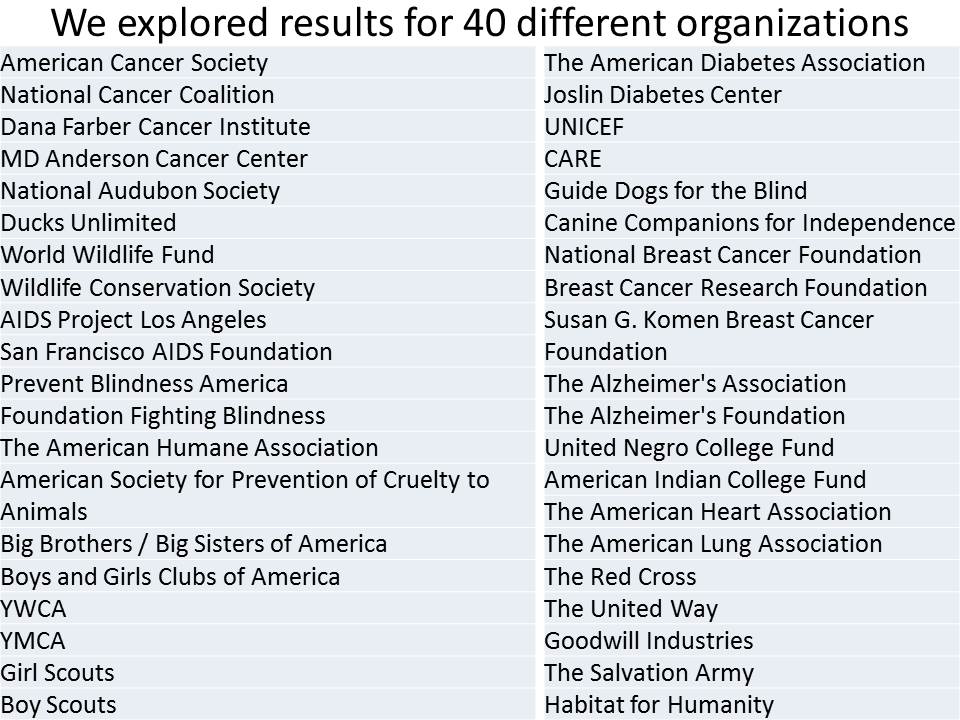
In this experiment, we tested these results for 40 different large national charitable organizations which are listed above. As you will see later, when comparing across different groups, we often split organizations of the same type into two different groups in order to measure the effect of intervention types on each type of charity. Because of the number of different interventions used here, totaling six different types of interventions plus a control group, we were not able to apply all seven conditions to all 40 organizations. This would have made the survey length unwieldy. In its current form the typical respondent took about 35 minutes, on average, to complete the survey.
The survey was available online and all surveys were completed online. Respondents came from across the age spectrum of adults, with some fairly young and some quite old. In a later examination of the results we will separately examine responses from older adults, about whom we are particularly concerned when it comes to charitable bequest planning.
Prior to having the participants answer questions related to bequest giving, they were required to answer a series of questions intended to induce mortality salience. The reason for this is that, in actual practice, bequest decisions are made in a context that has an extremely high level of personal mortality salience. In other words, the estate planning process typically does not happen instantaneously on the spur of the moment. Rather, it is an extended process that involves an extended period of contemplation of one’s own personal mortality. Because that contemplation is inherent in the estate planning process, we wanted to duplicate the same decision-making environment, as much as possible, for our survey responses in order to increase the similarity with real-world decisions. Consequently, prior to answering our questions of interest, participants answered questions related to their preferences for personal funeral arrangements and burial options as well as their knowledge of estate planning related terms. Let’s now turn to examining the results of the experiment.
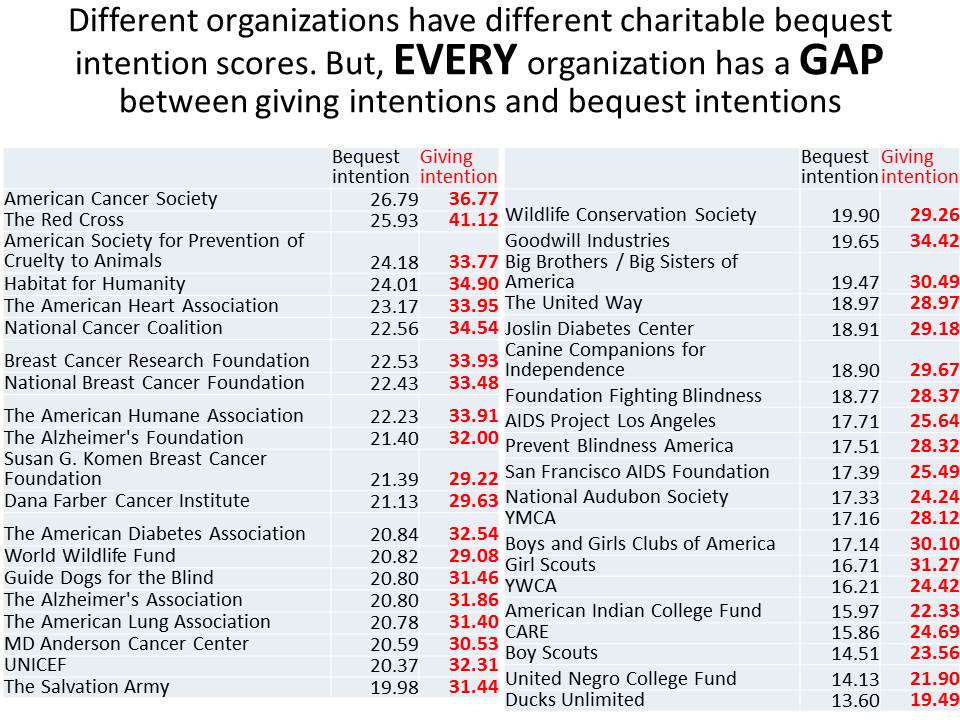
To begin with, we received results for bequest intentions and gift intentions for all 40 charities from the respondents who received no marketing interventions. In the above chart, the column labeled “bequest intention,” shows the average level of agreement with the bequest intention question. Similarly, the column labeled “giving intention” shows the average level of agreement with the giving intention question. (These are the scores using the 100-point agreement scale shown earlier.) Because this was an average response, it combined the typically large number of respondents giving a very low score, with the typically smaller number of respondents giving a high score for each particular charity.
As we look at these results for all 40 different organizations (here sorted from the highest bequest intention to the lowest bequest intention) we see that there were a wide range of scores associated with different organizations. Some charities had relatively high giving and bequest intentions among the people surveyed here. Some had relatively low giving and bequest intentions among the people surveyed here. However, there was one characteristic that every single organization shared in common. Whether they were ranked, on average, high or ranked, on average, low, they all shared the common experience of being ranked higher in giving intention than in bequest intention.
This confirms the idea that the presence of a gap between intention to give and intention to give through bequest is universal. It was true for cancer organizations. It was true for health organizations. It was true for international relief organizations. It was true for animal charities. It was true across the board. Thus, regardless of whether or not your particular charity of interest was on this list of 40 charities, we can say with pretty high confidence that your charity also has a gap between donors giving intentions and their bequest giving intentions. The gap is universal. Next we turn to examining interventions used in an attempt to close that gap.
We tested six different marketing messages. Two of these marketing messages were suggested by (or at least consistent with) the experimental psychology results and theory originating with “terror management theory.” Two of the messages with two variations each were suggested by the findings from our neuroimaging results.
In total, there were five different surveys types used for this part of the study. The 2,452 respondents were relatively evenly distributed among the five survey types, resulting in about 500 respondents per survey version. As a side note, it is important to realize that although the interventions were consistent with these previous theories or findings, whether or not the intervention worked would not necessarily prove or disprove the previous theories or findings. Describing the connection simply recognizes the origin of the ideas for each intervention. Ultimately, the goal is to use the ideas suggested by the theories to identify effective marketing messages, and not to definitively support or contradict the previous theories or findings.
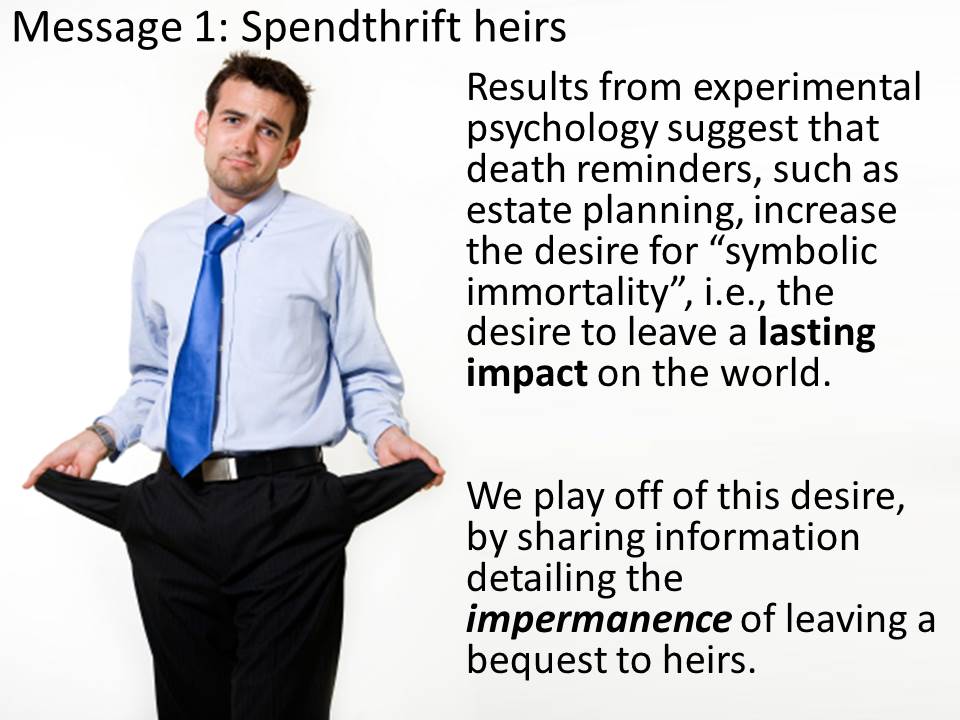
Previous research from terror management theory suggests that, in the face of mortality reminders, we will be particularly interested in expressions of our self or our community that will live beyond us. We seek avenues that provide some level of symbolic immortality. This idea of symbolic immortality requires some sense of permanence. In other words, we want something that lasts. If it doesn’t last, then it doesn’t really provide significant psychological support against the unpleasant thought of our own disappearance and insignificance.
Playing off of this subconscious desire for permanence, we created an initial message intended to emphasize the impermanence of leaving money to noncharitable heirs. The idea was to present accurate statistical evidence about the rapidity with which inheritances are often spent as a way to motivate people to consider adding charitable beneficiaries along with gifts to heirs.
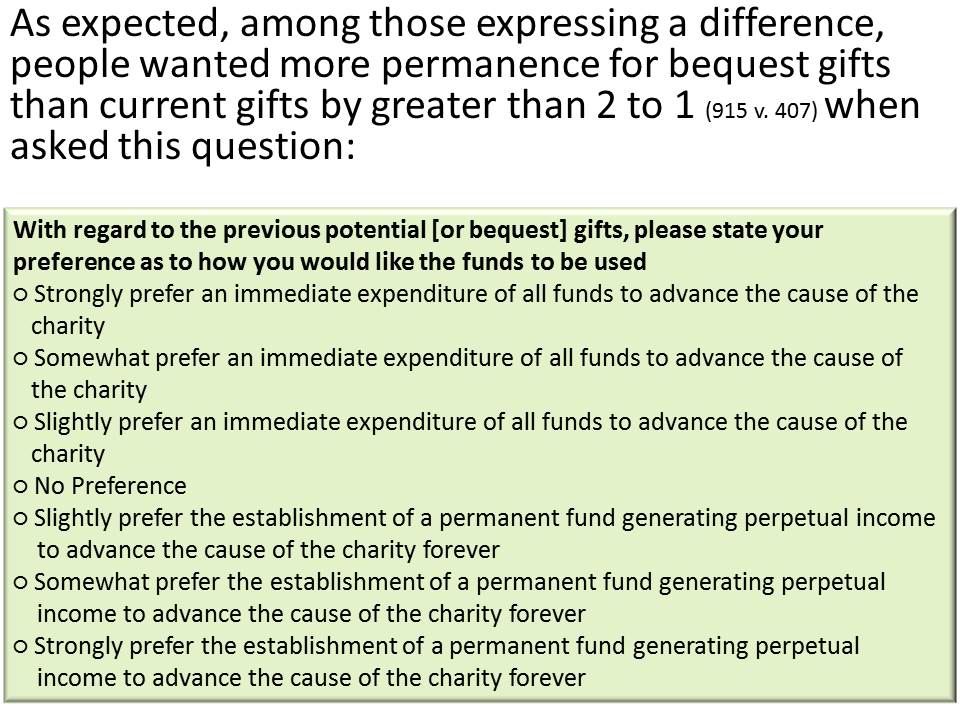
This intervention was based upon the theoretical assumption that people preferred to have permanence in their bequest giving. If people actually didn’t prefer permanence, then the intervention, which emphasized the lack of permanence in noncharitable beneficiaries, might not make sense. To measure whether or not this assumption was valid, we asked people about their preferences for permanence in current charitable giving and bequest charitable giving.
The psychological experimental results from terror management theory would lead us to believe that people would like to have more permanence with a death-related gift than with a current gift. Indeed, this is what we found among those people who expressed a difference between the level of permanence. These individuals expressed a desire for greater permanence for bequest gifts by a margin of greater than 2 to 1. Of course, this does not mean that everyone holds the same opinion, but it does mean that among those who had a difference in preference, the dominant difference in preference was to prefer more permanence for bequest gifts.
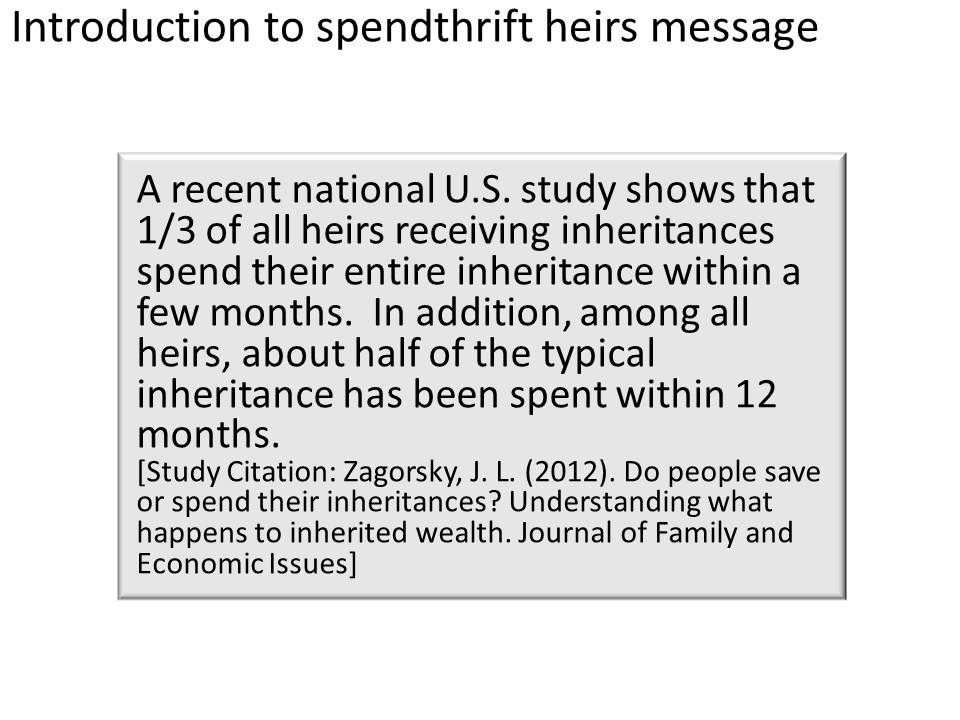
Feeling somewhat confident about the differential underlying desire for permanence, let’s move on to the actual intervention used in this case. We will refer to this as the “spendthrift heirs” intervention. First, participants were provided with data from a recent national study showing the substantial share of all heirs that spend all, or at least half, of their inheritance within just a few months. This is a published study and these are real results, so there was nothing a false about this part of the presentation. The results mentioned simply reflected the statistical reality of what happens to inherited money.
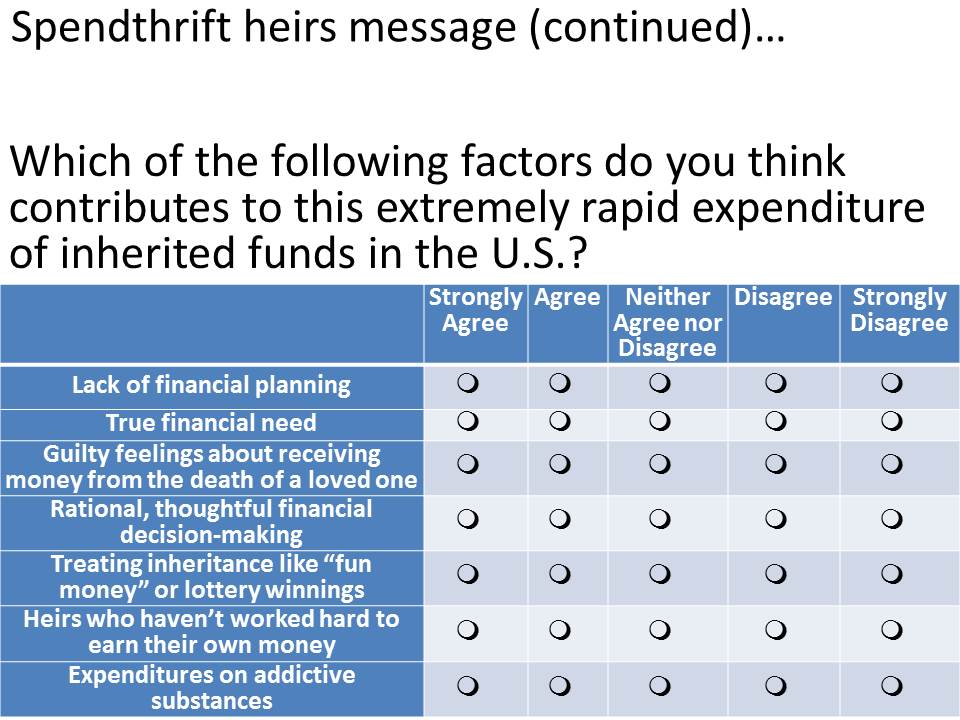
In addition to providing the initial information from the study, we wanted to make sure that participants really interacted with it. In other words, we wanted them to think about the implications of this information. We wanted them to really internalize the information presented here. In order to do that, we included a series of questions about their beliefs as to factors that contributed to the rapid expenditure of inherited funds in the United States.
Notice that some of the potential explanations also emphasized the potential negative impacts of leaving money to heirs, such as expenditure on addictive substances, heirs who haven’t worked hard to earn their money, or treating inheritance like a lottery winning. All of these are intended to emphasize the impermanence and negative associations with traditional bequest recipients as compared to charitable bequest recipients.
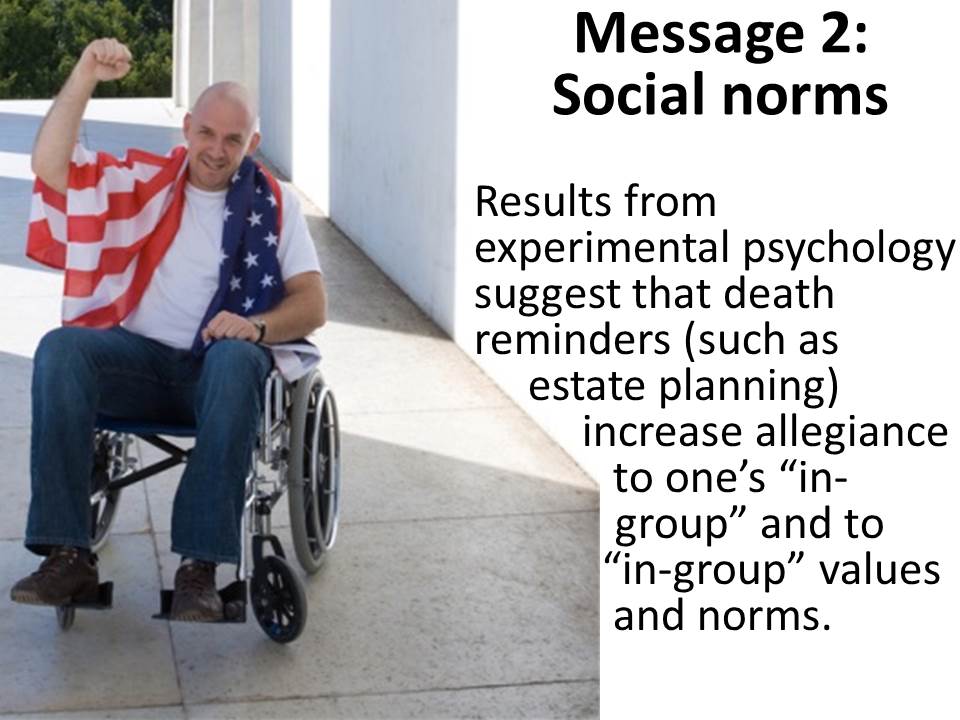
For the second set of interventions, we focused on the idea of social norms. Results from terror management theory experiments repeatedly confirm the idea that when faced with mortality reminders, people tend to attach more strongly to their in-group community and become more committed to the values of their in-group community. Using that knowledge, we created this intervention based on the premise that, because of mortality salience, people would become more attached to the in-group and in-group values (and consequently become less attached to any out-group or out-group values).
Because we didn’t know anything about the particular in-groups of our respondents, other than that they were U.S. residents, we chose national characteristics as the in-group and contrasted that with other nation’s characteristics as the out-group. It is useful to consider, before we get into this specific intervention, the intention behind its development. Simply put, we wanted to create the most extreme intervention we could. We wanted to, as strongly as possible, make the case for leaving a charitable bequest as an appropriate social norm.
The reason that we started with a strong intervention was because if we got no response from the most extreme intervention, then we could feel more comfortable with the idea that these factors simply weren’t motivational. Once the extreme intervention has failed, it is most likely that softer versions of the same intervention would not produce anything either. On the other hand, if the extreme intervention did get a good response, then we could later test more reasonable (and practical) versions of the intervention. This is all a way to explain that the goal of the intervention was to intentionally present the most slanted information in order to see if it was possible to get any impact at all.
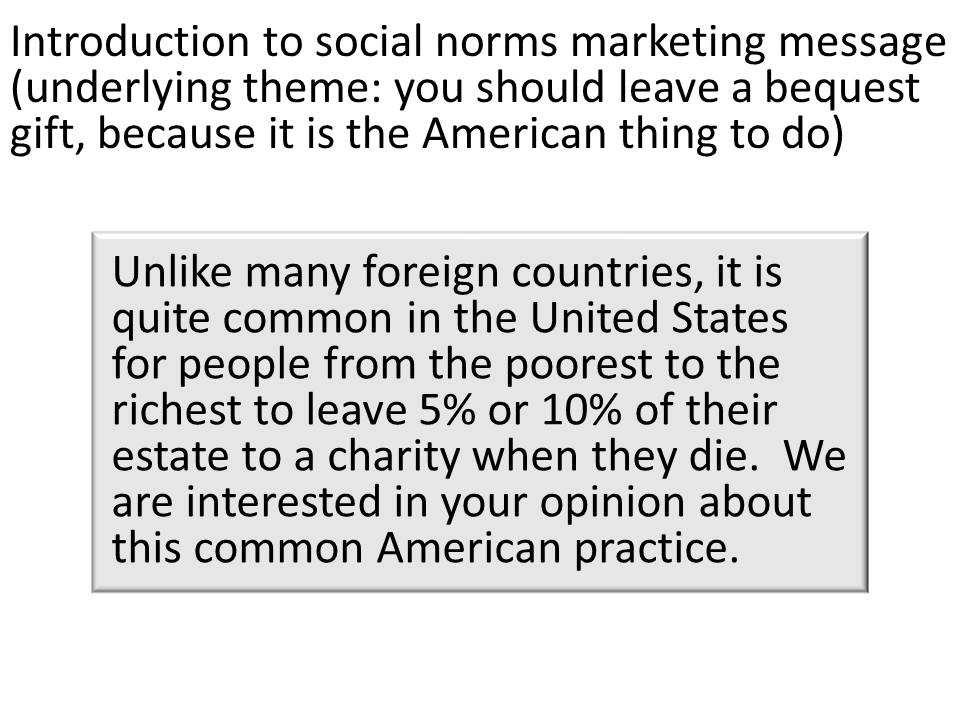
So for this intervention, we began with a preliminary statement intended to emphasize the idea that leaving a bequest gift is the American thing to do. In particular, we emphasized that it was a common American practice among those of all different economic levels. The purpose here was to emphasize that this behavior was an accepted norm which would apply to the survey respondents regardless of their economic level.
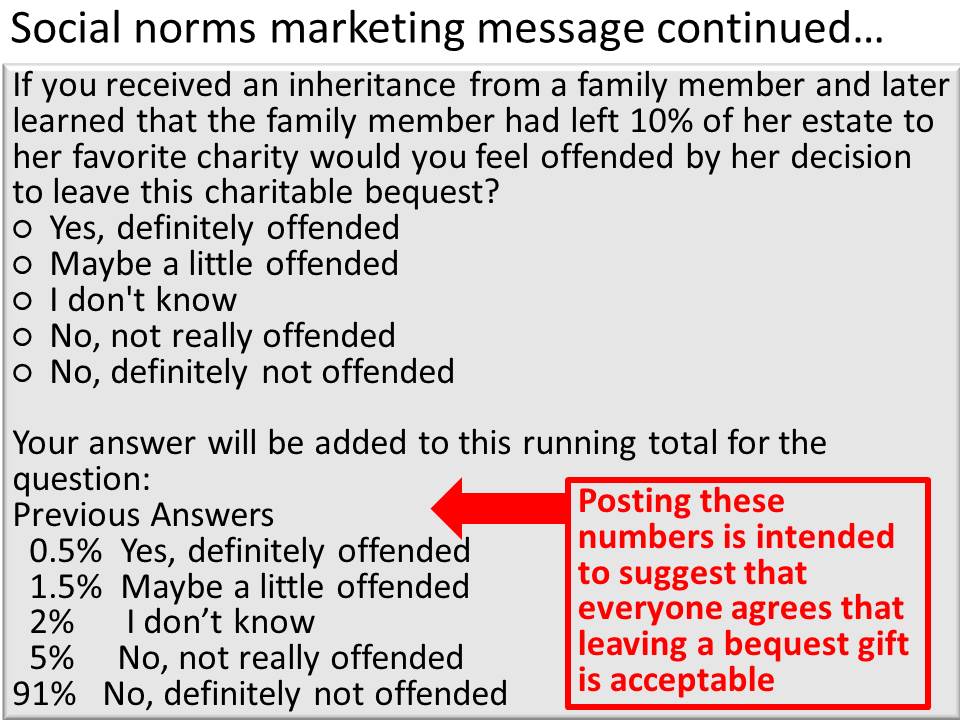
The “American social norms” marketing message then continued by asking a survey question regarding whether or not the person would feel offended if they received an inheritance from a family member and later learned that the family member had left 10% of her estate to her favorite charity. There are two reasons for this phrasing. The first was to take the decision process and reverse it, so that the person considers being the recipient rather than the donor. It allows the person to fill the role of the beneficiary, giving moral consent to the transfer of funds to a charitable entity.
In this way we attempted to attach the positive social value, in this case not being greedy, to the desired behavior of leaving a charitable bequest. We attempted to attach a positive social norm to the behavior by reversing the decision context and then additionally, we broadcast group agreement with the social norm by publishing the “running total.” This percentage distribution for the “running total” did not change during the course of the survey. Simply put, this was not a running total. This was a methodology used to suggest that essentially everyone agreed with leaving a bequest gift as an acceptable activity (or at least 96% of the sample agreed with that idea). The concept was to show that if the person believed the behavior was inappropriate, then they were clearly in a very small minority (i.e., not confirming to group social norms). Findings from terror management theory suggests that the last thing a person wants to experience following mortality salience is the sense that they are an outcast from their in-group. Note that the information in the inset box is a commentary and was not included in the original survey.
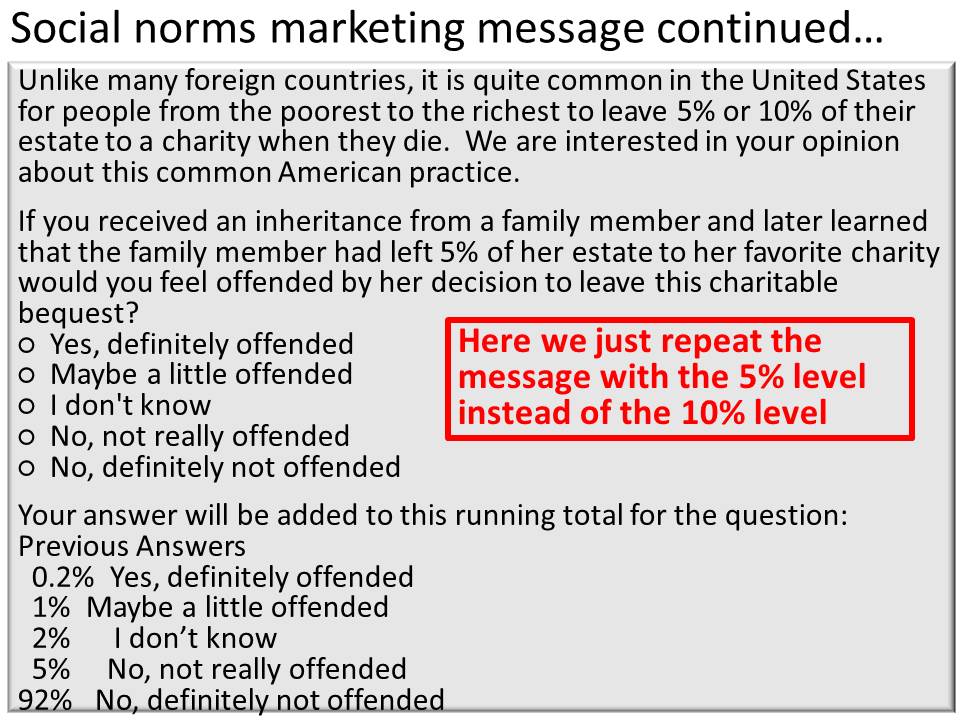
The next page of the survey essentially repeated this same scenario but used the 5% charitable contribution level rather than the 10% charitable contribution level. This was just an attempt to repeat the information supporting charitable bequests as an accepted social norm. Once again, the “running total” demonstrated the vast acceptance of this behavior. Note again that the information in the inset box is a commentary and was not included in the original survey.
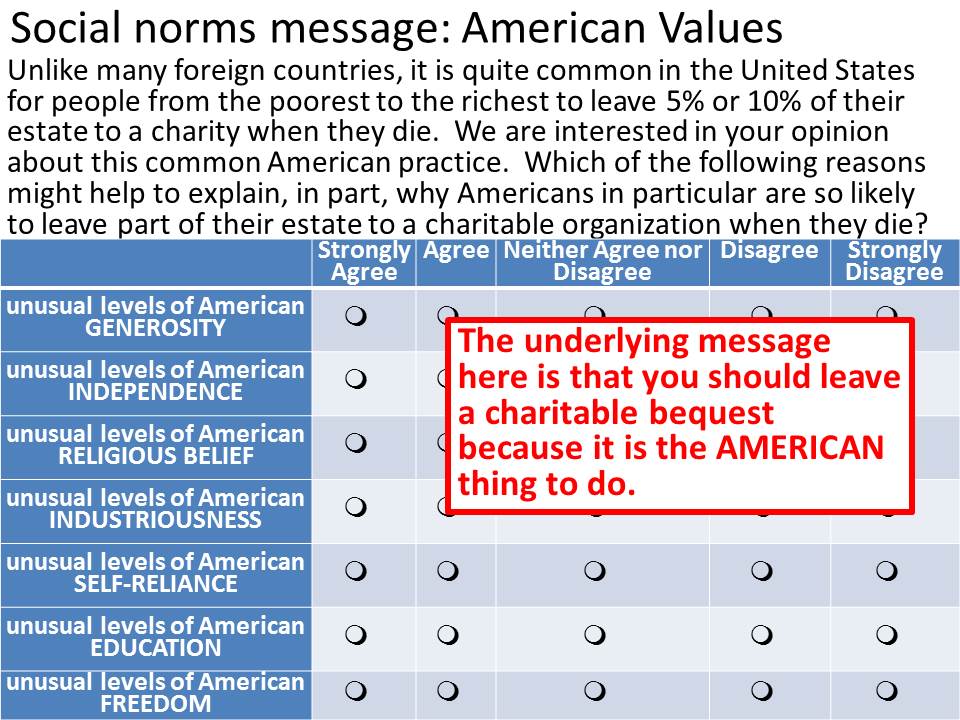
The last part of this intervention then asked a series of questions about the “established” social norm. This series of questions was intended to cause the participant to interact with and contemplate the idea that the behavior is not only a social norm, but is related to defining characteristics of the national identity. Consequently, the questions relate to other potentially positive defining characteristics of the national identity to strengthen the importance and in-group identity of the social norm.
To the extent that the social norm is identified not just with the in-group (in this case one’s nation), but is identified with the cherished values which define the core characteristics of that in group, it makes rejection of the social norm (charitable bequest giving) a rejection of the ethical and moral norms of the national in-group. Note again that the information in the inset box is a commentary and was not included in the original survey.

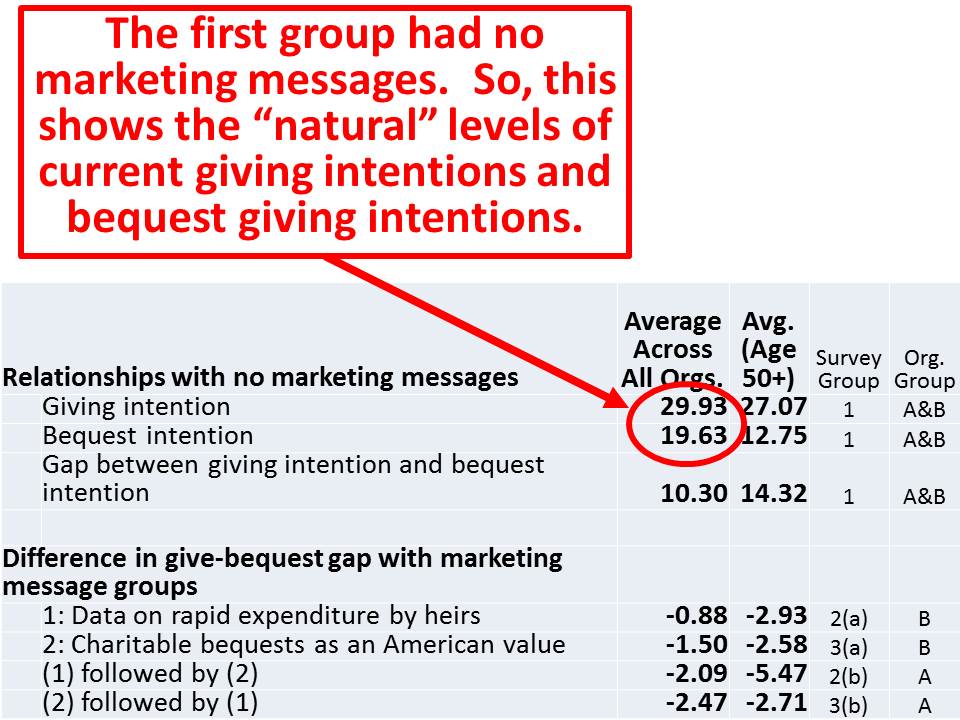
The above table shows the results from the control group and the groups receiving the first two interventions. The top four rows report results from the control group. This group answered the giving and bequest intention questions without any marketing message interventions. Consequently, we will use these responses as our comparison point throughout later analyses.
The second column reports the average giving intention. The circled results show the average giving intention across all organizations and the average bequest intention across all organizations for the control group that received no marketing messages. As expected, we see that there was approximately a 10 point gap between giving intention and bequest intention.
The third column reports the same results, but limited only to those respondents who reported being age 50 or above. Perhaps a bit disturbingly, the giving-bequest intention gap was even greater for those who were age 50 and above. Thus, the problem appears worse for those whose decisions matter the most.
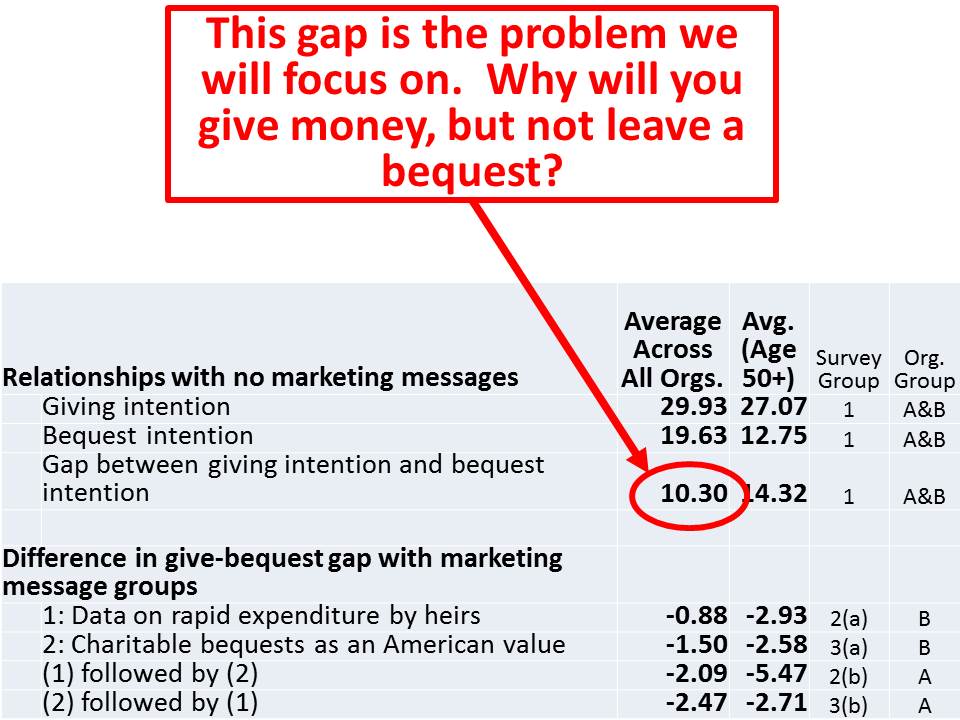
The primary number we will focus on for this research project is the giving-bequest intention gap. Basically we want to know why people will give money, but not leave a bequest. More to the point, we want to know what can we do to reduce this tendency of people who are willing to give money, to be simultaneously unwilling to leave a charitable bequest? We begin with the reality that there is a substantial gap in the control group that received no marketing messages. The gap is 10.3 points for the sample as a whole and 14.32 points for the sample aged 50 and above. Notice this gap is not a problem of people not liking the charity, which would generate low numbers for both forms of support. Instead, the problem is an aversion to one form of financial support over another. The problem isn’t that people don’t like the charitable organizations. Instead it’s about the ways in which people are willing to act in response to their support of the charity. It is this gap that we will attempt to reduce, or ideally even eliminate, with our marketing messages.
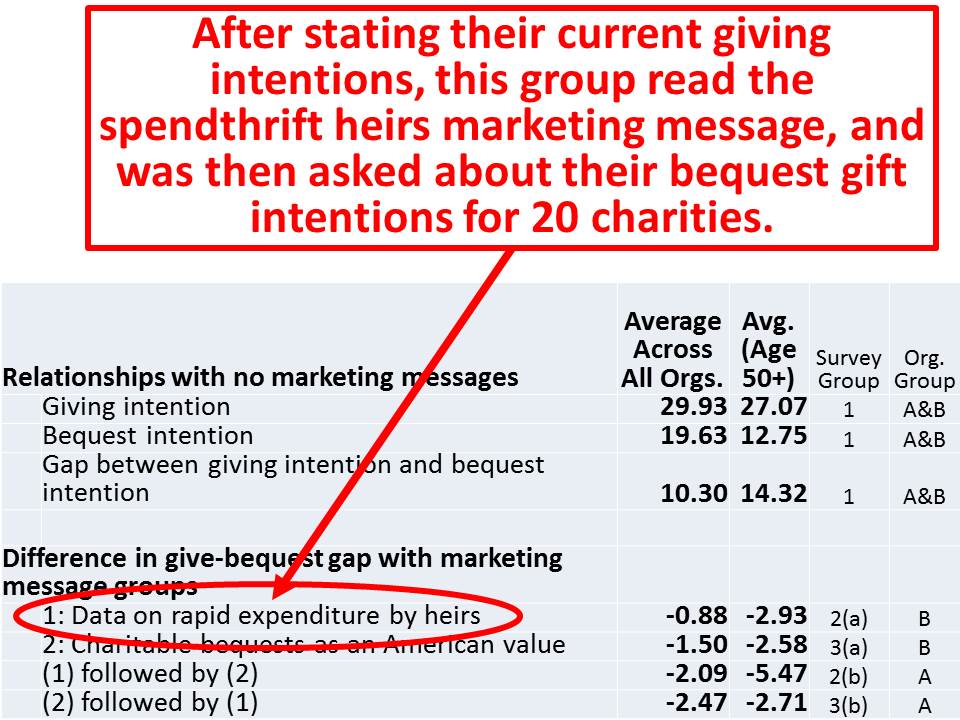
Moving further down the table, we see the first results from our marketing messages. This first group read the spendthrift heirs marketing message and then were asked about bequest gift intentions for 20 of the 40 charities. Notice in this table that the charities are broken into two different groups, that is group A and group B. When we divided charities into these two groups we attempted to keep representatives of all of the different charity types in both groups. Group A consisted of The American Cancer Society, National Audubon Society, The American Society for the Prevention of Cruelty to Animals, San Francisco Aids Foundation, Breast Cancer Research Foundation, Foundation Fighting Blindness, Boys and Girls Clubs of America, CARE, YWCA, The Alzheimer's Foundation of America, Dana Farber Cancer Institute, Wildlife Conservation Society, Guide Dogs for the Blind, American Indian College Fund, Habitat for Humanity, American Lung Association, Boy Scouts, The United Way, The Salvation Army, and Joslin Diabetes Center. Group B consisted of National Cancer Coalition, Ducks Unlimited, The American Humane Association, AIDS Project Los Angeles, National Breast Cancer Foundation, Prevent Blindness America, Big Brothers/ Big Sisters, UNICEF, YMCA, The Alzheimer's Association, MD Anderson Cancer Center, World Wildlife Fund, Canine Companions for Independence, United Negro College Fund, Susan G. Komen Breast Cancer Foundation, The American Heart Association, Girl Scouts, Goodwill Industries, The American Red Cross, and The American Diabetes Association.
The reason that we didn’t test each intervention with every single charity is twofold. First, it would have dramatically expanded the size of the survey instrument, which already took on average 35 minutes. Second, it would not allow the ability to easily test the effect of stacking multiple marketing interventions.
Notice in this analysis, we are comparing the gap presented by the experimental group (which received marketing messages after the giving question but before the bequest question) to the gap presented by the control group (which received no marketing messages). We are thus comparing two separate groups, rather than making a before and after comparison of the same people. People have a hesitancy to change an initial response. Because of this attachment to personal consistency, we may not be able to see the impact of an intervention in a “before and after” analysis. This is true even when the intervention truly would have had an impact if the individual had not already committed to a response prior to being exposed to the intervention. This is the reason why in this analysis we are comparing different groups, rather than “before and after” changes.
The circled result shows us the difference in the gap between the experimental group (which received the marketing message) and the control group (which received no marketing message). In this first example, the gap was .88 points smaller for the experimental group (that receiving the spendthrift heirs marketing message) as compared with the control group (that received no marketing messages). In other words, the group that received the spendthrift heirs marketing message had a current giving-bequest giving intention gap of 9.42 points instead of 10.30 points.
This is modestly good news, in that it suggests this marketing message may have had some positive effect in reducing the gap between giving intention and bequest intention. One advantage of focusing on the intention gap, rather than the absolute level of bequest intention, is that it avoids the problem of having one group that just happened to be more charitably inclined than the other group, and mistaking this for an effect of the marketing intervention. Because we are focused on the gap (i.e., the difference between charitable giving intention and bequest giving intention) if one group was overall more charitable or less charitable, it wouldn’t necessarily have any effect on the gap. The gap measures the difference between the desire to give by current giving and the desire to give by bequest giving.
Although the .88 reduction in the gap is a positive step, it is also relatively small. Fortunately, some of our other results are more encouraging.
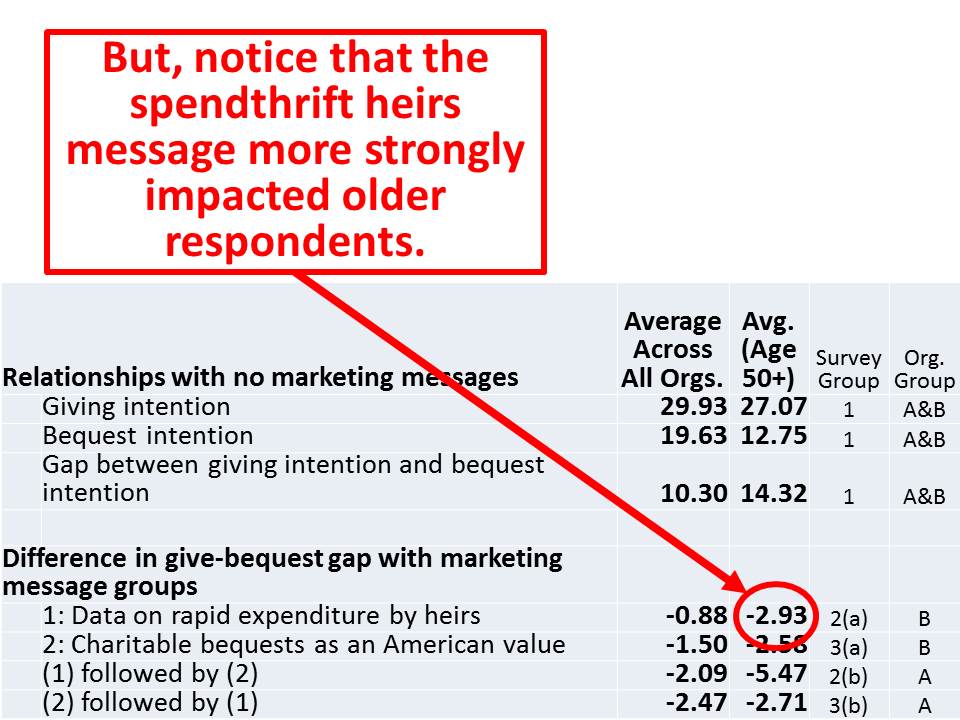
The result circled above indicates that the “spendthrift heirs” message had a much greater effect on older respondents. It might be that the older respondents were thinking of the spendthrift heirs as spending the respondents’ money, where the younger respondents might have been thinking about being a recipient of a bequest transfer. It may also be that the younger respondents were more likely to see immediate expenditure as a completely appropriate use of an inheritance.
Next we turn to the third group, which did not begin by receiving the spendthrift heirs message, but instead began by receiving the “American social norms” message. Notice also that this third group answered questions about the same set of organizations as the second group did.
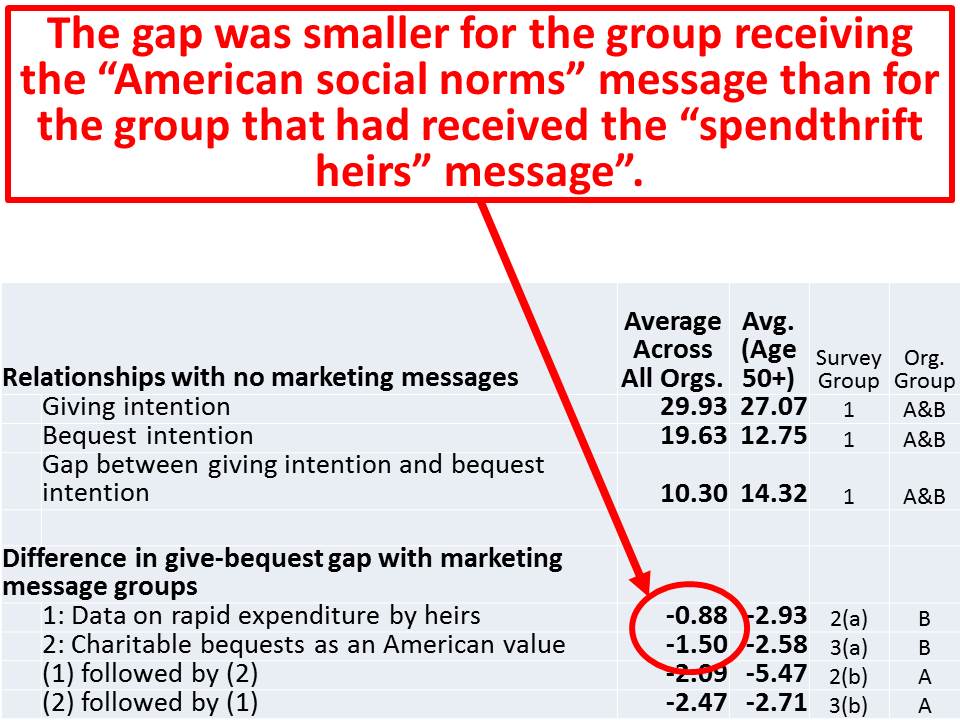
According to the circled results, for the sample as a whole, the “American social norms” message appears to have been more powerful in reducing the gap than the spendthrift heirs message. Notice, however, that this was not the case for older adults. For older adults, both messages were relatively similar in their impact, although the “spendthrift heirs” message was slightly more powerful in reducing the gap.
This emphasizes the importance of age appropriate messaging in this field. Ultimately, what we can say from these first two results is that both messages appear to have had some impact in reducing the gap. However, the spendthrift heirs message was primarily effective for an older audience, not a younger audience.
As an additional way to compare the impact of these messages, we then gave the second message to the group that already had received the first message and vice-versa. After receiving both sets of marketing messages the respondents in both groups then answered bequest questions regarding the 20 remaining charities. It is important to note that none of the marketing messages were delivered until after the current giving questions were asked. These marketing messages were given between the time that the current giving questions were asked and the time that the bequest giving intention questions were asked. Thus, the gap is never reduced by the intervention changing the current giving intentions, but only by the intervention changing the bequest giving intentions
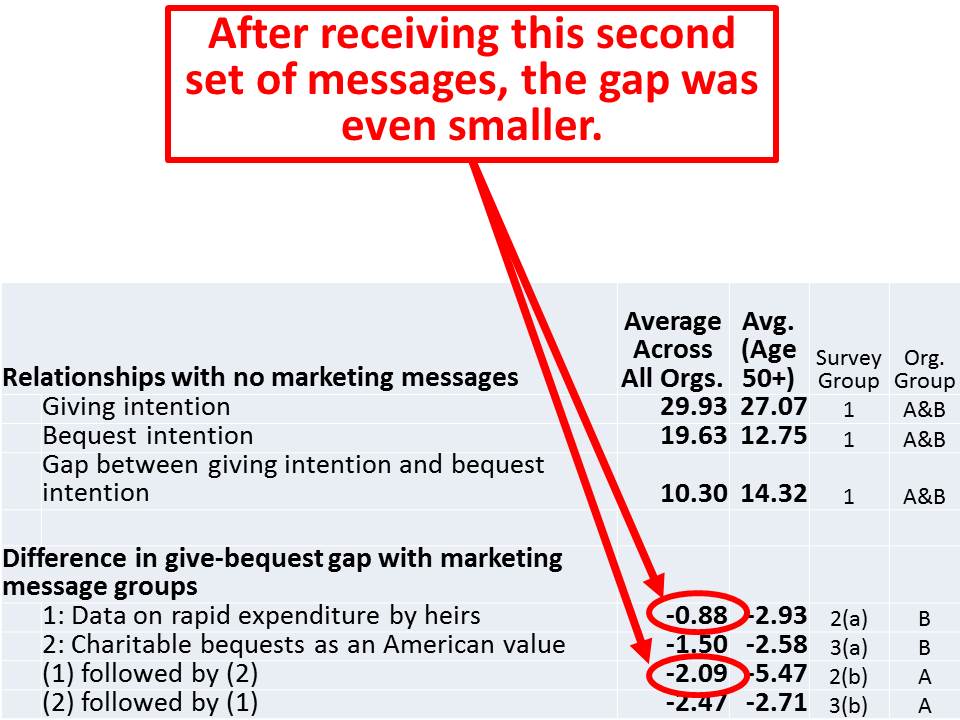
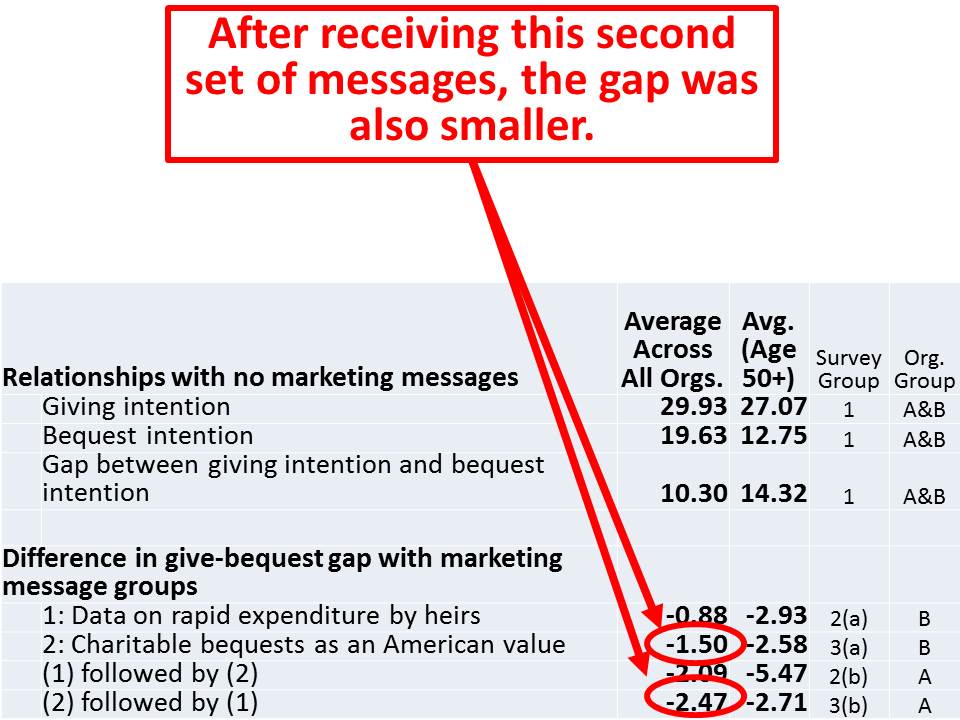
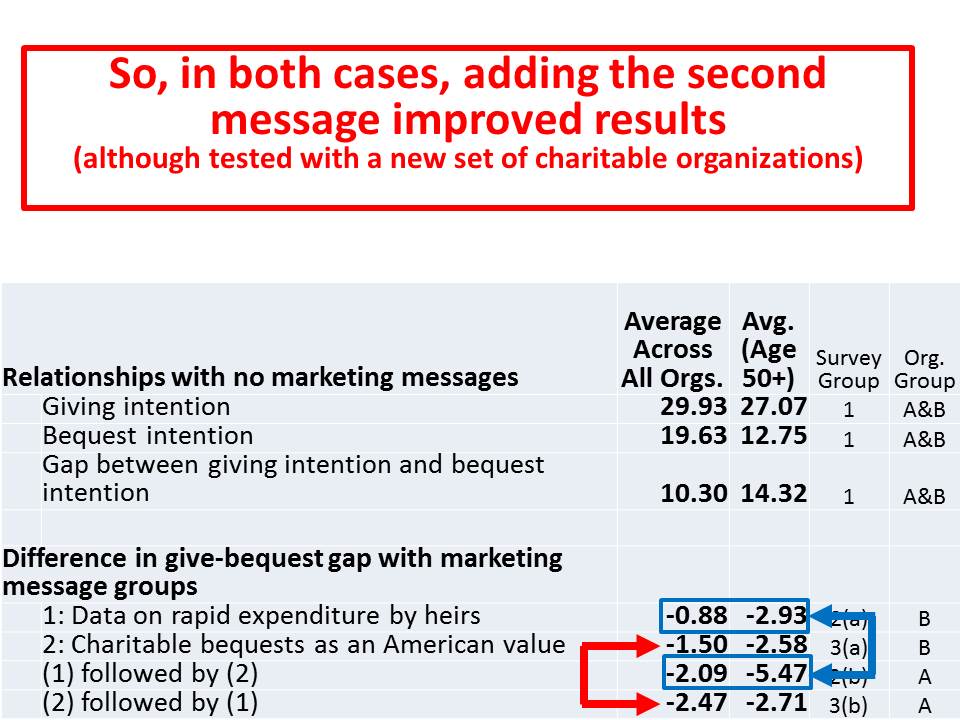
The above results suggest that these messages were “stackable” in the sense that providing the second of the two messages in both cases seemed to provide an additional impact in reducing the giving-bequest intention gap. This was true when the “spendthrift heirs” message was added on to the “American social norms” message. This was also true when the “American social norms” message was added on to the “spendthrift heirs” message. Both were true for the sample as a whole and for the sample limited to older adults.
Consequently, this suggests that these two interventions are complementary. We could theoretically emphasize both messages and get a bigger consequence than when we simply emphasized one. Nevertheless, the conclusions to be drawn from this are limited by the fact that the second set of questions referred to a different set of nonprofit organizations. Making a comparison across groups, it does appear that there was a larger impact from adding the “American social norms” message than from adding the “spendthrift heirs” message and that this was true in both the sample as a whole, and the older adult sample.
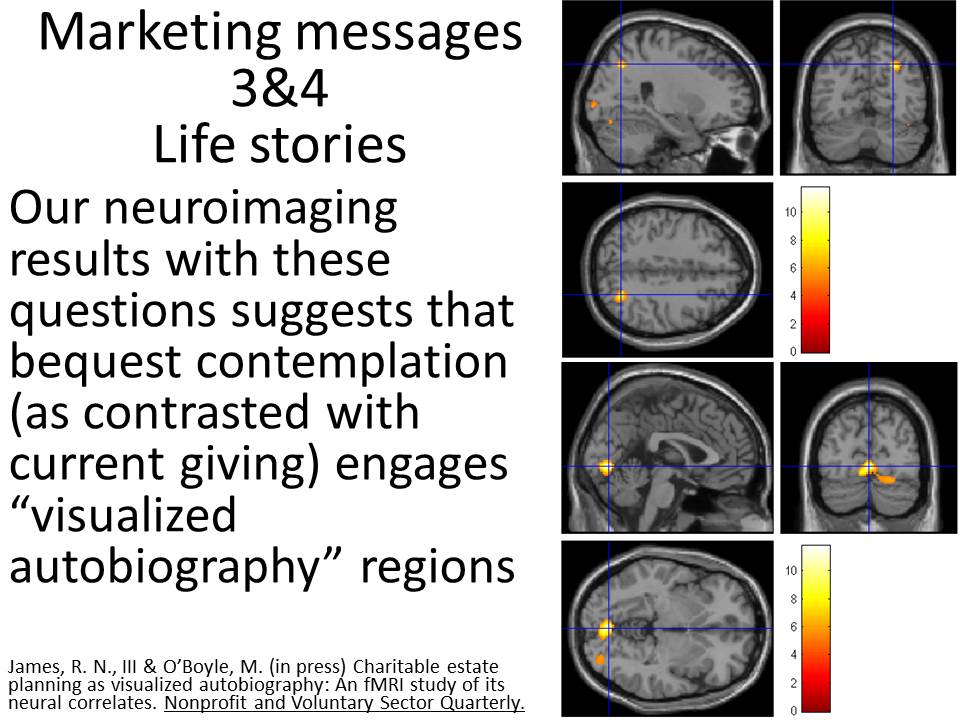
For the next set of interventions we will look at “life story” messages with a visual component. The previous neuroimaging results were consistent with the hypothesis that bequest contemplation particularly engages visualized autobiography regions as compared with current giving contemplation. Following from this finding, we use marketing messages taken from the Leave a Legacy® campaign about the life stories of deceased donors and how those deceased donors are continuing to make an impact consistent with their life story many years after the death of the donor. The text is taken from the Leave a Legacy® campaign, however, the images are not those used with the campaign materials. We used these different images in part because we also modified the text of the Leave a Legacy® campaign stories for an additional variation where the stories were of currently living donors and their plans for making an impact in the future through planned charitable bequest giving, and we wanted the images to be easily interchangeable with both types of stories.
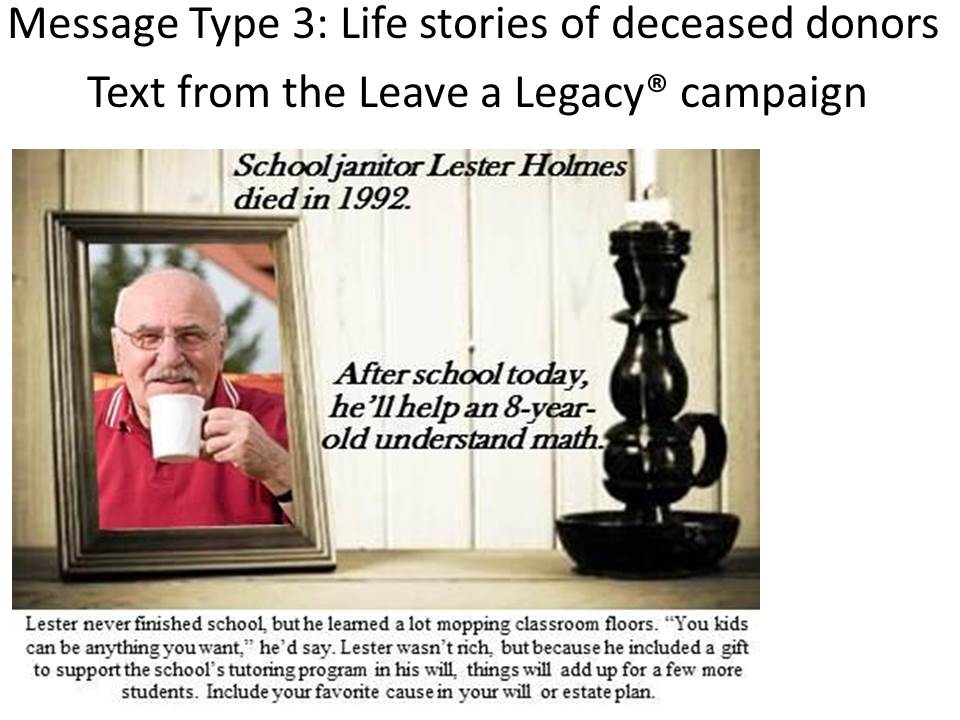
The above is an example of the life stories of deceased donors used in this survey.
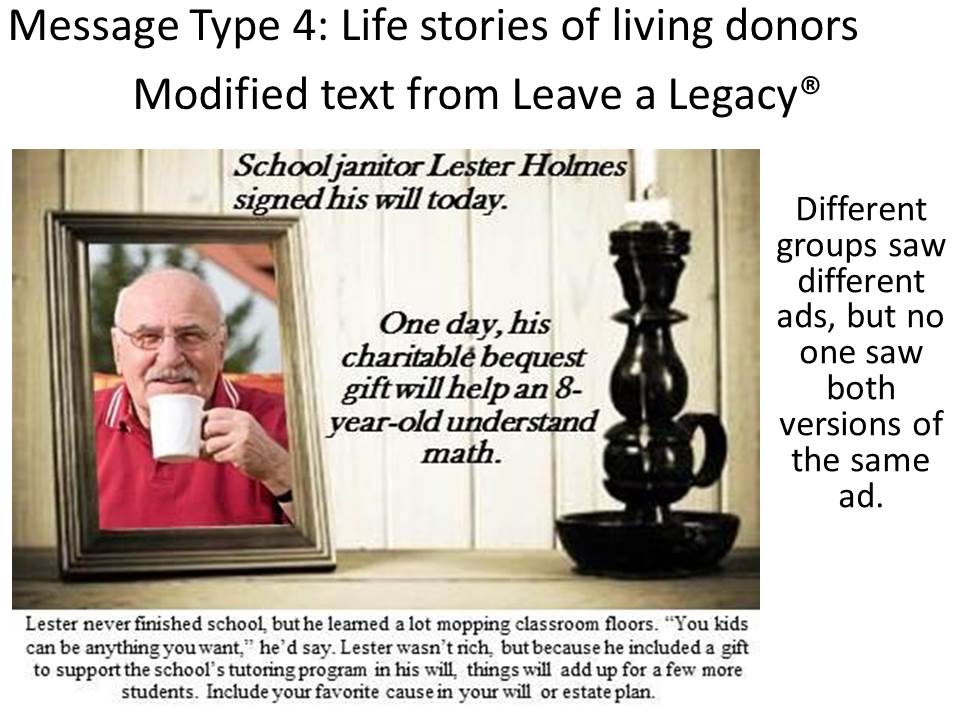
The above shows an example modification of the original text to generate life stories of living donors who have planned to leave a charitable bequest. Notice that the text is kept as close to the original as possible while changing the story from that of a decedent to that of a living planner. Also note that different groups saw different ads, but no one saw the same add in both versions (i.e., no one saw the same add in both its “living donor” and “deceased donor” formats).
The following images show the exact ads that were used in these tests. The group exposed to the life stories of deceased donors first would have seen the ads shown in the left column (following the deceased donor ad shown above). The group exposed to the life stories of living donors first would have seen the ads displayed in the right column (following the living planned bequest donor shown above). The bequest questions for the first 20 charities were asked after the first set of ads (either living or deceased donors) and then the questions related to the remaining 20 charities were asked after the remaining ads had been displayed.
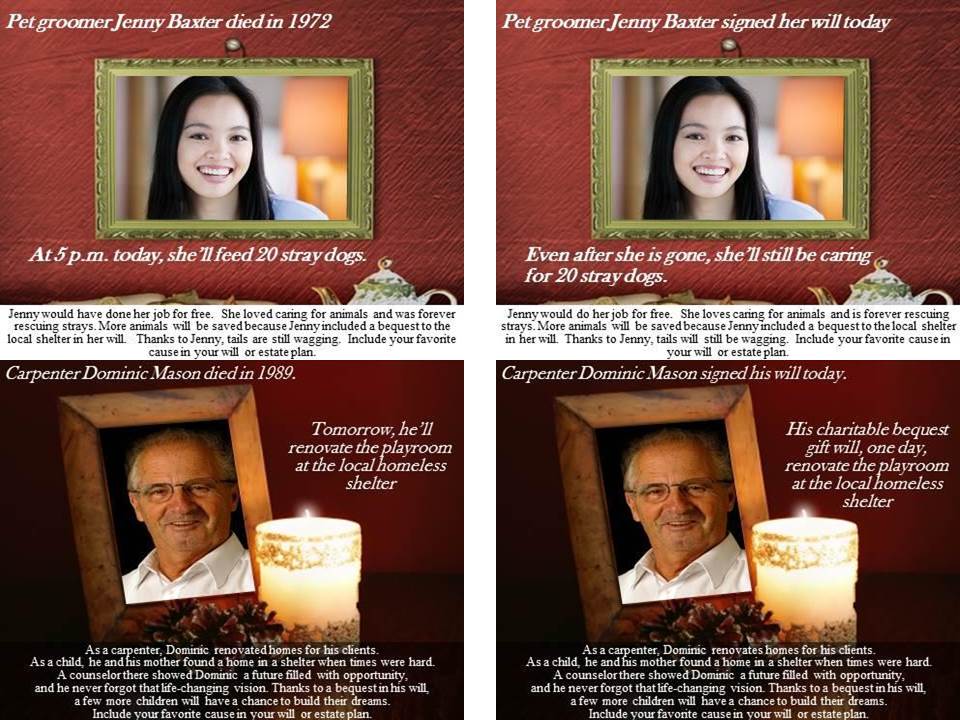
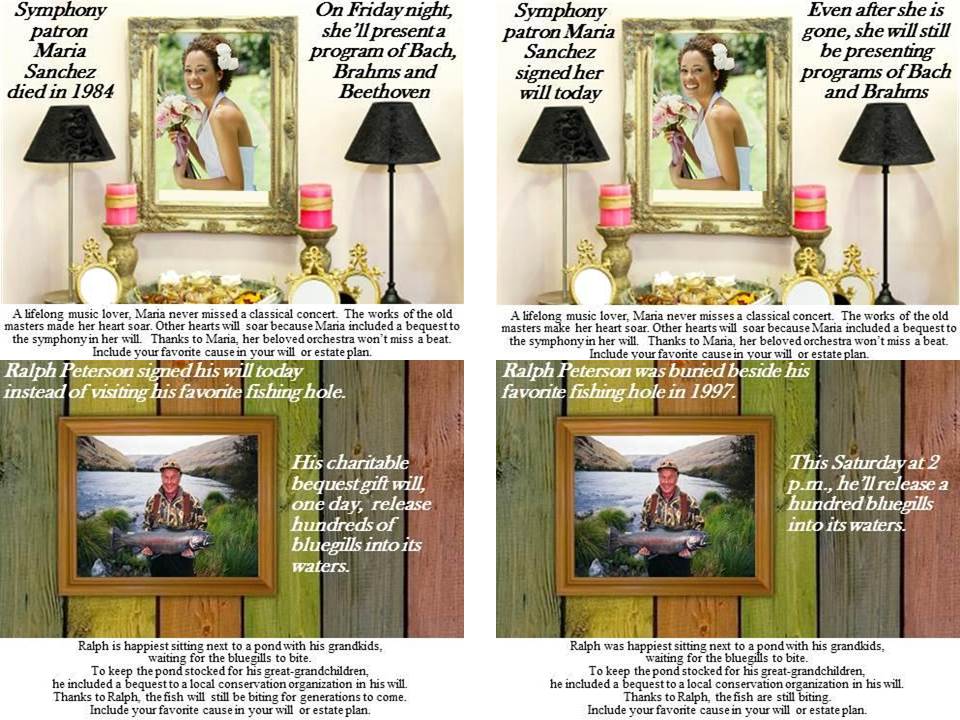
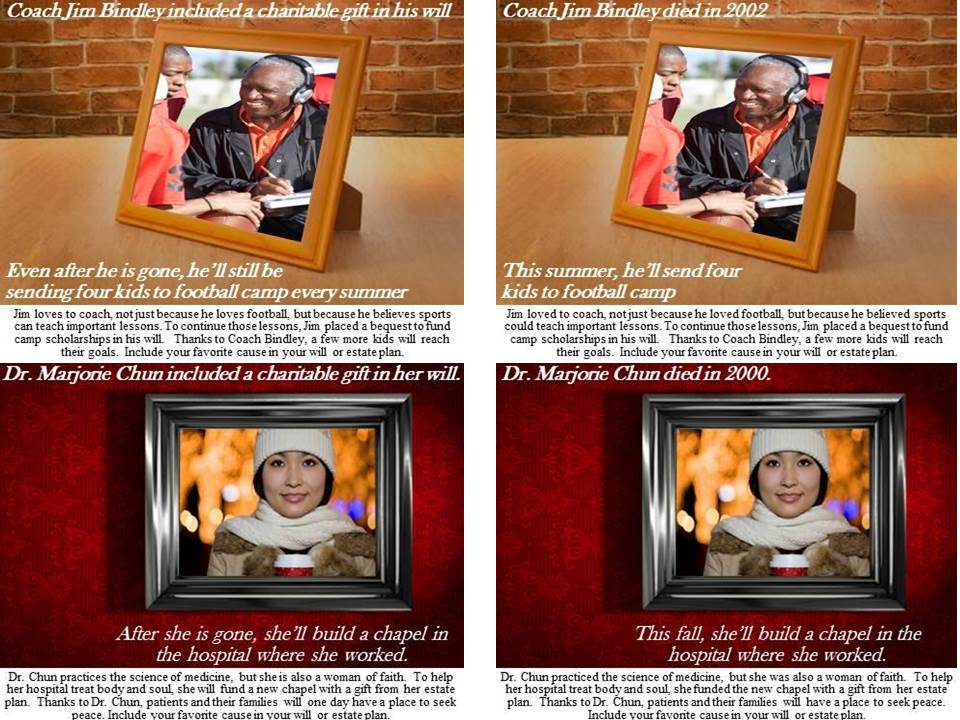
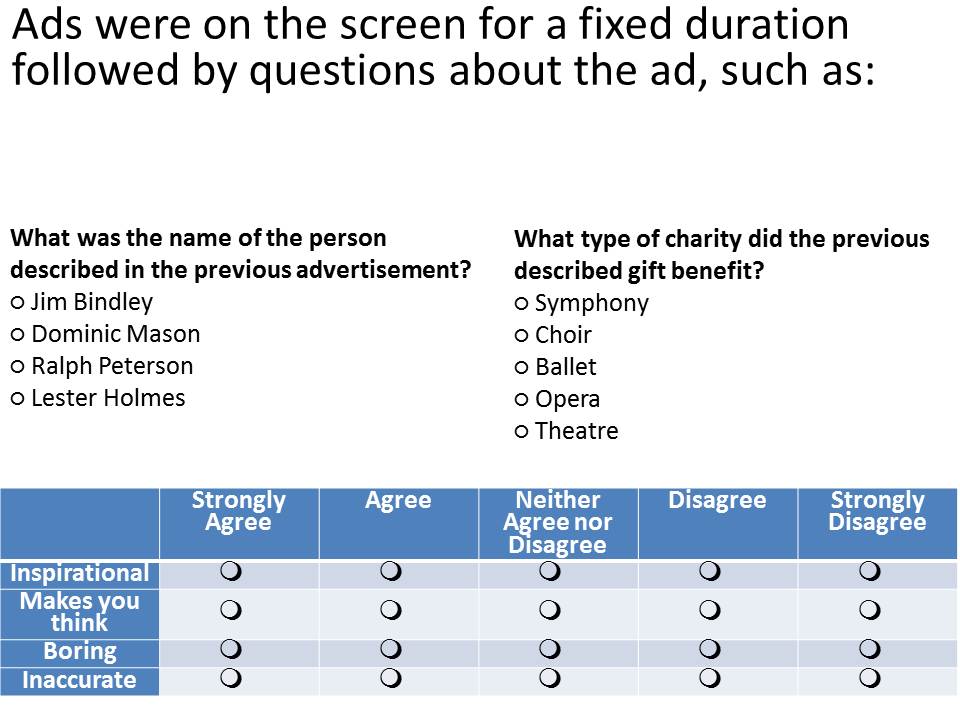
In order to make sure that individuals were paying attention to the content of the advertisements each advertisement was followed by different types of questions. These questions asked about the content of the ad. Some required the participant to remember the text content. Others asked the participants’ opinions regarding the characteristics of the advertisement. The primary goal of these questions was to encourage participants to closely examine the advertisements, knowing that they would later be asked questions regarding the content.
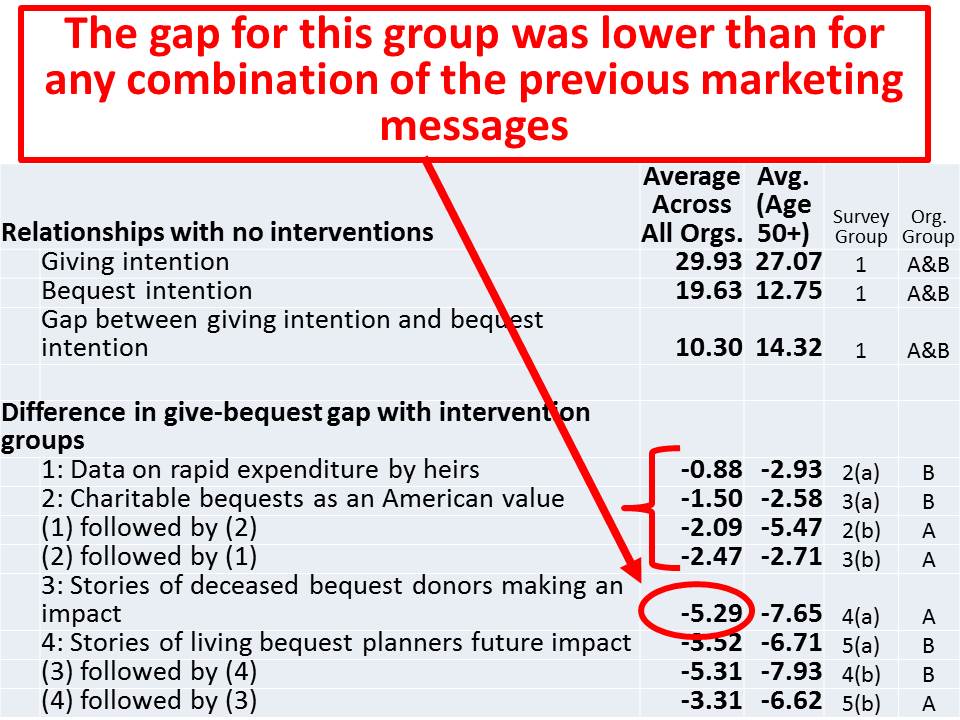
The above table displays these results in addition to the one’s seen from the previous interventions. The results from the deceased bequest donor stories show an impact greater than any seen for the previous two interventions, either alone or combined.
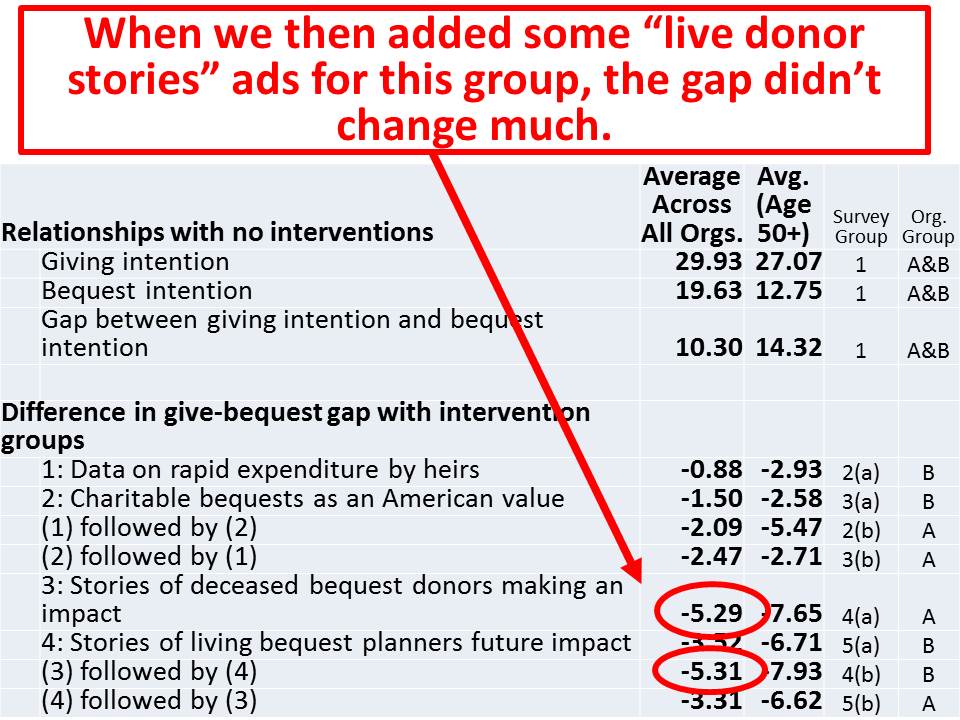
In the results circled above, we can see that adding living bequest donor stories to deceased bequest donor stories did not appreciably change the impact on the giving-bequest intention gap. This same result appears relatively consistent throughout all of the applications of these “life story” interventions, even when the sequence of nonprofit groups was switched. Taken together, this suggests that the two types of “life story” messages are not “stackable” in the sense that adding one type to another does not provide an additional large boost. Rather, the messages appear to be largely interchangeable.
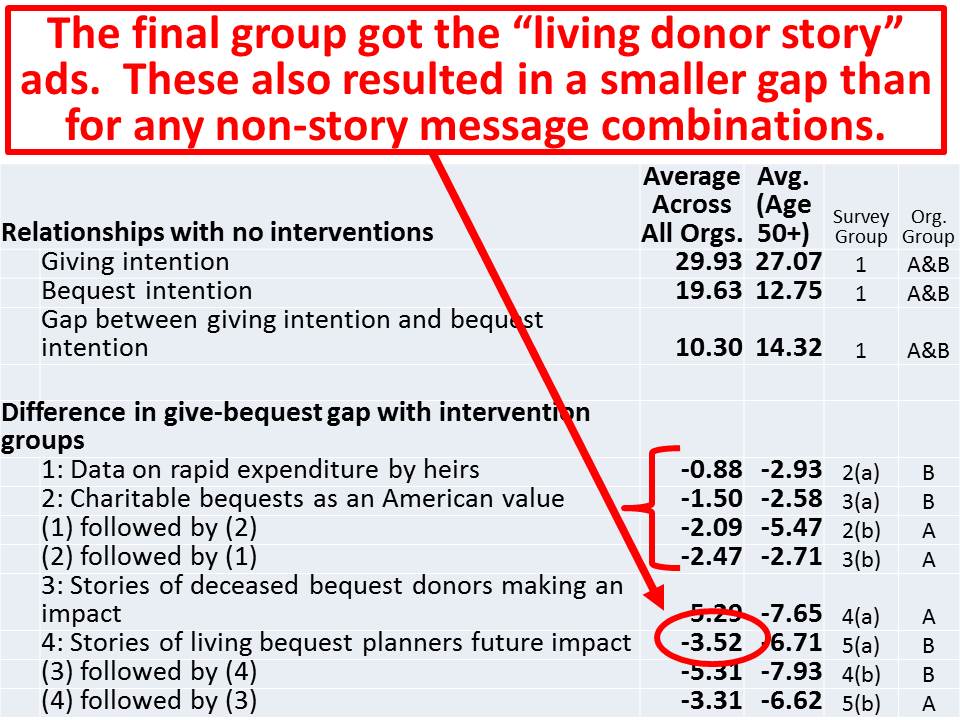
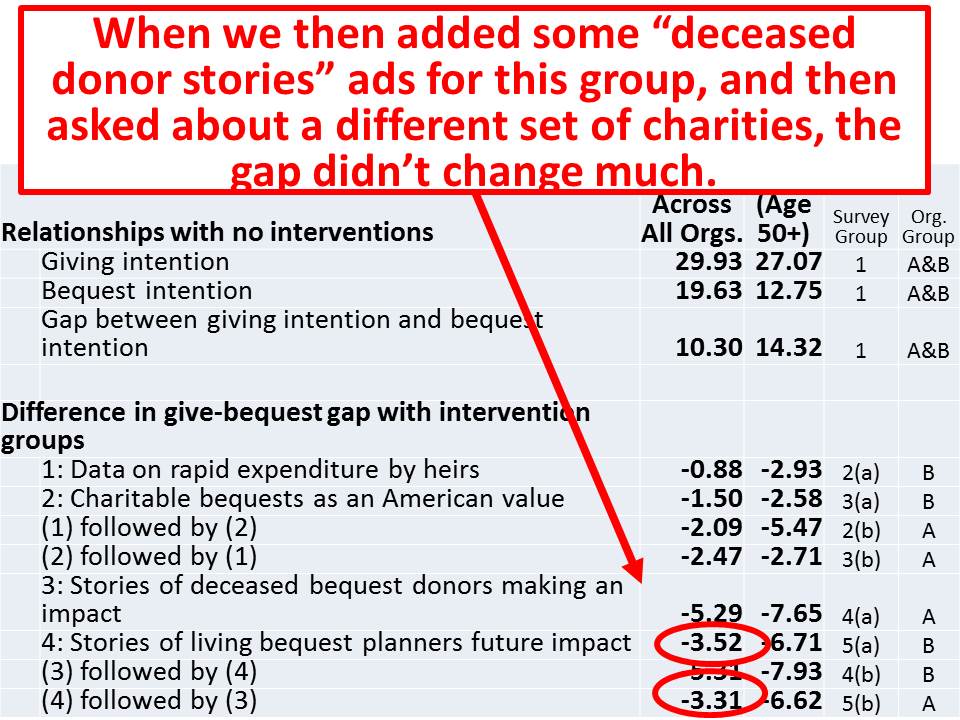
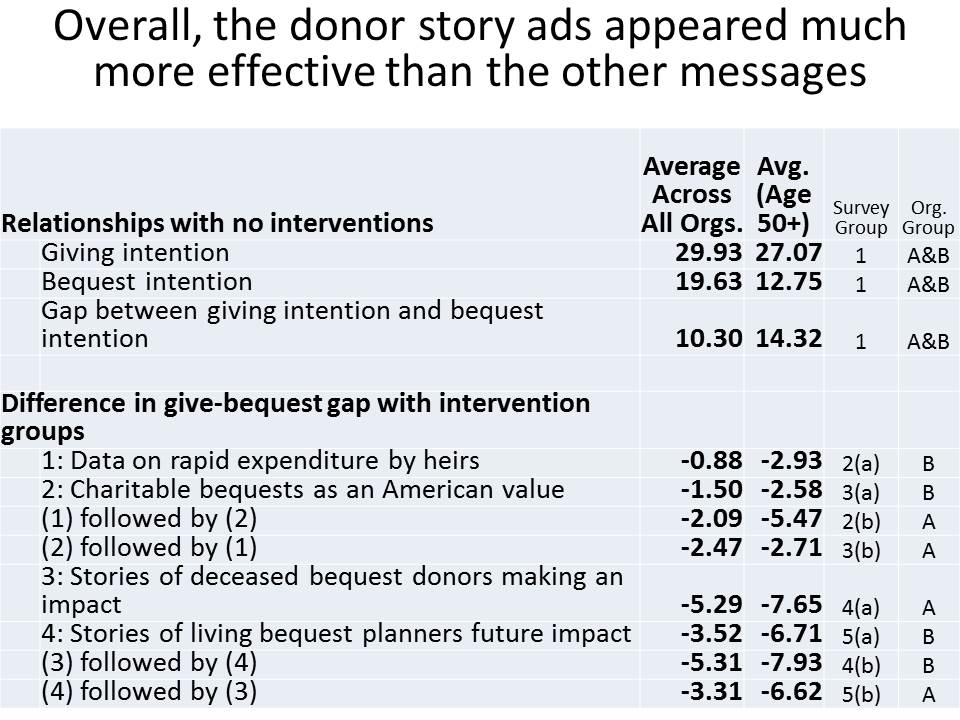
In looking at all of the results from these tables, we can take from it that although all of the ads appear to have a positive impact in reducing the gap between giving intention and bequest intention, overall, the donor life story advertisements were more powerful than the other interventions.
However, these results left unanswered the question as to whether deceased donors were more or less powerful than the stories of living bequest planners. As a result, the following tests were intended specifically to compare living donor stories with deceased donor stories under a range of conditions.
(The notation changes slightly here as charities are listed at “1 to 20” or “21 to 40” rather than A or B, and survey group 1 becomes A, 2 becomes B, 3 becomes C, 4 becomes D, and 5 becomes E. Survey groups F, J, H, I, J, and K are new.)
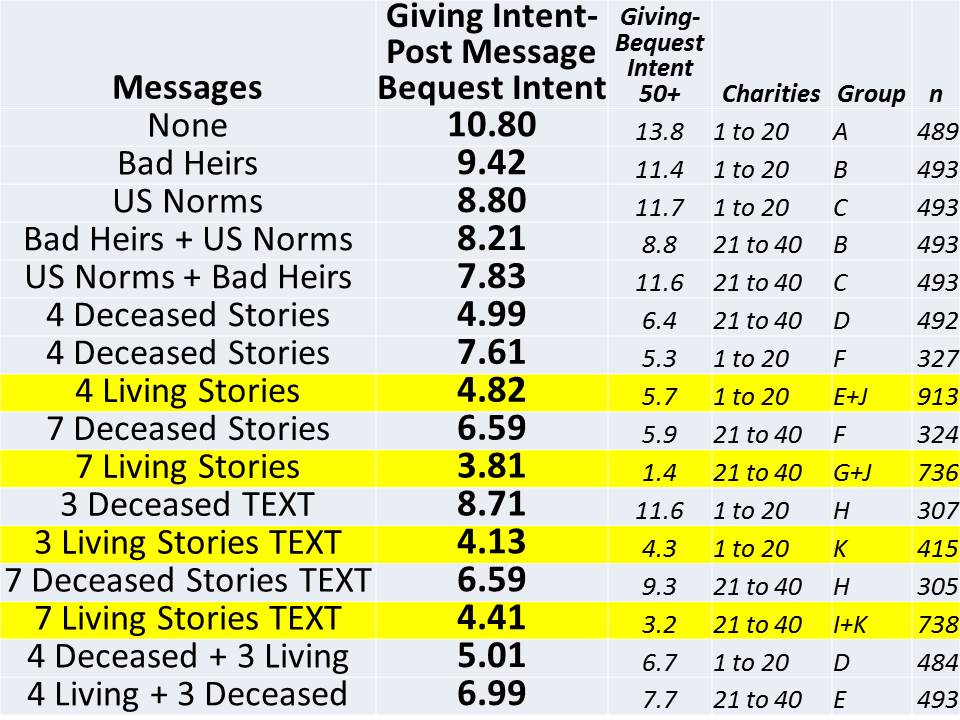
The above table shows results from both the previous tests and the new tests. In total these results represent 11 different online surveys with a total of 4,560 respondents. The highlighting marks the four strongest marketing messages tried. Notice that all four involved the exclusive use of living donor stories. In each example where living donor stories were compared against deceased donor stories, the living donor stories reduced the giving-bequest intention gap more than the deceased donor stories.
Interestingly, even when the living donor stories were presented only as text, with no accompanying pictures, they continued to perform well. Normally, the more visually interesting message would be more powerful. But, perhaps in this case the message without the image of a particular person more easily allows the reader to project him or herself into the situation. On the other hand, in this scenario respondents were required to read the message and answer questions about it. Perhaps in a more realistic advertising context the images would perform better in attracting readers’ attention.
One remarkable feature of this result, clearly dominantly in favor of the living donor stories, is that it is the opposite of what we should have seen, given that the original campaign text was designed exclusively around deceased donor stories. In other words, the living donor stories were simply a cobbled modification of the original campaign (changing the tense of a few words and such), and yet these clearly outperformed the deceased donor stories in their original form.
Despite this strong performance of the living donor stories, it should not be lost that the deceased donor stories were not a weak message in that they still outperformed the other two intervention types tested.
Our final set of results relate to tribute gifts, either memorial gifts for a deceased person or honoring gifts for a living person. (These results come from the first set of 2,452 surveys only.)
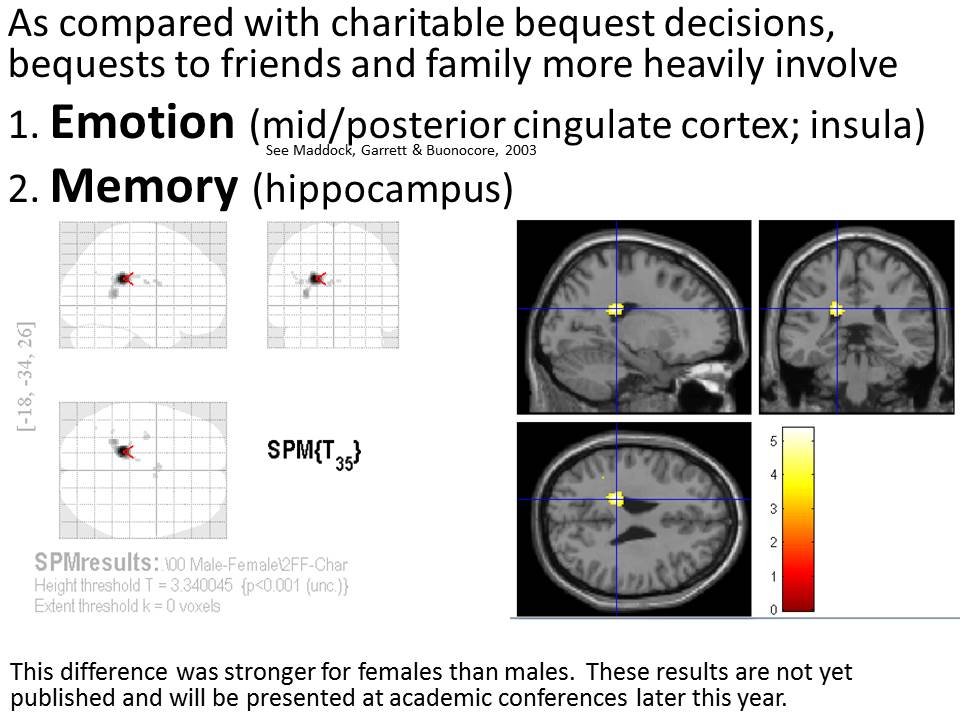
This intervention was motivated by the neuroimaging results showing that much greater emotion and memory activation attached to bequest decisions related to friends and family members than bequest decisions related to charities. This intervention is an attempt to attach the charity with the emotion and memory associated with a loved one. And further, it attempts to test whether or not such an attempted attachment can make an impact on stated intentions to leave a bequest gift.
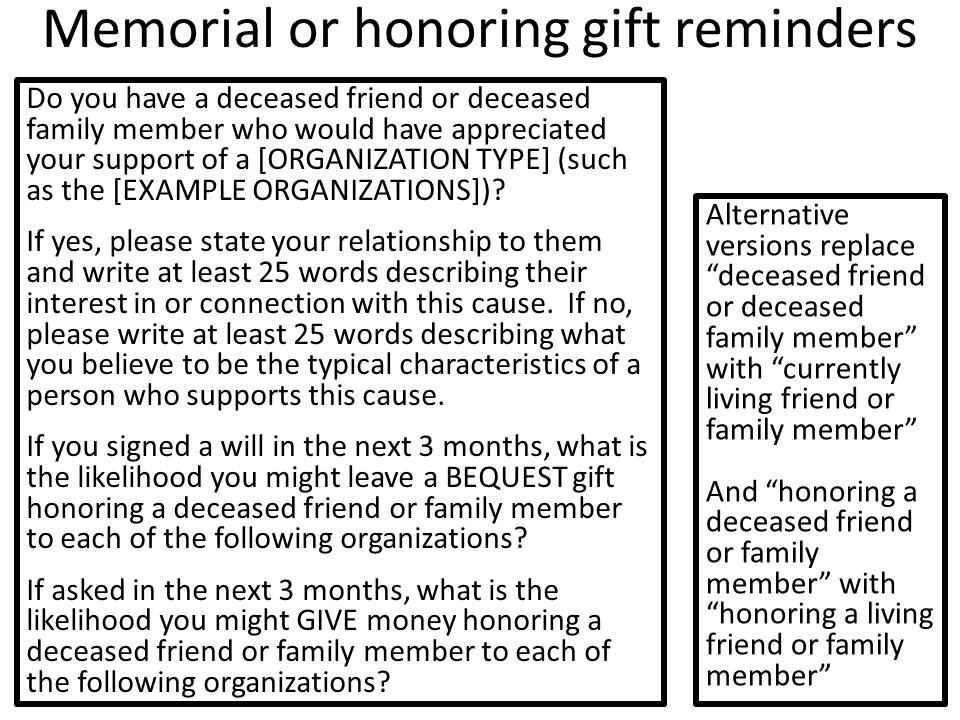
The above slide shows the text of the questions for the memorial or honoring gift reminders. First, respondents were asked the question, “Do you have a deceased friend or deceased family member who would have appreciated your support of” a particular organization type, which was then followed by example organizations. For example, one question read, “Do you have a deceased friend or deceased family member who would have appreciated your support of a Cancer Research Organization (such as the National Cancer Coalition, the American Cancer Society, The MD Anderson Cancer Center, or the Dana Farber Cancer Institute)?” Other organizations types (and specific organizations) were a Wild Birds Preservation Organization (such as Ducks Unlimited or The National Audubon Society), an AIDS research and care organization (such as AIDS Project Los Angeles or San Francisco AIDS Foundation), an animal welfare organization (such as The American Humane Association or The American Society for the Prevention of Cruelty to Animals), a Youth-Related charitable organization (such as The Big Brothers/Big Sisters of America, Boys and Girls Clubs of America, YMCA, YWCA, Girl Scouts, or Boy Scouts), an Alzheimer's research and care organization (such as The Alzheimer's Association or The Alzheimer's Foundation of America), a blindness related nonprofit organization (such as Prevent Blindness America or Foundation Fighting Blindness), a diabetes research and treatment organization (such as The American Diabetes Association or The Joslin Diabetes Center), an International Relief charitable organization (such as UNICEF or CARE), a nonprofit organization supporting service dogs (such as Canine Companions for Independence or Guide Dogs for the Blind), a wildlife-focused nonprofit organization (such as the World Wildlife Fund or the Wildlife Conservation Society), and a breast cancer research organization (such as the National Breast Cancer Foundation, Breast Cancer Research Foundation, or Susan G. Komen Breast Cancer Foundation)
If the respondent answered, “yes” to this question, then they were asked to write at least 25 words describing the friend or family member and their friend or family member’s interest in or connection with the cause. If the respondent answered, “no” to this question, they were asked to write 25 words on another issue. This was done primarily to equalize the workload between those who responded “yes” and “no” to the question, so as to not discourage “yes” answers. Following this reminder and writing requirement, both the current giving and bequest giving questions were asked again, although this time they were asked in the context of a gift honoring a deceased friend or family member.
For the alternate version of this intervention the deceased friend or deceased family member was replaced with a currently living friend or family member in order to compare the impact of tribute reminders for deceased associates with tribute reminders for living friends or family members.
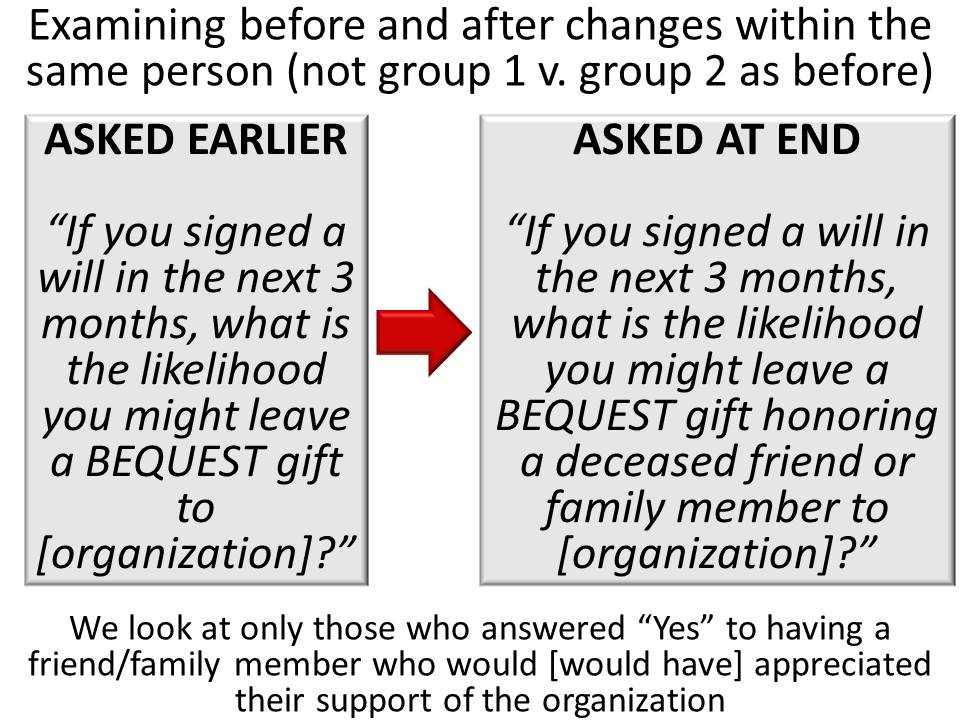
Notice that here we are making a very different kind of comparison to those made with the previous interventions. Here we are comparing changes within the same individuals by comparing their answers before the intervention to their answers after the intervention. This may avoid the previously discussed problem of participants anchoring on their previous answer, because the second set of questions were slightly different. The second set of questions asked specifically about bequest gifts that honored or memorialized a friend or family member. Thus, the idea is that people would not feel that they were being inconsistent if they changed their earlier response because the questions themselves had changed.
Because we are looking at the same people (before v. after) we will be able to look directly at the change in their bequest giving intention rather than relying on examining only the gap between giving intention and bequest intention. (Remember that the gap analysis allowed us to protect against group differences in overall charitable inclinations towards nonprofits. We don’t have to protect against this in the current analysis because we are comparing the same individuals’ responses before and after the intervention.)
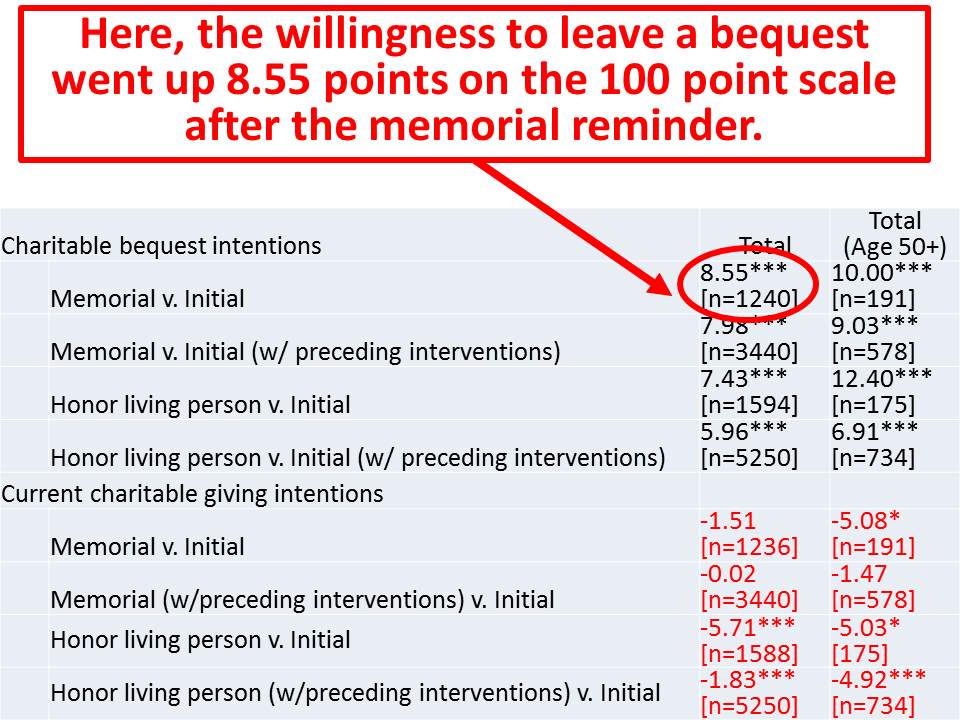
The above table of results shows the change in bequests and current giving intentions before and after each intervention. It compares stated intentions regarding the general bequest question before and regarding the narrower tribute bequest question after. In comparing the responses after the memorial reminder, we see a notable increase in charitable bequest intentions.
Note that this increase refers only to those who said “yes” to having a friend or family member who would have appreciated their support of the organization. The n= number refers to the total number of times a respondent said “yes” to having a friend or family member who would have appreciated his or her support for this category of nonprofit organization. The number circled above shows the impact of the memorial reminder among those who had received no other marketing interventions. Note that the impact here was even greater for the older adult sample (+10.00 points) than for the sample as a whole (+8.55 points). Given the relative importance of decisions made at older ages in generating charitable bequests, this is particularly encouraging for this type of intervention.
Technical side note: As a conceptual matter leaving a bequest gift that honors a deceased friend or family member is a subcategory of leaving a bequest gift for any purpose. Thus logically, we ought to see less willingness to leave a bequest gift for a narrowly defined purpose than to leave a bequest gift for any and every purpose imagined by the donor. This is not, however, how humans think. Most people do not naturally think of the ability to leave a bequest gift that honors a deceased friend or family member unless it is presented specifically as an alternative.
The next question is whether or not the improvements seen from this type of intervention still occurred among those individuals who had already seen a previous set of marketing messages. The second row of results provides the initial answer.
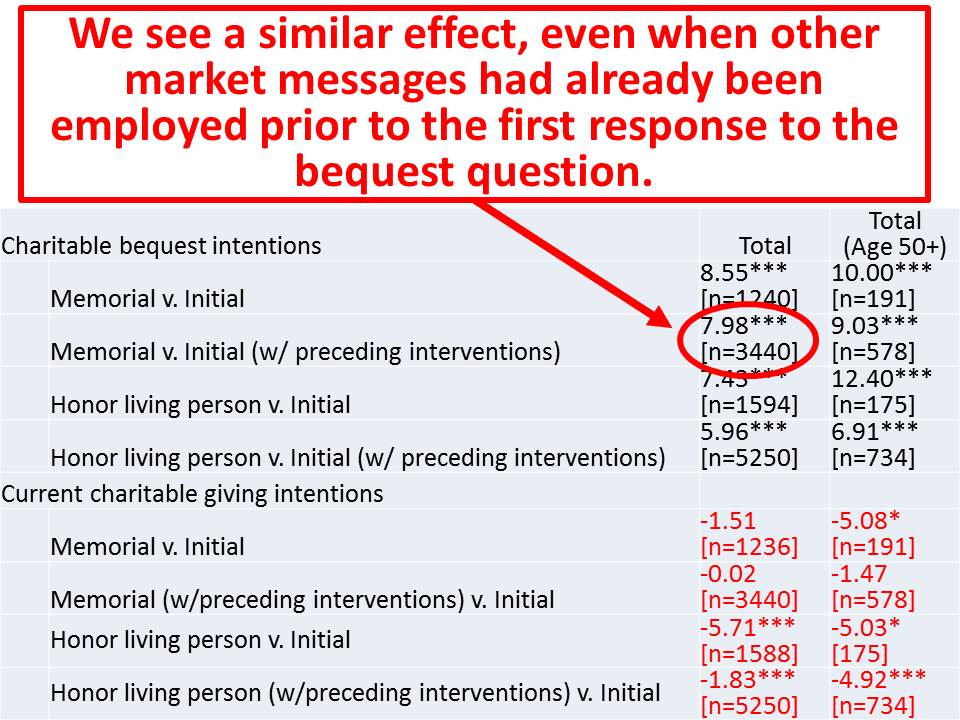
These results suggest that the memorial bequest opportunity can be “stacked” with other marketing messages to achieve a high level of charitable bequest intentions. Note that in this second column, we are comparing the initial response to bequest intention questions. In the circled category, this initial bequest response occurred after the marketing interventions. This means that the initial comparison point had already been “bumped up” by the effects of the previously described marketing messages.
Even though the initial comparison point had already been impacted by the previous marketing messages, we still see a very strong – nearly identical – impact from the memorial reminders. This is quite an exciting result because it tells us that in the context of an extended marketing campaign we can stack the previous marketing messages and memorial reminders to achieve higher and higher levels of charitable bequest intentions. We next turn to the question of whether or not this same effect can be seen if we are honoring living family members as contrasted with deceased family members.
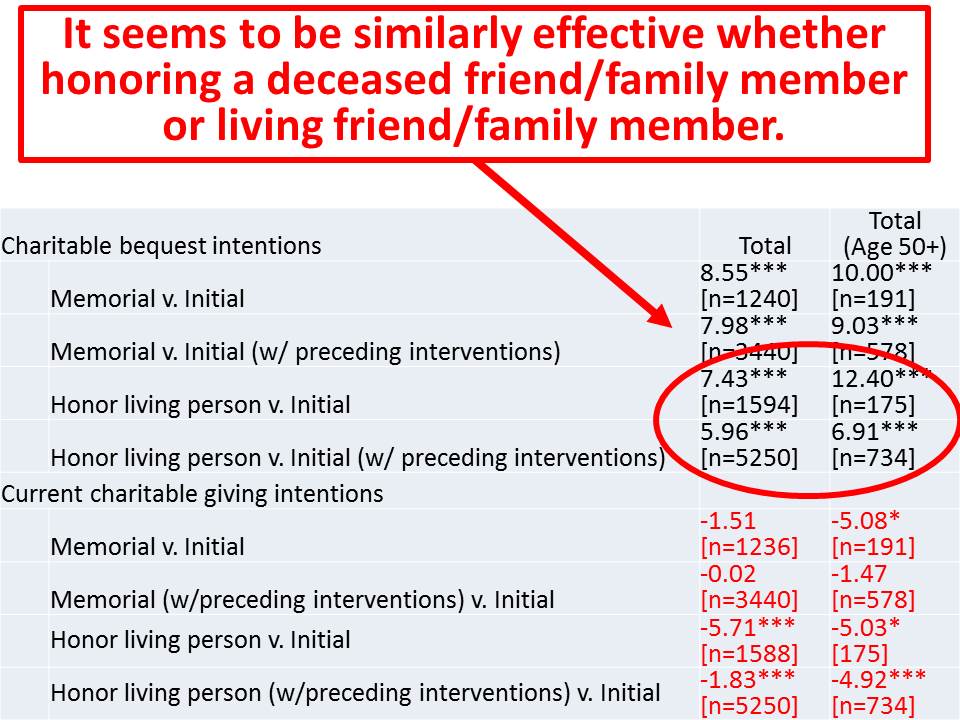
The next group of results comes from the same set of reminders, but this time directed towards living friends or family members. Taken together, the results appear to show that honoring a living person was roughly as effective as honoring a deceased person. For the group receiving no other marketing interventions, honoring a living person increased bequest intentions slightly less (+7.43 points) than did the memorial reminders (+8.55 points). However, among those over 50, the effect was stronger for living person reminders (+12.40) than for memorial reminders (+10.00). Among those who had received previous marketing messages, the effect was slightly weaker for honoring a living person than for memorial gifts in both age categories. To the extent that honoring a living person was a weaker intervention, the differences were quite small. However, given our mixed results here, it appears the two interventions were approximately equal in their effects.
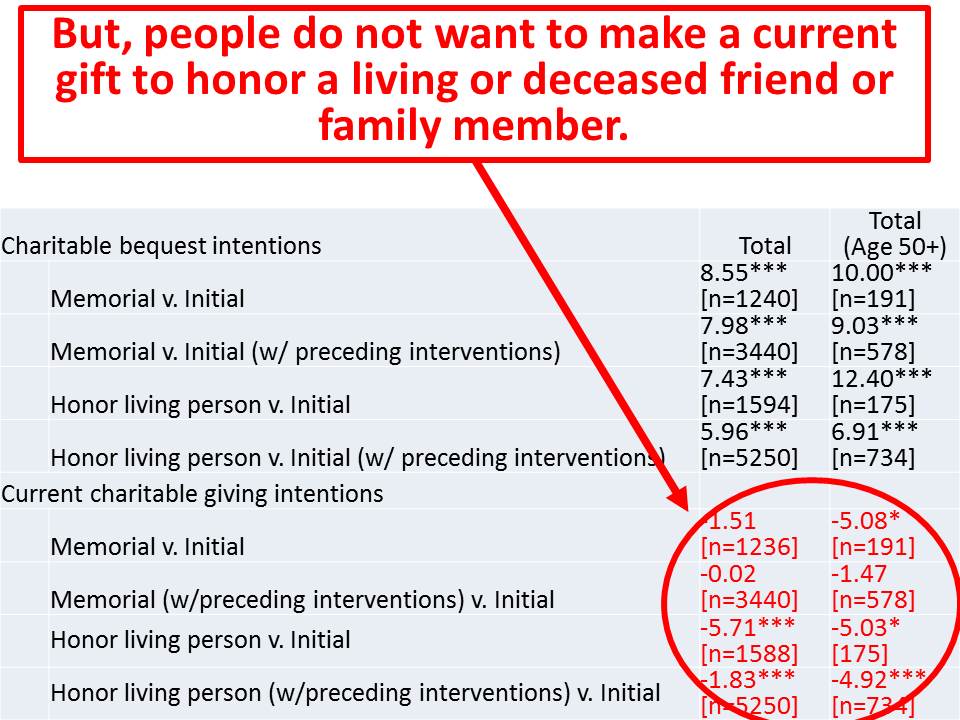
In contrast with the universally strong positive results on charitable bequest intentions for tribute purposes, we had universally negative results from suggesting that people make a current gift to honor a living or deceased friend or family member. This does not suggest that the reminder reduces the desire to make current gifts for other purposes, only that individuals are not interested in making current gifts for the purpose of honoring a living or deceased friend or family member. So the identical intervention works exceedingly well for bequest giving and exceedingly poorly for current giving.
This is once again another example of how bequest giving is fundamentally a different animal than current giving. This might be explained by cultural differences that support the use of independently created bequest gifts for these kinds of tributes, but expect that current gifts for tribute purposes be initiated by someone else (such as at the request of a close family member of the decedent or honoree).
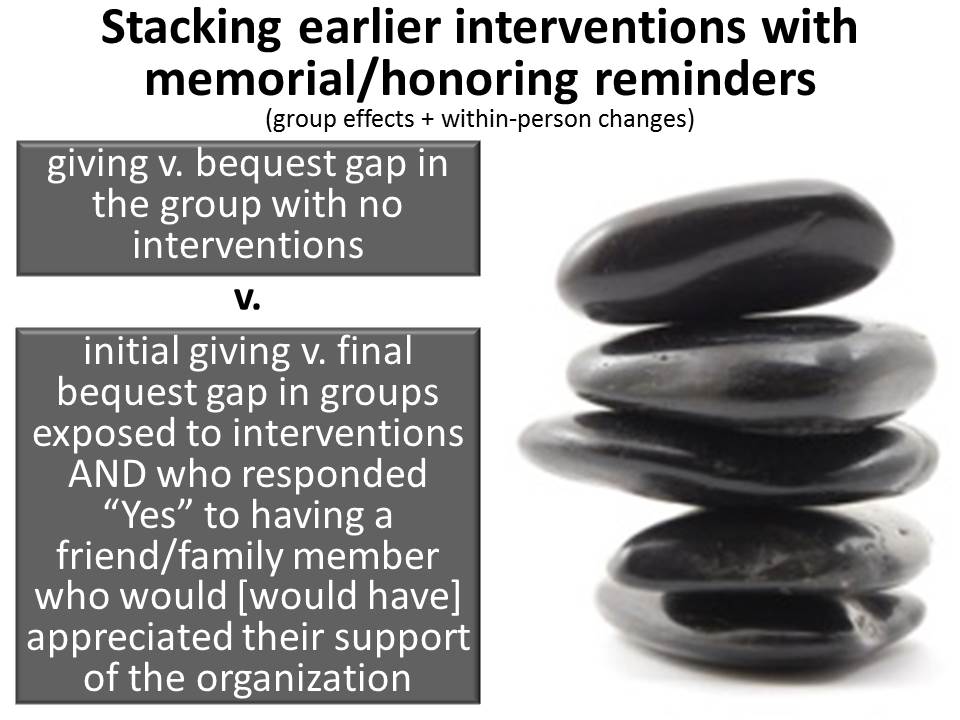
The last analysis of this section looks at the possibility of stacking a series of interventions together. In particular, we want to look at the combined effects of first applying the marketing message interventions (which apply to charitable bequest decision-making in general) and then adding to this general marketing intervention the reminder of a friend or family member who would appreciate (or would have appreciated) the support and asking about interest in a tribute bequest gift. Learning whether or not messages can be stacked is important. If a series of positive results from different messages cannot be stacked, it means we have multiple avenues to get the same result. Although it is helpful to know that we have multiple avenues to get to the same result, it is not as powerful as learning that certain techniques, when placed together, can have an even larger effect than when used alone. If techniques can be successfully stacked, then we can get even closer to eliminating the gap between bequest gift intentions and current gift intentions. But if the techniques cannot be stacked then we simply have different ways to produce approximately the same reduction in the gap.
However, in this case, examining the combined effect is made more difficult because we are combining two types of measurements. On the one hand, we are examining a comparison across groups (inter-person differences). The initial marketing interventions compare differences between a group that had received the marketing intervention and a group that had not received the intervention. On the other hand, the tribute reminders compare individuals’ prior answers with their subsequent answers. This examines within-person changes (intra-person differences) rather than cross group differences (inter-person differences).
To combine both of these interventions requires comparing the tribute bequest gift intentions with the current giving intentions acquired prior to either the marketing interventions or the tribute reminder. This is the gap between pre-existing current giving intentions and ultimate bequest giving intentions after two marketing interventions and the tribute reminder were applied. Finally, we compare that gap to the giving-bequest gap that existed for the group where no interventions were applied.
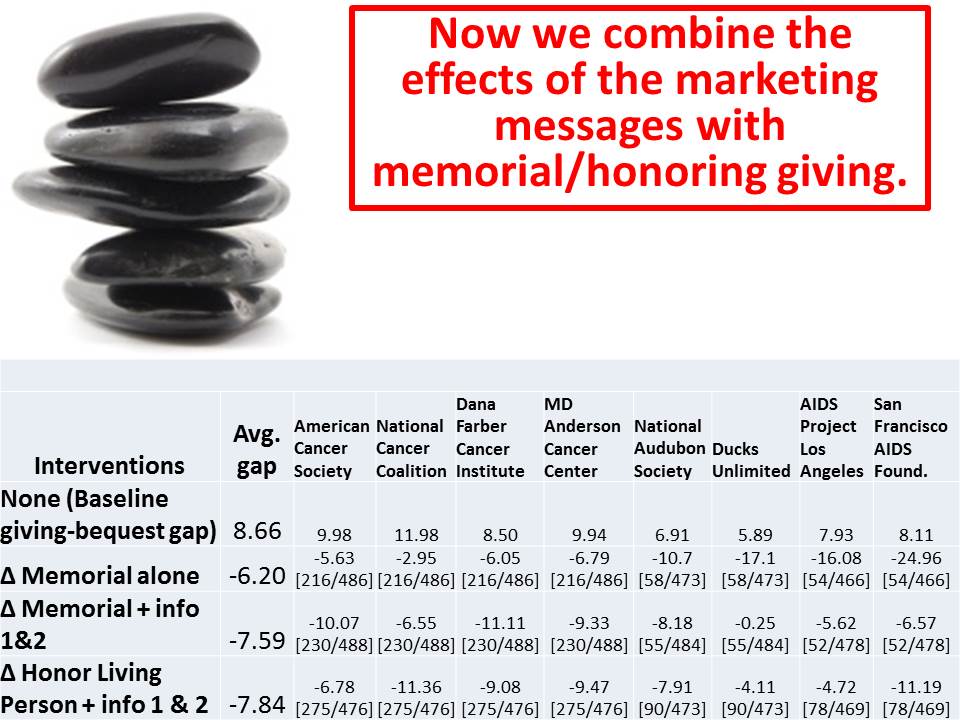
The ultimate goal of this section is to examine the combined effects of the marketing messages with the opportunity to engage in memorial or honoring bequest giving.
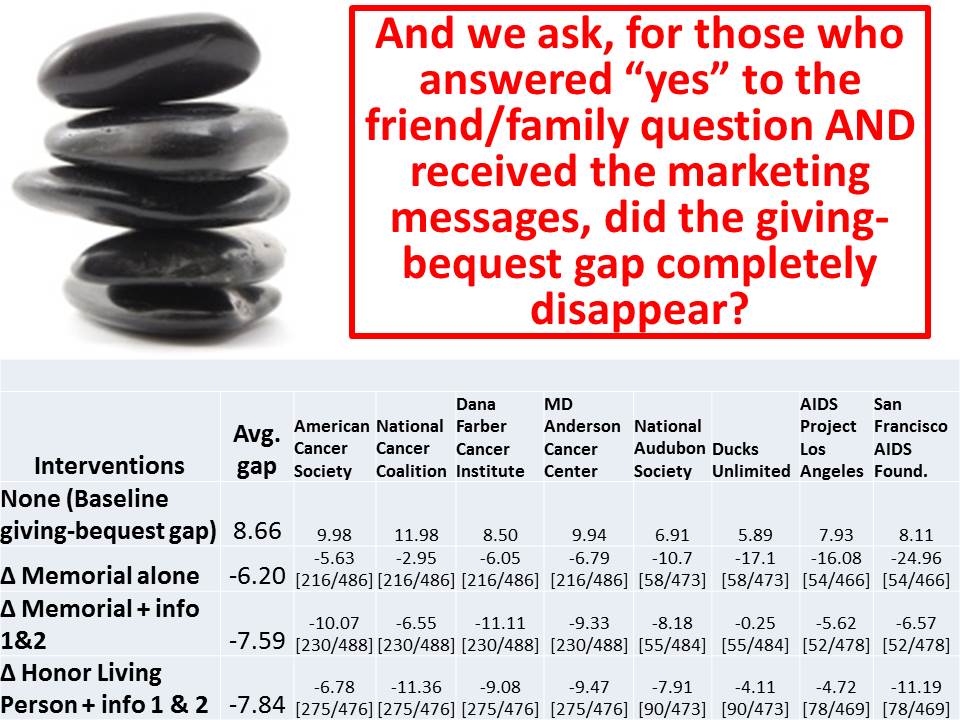
Specifically, we want to know for the group that answered “yes” to having a friend or family member (either alive or deceased) who would have appreciated their support of a particular type of organization, whether or not the giving-bequest gap would disappear completely. Note, this would not mean the gap would disappear completely for all individuals. Instead, it tests whether or not the gap disappears for those individuals agreeing that they have a friend or family member who would appreciate (or would have appreciated) their support for the organization.
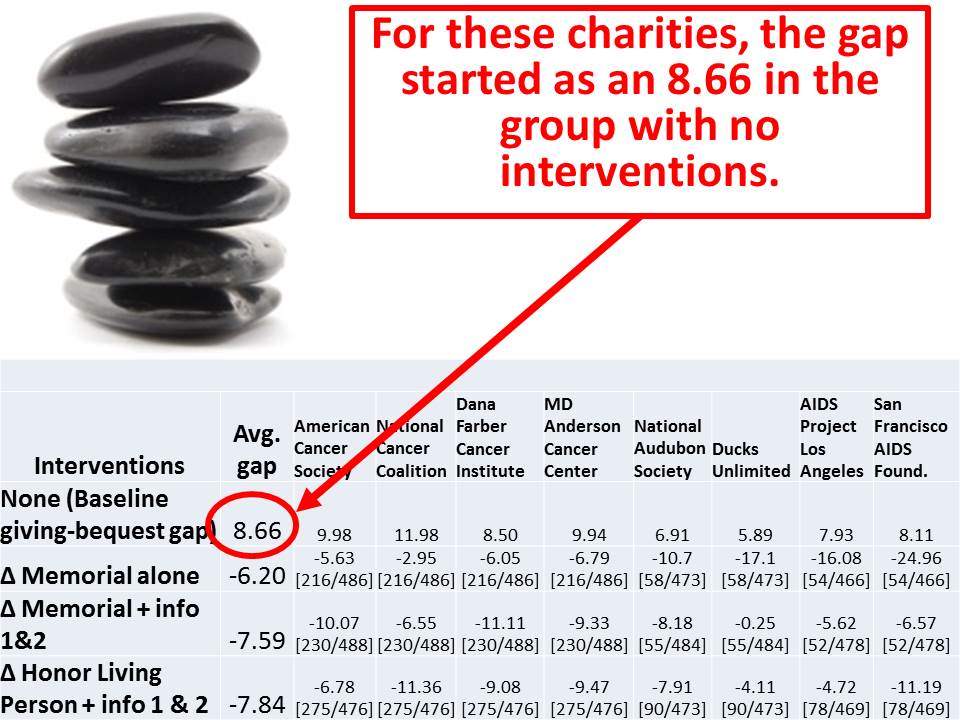
Because of the complexity of stacking these kinds of interventions, we were not able to use every single combination of interventions with every nonprofit organization. Consequently, different intervention combinations were used for different organizations. The tables in this section show which organizations were used for the different types of interventions. As a result, the baseline giving-bequest intention gap will differ across organizations because the individual organizations examined will differ.
In our first set of results, the above circle highlights that this group of charities had a combined giving-bequest intention gap that averaged 8.66 when there were no interventions. The table above also shows these gaps for each individual organization involved. This is the baseline gap, as it is the gap when no marketing interventions and no memorial or honoring reminders were given.
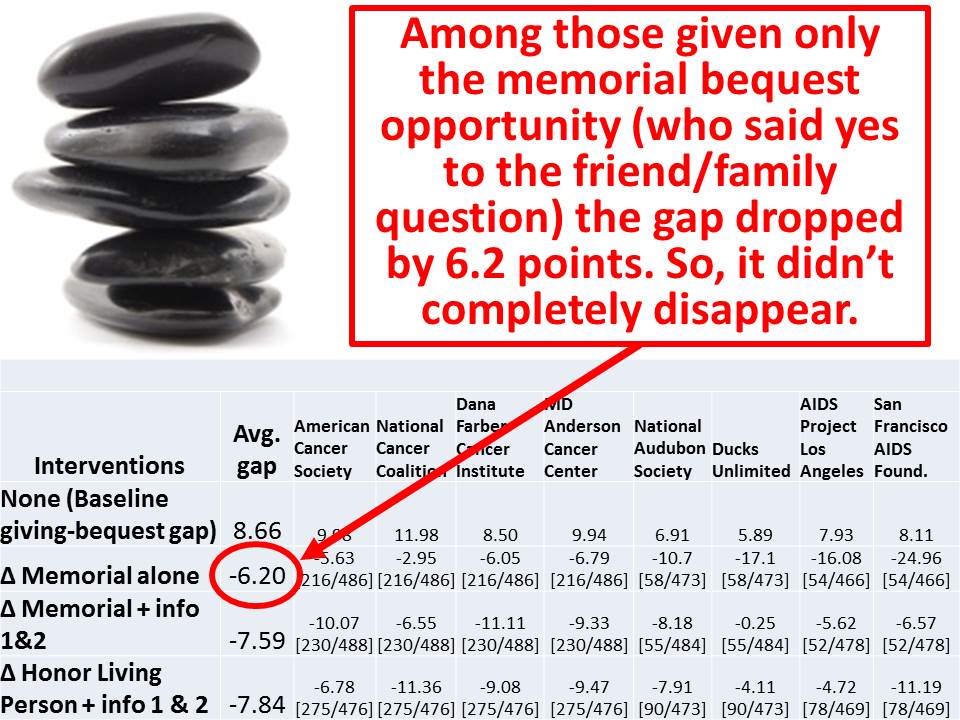
The next row down reports the impact of the memorial reminders on the giving-bequest gap for those individuals who received no other marketing interventions. For these individuals, the giving-bequest gap dropped by 6.20 points. This was a substantial drop, but did not completely eliminate the initial giving-bequest gap, which was 8.66 points.
The numbers in the bottom three rows report the difference between the baseline gap and the experimental treatment gap. In other words, they report the difference in the giving-bequest gaps as compared with that seen in individuals who had no interventions. (The corresponding numbers for each organization report these results separately for the individual nonprofits tested.)
In brackets is the number of people who responded “yes” to the question regarding whether or not they had a friend or family member who would or would have appreciated their support of the organization (followed by the total number asked the question). This number is also important because the tribute reminder intervention is only relevant for those individuals reporting the presence of a friend or family member who would appreciate (or would have appreciated) their support for the organization. If there are no friends or family members who would themselves appreciate the support of this organization, then there is no basis for a tribute gift.
For example, in the above table, the cancer-related charities were much more likely to have respondents who indicated they had a friend or family member who would appreciate (or would have appreciated) their support for this type of charitable organization. In row three, 216 out of the 486 individuals asked this question responded positively. In contrast, only 58 of 473 responded positively to this question for the wildlife birds organizations. And only 54 out of 466 responded positively to this question for the AIDS organizations. Thus, while the intervention was phenomenally successful for the AIDS organizations in terms of its impact on those who had a deceased friend or family member who would have appreciated their support (corresponding to a massive -16.08 or -24.96 drop in the giving-bequest gap), this applied to a relatively small percentage of the sample.
Although this smaller audience size limits the impact of this type of intervention for some organizations, this factor may not be particularly limiting when marketing to a group that is already supporting the organization. Even if a relatively small percentage of people have a deceased friend or family member who would have appreciated their support of an AIDS organization among the general population, this percentage is likely to be higher among those who are currently giving to such organizations.
The number reported under the “average gap” heading is not the average across all organizations weighting each organization identically. Rather, it is the per person average across all of these organization types. Consequently, the large effects for the AIDS organization are not weighted as heavily as the effects for the cancer organizations, because the AIDS organizations responses represented a smaller proportion of total responses.
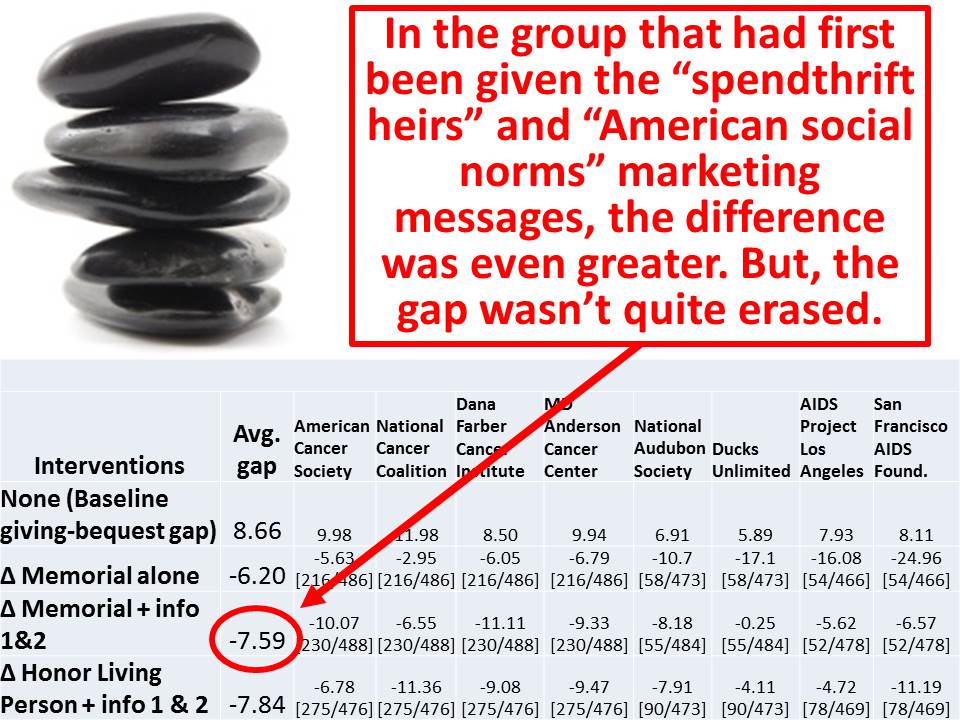
The fourth row reports the first results that combine both general marketing messages with a memorial reminder. In this case, we see that the ultimate gap is smaller but has not been completely erased. This group would have first seen the “spendthrift heirs” marketing messages and then the “American social norms” marketing messages prior to responding positively to the memorial question regarding whether or not they had a deceased friend or family member who would have appreciated their support for this type of organization.
Although the gap does not, on average, completely disappear as the result of the combined intervention, it does completely disappear for certain organizations. For example, the American Cancer Society had a baseline giving-bequest gap of 9.98 points. The gap following both “spendthrift heirs” marketing messages and “American social norms” marketing messages and the memorial reminder was reduced by 10.07 points, meaning that the gap completely disappeared. (In fact, in this case, the final stated willingness to leave a bequest gift was slightly higher than the initial stated willingness to make a current gift, among this subset of respondents.)
In contrast, the combined effect for Ducks Unlimited was minimal, coming in at only a 0.25 point reduction in the giving-bequest gap. Note, however that here we are dealing with an exceedingly small sample, totaling only 55 individuals. Consequently, we shouldn’t put as much trust in the individual organization numbers. (The average gap column reports the per person average across all organization types, not the per organization average. Thus, it gives less weight to the 55 individuals responding positively to the wild birds organization memorial reminder than to the 230 individuals responding positively to the cancer organization memorial reminder.) Note also that each row represents completely separate groups of individuals. The responses from any one individual could not influence more than one row of results, because each row represents a different combination of interventions and organizations that was given to only one particular group.
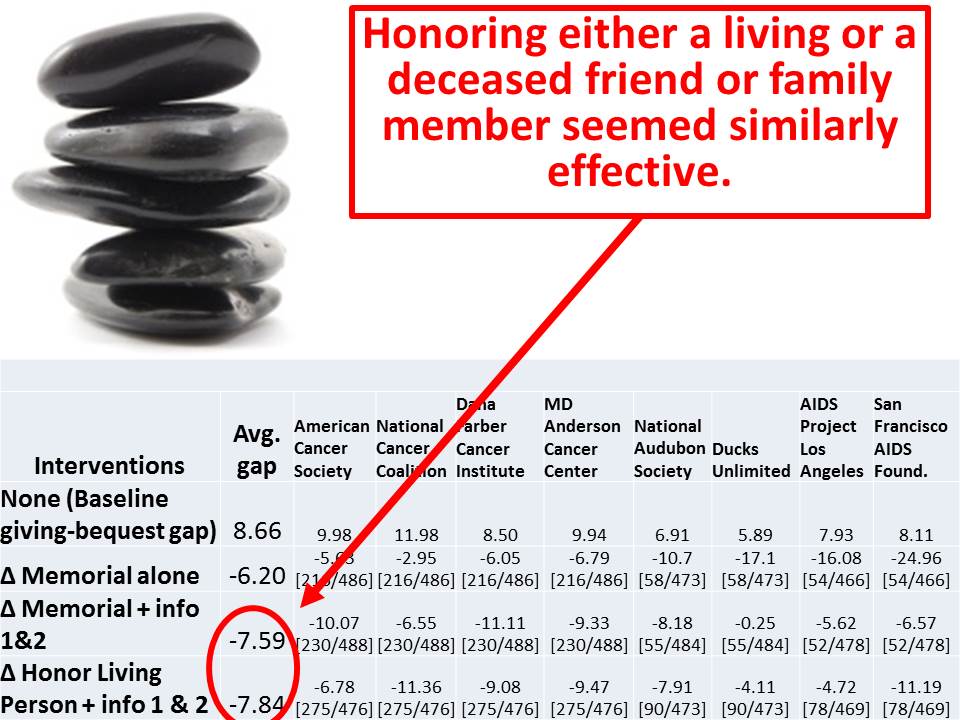
In comparing the results from the memorial gift reminder with the living tribute gift reminder in this table, there appears to be relatively little difference in the average results. This is not a definitive test of these two approaches because, of course, these are presented in combination with other interventions and are used on two different and relatively small groups regarding a subsample of only eight nonprofit organizations.
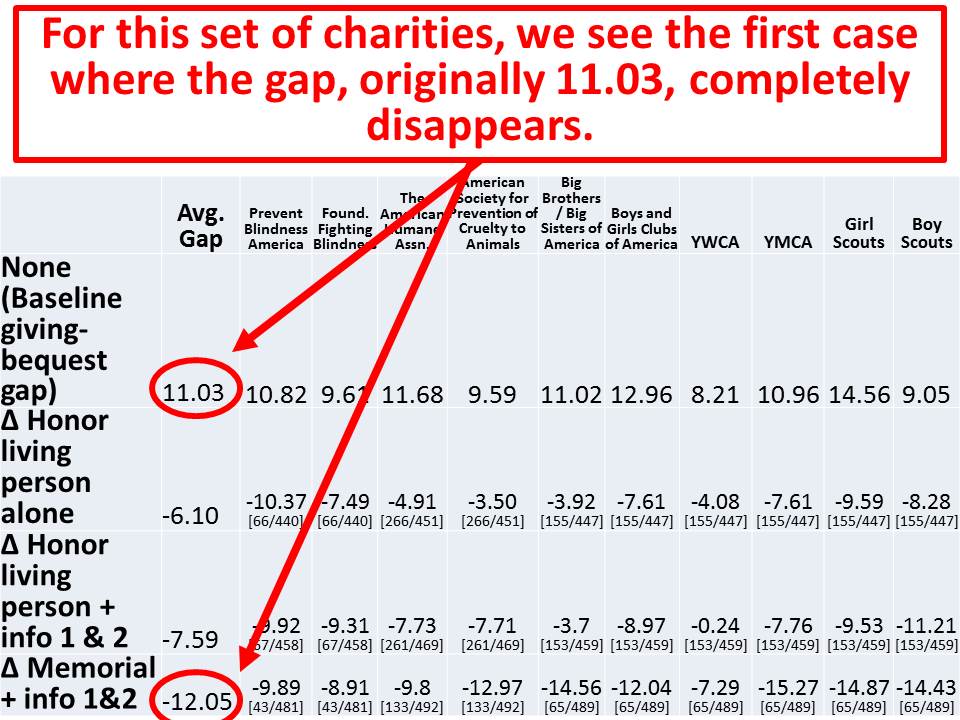
The above set of results presents a different combination of interventions for a different set of nonprofit organizations. We see first that the suggestion to honor a living person by itself reduced the gap by 6.10 points. This was comparable to the gap reduction of 6.20 points for the memorial reminder alone seen in the previous table for a different set of organizations.
However, in comparing the average change in the giving-bequest intention gap reported in the final two rows, we see our first result that clearly differentiates between the memorial intervention and the intervention of honoring a living person. In this case, the memorial reminder when following the “spendthrift heirs” and “American social norms” interventions produced our first example of the complete elimination of the giving-bequest intention gap among a group of charities.
This is encouraging, but it is important to note that the result is based upon a relatively small number of total observations because none of the charitable organizations in this particular set had a relatively large number of individuals reporting the presence of a deceased friend or family member who would have appreciated their support of the organization. Consequently, we should be more hesitant to have a high level of confidence in this particular result. But, it is both the first result to show complete elimination of the intention gap and the first to show a much stronger effect for memorial bequest gifts than living tribute bequest gifts.
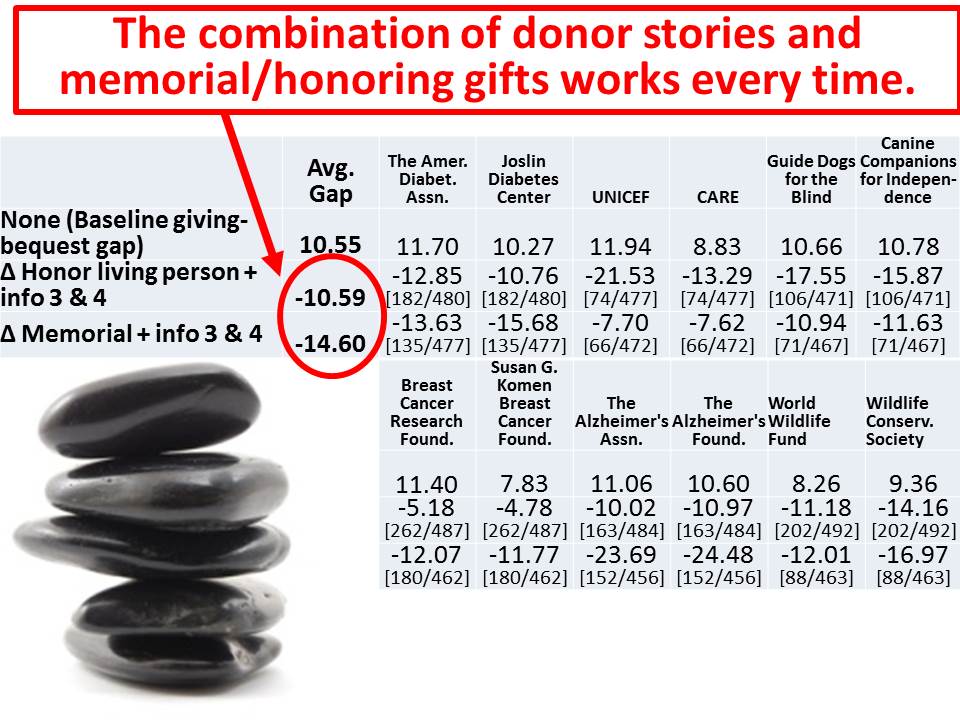
In the above table, we finally start to see a consistent disappearance of the giving-bequest gap following combined interventions. This is the first table to show the combined impact of the tribute reminders and the “life story” marketing messages. Of course, this result corresponds with the previous findings that the life story interventions were the most powerful general marketing interventions. But it also shows us that these more powerful marketing interventions can be successfully stacked with a memorial or tribute reminder to produce tremendous results. When the “life story” interventions were combined with either living tribute or deceased memorial reminders they completely eliminated the giving-bequest intention gap for this subsample of individuals.
Once again, the memorial reminders were more successful than the living tribute reminders, although both completely eliminated the giving-bequest intention gap. The combination of “life story” marketing messages and memorial reminders completely eliminated the giving-bequest intention gap not just overall, but individually for 10 of the 13 organizations tested. This is a powerful result, suggesting just how effective this combination can be for a segment of the population. It is also dramatic to see the magnitude of the result created for the Alzheimer’s related organizations. In those cases, the approximately 11 point gap dropped by roughly 24 points. Along with the previous results regarding the AIDS organizations, this suggests that there are certain causes, particularly related to fatal diseases, where such memorial giving reminders can have an unusually large impact.
Taken together, these results are quite encouraging. In this experimental setting, it was possible to completely eliminate the gap between charitable giving intentions and bequest giving intentions, at least for those individuals who indicated that they had either a living or deceased friend or family member who would have appreciated their support for the organization. Of course, this is only an experimental setting and even after changing intentions, it is still necessary to convert those intentions into actual actions. But, this experimental result is still tremendously exciting. It suggests that the core problem of a giving-bequest intention can not only be influenced, but can be completely eliminated for certain groups. The ability to stack certain types of interventions suggests the importance of multiple simultaneous messaging on this topic.
As a technical aside, several factors suggest that these experimental results are showing something other than simple social acceptability bias. To begin with, we are examining the gap between different kinds of socially acceptable behavior. If an individual respondent had a tendency to overstate their pro-social intentions, this generalized tendency would not necessarily influence our results, because we are comparing only the difference in stated intentions for two different types of pro-social activities.
Another contrary argument would be that we were seeing merely an effect of the intervention exclusively because of the intervention’s ability to communicate the socially desirable nature of the behavior. This would require the assumption that support of nonprofit organizations through charitable bequest giving was not previously perceived to be a socially desirable behavior. Even if one were to accept that assumption and claim that the interventions worked exclusively through the ability to communicate the socially desirable nature of the behavior, this would still reflect positively on the intervention as an effective tool to influence intentions. Further, seeing the cumulative impact of multiple interventions, especially the within-person changes from the memorial/tribute interventions which followed marketing interventions, suggests that something other than the respondents’ desire to answer in accordance with the investigator’s intentions is at work here. This is because the investigator’s intentions would be clearly indicated by the first set of marketing interventions. The subsequent impact of memorial reminders could not be explained as the result simply of respondents desiring to answer in accordance with the investigator’s intentions, which were fully revealed prior to the comparison set of bequest questions. All of these factors combine to suggest that there is true underlying validity to the results demonstrated in this chapter, even given the reality that these are results from an experimental setting using survey methodology.
The “take home” message resulting from all of these experimental results is that the two most powerful types of interventions were (1) bequest giving to honor a deceased or living friend or family member, and (2) stories about deceased or living bequest donors making a lasting impact. In addition, these interventions, in combination, were consistently powerful enough to completely eliminate the giving-bequest intention gap. It is also worth noting that both of these interventions also corresponded with the previously discussed neuroimaging findings regarding how people engage in bequest decision-making.