We now consider the second-stage defense against mortality salience, which I will label using the title of “symbolic immortality.”
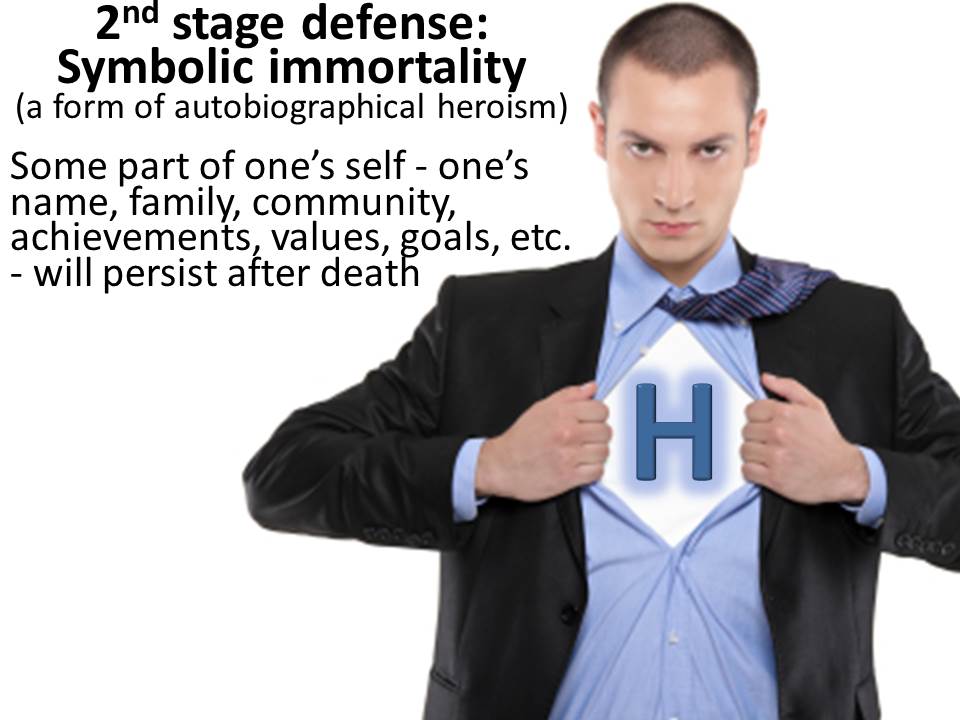
The second-stage defense to mortality reminders can be thought of as an attempt to achieve symbolic immortality. The idea of symbolic immortality is that some part of one’s self – one’s name, family, community, achievements, values, goals, etc. – will persist after death. Mortality salience is an attack on our psychological selves. As a defense to that attack, we can focus on those parts of “ourselves” that are not mortal. To the extent that some part of “us” is not mortal, this can act as a perfect defense to the psychological crises that may result from contemplating our own finiteness. How then is this “symbolic immortality” constructed? We now turn to this question.
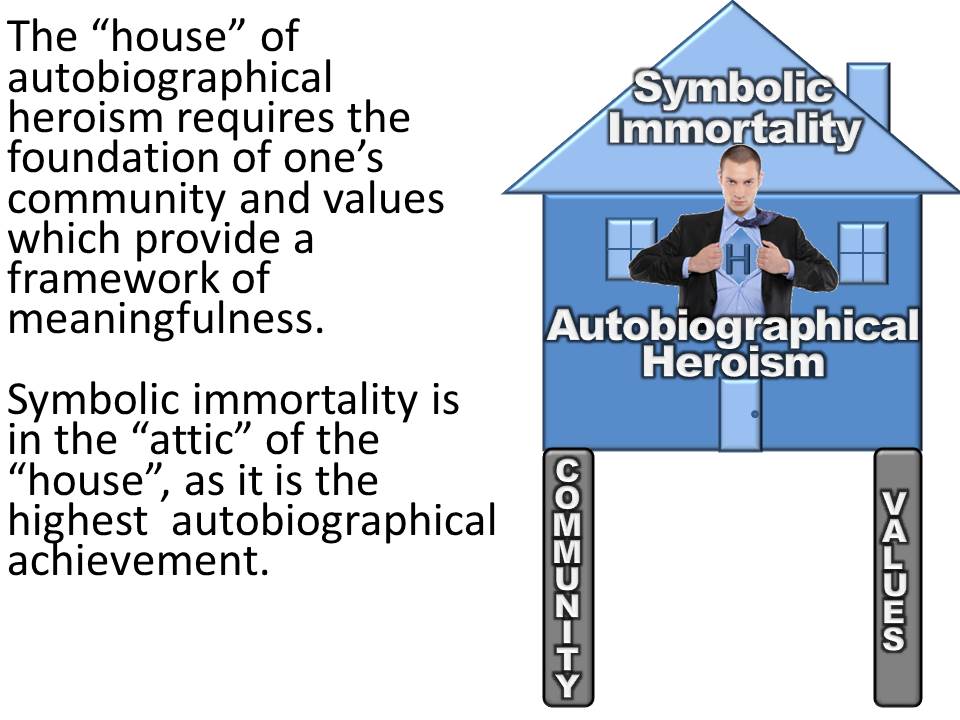
The psychological construct which we will refer to as “symbolic immortality” can best be thought of in terms of the above graphical representation. (For those who wish to go beyond this representation and interact with the more involved, sophisticated, and convoluted dimensions of the various psychological theories, I recommend to your reading Otto Rank, Ernest Becker, and the modern researchers in “terror management theory,” which can be readily obtained by searching for that term in Google Scholar.) The core idea conveyed by the above image is that symbolic immortality is not a simple construct. Instead, it is better to think of it as the attic or the top of a construction. This construction, like a house, depends upon the connection with and strength of its foundations.
Symbolic immortality may be thought of as the most extreme or highest example of autobiographical heroism. Autobiographical heroism is the idea that we like to see ourselves as having positive and meaningful lives as reflected by our life stories. The greatest example of autobiographical heroism is the hero story that lives beyond the life of the hero and becomes a permanent, meaningful story within the culture of the community.
However, this idea of symbolic immortality requires a social foundation. It is not something we can construct on our own. Think, for example, of a scenario where you are on a deserted island with certain knowledge that no one would ever find you and that at the end of 20 years, you, and the island itself, would be completely destroyed and submerged into the sea as the result of a volcanic eruption. Within that framework – within that reality – it is very difficult to contemplate achieving symbolic immortality. It is difficult to imagine accomplishing something that would live beyond your own life. This is because achieving any element of symbolic immortality, at least on this earth, requires a community of others who will live on beyond your death.
It is only in the continuing existence of the community that we can achieve a measure of symbolic immortality. Although each of us will die, the community will live on. To the extent that we are able to influence our community that lives beyond us, we are then able to achieve a measure of symbolic immortality. In the same way, autobiographical heroism cannot live beyond one’s death if no one else knows the story.
Thus, symbolic immortality, or any form of autobiographical heroism that will live beyond the individual’s death, requires a community. And it is the values of this community that provide the underlying framework that defines meaningfulness. In the absence of meaningfulness, there can be no such thing as heroism. If we engage in what we perceive to be autobiographical heroism, but there is no community that will hear of our story, no community which shares the constructs of meaningfulness that define our life in heroic terms, then our self-perceived heroism cannot live beyond our own death. Thus, fundamentally, in order to achieve symbolic immortality, or any modicum of autobiographical heroism that will live beyond ourselves, we must rely exclusively upon the foundation of our community and community values.
It is important to understand that the term “community” here refers only to another person or group of people. It may refer to one’s friends, or one’s family, or one’s colleagues, or those with similar interests or similar backgrounds or similar affiliations or similar ethnicity. It may ultimately refer to any group of people that one considers to be one’s community. The community here consists of those considered to be an audience of importance by the person. Thus, in this context, community does not necessarily refer to one’s neighborhood, municipality, or nation. (However, for many people this does define a highly relevant community.) And so it is upon the basis of this community, however we define it, that our hopes for symbolic immortality must rest.
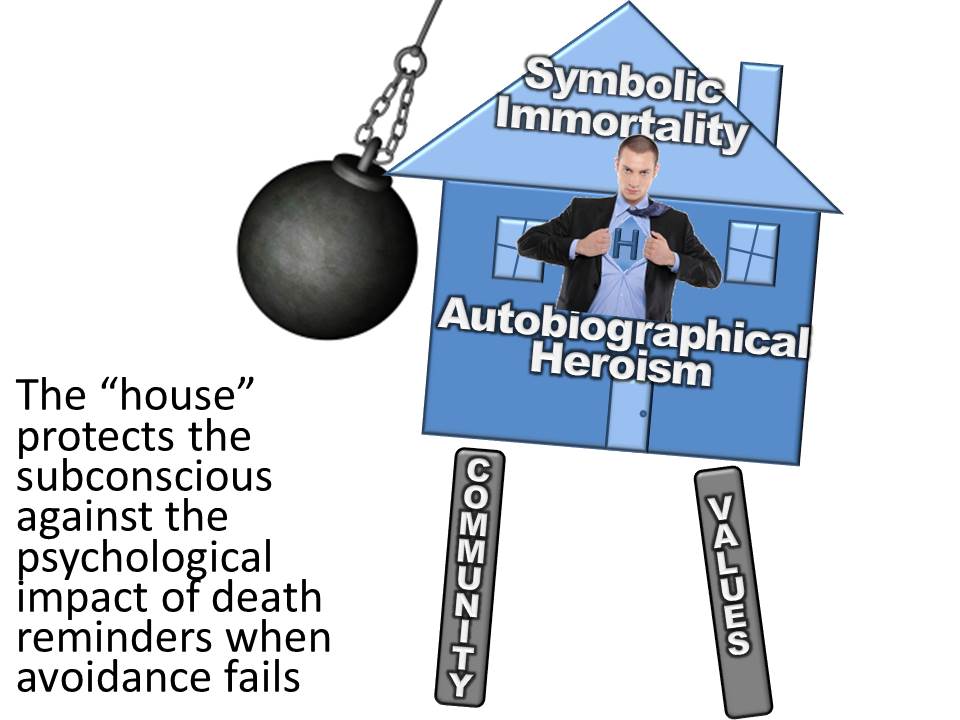
Although we may be able to think about the social structures underlying our life story and meaning at any point, their relevance becomes critical when we are faced with the psychological impact of personal mortality reminders. In other words, this “house” of autobiographical heroism and symbolic immortality is like a wall of defense protecting the psychological self or ego. When we are faced with an unavoidable death reminder, that reminder acts as a wrecking ball attempting to damage our sense of psychological self. It attacks the very core of our value and meaningfulness by reminding us of our ultimate and impending finiteness. The house of symbolic immortality and autobiographical heroism can serve as a shield against this painful attack. And, so it is in the face of these death reminders that this defense becomes so critical and so important to our psychological well-being. These issues, while formerly they may have been simply in our subconscious background, become critical issues of immediate importance when we focus on our own personal mortality.

Thus, a death reminder results in a greater attachment to and support of these defenses. When the ego is attacked, the response is to build up the defenses to protect against these attacks.
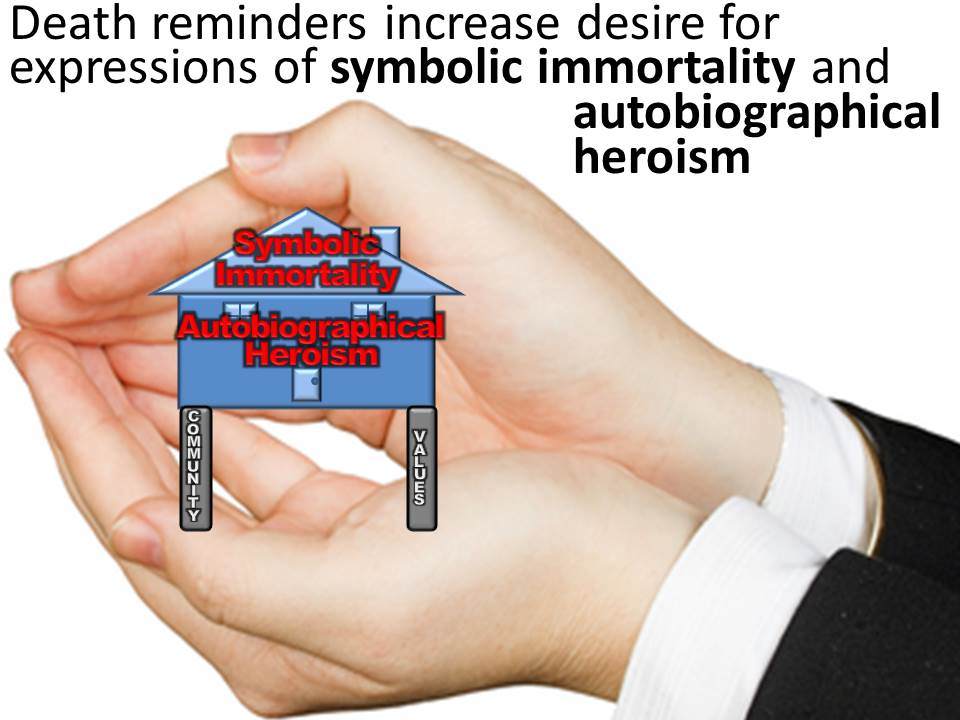
Because of this defensive reaction, we expect that death reminders will increase the desire for expressions of symbolic immortality and autobiographical heroism based upon the foundation of our community and the values shared with the community. So let’s now set aside, for a moment, the pure pontification of psychological theorizing and turn instead to real experimental results that demonstrate exactly how mortality salience changes the behavior, preferences, and choices of human beings.
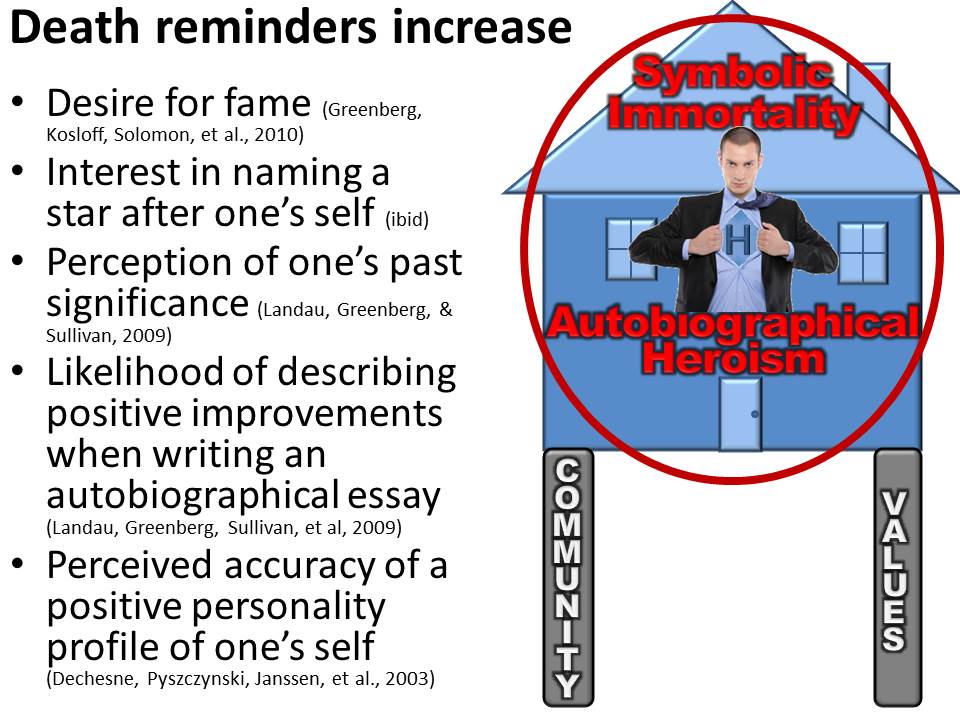
Let’s begin at the top half of the “house” by looking first at symbolic immortality and autobiographical heroism. How do psychology experiments measure what happens as the result of mortality salience? The typical experimental approach is to begin with two groups. One of the groups, prior to answering some outcome questions, is reminded of their personal mortality. The other group does not receive reminders of their personal mortality, but instead completes some other task unrelated to personal mortality. (Typically this control task is something that might also be considered aversive, such as, for example, answering questions about dental pain.) After this initial set of mortality reminders or some comparable non-mortality activity, both groups are then asked the same set of questions. Alternatively, responses can be compared within the same people, both before and after reminders of mortality.
These reminders of mortality can vary from experiment to experiment, but could include issues such as describing one’s funeral, eliciting opinions about death, decay, and burial or reading about tragic and death-related scenarios. However, for our purposes we will put all of them under the simple heading of “death reminders.” So let’s review some of the results. How do death reminders change people’s desires and behaviors?
To begin with, death reminders have been shown to increase people’s desire for fame. As a particularly interesting example of this, death reminders have been shown to increase people’s interest in having a star named after them. (In case you are interested, this is something you can get on the Internet and pay to do at websites such as www.starregistry.com. There are many, many stars, so there is no risk of running out of stars to take people’s names.) These two examples: an increasing desire for fame and an increasing interest in naming a star after oneself are closely related to the idea of living beyond one’s own lifetime in the memories of others. We can achieve symbolic immortality by being famous, or by having, for all eternity, a star with our own name attached to it.
Death reminders also increased people’s tendency towards autobiographical heroism. For example, death reminders increased the perception of one’s past significance. Death reminders also increased the likelihood of describing positive improvements throughout one’s life when writing an autobiographical essay. (This is most clearly a measurement of increased autobiographical heroism in the sense that it shows an increased likelihood of writing a heroic, or at least positive, life story about one’s self.) Additionally, death reminders increased the perceived accuracy of a positive personality profile of oneself. When people were given a positive assessment of their own personality profile and asked to measure the accuracy of that assessment, being reminded of one’s own mortality prior to this task increased the likelihood that a person would perceive the positive personality profile as being accurate. Again, this relates to the increased desire for a positive life story or what we might call, in more colorful language, autobiographical heroism.
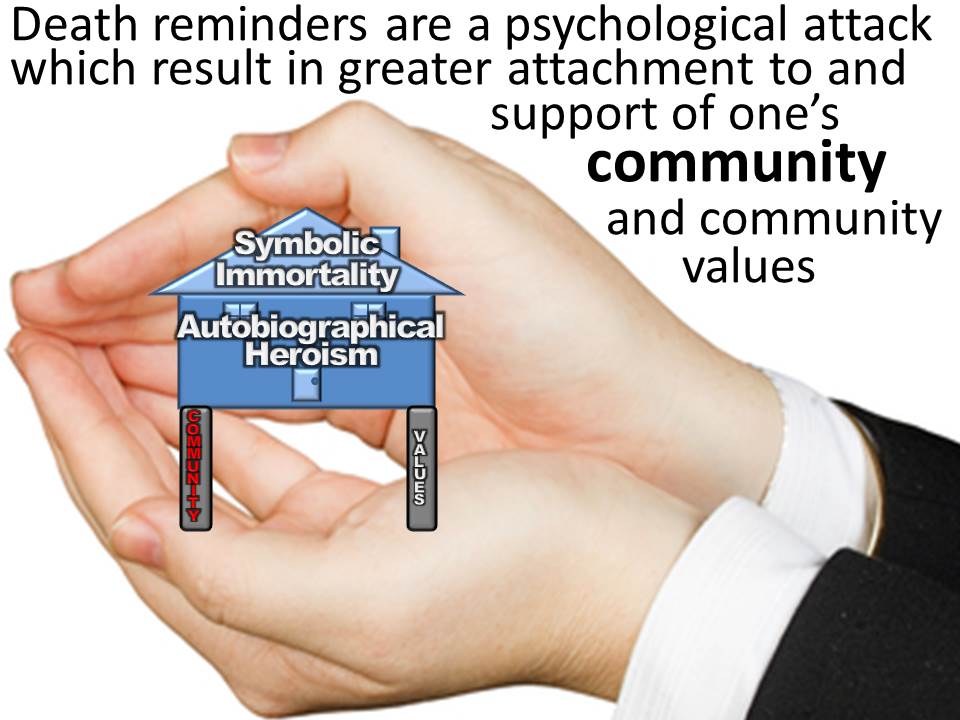
As stated before, death reminders are a psychological attack on the self. This attack results in defense and support of our defensive construct referred to as symbolic immortality. For the reasons described previously, symbolic immortality, and even autobiographical heroism that will live beyond one’s own life, is dependent upon the foundation of one’s community and the community’s values. Consequently, the defense of one’s symbolic immortality “house” requires a defense and support of the foundations of the community and community values. Examples of this heightened defense of one’s community and community values can be seen in a wide variety of experimental results.
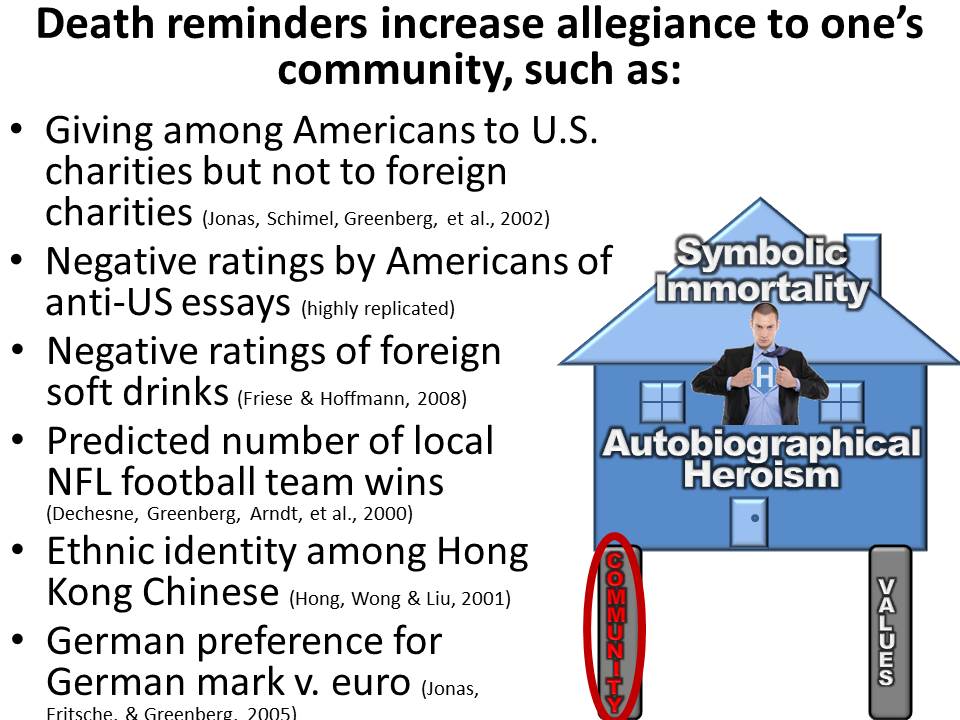
A variety of results from many different countries repeatedly support the notion that death reminders increase allegiance to one’s community and community values. For example, death reminders increased giving among Americans to US charities, but they did not increase giving among Americans to foreign charities. This differential result on domestic versus foreign suggests that death reminders have a unique impact related to our own community (“in group”). In another study where American participants were asked to rate the content and quality of anti-United States essays, those who had experienced death reminders first gave much more negative ratings to the essays than those who had not. This suggests that a death reminder increases the allegiance to one’s national community. At the same time, it increases resistance to those who would attack one’s community. We refer to this as a defense of the “in group” and a simultaneous resistance to the “out group.” Thus, death reminders make us simultaneously more pro-social and anti-social. We become much more pro-social for our “in group” while we become more antisocial for our “out group.”
This “in group” allegiance can take forms that are both humorous and frightening. For example, a study in the U.S. showed that death reminders increased the predicted number of wins that the local NFL football team would have in the following season. Thus, people became more supportive of their “in group” team, and simultaneously less enamored with any “out group” teams. Similarly, death reminders increased the negative ratings of foreign soft drinks. As a somewhat humorous side effect of this “out group” resistance, people apparently decided that their taste buds were also more nationalistic following mortality reminders. These results are by no means limited to those in the United States. For example, one study showed that mortality reminders increased the ethnic identity among Hong Kong Chinese. Similarly, mortality reminders increased the German preference for the German mark currency as compared with the euro currency.
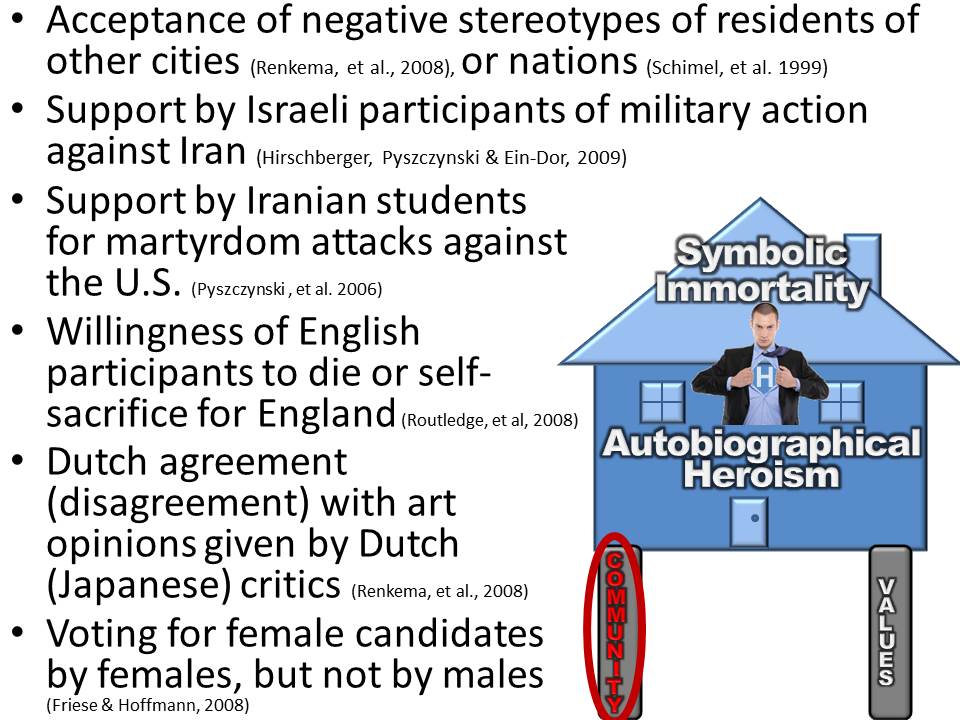
In these additional examples of the in-group/out-group effects of mortality salience, we continue to see consistent results. Mortality salience increased the acceptance of negative stereotypes of residents of other cities or other nations. This serves as another example of out-group resistance increasing along with in-group support.
Such reactions can be important in the more serious context of international conflict. For example, mortality reminders increased the support by Israelis of military action against Iran. Conversely, it increased the support by Iranian students for martyrdom attacks against the United States. In a British context, death reminders increased the willingness of English participants to die or otherwise self-sacrifice for England. Notice here as elsewhere, we are seeing examples where a support of the foundations of symbolic immortality is powerful enough to actually lead to decisions that increase or ensure the possibility of personal mortality. However, in a sense, the fear of personal mortality has been overcome by the defense of symbolic immortality.
In other, less hostile, contexts we see more examples of this same behavior. For example, following mortality salience, Dutch participants increased their agreement with art opinions given by Dutch critics while simultaneously decreasing their agreement with art opinions given by Japanese (“out group”) critics. In the context of gender community, mortality salience increased voting for female candidates by females, but did not have the same effect on males.
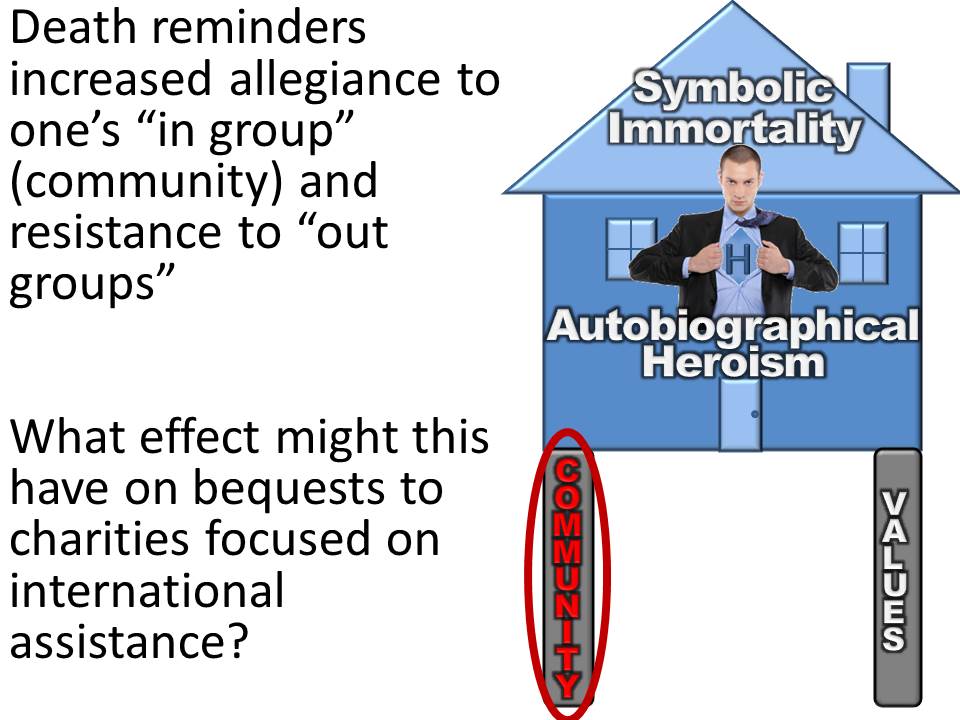
To summarize this group of findings, and a wide range of other findings not reported here, we can confidently say that death reminders increase allegiance to one’s “in groups” and simultaneously increase resistance to one’s “out-groups”. Is it possible that we might be able to directly see the effects of this in a comparison of current giving and bequest giving? Can we differentiate preferred methods of giving dependent upon the charities’ domestic or international focus? Although we do not have this kind of data for the United States, there is data in the United Kingdom allowing these types of comparisons. Caritas Data, in collaboration with the Cass Business School (City University London) and professor Cathy Pharoah, publishes this data in their Charity Market Monitor. In the following, we examine results compiled from their 2010 Charity Market Monitor.
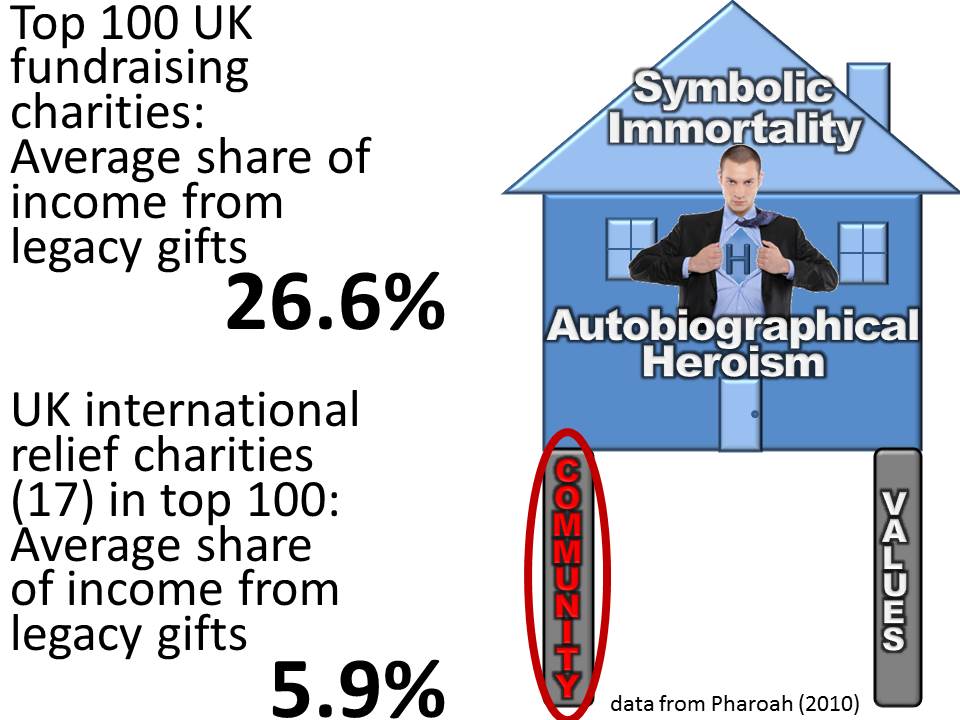
Because the data from Prof. Pharaoh’s research includes reports of both current and legacy gifts, we are able to compare the relative importance of these gifts for different charities. Looking just at the top 100 UK fundraising charities, i.e., those charities that raised the most total amount of money, we see a distinction among charities focused on international relief. The average share of income from legacy gifts among the top 100 UK fundraising charities was 26.6%. In contrast, the average share of income from legacy gifts among those UK international relief charities in the top 100 was only 5.9%. This does not suggest that international relief charities are not popular. Indeed 17 of the top 100 UK fundraising charities were international relief charities. People obviously support these charities with massive amounts of total donations. However, what is interesting for our purposes is that it appears there is a preference to support these charities with current dollars, but not bequest dollars. This is consistent with the idea that mortality salience increases the support for one’s own community and simultaneously decreases the support for outside groups.
Although this tends to confirm the basic ideas from the psychological model, it is important not to overreact to the results. Neither the psychological model nor the results from the UK suggests that international relief charities should not care about bequest gifts. No doubt the 17 UK international relief charities referenced here would not enjoy seeing a 6% reduction in their gift income that would occur if legacy gifts stopped altogether. Further, the presence of substantial legacy gifts shows that this barrier is not an insurmountable one. But it demonstrates that this psychological model has real, bottom-line impact on charitable fundraising. Furthermore, understanding this underlying model might suggest strategies that could help, ultimately, to overcome these barriers. (One might even imagine making the beneficiaries of international charities so closely connected with donors that they too would become part of the donors “in group.”)
It is certainly possible to object to the prior conclusion based on these giving results by arguing that the distinction in legacy giving relates to the cause of poverty relief in general and not specifically to the international nature of these charities. In response to this, the next set of results uses a more closely aligned comparison.
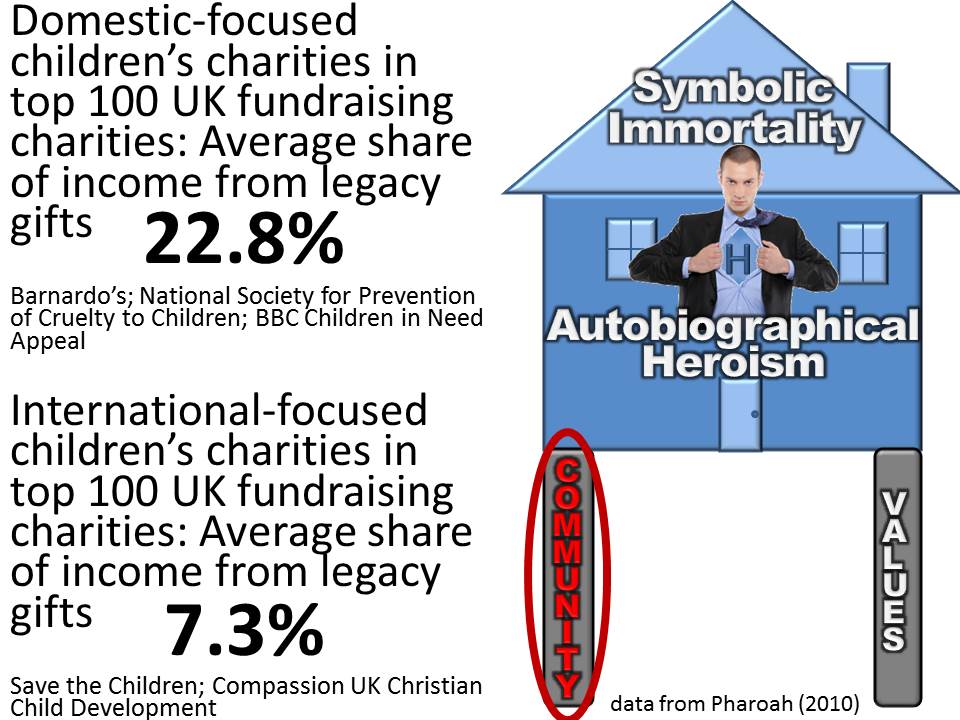
Here we examine charities focused on supporting children and divide those charities into domestic-focused children’s charities and international-focused children’s charity. Here, the comparison is somewhat closer because, in both cases, we are examining charities focused upon supporting children in need. And in the context of this closer comparison, we see a similar contrast.
Among the domestic focused children’s charities in the top 100 of all UK fundraising charities, the average share of income from legacy gifts was 22.8%. The international focused children’s charities received only 7.3% of their gift income from legacy gifts. So we see a similar contrast here between people’s preferences in current giving and legacy giving. Again, the international charities are well supported, being among the top 100 UK fundraisers. However, the preference is to support them with current giving rather than bequest giving. This is consistent with the idea that when we place people in the “mortality salience” frame of mind, they become more likely to support their in-group community and less likely to support an out-group. This is important because it takes the academic and psychological results and demonstrates their impact in real world of giving behavior. Thus, these constructs are not merely fanciful creations of research professors with too much time, but in fact describe human behavior critical to the charitable bequest decision-making process.
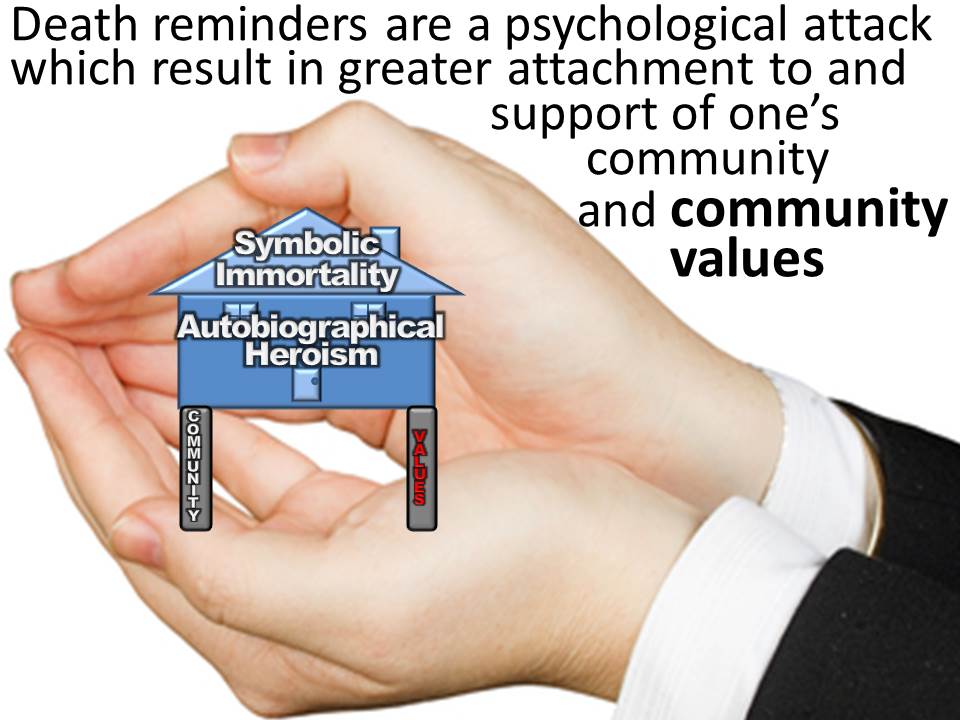
Finally, we see additional results that support the idea that death reminders result in greater attachment to and support of one’s community and also one’s community values. It is not simply the community itself that a person becomes more defensive of in the face of mortality reminders, but it is also the shared values and beliefs of that community that are increasingly defended. As discussed previously, any attempt at a positive or heroic life story that will live beyond oneself depends upon the continued existence of the community and of the community values. It is the community values that provide a framework of meaningfulness that can define what is and is not positive or heroic. Although one can personally have completely independent values to define what is positive or heroic, these individual level values cannot live beyond the death of their holder unless there is a community that also accepts these values. Thus, these community values give meaning to the definition of a positive life story that could survive the death of the individual.
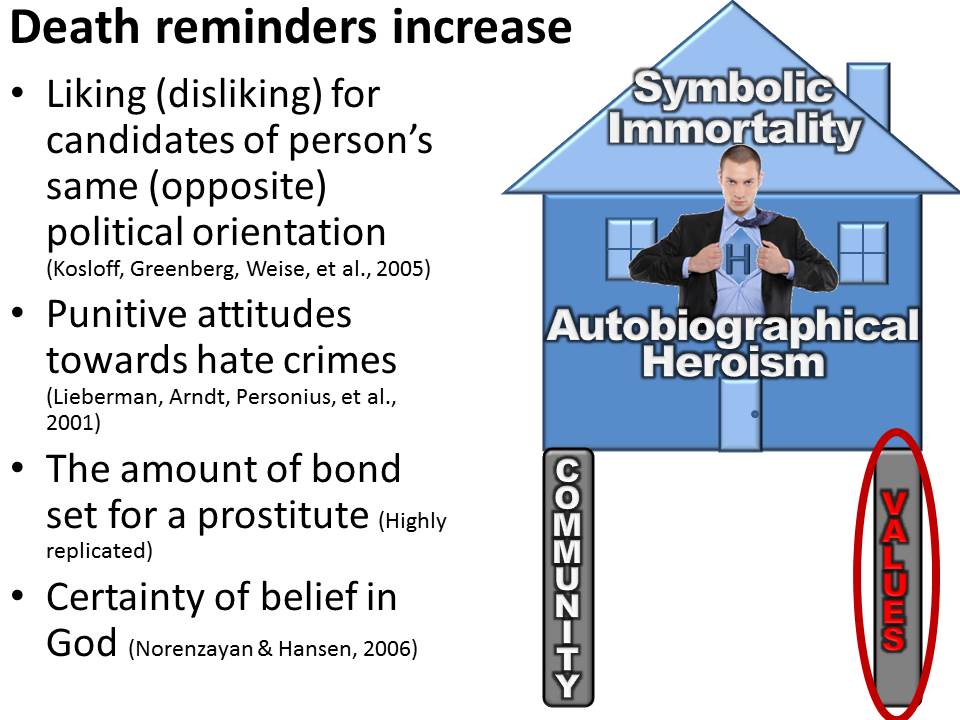
In these results, we see that death reminders increased support for one’s community and community values. For example, death reminders increased participant’s liking and support for candidates of their same political orientation, but also increased disliking for candidates who were not of their same political orientation.
Hate crimes are often seen as moral violations of the community’s values. The amount of punishment attached to these hate crimes increased following death reminders. This again suggests the idea of increasing support and defense of community values as a result of death reminders. Similarly, in a result that has been replicated again and again in a wide range of studies, the dollar level of bond participants set as appropriate for an arrested prostitute has been shown to reliably increase following death reminders. Once again, the conclusion is that support of community values increases following death reminders. Finally, in a religious context, we see that death reminders increased the reported certainty of one’s belief in God.
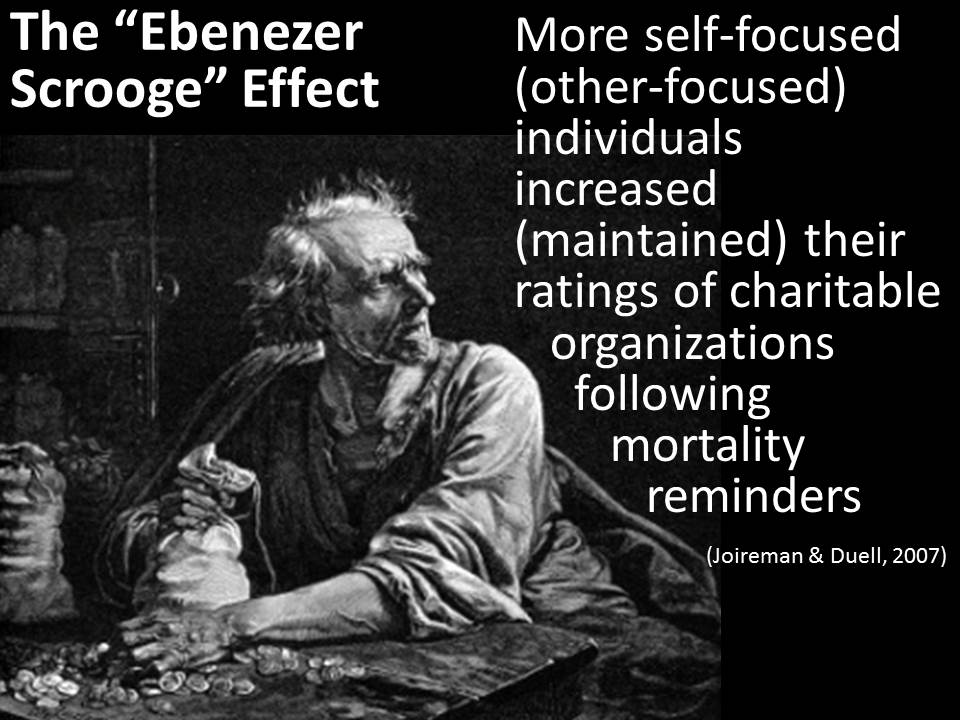
The results of this next study are particularly instructive for those in charitable bequest planning. In 2007 Jeff Joireman and Blythe Duell, both of Washington State University, experimentally found that more self-focused individuals increased their ratings of charitable organizations following mortality reminders. Those who began the experiment being more other-focused maintained their initially higher ratings of charitable organizations in the same context. This led the authors to refer to the “Ebenezer Scrooge” effect. Following the story of Ebenezer Scrooge in A Christmas Carol, the self-focused miser – when faced with his own mortality – becomes charitable.
Aside from supporting the psychological basis for the Scrooge character in a Christmas Carol, this finding has important significance for practitioners in charitable bequest fund raising. It is consistent with the widespread experience of many charities that report receiving substantial bequest gifts from individuals who either supported the charity rarely and minimally, or in many cases never made a gift during life.
In stark terms, it points out the fundamental reality that charitable bequest decision-making is a different animal from current gift decision-making. Decision-making in the context of mortality salience (i.e., estate planning) will produce different results than decision-making in a normal, daily context. Thus, receiving bequest gifts from non-donors is not at all surprising, because one decision context (bequest giving) has high mortality salience and the other decision context (current giving) has no mortality salience.
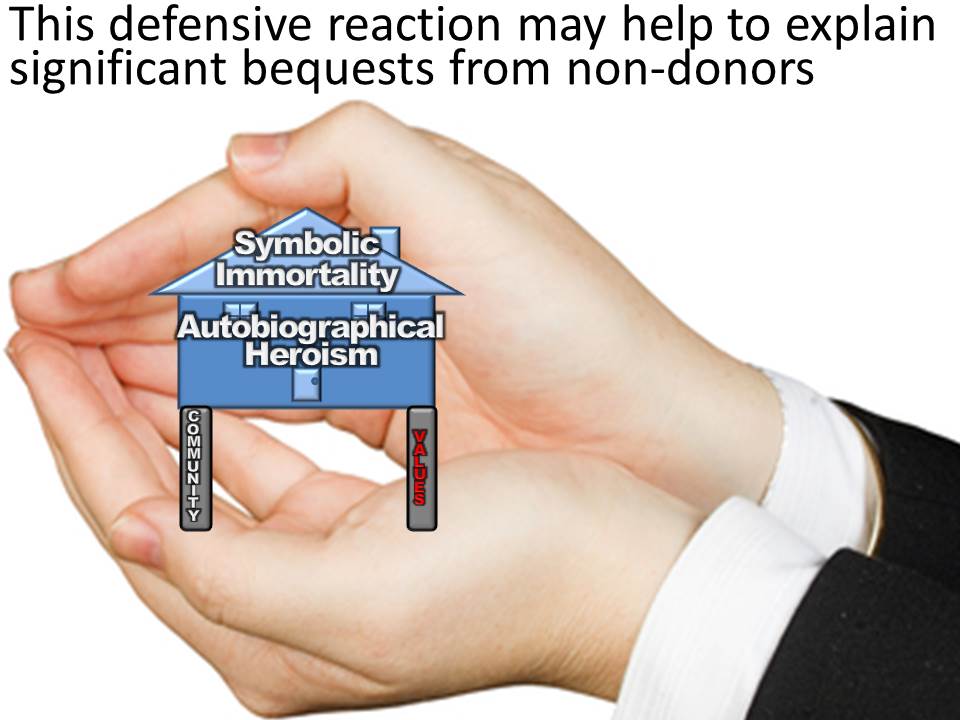
Thus, the behavior of non-donors in leaving a charitable bequest is not psychologically inconsistent. A more self-focused individual may not, as a matter of course, consider the importance of his or her community and community values. These things simply do not become a matter of focus in daily life. However, the psychological attack of a death reminder shows the clear limitations of a life completely focused on the self. The self is mortal. The self will die. If the self is all there is, then impending death is the end of all things, which is a psychologically frightening prospect. As a defense to this frightening prospect, people may engage in the construction of some form of symbolic immortality and autobiographical heroism based upon their community and its values. Thus, when faced with this threat, the importance of the community becomes immediately paramount in a way that would never happen during the distractions of daily busyness.
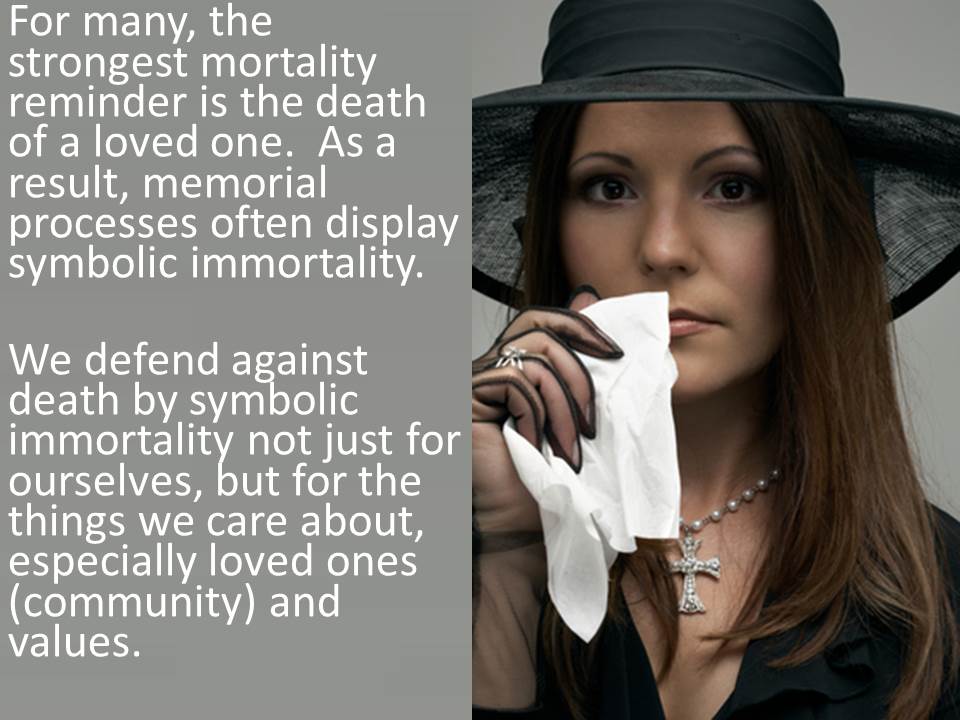
To this point we have been discussing the second-stage defense of symbolic immortality and autobiographical heroism as something that applies only to the individual himself or herself. In fact, some of the most obvious applications of this defense apply not to ourselves but to close loved ones who have died. This behavior also relates to personal mortality salience defense, even though the autobiographical heroism is applied not to oneself, but to a deceased “community” member. However, this is still important to one’s own self-conception because, if other valued community members’ memories can die, so can ours. By demonstrating that those important community members will continue to be remembered we can demonstrate to ourselves that we also may be remembered after our death.
This is especially critical immediately after the death of a loved one, because the death of a loved one is, by far, one of the strongest reminders of personal mortality. If we can provide some measurement of symbolic immortality for the deceased loved one, it helps to provide assurance that we, too, can achieve some level of symbolic immortality. (Or, at least that our community is capable of conveying symbolic immortality in the right circumstances.) Thus, this defensive structure of autobiographical heroism and symbolic immortality is something people will apply to deceased loved ones as well as to their own life stories. This can also be seen in a variety of common practices of memorializing the dead.
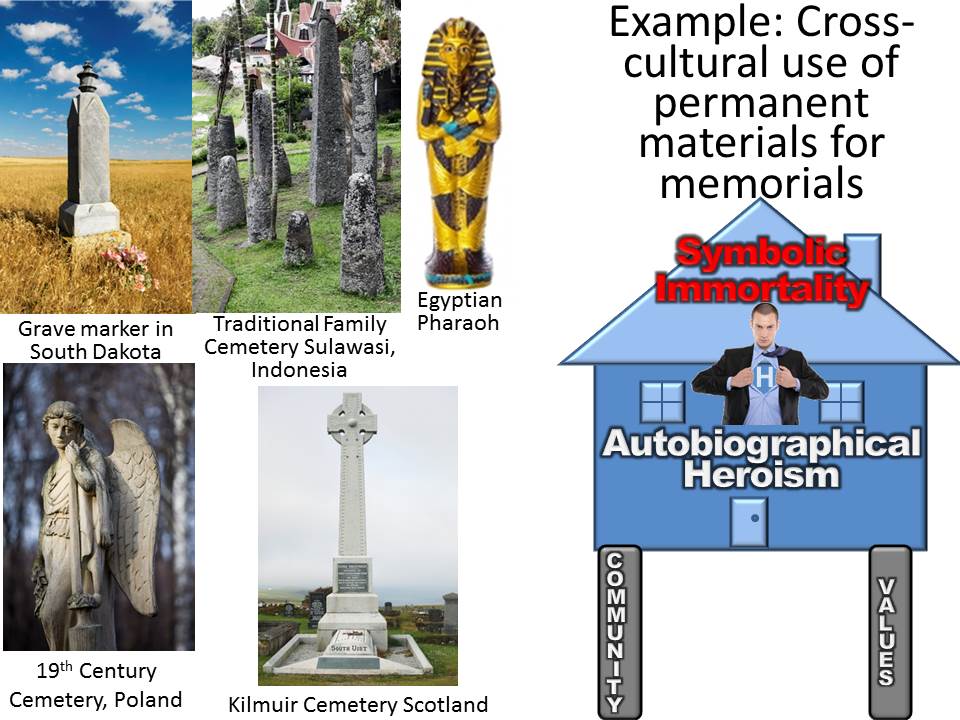
As visually demonstrated in the above examples, the use of permanent long-lasting materials for the construction of memorials is common across a wide range of human cultures, both modern and ancient. This is not an accidental occurrence. Rather, the use of permanent materials fits with the concept that we fight against the unfortunate reality of personal mortality by creating lasting symbols. The more important a person was to the community, the more important it is to show that they have achieved symbolic immortality. Because, if the most important people within a community are quickly forgotten, then there is no hope of achieving symbolic immortality for any members of the community, and we are again left with a world of isolation where there is no remembrance beyond our own personal mortality. Such a world is one that provides no protection against the psychological attack of the reality of personal mortality. Consequently, it is no surprise that we see cultural practices that emphasize symbolic or literal immortality across many peoples, places, and times.
One of the most obvious and commonly experienced applications of this concept of autobiographical heroism as a defense to mortality salience can be seen in the way that the life stories of the recently and unexpectedly deceased are often immediately altered following their death. A description of the person’s characteristics and life story that would have been considered completely acceptable prior to death is, by virtue of their death, immediately converted into a reality that is no longer socially acceptable. We are unwilling to convey the same kind of negative information about a person who is recently deceased. Any information or stories that contradict or interfere with the plausibility of a story of autobiographical heroism, or at a minimum a positive life impact, is deemed socially offensive.
Why is this? It may relate to the need to protect ourselves from the stark reality of personal mortality by providing a symbolic immortality defense for the recently deceased person. Perhaps we construct this protective covering of autobiographical heroism as a way of demonstrating that symbolic immortality, including some sense of autobiographical heroism, is not only possible for community members, but is normal, appropriate, and expected. This reinforces the role of the community in serving as a source of protection against complete oblivion at the point of death. For our purposes, it is yet another demonstration of the role of community-supported autobiographical heroism as a natural reaction to a mortality-salience inducing event.
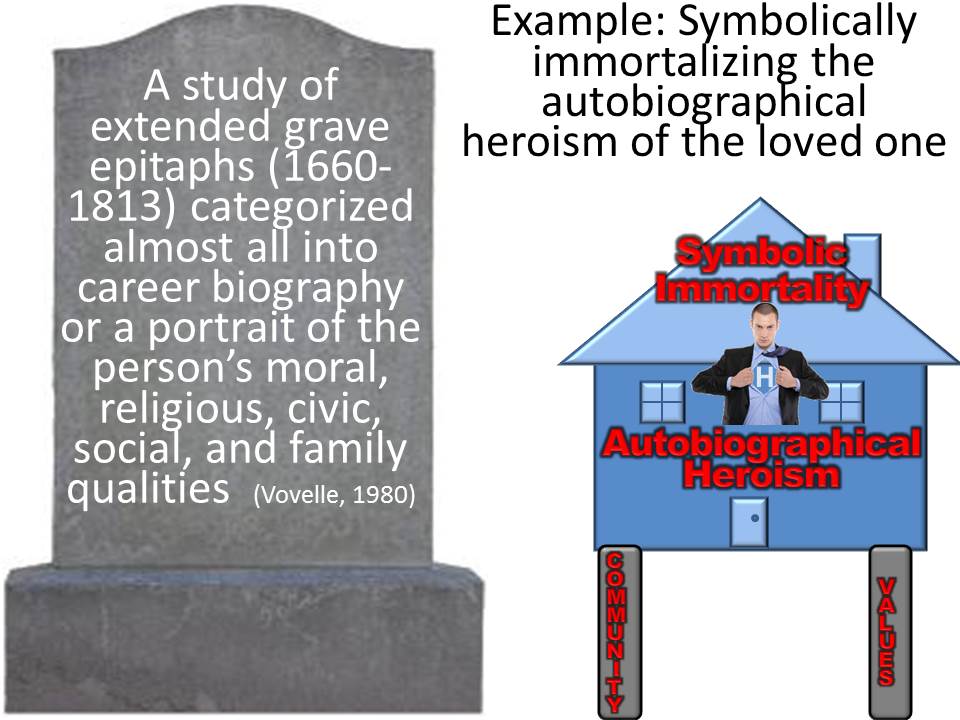
We can see a more tangible and concrete expression of this same tendency in the words used in grave epitaphs. In 1980, Michel Vovelle (University of Provence Ais-Marseille) published a study of American grave epitaphs appearing from 1660-1813. Of particular interest for our purposes is that the extended epitaphs, those going beyond simply the person’s name and dates, fell into clearly delineated categories. Specifically, almost every one was either a career biography or a portrait of the person’s religious, moral, civic, social, and/or family qualities. In the context of our current model, this fits cleanly with the idea of defending against mortality salience by supporting the community, the community values, and/or one’s sense of autobiographical heroism. Over these centuries, when loved ones have wished to immortalize some characteristic of the deceased in an epitaph, that immortalization almost universally fell within the framework of documenting their support of the community and the community values through their life and career stories.
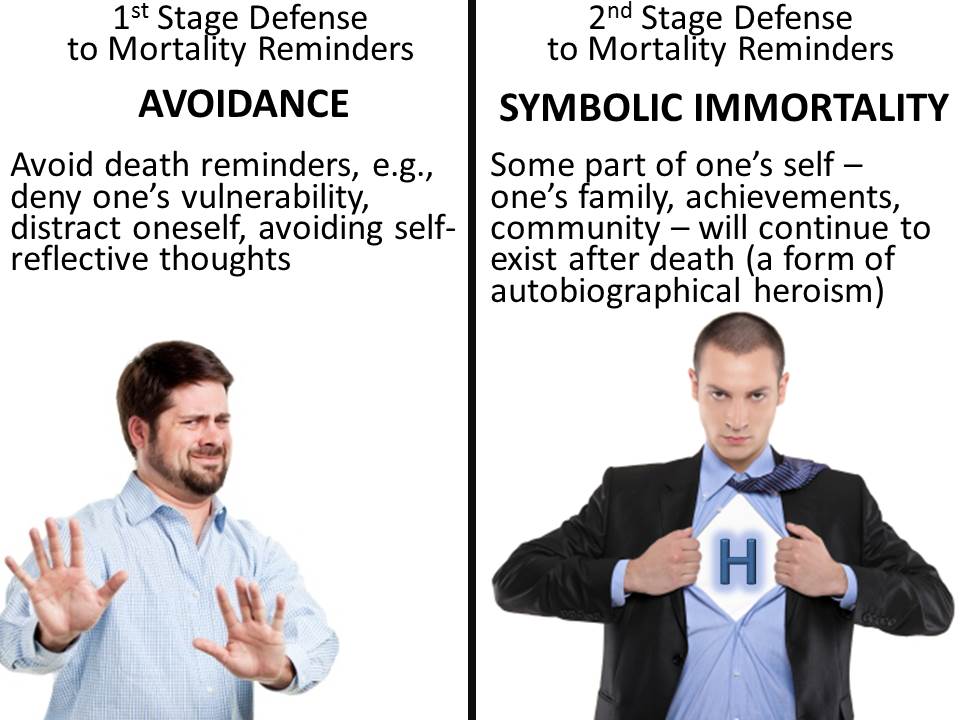
And so, once again, we returned to the original model. Having reviewed some samples of the evidence, both from experimental and historical studies, it appears that the model has reasonable validity for our purposes. Next, as we progress in examining results from more modern scientific analysis of neural patterns and work towards generating practical applications for charitable bequest planners, we will continue to refer back to this basic model of how humans react to mortality reminders. First, with an immediate reaction of avoidance, and when such reaction is no longer sufficient to protect against mortality reminders, then moving to a second-stage defense of pursuing symbolic immortality through a story of autobiographical heroism that supports and is supported by the community and the community’s values. (In the academic literature these first-stage defenses are referred to as proximal defenses, whereas the second-stage defenses are referred to as distal defenses. However, for our discussion purposes we will try to keep the jargon to a minimum and so will continue to use the descriptions of first-stage and second-stage.)