Beginning the narrative arc
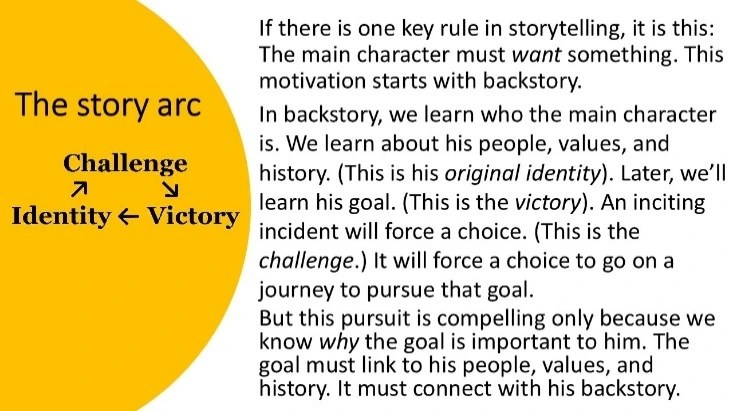
If there is one key rule in storytelling, it is this: The main character must want something. This motivation starts with backstory.
In backstory, we learn who the main character is. We learn about his people, values, and history. (This is his original identity). Later, we’ll learn his goal. (This is the victory). An inciting incident will force a choice. (This is the challenge.) It will force a choice to go on a journey to pursue that goal.
But this pursuit is compelling only because we know why the goal is important to him. The goal must link to his people, values, and history. It must connect with his backstory.
If there is one key rule in fundraising, it is this: The donor must want something the charity can offer. This motivation starts with the donor’s backstory.
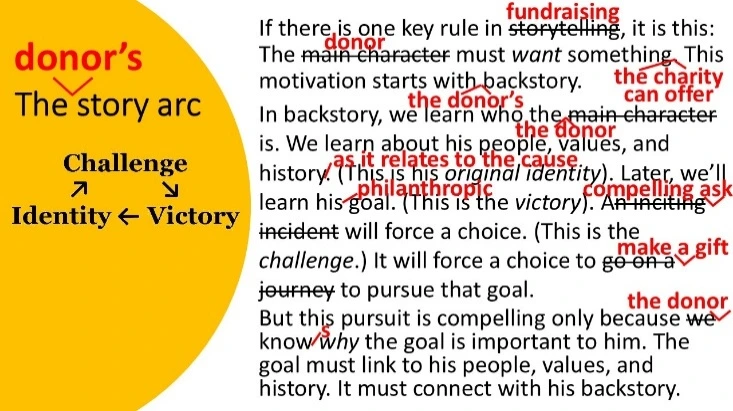
In backstory, we learn who the donor is. We learn about his people, values, and history as it relates to the cause. (This is his original identity.) Later, we’ll learn his philanthropic goal. (This is the victory.) A compelling ask will force a choice. (This is the challenge.) It will force a choice to make a gift to pursue that goal.
But this pursuit is compelling only because the donor knows why the goal is important to him. The goal must link to his people, values, and history. It must connect with his backstory.
Openings
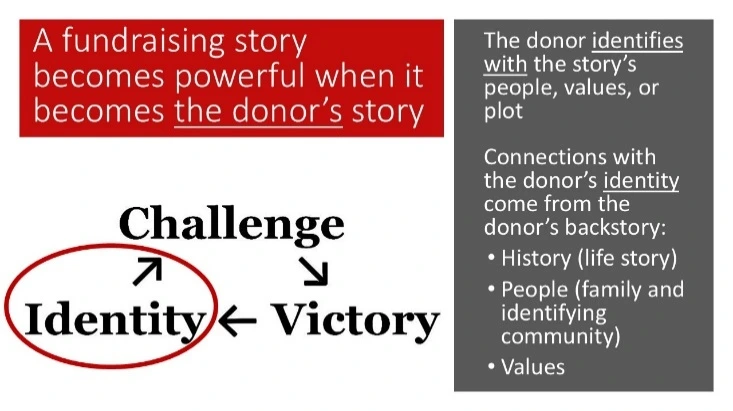
No story can be a powerful fundraising story until it becomes the donor’s story. This happens when the donor identifies with the story’s people, values, or plot. Questions can help. Questions can uncover connections with the donor’s identity.
The donor’s identity comes from the donor’s backstory. It comes from the donor’s
- History (life story),
- People (family and identifying community), and
- Values.
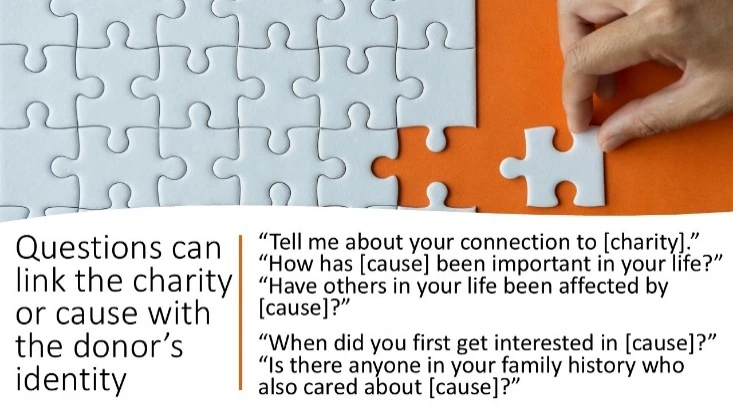
Questions or prompts can link the charity or cause with this identity. For example,
- “Tell me about your connection to [this charity].”
- “How has [this cause] been important in your life?”
- “Have others in your life been affected by [this cause]?”
Questions can explicitly connect with origins. For example,
- “When did you first get interested in [this cause]?”
- “Is there anyone in your family history who also cared about [this cause]?”
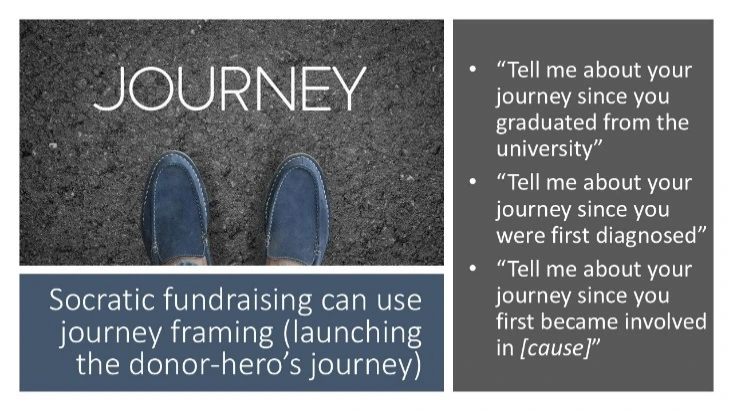
This can even inspire monomyth framing. The origin connections become the starting point in the donor-hero’s journey. For example,
- “Tell me about your journey since you graduated from the university.”1213
- “Tell me about your journey since you were first diagnosed.”
- “Tell me about your journey since you first became involved in [this cause].”
This might look like simple information gathering. And, yes, that does happen. But the questions are important even if we already know the answer.
The questions are powerful because the donor is answering them. Restating a connection or belief strengthens it.1214 This encourages actions that match. In fundraising, this encourages donations.
Does it work? Let’s look at some experimental results.
Experiment 1
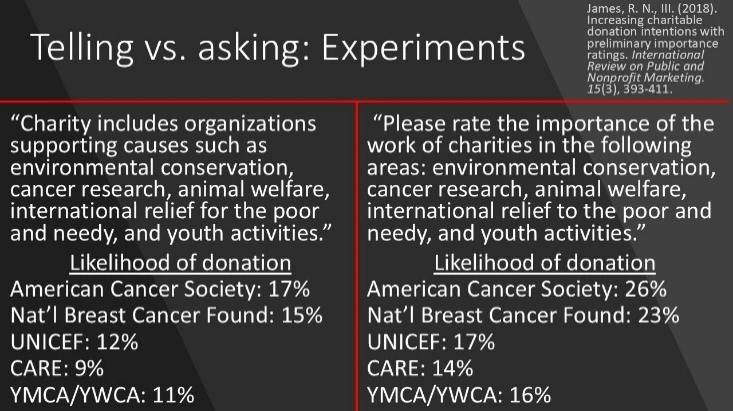
In one experiment1215 some people were simply told about causes. They read,
“Charity includes organizations supporting causes such as environmental conservation, cancer research, animal welfare, international relief for the poor and needy, and youth activities.”
Others were instead asked questions. They were asked to rate the importance of the causes. They read,
“Please rate the importance of the work of charities in the following areas: environmental conservation, cancer research, animal welfare, international relief to the poor and needy, and youth activities.” [The response scale was from “0=absolutely no importance” to “100=absolutely the greatest importance”]
Did asking questions make a difference? Yes. The likelihood of donating to the American Cancer Society was 17% for the first group. It was 26% for the second. For the National Breast Cancer Foundation, the increase was from 15% to 23%. For UNICEF, it went from 12% to 17%. For CARE, it went from 9% to 14%. For YMCA/YWCA it went from 11% to 16%. For all ten charities tested across all five cause types, the outcome was the same. The likelihood of donating always went up. Questions worked.
Experiment 2
In another experiment, people were asked to donate to conserve the environment. But some were first asked an identity question. They were asked to describe “ways in which they would have a positive impact on future generations.”1216 Those people donated nearly 50% more.
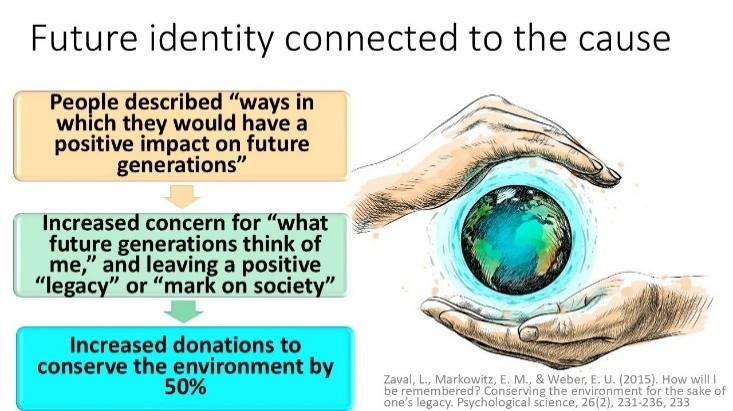
Why? Further analysis gave the answer. This question increased concern for “what future generations think of me.”1217 It increased interest in leaving a positive “legacy” or “mark on society.” The question highlighted the importance of one aspect of the donor’s identity. That aspect connected to the charitable cause. (Environmental conservation has a “positive impact on future generations.”) As a result, donations increased.
Experiment 3
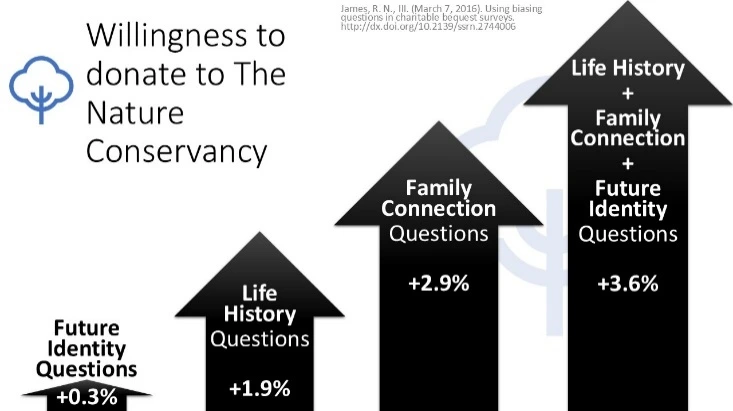
A later experiment1218 tested willingness to donate to The Nature Conservancy. Some were first asked about their desired future identity. (This was like the prior experiment.1219) Others were asked about their life history with conservation.1220 Still others were asked about family connections to conservation.1221
Donation likelihood went up
- Slightly for the future identity questions,
- More for the life history questions, and
- Even more for the family connection questions.
However, it went up the most for those who were asked all three sets of questions. Each type of identity connection helped encourage the gift. Questions worked. More questions worked better.
Bequest experiments
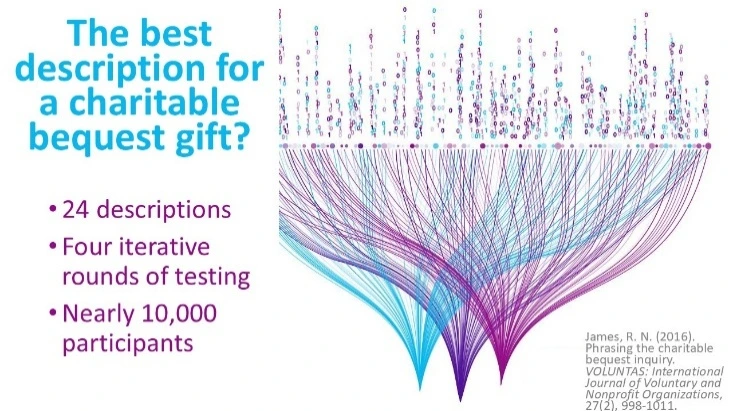
Linking with the donor’s identity can also work with bequest gifts. One experiment searched for the best description of a charitable bequest gift. It tested 24 different descriptions in four iterative rounds. Nearly 10,000 people responded.1222 The description most likely to trigger giving was
“Make a gift to charity in your will to support causes that have been important in your life.”
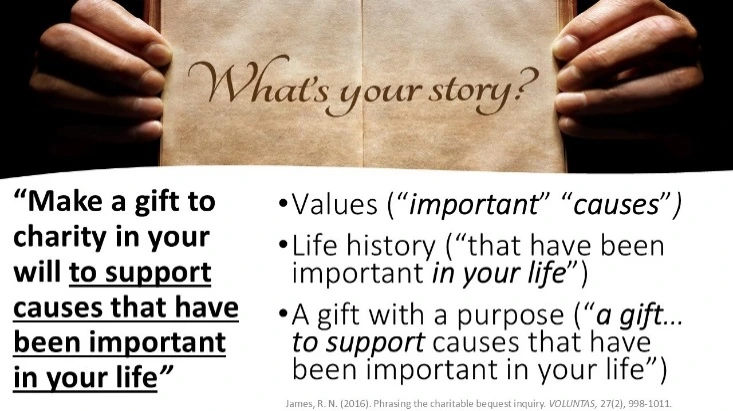
This description links
- Values (“important”),
- Life history (“important in your life”),
- A cause (“causes that have been important in your life”), and
- A gift (“a gift… to support causes that have been important in your life”).
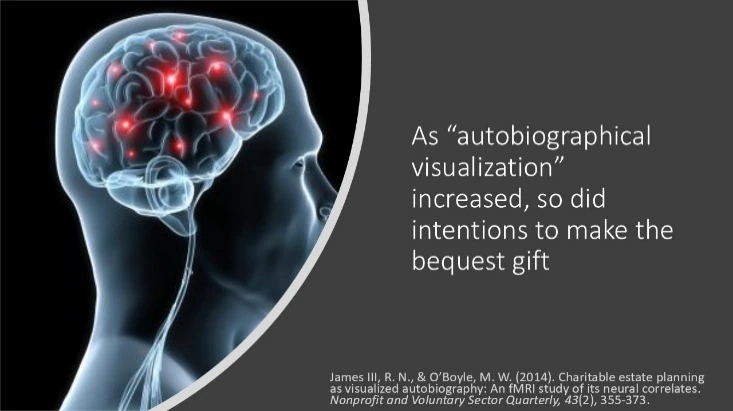
A neuroimaging study found similar results.1223 People were asked about making bequest gifts to different charities. As “autobiographical visualization” increased, so did intentions to make the gift. The neural signature for life story connections predicted bequest giving intentions.
A qualitative study found similar results.1224 It interviewed people with charitable bequest plans. It asked them why they picked those charities. The answer? These charities linked with their life stories.
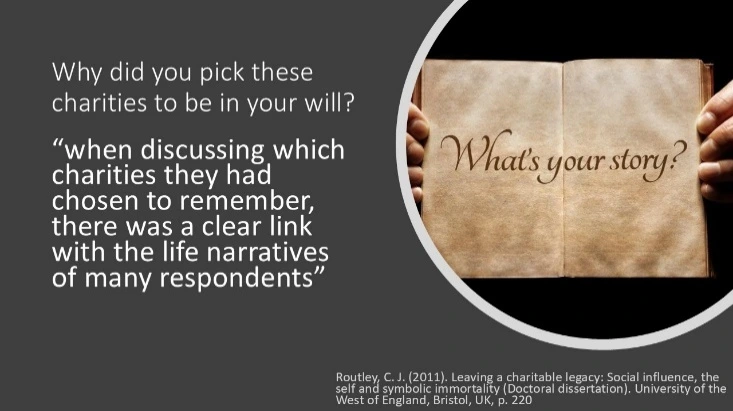
Life story reminiscence can be powerful. But it’s most powerful during older ages.1225 This is when major lifetime or legacy gift decisions are often made.1226
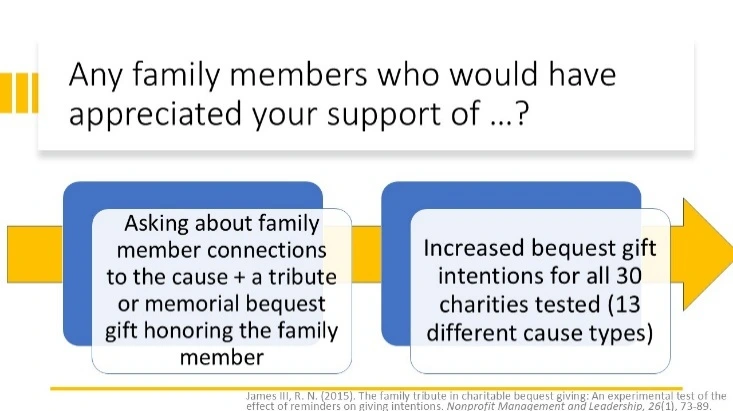
In another experiment1227 people increased bequest gift intentions when asked about
- Family member connections to the cause, and
- A tribute or memorial bequest gift honoring the family member.
This worked for all 30 charities tested.1228 These came from 13 different cause types.
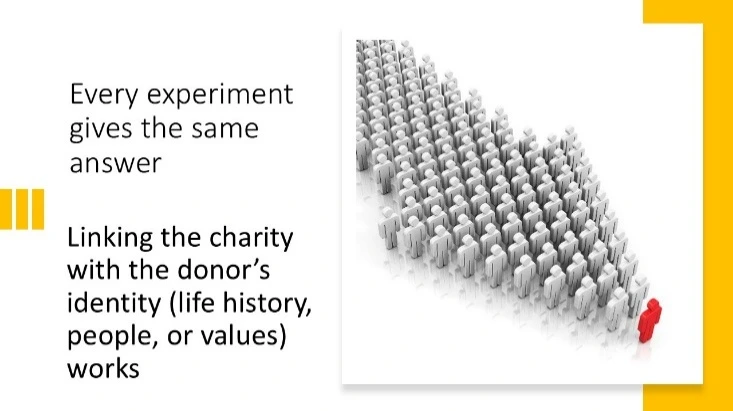
In all these experiments, the answer was the same. Linking the charity or cause with the donor’s identity (history, people, or values) worked. A compelling story starts with backstory. It starts with identity.
Social norms experiments
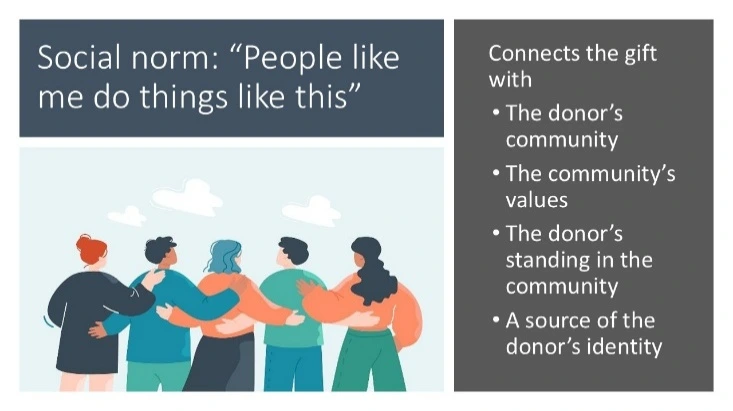
One of the most powerful messages in giving experiments is the social norm. This is the message that “people like me do things like this.” It shows that the donor’s community supports the values, the charity, and the donation. It connects the gift with standing in the community. It connects the gift with a source of the donor’s identity.
The social norm works. But experiments show one thing works even better. Asking questions about the social norm.
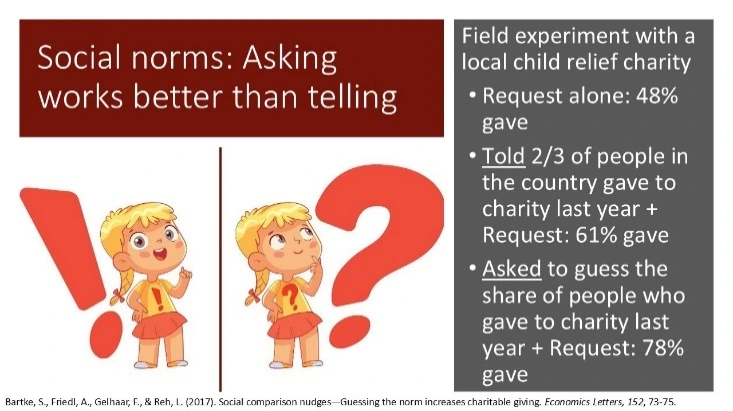
One field experiment asked people to give to a local child relief charity. With just this request, 48% gave. Others were first told that 2/3 of people in the country gave to charity last year. In this group, 61% gave. (This is the social norm effect.) Before being told this, another group first answered a question. They guessed the share of people who gave to charity last year. In this group, 78% gave.1229 Asking worked better than just telling.
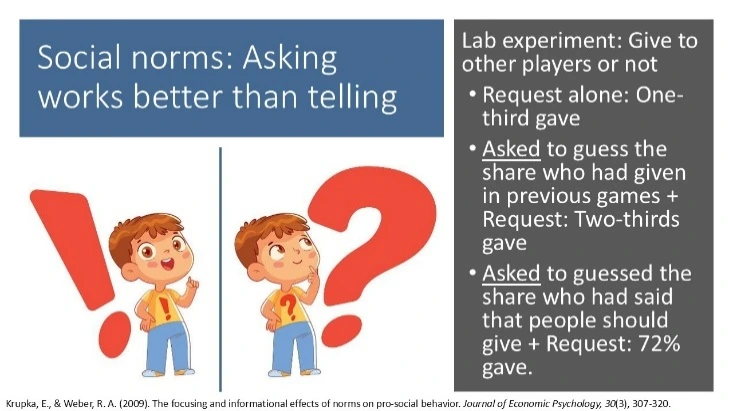
In one lab experiment, people could choose to give to other players or not.1230 There were three groups.
- In the normal group, one-third chose to give.
- In a second group, people first answered a question. They guessed the share of others who had given in previous games. In this group, two-thirds gave. Asking about others’ giving actions doubled giving.
- In a third group, people first answered a different question. They guessed the share of others who had said that people should give. In this group, 72% gave. Asking about others’ giving beliefs more than doubled giving.
Another lab experiment found the same effect for donations to charity.1231 In giving decisions, social norms are powerful. But, here too, the same rule applies. Asking works better than telling.
The magic of follow-up questions
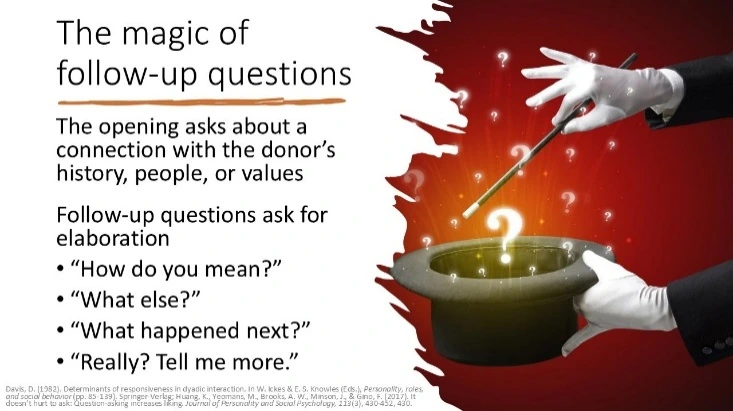
The opening starts the conversation. It asks about a connection with the donor’s history, people, or values. But the real power comes in the follow-up questions.
Follow-up questions ask the speaker to elaborate.1232 Generic versions include,
- “How do you mean?”
- “What else?”
- “What happened next?”
- “Really? Tell me more.”
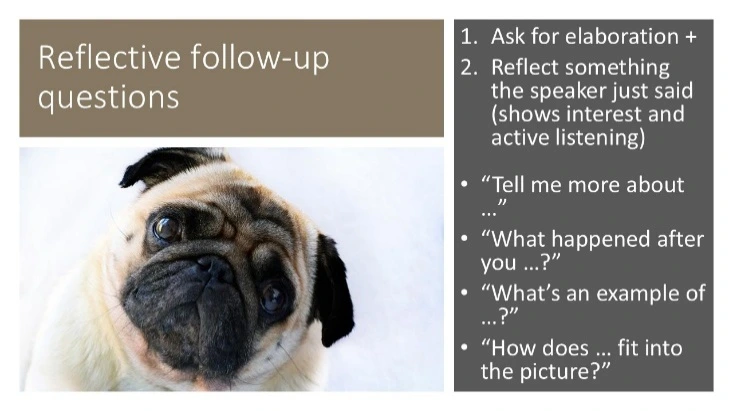
Even better is the two-part follow-up question. The first part asks for elaboration. The second part reflects something the speaker just said. This shows interest and active listening.
- “Tell me more about ….”
- “What happened after you …?”
- “What’s an example of …?”
- “How does … fit into the picture?”
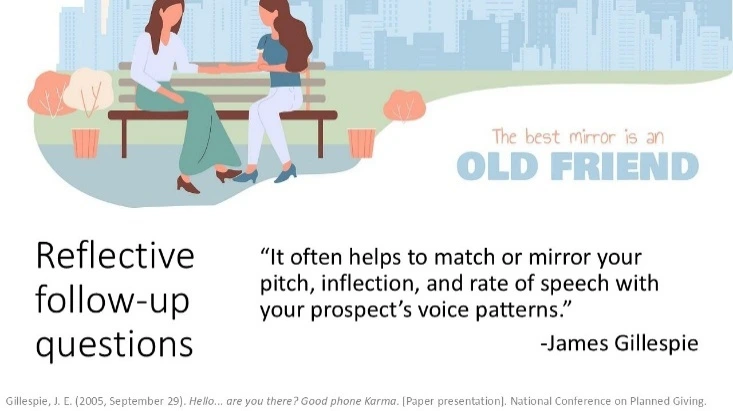
Reflective communication isn’t just about words. James Gillespie explains,
“It often helps to match or mirror your pitch, inflection, and rate of speech with your prospect’s voice patterns.”1233
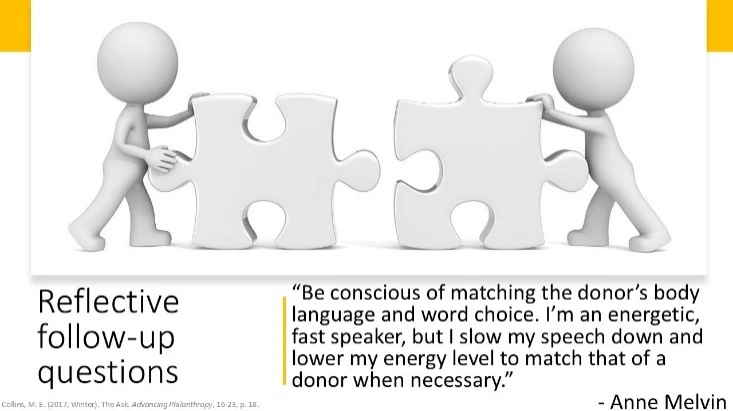
Anne Melvin adds,
“Be conscious of matching the donor’s body language and word choice. I’m an energetic, fast speaker, but I slow my speech down and lower my energy level to match that of a donor when necessary.”1234
Follow-up questions and reflective communication work. They elicit information. But they do more. They show we care.
Follow-up questions in research
Many experienced fundraisers will say, “It’s all about relationships.” And that’s often true. But how can we make this happen? Research provides some insights.
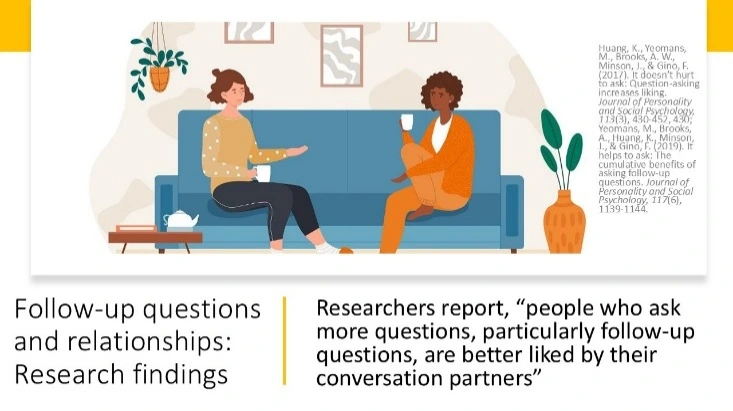
Questions can help. People who elicit personal information are better liked. This is particularly true in long-term relationships.1235 Several experiments showed
“people who ask more questions, particularly follow-up questions, are better liked by their conversation partners …”1236
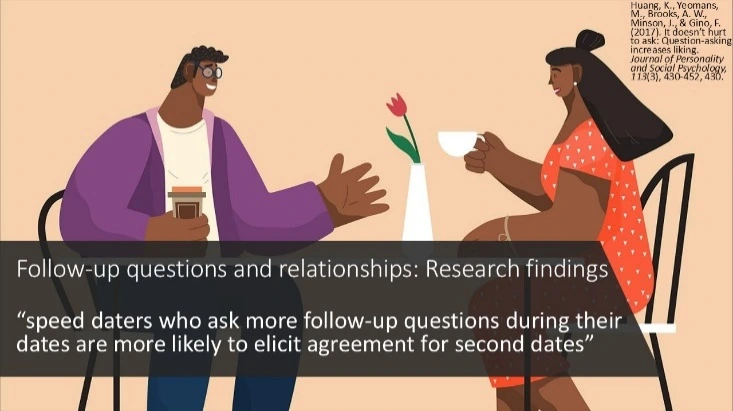
This even works for dating. One experiment found
“speed daters who ask more follow-up questions during their dates are more likely to elicit agreement for second dates …” 1237
Questions can help. But in experiments, not all questions worked. Introductory questions didn’t do much. These were questions like,
“Hey, how’s it going?”
Questions that switched topics could actually hurt. These were questions like,
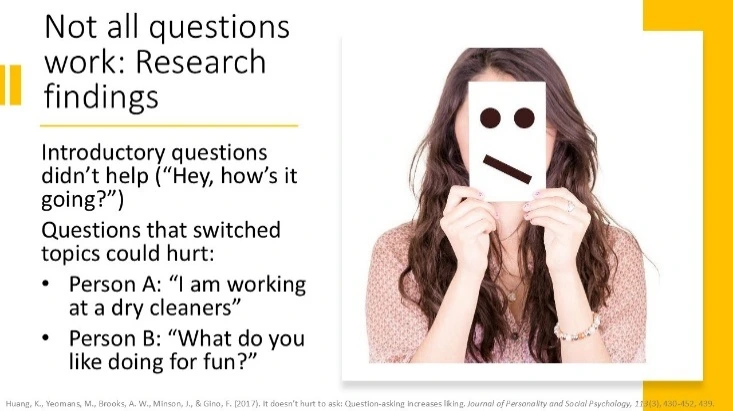
Person A: “I am working at a dry cleaners.”
Person B: “What do you like doing for fun?”1238
Socratic fundraising involves questions. But these are questions from active listening.1239 They are questions of appreciative inquiry. They are follow-up questions. Researchers explain,
“follow-up questions seem to have special power. They signal to your conversation partner that you are listening, care, and want to know more. People interacting with a partner who asks lots of follow-up questions tend to feel respected and heard.”1240
One early study called those skilled at eliciting information, “Openers.”1241 How were such people different? On personality scales, they scored high1242 in
- Perspective taking
- Sociability
- Self-esteem, and
- Awareness of one’s own thoughts and feelings.
In conversation experiments, these “Openers” behaved differently. Researchers found,
“In addition to being more receptive and attentive, high openers may also actively elicit more disclosure from their partners by asking more follow-up questions.”1243
Follow-up questions work. They elicit information. They build relationships. But the fundraiser is not just being friendly. The fundraiser is the guiding sage in the donor’s hero story.
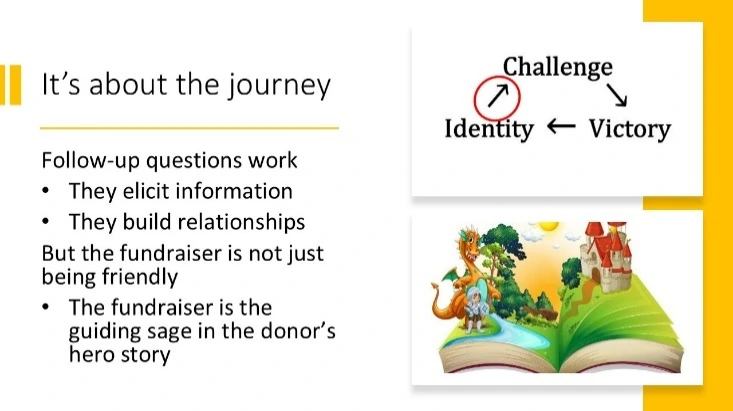
The questions have a point. The point is to connect the donor’s original identity with the cause or the charity. This is the first step in the donor-hero’s journey.
Why the first step isn’t enough
This first step reminds donors of their connections to the charity. This encourages support. But this, by itself, will never motivate a major gift. Why not?
Consider this. Suppose a donor loves our charity. So, he donates $100. Great! But how can we motivate a gift of $1,000? Can we make the donor love our charity ten times more than he already does? Probably not.
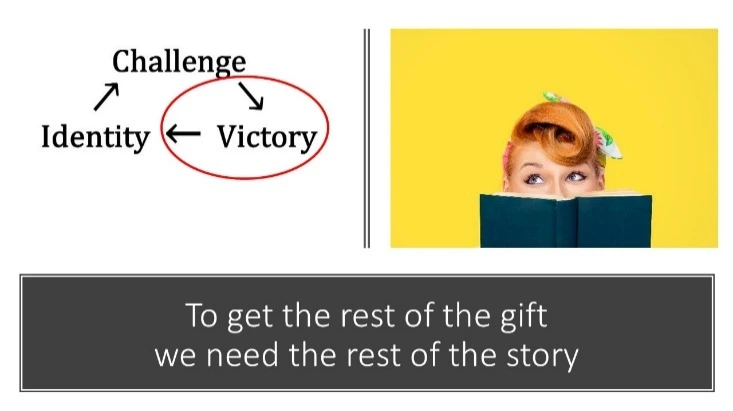
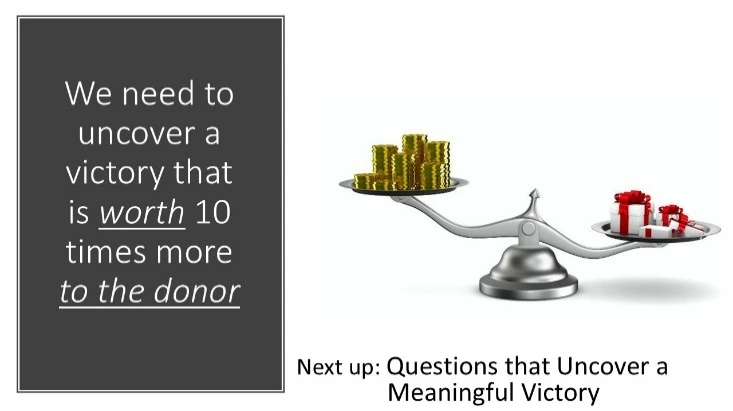
Instead, we need to move beyond just connecting the donor to the charity. To get the rest of the gift, we need the rest of the story. We need to uncover a personally meaningful victory. We need to find a victory that is worth ten times more to the donor.
How? By asking questions.
Notes and references
Vidmar, T. (2020, May 1). Personal communication. Tony Vidmar, VP University Advancement and Public Affairs, Midwestern State University. (Tony adds this important comment on the phrasing, “I specifically say the name of the institution and usually in the informal vernacular—i.e. “Tech” for Texas Tech University or “Ohio State” for The Ohio State University or “Midwestern” (or MSU Texas) for Midwestern State University. By doing so, I convey hopefully a commonality that we have as both being “intimate” enough with the institution and it’s culture to be comfortable enough and “cool enough” to use the informal vernacular.”
↩Fazio, R. H., Chen, J. M., McDonel, E. C., & Sherman, S. J. (1982). Attitude accessibility, attitude-behavior consistency, and the strength of the object-evaluation association. Journal of Experimental Social Psychology, 18(4), 339-357; Glasman, L. R., & Albarracín, D. (2006). Forming attitudes that predict future behavior: A meta-analysis of the attitude-behavior relation. Psychological Bulletin, 132(5), 778–822.
↩James, R. N., III. (2018). Increasing charitable donation intentions with preliminary importance ratings. International Review on Public and Nonprofit Marketing. 15(3), 393-411.
↩Zaval, L., Markowitz, E. M., & Weber, E. U. (2015). How will I be remembered? Conserving the environment for the sake of one’s legacy. Psychological Science, 26(2), 231-236, 233.
↩Id. at 233.
↩James, R. N., III. (2016, March 7). Using biasing questions in charitable bequest surveys. Available at SSRN: https://ssrn.com/abstract=2744006 or http://dx.doi.org/10.2139/ssrn.2744006
↩“Please rate the importance to you of the following” regarding (1) “Being a good example for the next generation,” (2) “Making a lasting impact in the world,” and (3) “Insuring that your values will be remembered by future generations.” The available ratings were “None,” “Slightly important,”
“Somewhat important,” “Important,” and “Highly important.”
↩“At what age did you first begin to think about the importance of conserving the natural environment?” with the available answers of “In childhood,” “In high school,” “In my 20s,” “In my 30s or later,” and “I have never thought
about the importance of conserving the natural environment.” Followed by, “Which of the following have been important in your life? (check any that apply),” with the available options of “Time I have spent outdoors,” “Time I have spent on a river,” “Time I have spent in a forest,” “Time I have spent on a lake,” “My life experiences with wildlife,” “My life experiences with wild birds,” and “My life experiences with trees and plants.”
↩“Do you have more or less than two family members who consider conserving the natural environment to be important?” with the available options of “About 2,” “More than 2,” and “Less than 2.” Followed by, “Were there any family members in your life who were particularly influential in shaping your views on the importance of nature conservation? (Check any that apply)” with the available options of “Grandmother,” “Grandfather,” “Aunt,” “Uncle,” “Mother,” “Father,” “Sibling,” and “Other family member.”
↩James, R. N., III. (2016). Phrasing the charitable bequest inquiry. VOLUNTAS: International Journal of Voluntary and Nonprofit Organizations, 27(2), 998-1011.
↩James, R. N., III., & O’Boyle, M. W. (2014). Charitable estate planning as visualized autobiography: An fMRI study of its neural correlates. Nonprofit and Voluntary Sector Quarterly, 43(2), 355-373.
↩“Indeed, when discussing which charities they had chosen to remember, there was a clear link with the life narratives of many respondents.” Routley, C. J. (2011). Leaving a charitable legacy: Social influence, the self and symbolic immortality [Ph.D. dissertation]. University of the West of England, Bristol, UK, p. 220.
↩Reminiscing about the distant past is also a particularly effective way to communicate with older adults or those with diminished capacity to generate new memories. See Hyppa-Martin, J. & Hofmann, R. (2018, October). Stewarding donors with dementia. [Paper presentation]. National Association of Charitable Gift Planners Conference, Las Vegas, NV; Bohling, H. R. (1991). Communication with AD patients: An analysis of caregiver listening patterns. International Journal of Aging and Human Development, 33(4), 249-267, 252.
Ripich, D. N., Wykle, M., & Niles, S. (1995). Alzheimer's disease caregivers: The FOCUSED program: A communication skills training program helps nursing assistants to give better care to patients with alzheimer's disease. Geriatric Nursing, 16(1), 15-19.
↩James, R. N., III. III. (2020). The emerging potential of longitudinal empirical research in estate planning: Examples from charitable bequests. UC Davis Law Review, 53, 2397-2431
↩James, R. N., III. (2015). The family tribute in charitable bequest giving: An experimental test of the effect of reminders on giving intentions. Nonprofit Management and Leadership, 26(1), 73-89.
↩UNICEF; CARE; The American Diabetes Association; The Joslin Diabetes Center; World Wildlife Fund; Wildlife Conservation Society; National Breast Cancer Foundation; Breast Cancer Research Foundation; Susan G. Komen Breast Cancer Foundation; The Alzheimer's Association; The Alzheimer's Foundation of America; The American Humane Association; The American Society for the Prevention of Cruelty to Animals; The Big Brothers/Big Sisters of America; Boys and Girls Clubs of America; YMCA; YWCA; Girl Scouts; or Boy Scouts; Prevent Blindness America or Foundation Fighting Blindness; National Cancer Coalition; the American Cancer Society; The MD Anderson Cancer Center; or the Dana Farber Cancer Institute); United Negro College Fund; American Indian College Fund; Ducks Unlimited or The National Audubon Society; AIDS Project Los Angeles or San Francisco AIDS Foundation; Canine Companions for Independence; Guide Dogs for the Blind.
↩Bartke, S., Friedl, A., Gelhaar, F., & Reh, L. (2017). Social comparison nudges—Guessing the norm increases charitable giving. Economics Letters, 152, 73-75.
↩Krupka, E., & Weber, R. A. (2009). The focusing and informational effects of norms on pro-social behavior. Journal of Economic Psychology, 30(3), 307-320.
↩Asking participants to guess the share of people who had given in previous games significantly increased charitable giving. This worked both when people’s decisions were private [labeled SelfSig BE] and when they were being watched by others [labeled SocSig BE]. Bolton, G., Dimant, E., & Schmidt, U. (2020). When a Nudge Backfires: Combining (Im)Plausible Deniability with Social and Economic Incentives to Promote Behavioral Change. CESinfo Working Paper No. 8070, Available at SSRN: https://ssrn.com/abstract=3531419
↩Davis, D. (1982). Determinants of responsiveness in dyadic interaction. In W. Ickes & E. S. Knowles (Eds.), Personality, roles, and social behavior (pp. 85-139). Springer-Verlag; Huang, K., Yeomans, M., Brooks, A. W., Minson, J., & Gino, F. (2017). It doesn’t hurt to ask: Question-asking increases liking. Journal of Personality and Social Psychology, 113(3), 430-452, 430.
↩Gillespie, J. E. (2005, September 29). Hello... are you there? Good phone Karma. [Paper presentation]. National Conference on Planned Giving.
↩Collins, M. E. (2017, Winter). The Ask. Advancing Philanthropy, 16-23, p. 18. Quoting Anne T. Melvin, J.D., Director of training and education, Alumni affairs and development at Harvard University.
↩Miller, L. C., Berg, J. H., & Archer, R. L. (1983). Openers: Individuals who elicit intimate self-disclosure. Journal of Personality and Social Psychology, 44, 1234-1244.
↩Huang, K., Yeomans, M., Brooks, A. W., Minson, J., & Gino, F. (2017). It doesn’t hurt to ask: Question-asking increases liking. Journal of Personality and Social Psychology, 113(3), 430-452, 430. See also, Yeomans, M., Brooks, A., Huang, K., Minson, J., & Gino, F. (2019). It helps to ask: The cumulative benefits of asking follow-up questions. Journal of Personality and Social Psychology, 117(6), 1139-1144.
↩Huang, K., Yeomans, M., Brooks, A. W., Minson, J., & Gino, F. (2017). It doesn’t hurt to ask: Question-asking increases liking. Journal of Personality and Social Psychology, 113(3), 430-452, 430.
↩Id. at Tables 2 & 3, p. 439.
↩Weger, H., Jr., Bell, G. R. C., Minei, E. M., & Robinson, M. C. (2014). The relative effectiveness of active listening in initial interactions. International Journal of Listening, 28, 13-31.
↩Brooks, A. W., & John, L. K. (2018). The surprising power of questions. Harvard Business Review, 96(3), 60-67
↩Miller, L. C., Berg, J. H., & Archer, R. L. (1983). Openers: Individuals who elicit intimate self-disclosure. Journal of Personality and Social Psychology, 44, 1234-1244.
↩Id. at p. 1237, Table 3.
↩Id. at p. 1242.
↩