This series started with The Storytelling Fundraiser. That introduced fundraising and the science of story. Next was The Epic Fundraiser. That focused on a specific story: the monomyth. Now we begin The Primal Fundraiser. This explores the natural origins of philanthropy.
These three topics are like a Russian nesting doll. Each doll contains a smaller doll hidden inside it.
The first part was the surface doll. It focused on story words and simple experiments. The results were objective. The science was “hard” science.
Inside that doll was another. It took a turn to the subconscious. It explored myth: the universal hero’s journey. It explored psychology: Jung’s hero archetype.
But inside that doll is yet another. (Don’t worry! It’s the last doll. The final book focuses only on practical applications.)
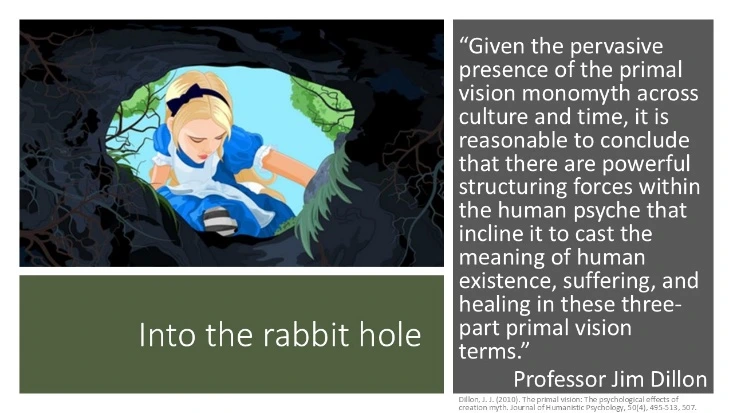
Into the rabbit hole
The attraction to the hero’s journey is deep and primal. It connects with myth and psychology. But the attraction goes further. It taps into the natural origins of mankind.
Professor Jim Dillon writes,
“Given the pervasive presence of the primal vision monomyth across culture and time, it is reasonable to conclude that there are powerful structuring forces within the human psyche that incline it to cast the meaning of human existence, suffering, and healing in these three-part primal vision terms.”705
The hero archetype, like other archetypes, originates in natural selection. Carl Jung explains that an archetype is,
“An inherited mode of functioning, corresponding to the inborn way in which the chick emerges from the egg, the bird builds its nest, a certain kind of wasp stings the motor ganglion of the caterpillar, and eels find their way to the Bermudas.”706
The reason that the archetype is universal is that it’s genetic.707 The study of naturally selected behavior is called ethology. Psychiatrist Anthony Stevens writes,
“Ethology and Jungian psychology can be viewed as two sides of the same coin … it is as if ethologists have been engaged in an extraverted exploration of the archetype.”708
Or, as Jung describes,
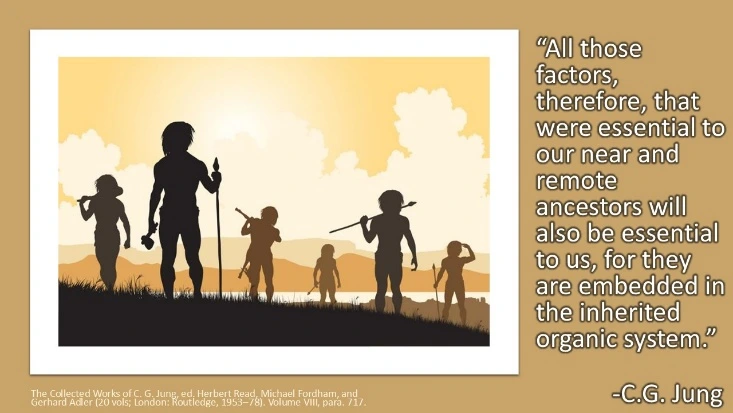
“All those factors, therefore, that were essential to our near and remote ancestors will also be essential to us, for they are embedded in the inherited organic system.”709
The following chapters explore these natural origins. These origins underlie philanthropy in general. But they also underlie the donor’s hero story in particular.
Why jump in?
Look. I get it. This type of theoretical inquiry feels far removed from everyday fundraising.710 But this isn’t just about academic theory. It’s about effective fundraising. It may be down the rabbit hole. But it’s still about being a better fundraiser tomorrow than you were yesterday.
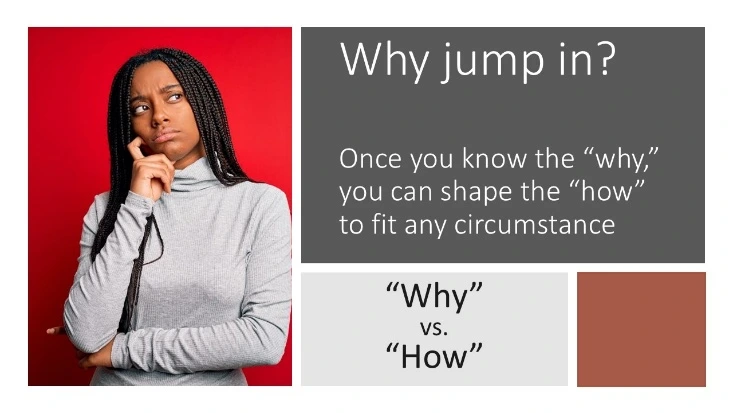
This book can help in two ways. First, it gives you the “secret code” for philanthropic behavior. This is different than just learning a few fundraising tips and tricks. A tactic may have worked for someone else. Understanding the “why” beneath the “how” does more. It shows when a tactic will or won’t work for you. It shows what to expect in any new scenario.
Once you understand the rules of the game, new is not scary. New causes, new messages, new donors, or new media aren’t a problem. The underlying principals still apply. The “how” may change. The “why” stays the same.711
Second, it deepens understanding and confidence in effective strategies. It shows triangulation. Each book takes a dramatically different approach. But these different approaches don’t lead to different conclusions. Instead, they converge.
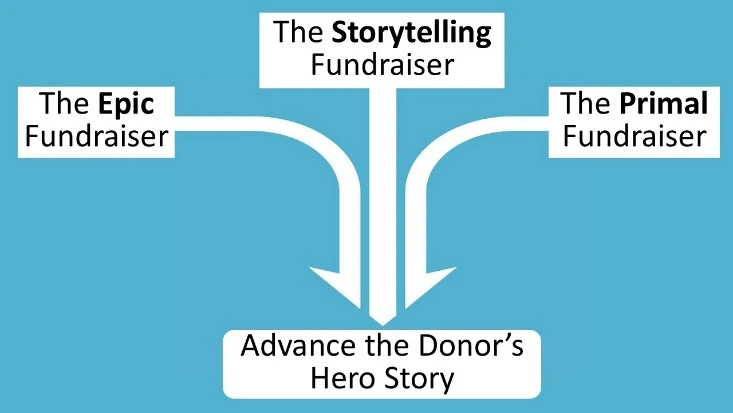
The “one big thing” in fundraising remains the same: Advance the donor’s hero story. Gaining deeper knowledge fits this same story. It matches the fundraiser’s role as the hero’s guiding sage.
What’s ahead?
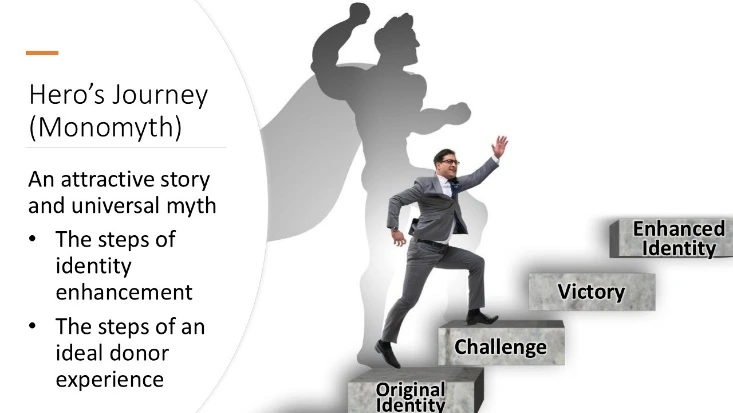
The hero’s journey is an attractive story. (See Book II in this series: The Epic Fundraiser.) It also contains the steps for identity enhancement. That journey progresses through,712

These same steps also create the ideal donor experience. Further, each step connects to natural origins. This book explores those connections. The following chapters match this sequence of steps. Each chapter title gives the topic. Each subtitle gives the emotional statement we want donors to feel.
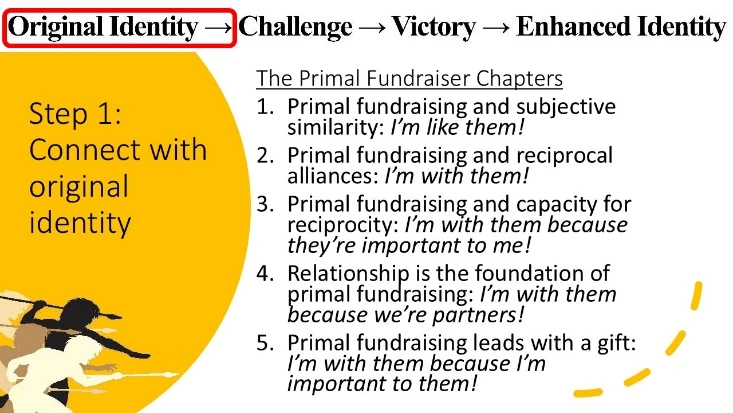
Step 1: Connect with original identity
- Primal fundraising and subjective similarity:
I’m like them!
- Primal fundraising and reciprocal alliances:
I’m with them!
- Primal fundraising and capacity for reciprocity:
I’m with them because they’re important to me!
- Relationship is the foundation of primal fundraising:
I’m with them because we’re partners!
- Primal fundraising leads with a gift:
I’m with them because I’m important to them!
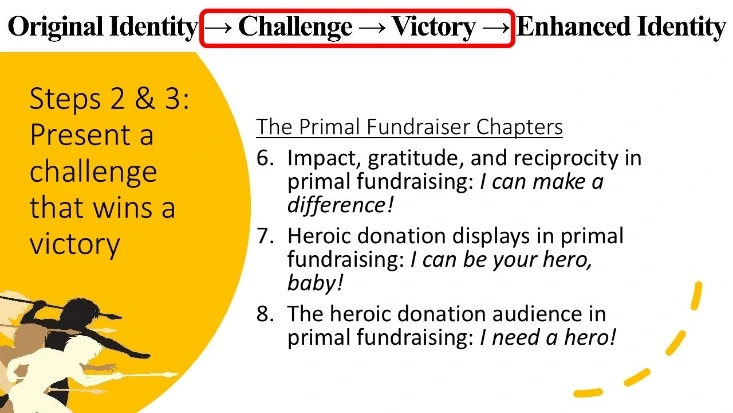
Steps 2 & 3: Present a challenge that wins a victory
- Impact, gratitude, and reciprocity in primal fundraising:
I can make a difference!
- Heroic donation displays in primal fundraising:
I can be your hero, baby!
- The heroic donation audience in primal fundraising:
I need a hero!
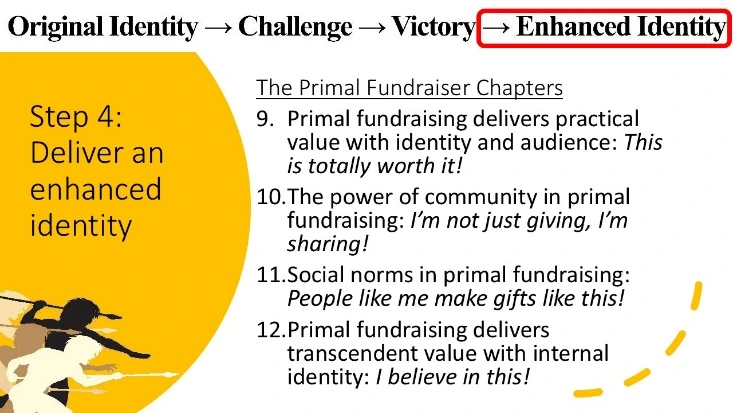
Step 4: Deliver an enhanced identity
- Primal fundraising delivers practical value with external identity:
This is totally worth it!
- The power of community in primal fundraising:
I’m not just giving, I’m sharing!
- Social norms in primal fundraising:
People like me make gifts like this!
- Primal fundraising delivers transcendent value with internal identity:
I believe in this!
Notes and references
Dillon, J. J. (2010). The primal vision: The psychological effects of creation myth. Journal of Humanistic Psychology, 50(4), 495-513. p. 507.
↩Jung, C. (1953-1978). On the nature of the psyche. In H. Read, M. Fordham, & G. Adler (Eds.), The collected works of C. G. Jung (20 vols). Routledge. Volume XVIII, para. 1228.
↩“Jung maps the psyche as a spectrum, with the archetype at the ultraviolet end and the instinct at the infrared end…. Imagine a line running through the psyche and connecting instinct and spirit at either end of it. This line is attached to archetype on one end and to instinct at the other.” Stein, M. (1998). Jung's map of the soul. Open Court. Ch. 4.
↩Stevens, A. (2001). Jung: A very short introduction. [Kindle Edition]. Oxford University Press. p. 52.
↩Jung, C. (1953-1978). On the nature of the psyche. In H. Read, M. Fordham, & G. Adler (Eds.), The collected works of C. G. Jung (20 vols). Routledge. Volume VIII, para. 717.
↩This relates to a fundamental reason why academic researchers and practitioners often fail to communicate. Academics tend to focus on the “Why?” questions. Practitioners tend to focus on the “How?” questions.
↩More formally, a deductive, theory-based approach can add to inductive, experience-based findings. A deductive theory (ideally one supported by past observations and experiences) can be used to predict future outcomes using new techniques in new scenarios.
↩Joseph Campbell uses a three-step circular illustration with this description:
“A hero ventures forth from the world of common day into a region of supernatural wonder: fabulous forces are there encountered and a decisive victory is won: the hero comes back from this mysterious adventure with the power to bestow boons on his fellow man.”
Campbell, J. (1949/2004). The hero with a thousand faces (commemorative ed.). Princeton University Press. p. 28.
I label these steps as follows:
The beginning point of “the world of common day” is “original identity.”
“Venturing forth into a region of supernatural wonder” is “challenge.”
“Fabulous forces are there encountered and a decisive victory is won” is “victory.”
“The hero comes back from this mysterious adventure with the power to bestow boons on his fellow man” is “enhanced identity.”
I apply this both to a scenario where the charitable gift serves as part of the final step in the heroic life story and where the gift request itself constitutes the challenge that promises a victory delivering enhanced identity.
↩