This series focuses on the “one big thing” in fundraising: Advance the donor’s hero story. The hero is a compelling and important character. It is a universal, ancient pattern imprinted in humans. It is an archetype.
But the hero is not the only archetype. It’s not the only character. Other archetypal characters can also be helpful in fundraising. They can provide alternative donor stories. They can even strengthen the donor-hero story.
The twelve archetypes
The twelve archetypes408 are
- Jester
- Lover
- Caregiver
- Everyman
- Innocent
- Ruler
- Sage
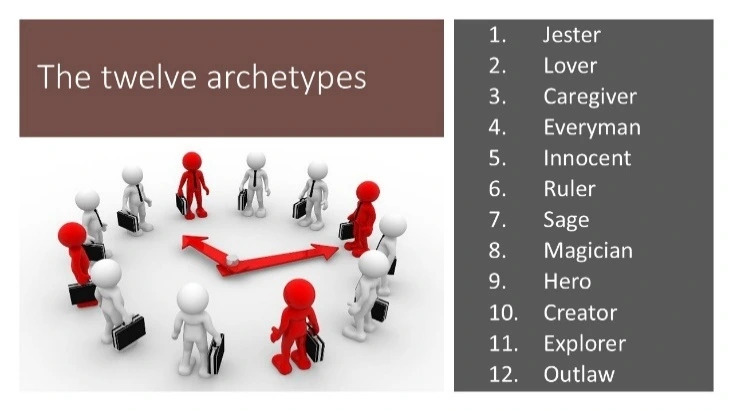
- Magician
- Hero
- Creator
- Explorer, and
- Outlaw.
Each character is common in storytelling. People can usually identify with one or more of these characters.409 This is important. A compelling story requires identifying with a character. In fundraising, this turns a story into the donor’s story.
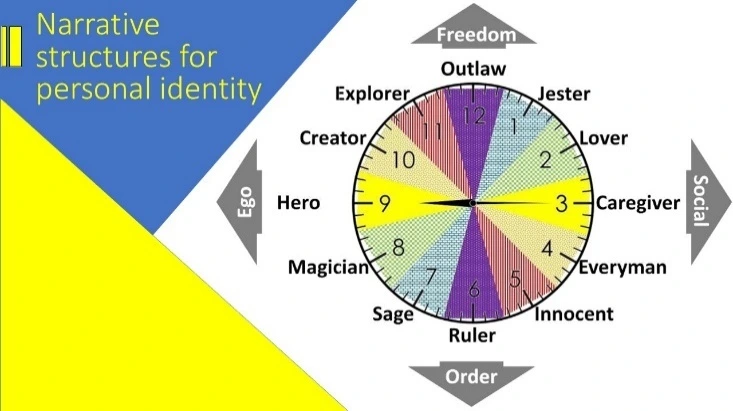
However, this goes beyond just storytelling. These archetypal characters form narrative structures for personal identity. Different people identify with different characters. Often, they prefer characters whose orientation matches their own along two different axes:
- The freedom-order axis, and
- The ego-social axis.
Each character matches with a location on these axes. Their numbers, 1 to 12, reflect this as hours on a clock.410 On a clock face, the vertical axis is the freedom-order axis. Up is towards freedom. Down is towards order. The horizontal axis is the ego-social axis. Left is towards ego. Right is towards social.
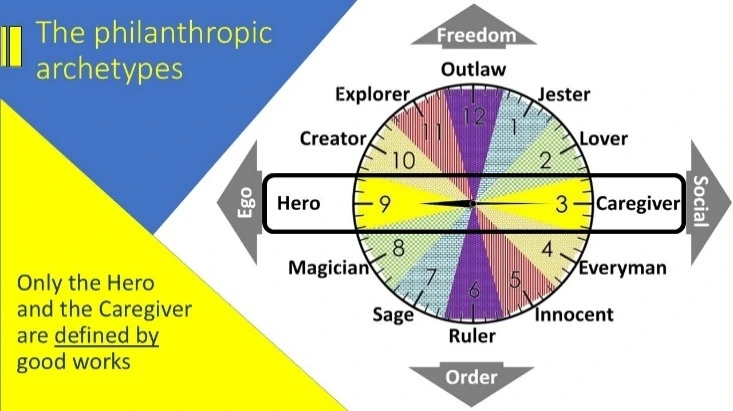
The philanthropic archetypes
How do these characters fit into a donation story? Any of the characters could help someone. Any could be, at least a little, charitable. But only two characters are philanthropic by definition. Only the Hero and the Caregiver are defined by good works.
The Innocent is good. But the goodness is based upon what is not done, rather than what is done. The Sage412 is good. But the goodness is based upon advising to act. It’s not based on actually performing the act. All others can perform bad acts without breaking character at all.
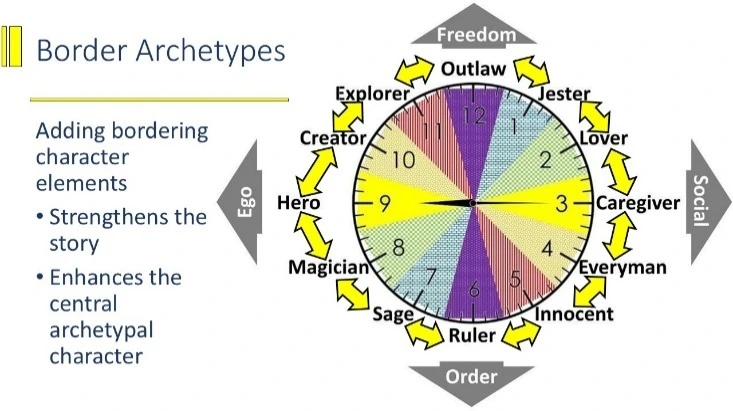
Border archetypes
The location on the two axes creates border archetypes. These complement each other. They fit together because they share similar axis orientations. Adding bordering character elements can enhance the central character. This can strengthen the story.
Consider the donor’s hero story. The Hero borders the Creator and the Magician. Adding these bordering character elements can enhance the donor’s hero story. A donor-hero character can also be a Creator-Hero. The donor creates a distinctive good work. It would not have existed without him. He brings it into being.
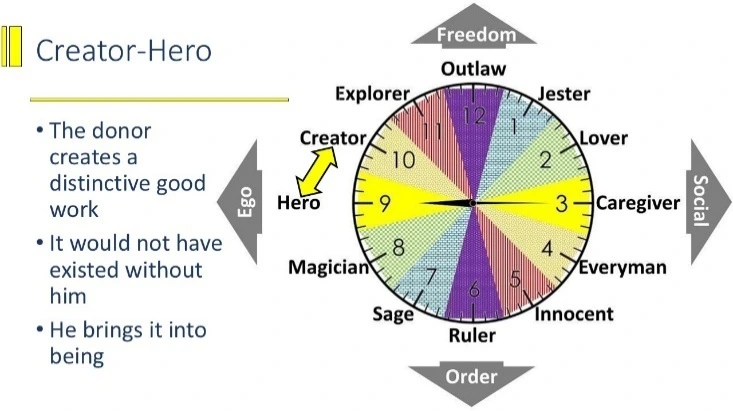
The donor may also be a Magician-Hero. A gift can serve as
“a kind of magic potion or magic wand that helps bring about the desired situation.”413
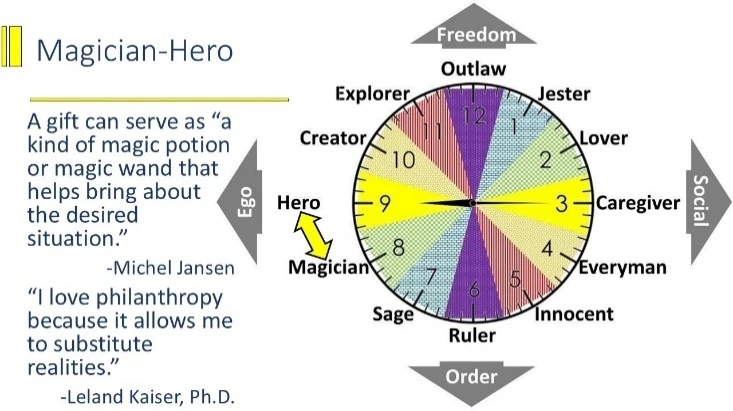
A gift that transforms a situation or organization is magical. It matches this character. Michel Jansen explains,
“Transformation is the key word for the Magician archetype.”414
Leland Kaiser also touches on this magical element. He says,
“I love philanthropy because it allows me to substitute realities.”415
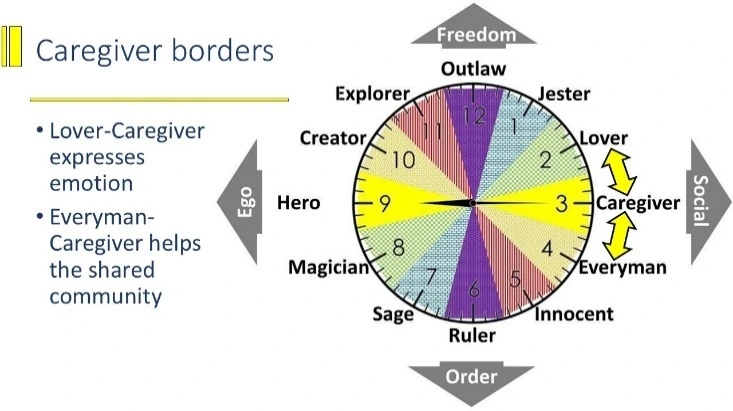
Adding border elements also strengthens the other philanthropic archetype. The Caregiver borders the Lover and the Everyman. The most inspirational Caregiver is the loving Caregiver. Adding Everyman elements also enhances the Caregiver story. The Caregiver helps because it’s what we all should do to support our shared community and values.
Shadow archetypes
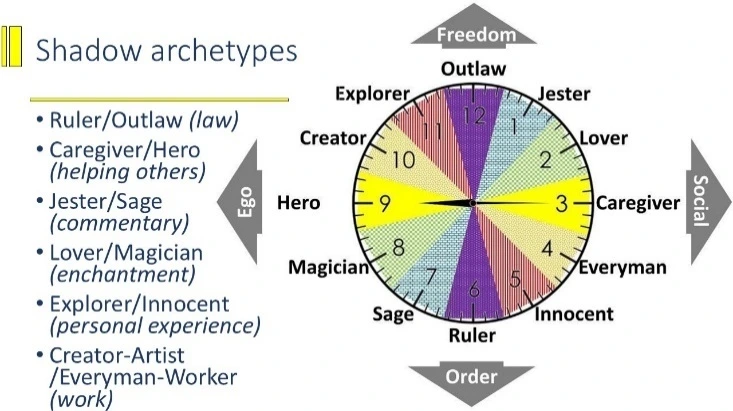
The archetypal circle also reveals the shadow archetypes.416 These reside opposite each other on the circle. They’re focused on the same issue, but they have an opposite orientation.
Opposite the Ruler is the Outlaw. Both are focused on law, but they differ along the freedom-order axis. The Outlaw represents more freedom. The Ruler represents more order. Focus on personal experiences shadows in the Explorer (more freedom and ego) and the Innocent (more order and social). Enchantment can come from a Lover (more freedom and social) or a Magician (more ego and order). Focus on talking shadows in the Sage (more order and ego) and the Jester (more freedom and social). Focus on work can build something new, individual, and unique (the Creator/Artist). Or, it can solidify something established, shared, and common (the Everyman/Worker).417
The final shadow pair are the two philanthropic archetypes. Both the Hero and the Caregiver focus on helping others. The Hero is a sacrificial protector of group members or values. So is the Caregiver. But these characters differ sharply. They are opposites on the ego-social axis.
The conflict of philanthropic archetypes
Does a donor strongly resist the hero story? This might reflect attraction to the shadow archetype. Resistance to the Donor-Hero matches attraction to the Donor-Caregiver. If the Caregiver archetype feels natural, the Hero will feel too egocentric. The hero is at the wrong location on the ego-social axis.
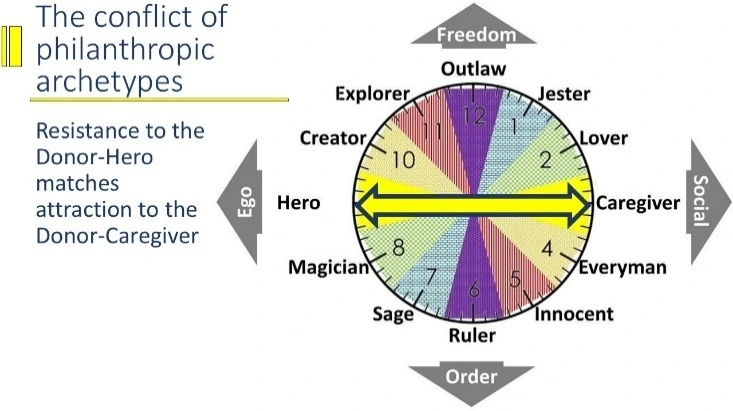
This ego-orientation conflicts with the Caregiver archetype. It also conflicts with the Lover-Caregiver and Everyman-Caregiver. This creates emotional resistance. For example,
- Heroism can feel too focused on the self. It’s not mainly about expressing emotional concern for others. (This violates the Caregiver character).
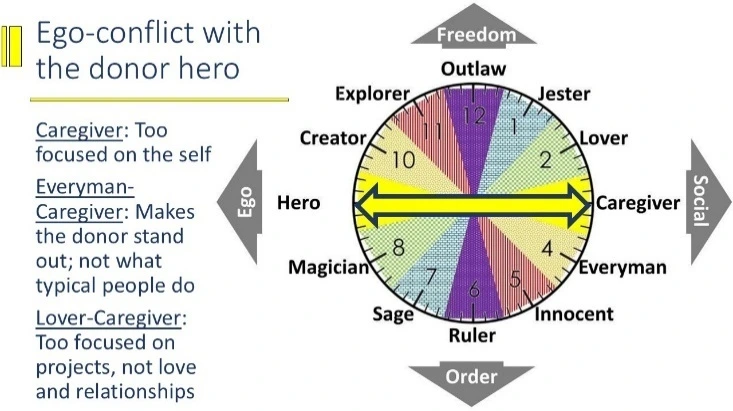
- Heroism can make the donor stand out. It’s not what typical people do. (This violates the Everyman-Caregiver character.)
- Heroism can be too focused on projects and creations. It’s not just about love and relationships. (This violates the Lover-Caregiver character.)
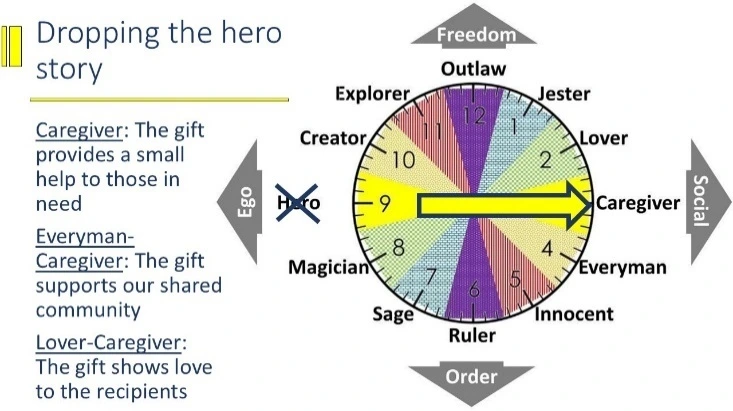
Dropping the hero story
One approach to this conflict is easy. Just use the donor’s preferred character. If the donor is naturally drawn to the Caregiver story, use it. For example,
- The gift provides a small help to those in need. This matches the Caregiver.
- The gift is what we all should do to support our shared community. This matches the Everyman-Caregiver.
- The gift shows love to the recipients. This matches the Lover-Caregiver.
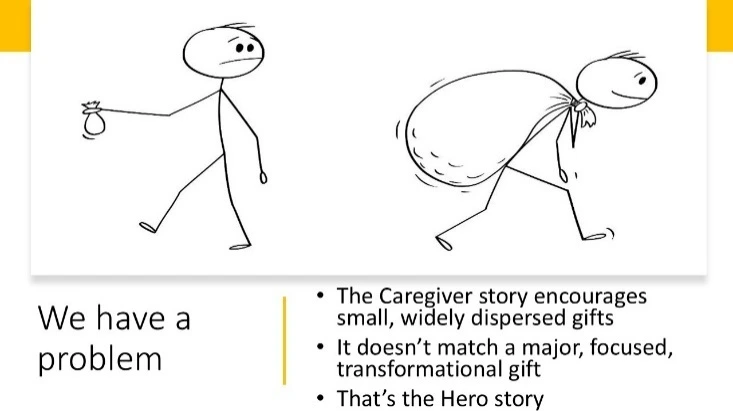
This works. But there is a problem. The Caregiver story does encourage giving. But it encourages small, widely dispersed gifts. The Caregiver ideal is doing a little bit of good in a lot of different places. It inspires the scattered light of a lamp that brightens a room. But it does not inspire the focused light of a laser that cuts through steel.
If we want donors to make regular, small, scattered gifts in response to regular, small, scattered appeals, then the Caregiver story works. But if we want to move the donor to make a major, focused, transformational gift, the story doesn’t match. For those gifts, we must look to the Hero. We must advance the donor’s hero story.
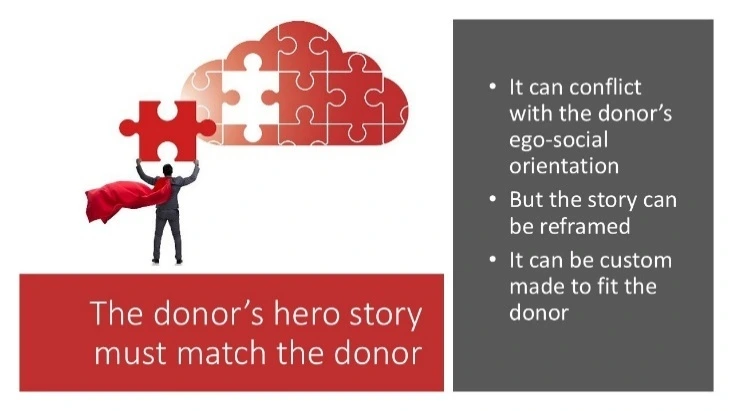
But the story must match the donor. By itself, a hero story may not fit. It may conflict with the donor’s ego-social orientation. But there is a solution. A hero story can be reframed. It can be reshaped to match the donor’s orientation. It can be custom made to fit the donor. The next chapter looks at this.
Notes and references
Although scholars differ somewhat in the number and labels of archetypes, variations of this particular list of twelve has been used extensively in marketing research, which is particularly relevant for fundraising applications. A detailed tracing of the lineage of each of these twelve archetypes through the works of C. G. Jung, Joseph Campbell, Dan MacAdams and others is presented in Faber, M. A., & Mayer, J. D. (2009). Resonance to archetypes in media: There’s some accounting for taste. Journal of Research in Personality, 43(3), 307-322. This list of twelve archetypes was presented and discussed extensively in a practical marketing context in Mark, M. & Pearson, C. (2001). The hero and the outlaw: Building extraordinary brands through the power of archetypes. McGraw-Hill.
↩In his book on marketing, Michel Jansen references this list. He explains that these twelve, “archetypes have a direct influence on people’s behaviour. As noted, people are driven by ambitions and aspirations in the (collective) unconscious. As soon as they are recognised in a situation, they are activated because they are meaningful …. From here a meaningful relationship with the consumer can be developed, because the brand connects with the consumer at a deeper level… [These twelve] archetypes offer concrete bases for creating a unique, consistent and consequent identity and developing a meaningful relationship with the consumer.” Jansen, M. (2006). Brand prototyping: Developing meaningful brands. Kluwer. p. 39. Thus, a focus on archetypal story character serves as a platform for fundraisers to access two powerful underlying giving motivations – identity and relationship.
↩This axis alignment of the twelve archetypes was proposed by Jansen (2006). Mark and Pearson (2001) proposed a different circular alignment of the twelve archetypes using the axes of “Belonging-Independence” and “Mastery Stability.” Bolhuis (2011) presented a circular alignment of the twelve archetypes using a three way axis excluding the fourth pole of “Ego.” Van Nistelrooij (2013) also presented the same three-way axis, but shifted the location of Magician and Explorer as compared with Bolhuis (2011). Oosterhout (2013) used the same three-way axis, but changed the locations using unequal distributions of archetypes within categories. Van Hoolwerff (2014) presented a circular figure of the twelve archetypes similar to Bolhuis (2011) but with the “Freedom” axis relabeled as the “Creative” axis. Broek (2014) employed a different circular arrangement of the twelve archetypes using the three poles of power, freedom, and expressive. Another circular arrangement of twelve archetypes appeared in Pearson (1991) as the Heroic Myth Index. This is sometimes incorrectly attributed as the source for Jansen’s (2006) popular circular image. Pearson’s (1991) image shows a circular arrangement of twelve archetypes without any axes and differs from Jansen’s (2006) by labeling Jester as Fool, Outlaw as Destroyer, Hero as Warrior, and Explorer as Seeker. Also, Everyman is absent and an additional character, Orphan is used.
Bolhuis, S. (2011). Archetypen: onderzoek naar de visualisatie van archetypen met behulp van vormkenmerken. [Master's thesis]. University of Twente.
Hoolwerff, D. (2014). Does your mascot match your brand’s personality? An empirical study on how visual characteristics of a brand mascot can function as a tool for transmitting an archetypical brand personality. [Master's thesis]. University of Twente.
Jansen, M. (2006). Brand Prototyping: Developing meaningful brands. Kluwer.
Pearson, C. S. (1991). Awakening the heroes within: Twelve archetypes to help us find ourselves and transform our world. HarperOne (Harper Collins).
Uit het Broek, N. (2014). The visualization of archetypes through the use of colors in logos. [Master’s thesis]. University of Twente.
Van Nistelrooij, E. (2013). Face it, your brand personality needs a logo. [Doctoral dissertation]. University of Twente, Enschede.
Oosterhout, L. (2013). Word marks: a helpful tool to express your identity: an empirical study regarding fonts of word marks as a tool for transmitting an archetypal identity [Master's thesis]. University of Twente.
↩This image was created using the same archetype titles and axis orientation as that presented in Jansen, M. (2006). Brand prototyping: Developing meaningful brands. Kluwer.
↩This character is also known as the mentor.
↩Jansen, M. (2006). Brand Prototyping: Developing meaningful brands. Kluwer. p. 64.
↩Id.
↩Leland R. Kaiser, Ph.D., quoted in Ahern, T. & Joyaux, S. (2008). Keep your donors. John Wiley & Sons. p. 18.
↩In the original Jungian context the term “shadow” refers to an inverse reflection of the ego, rather than as it is used here in reference to pairs of inverse archetypal characters. Even in its original usage, “shadow” need not refer to a negative characteristic. It references any inverse reflection of the ego, whether positive or negative. Murray Stein points to, “…those who have formed a negative identity. The black sheep who are proud of their greed and aggressiveness and flaunt such traits in public while in their hidden shadow side they are sensitive and sentimental.” Stein, M. (1998). Jung’s map of the soul. Open Court. Chapter 5 (unpaginated).
↩The Everyman and Creator shadow requires a bit more explanation. The Everyman is the practical, regular guy/gal, worker, or common man. Everyman goals are to belong or fit in to the group. Everyman fears are standing out or seeming to put on airs. See Mark & Pearson (2001), p. 166. The Everyman is high in order and social orientation. In contrast, the Creator is an artist, focused on creativity, originality, and intuition. The Creator is high in freedom and ego orientation. Michel Jansen explains, “Aspects such as creativity, originality, and intuition play an important role in this archetype.” Jansen, M. (2006). Brand prototyping: Developing meaningful brands. Kluwer. p. 60.
↩