A warning
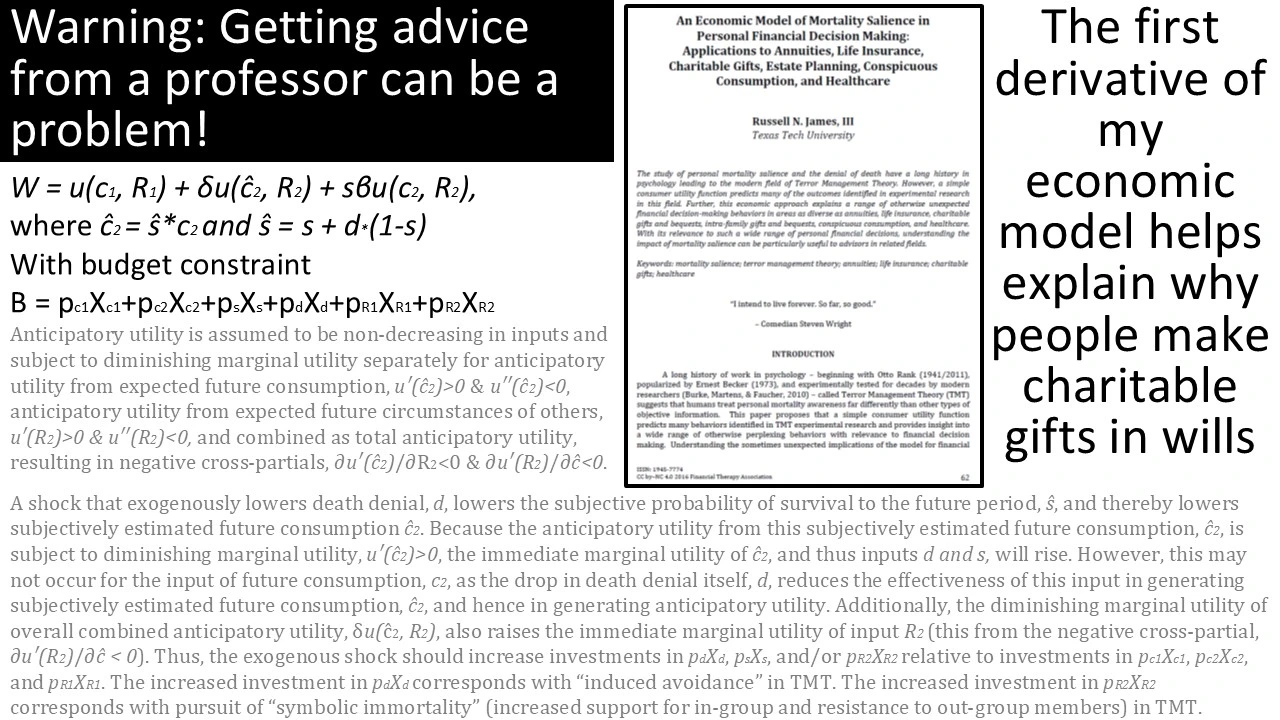
Getting advice from a professor can be a problem. I understand why. Professors love to be technical, theoretical, and esoteric. Being a professor, I’m guilty too. I love complex statistical methods. I love obscure scholarly writing. Worse yet, I love theory. I can happily spend all day discussing how the first derivative of my mathematical model explains charitable bequest giving.1
Warning retracted

But I’m not going to do that.
Why not? Because I’ve been there. Before I was a research professor, I was a fundraiser. For eleven years I worked in planned and major gifts. And since I’ve been there, I care about real-world outcomes. I care about practical results.
Why v. how
This series covers research and theory. It explores:
- Neuroscience
- Economics
- Sociology
- Psychology
- Anthropology
- Ethology
- Myth
- Law, and
- Literature.
If you think that’s too much, I understand. This seems far removed from everyday fundraising. You’re busy. You’ve got a job to do. The theory of why something works might be a curiosity. But it’s not the job.
First, let me make a practical argument. Unless you understand the “why,” the “how” won’t make sense. When it doesn’t make sense, things can go wrong. But once you know the “why,” you’ll be better at the “how.” You’ll know when the “how” applies. And you’ll know when it doesn’t.
More than that, you’ll be able to create your own “how.” You can shape your “how” to fit your situation. What works for this cause? For this charity? For this event? For this media? For this generation? For this donor? For this gift? Knowing the underlying “why” guides every answer.
A promise

Also, let me make a promise. This isn’t just academic theory. This is about effective fundraising. Yes, this series dives deep into the rabbit hole of academic research. But it’s still about being a better fundraiser tomorrow than you were yesterday.
The one thing

So, I’m not going to start with scholarly technicalities. Instead, I want to start with some famous cowboy advice. In the movie City Slickers, Jack Palance, playing Curly the cowboy, says, “Do you know what the secret of life is?” “This.” [He holds up one finger.] “One thing. Just one thing. You stick to that, and the rest don’t mean sh*t.” Billy Crystal asks, “But what is the ‘one thing?’” Palance smiles and says, “That’s what you have to find out.”
That one thing for fundraising is what I want to share with you now.
The one big thing in fundraising

After more than a quarter century as a fundraiser and a professor focused on fundraising research, theories, data, and experiments, I want to tell you the “one big thing.” It’s this:
Advance the donor’s hero story.
It’s a simple, five-word sentence.2 But it can change everything. If you understand every component deeply, it holds the key to donor motivation. If you master every part, you can become powerfully effective in fundraising.
Diving into that one big thing
What exactly do these words mean? For compelling fundraising storytelling, they have special meanings.
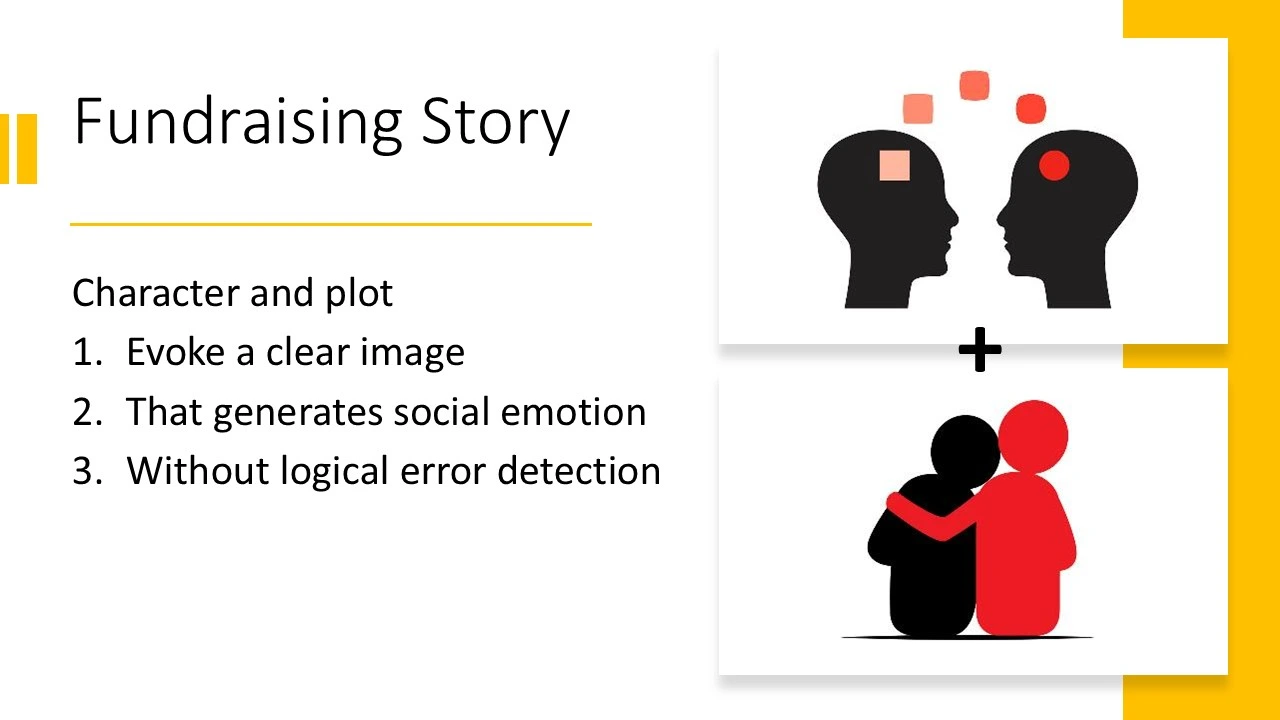
A story uses character and plot. In fundraising, it must
- Evoke a clear image
- That generates social emotion
- Without logical error detection.
A hero story is an archetypal story structure. Joseph Campbell describes it this way:
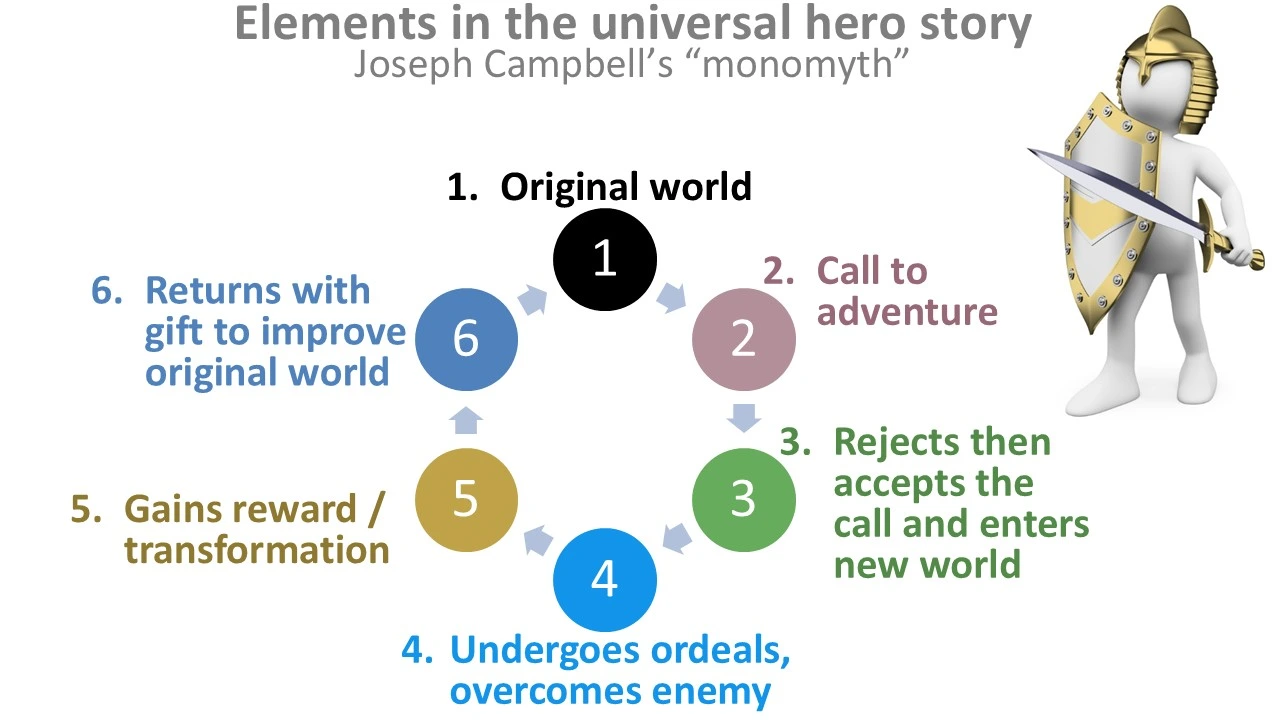
“A hero ventures forth from the world of common day into a region of supernatural wonder: fabulous forces are there encountered and a decisive victory is won: the hero comes back from this mysterious adventure with the power to bestow boons on his fellow man.”3
The hero progresses through:4

A donor’s hero story means that the donor is, or identifies with, the hero. This story includes the donor’s heroic gift. A heroic gift sacrificially protects the donor’s people and values in a crisis (threat or opportunity).
Advancing the donor’s hero story means moving through a narrative arc. This includes
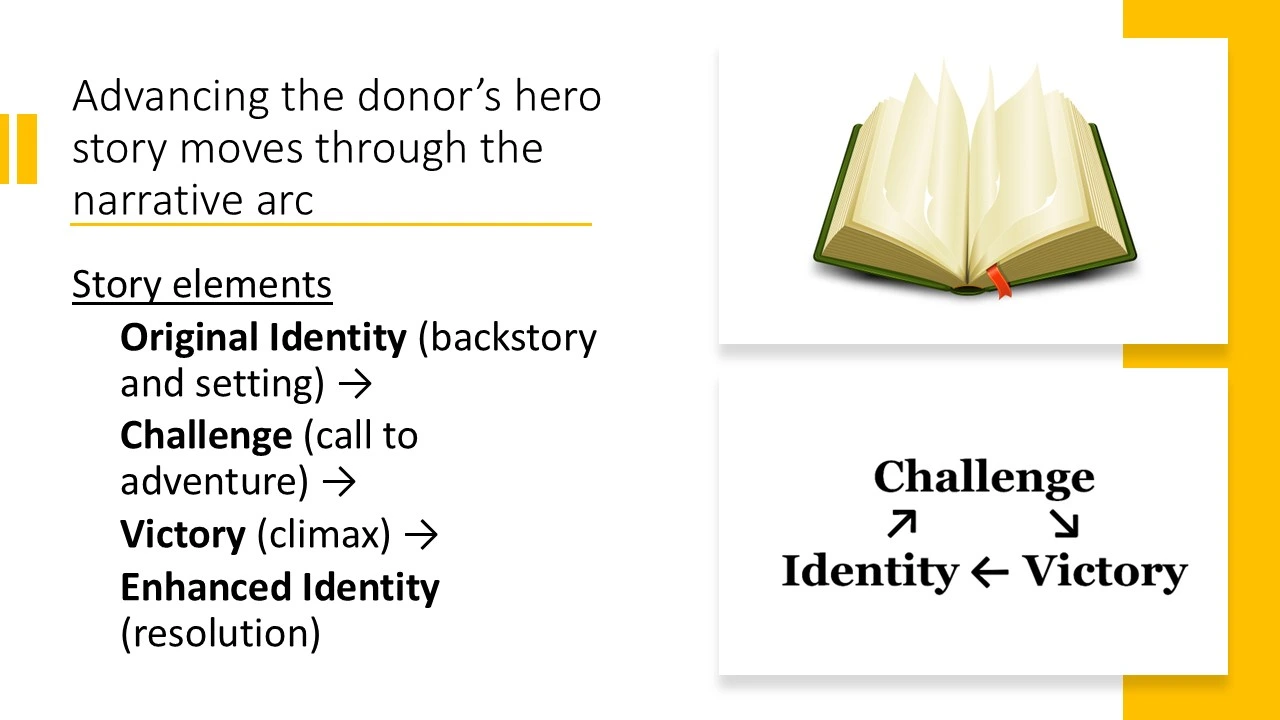
- Backstory and setting (original identity)
- This develops motivation from life story, values, and social norms before the ask.
- An inciting incident (challenge)
- This promises heroism and forces a choice at the ask.
- Climax and resolution (victory and enhanced identity)
- This confirms heroism through impact reporting, gratitude, and compatible publicity after the ask.
The “one big thing” starts simple. But understood deeply, it creates a unified framework for compelling fundraising.
What’s ahead
This book series explores research and theory underlying the “one big thing.” The books are
- The Storytelling Fundraiser: The Brain, Behavioral Economics, and Fundraising Story
- The Epic Fundraiser: Myth, Psychology, and The Universal Hero Story in Fundraising
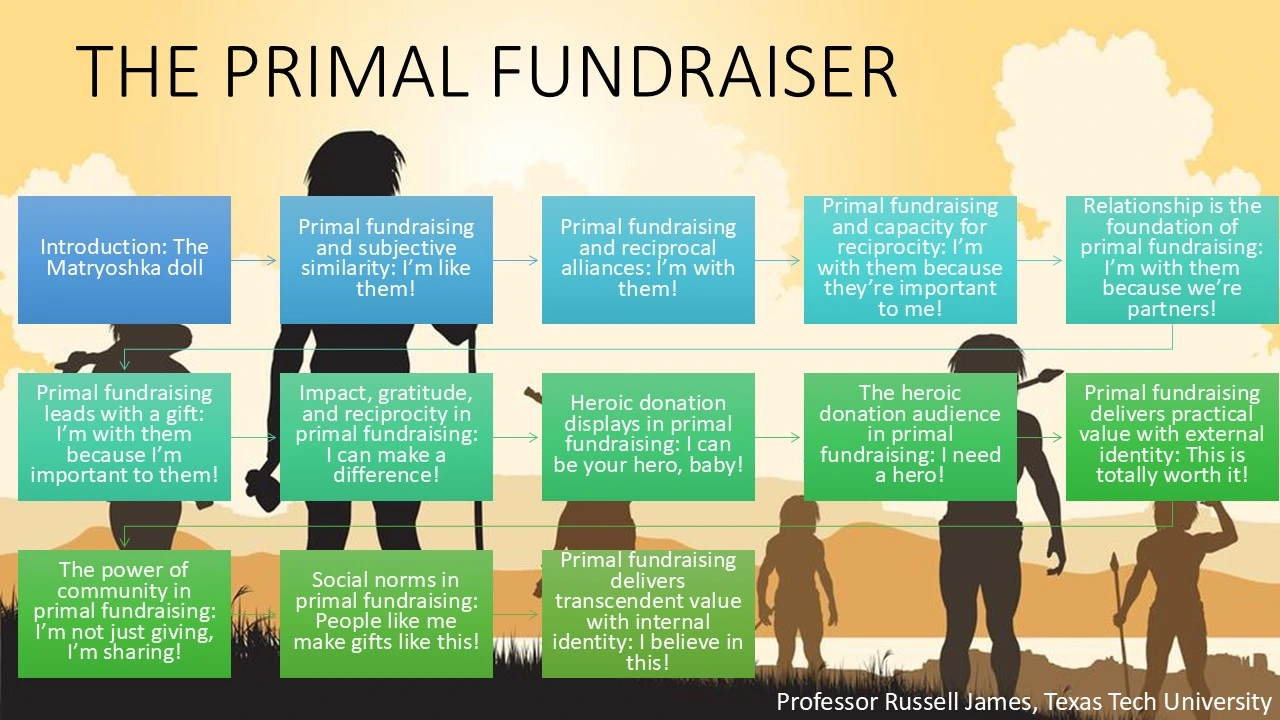
- The Primal Fundraiser: Game Theory and the Natural Origins of Effective Fundraising
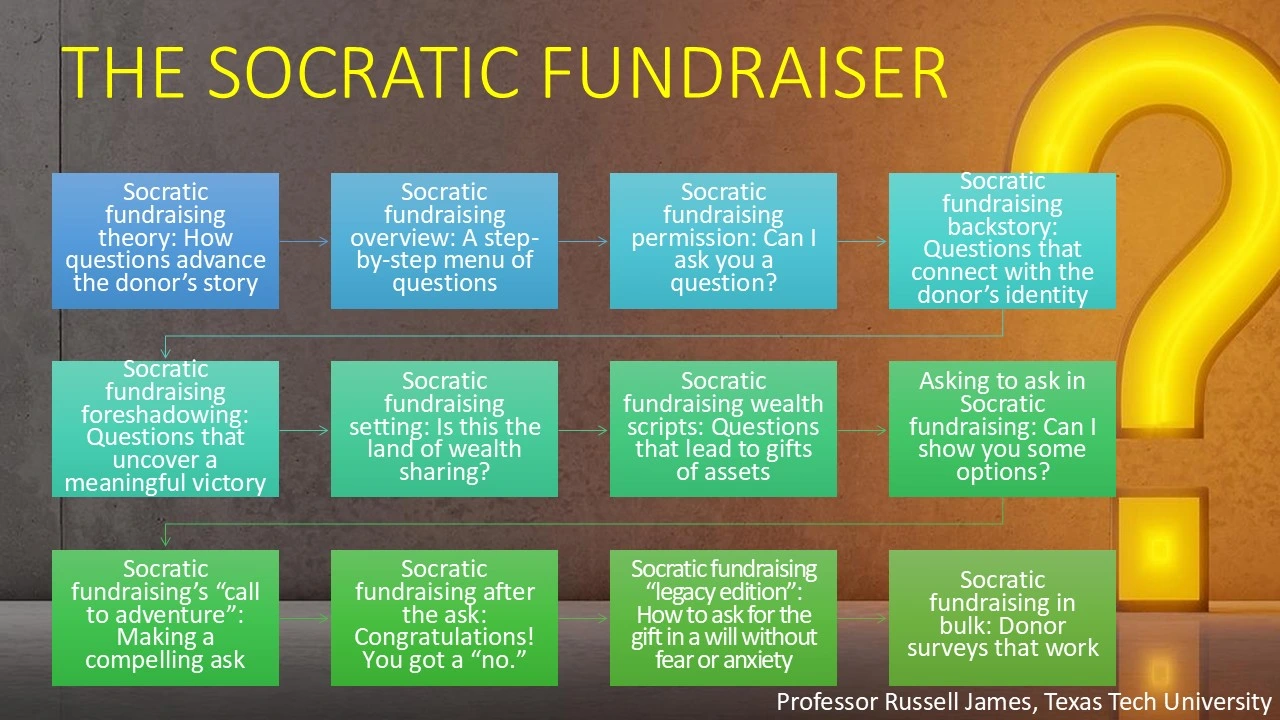
- The Socratic Fundraiser: Using Questions to Advance the Donor’s Story
Each book takes a different perspective. This has two purposes. The first is to find the language that connects best for you.
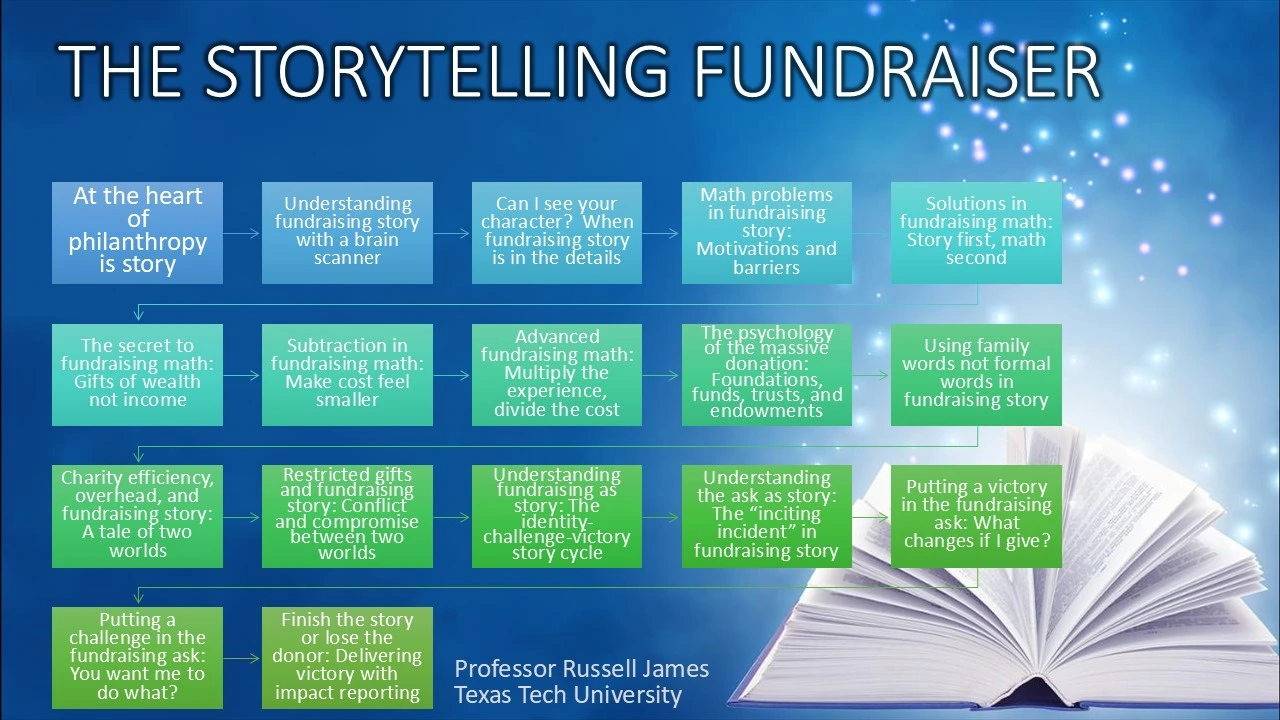
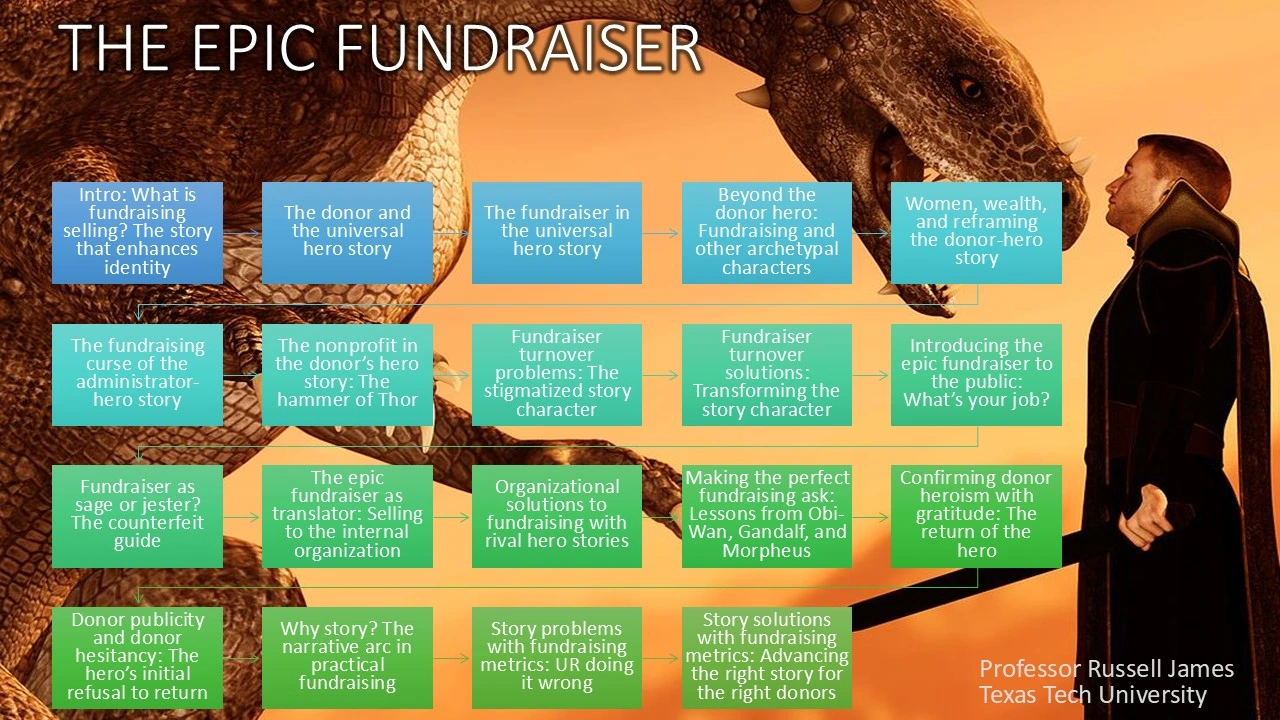
- Maybe you like scientific experiments testing words and phrases? The Storytelling Fundraiser is for you.
- Maybe myth and psychology are more your thing? The Epic Fundraiser might speak to you.
- Maybe the natural origin of behavior piques your interest? The Primal Fundraiser covers this.
- Maybe you just want to know what to say at your next donor meeting? The Socratic Fundraiser is what you need.
Using these diverse perspectives has a second purpose. It shows triangulation. The approaches are vastly different. Yet, they each point to the same answers. This triangulation increases confidence in the answers. It also increases the depth of understanding. The more deeply you understand the “why,” the easier it is to figure out the best “how,” even in new circumstances.
Conclusion
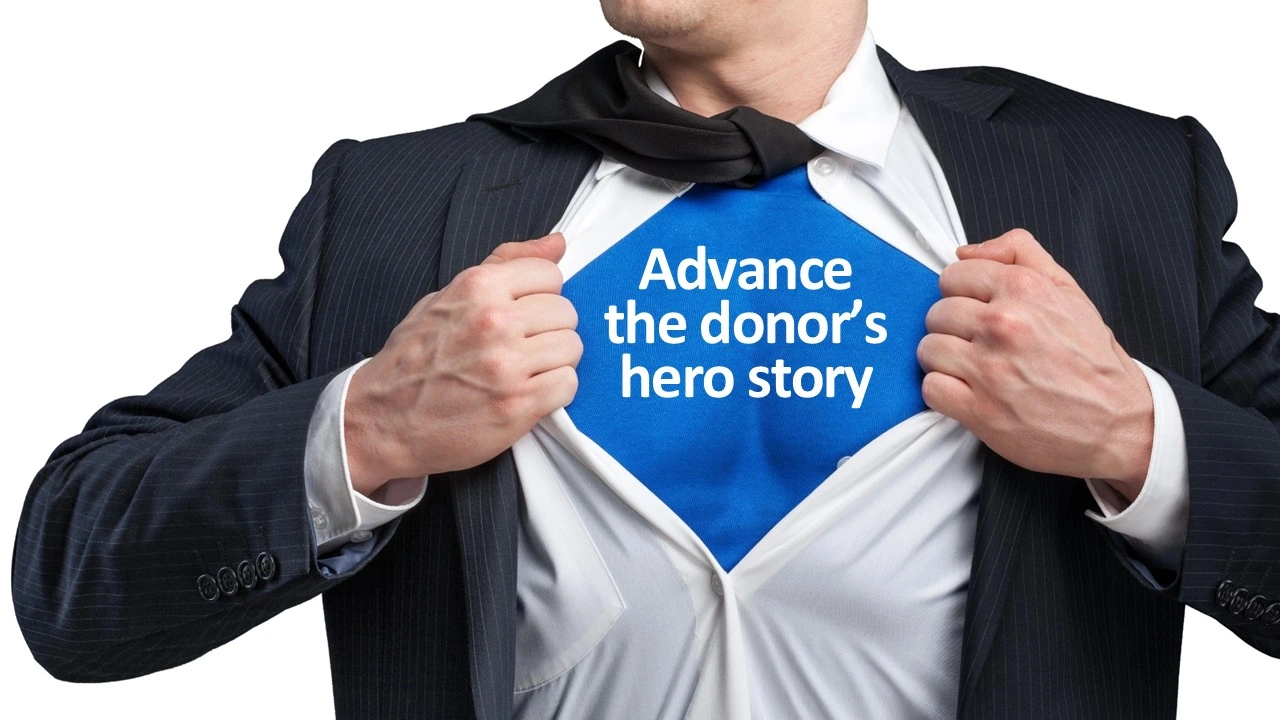
Properly understood, you only have to do one thing. Advance the donor’s hero story. That’s it. But doing that one thing requires skill, understanding, and even artistry. In his book on storytelling, Robert McKee explains,
“The essential form of story is simple. But that’s like saying that the essential form of music is simple. It is. It’s twelve notes. But these twelve notes conspire into everything and anything we have ever called music. The essential elements of the Quest are the twelve notes of our music, the melody we’ve listened to all our lives. However, like the composer sitting down at the piano, when a [storyteller] takes up this seemingly simple form, he discovers how incredibly complex it is, how inordinately difficult to do.”5
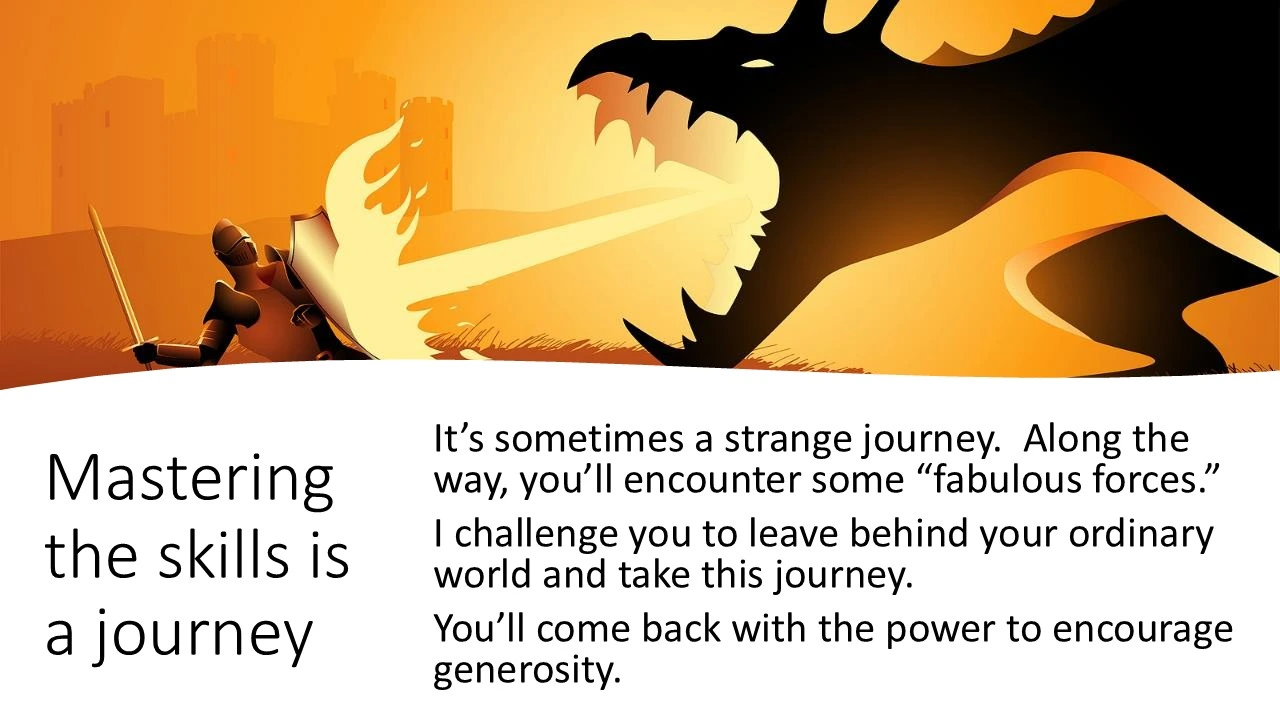
Mastering those skills is a journey. In this series, you may find that it’s sometimes a strange journey. Along the way, you’ll encounter some “fabulous forces.”6 It won’t always be easy. This is graduate-level work. But I challenge you to leave behind your ordinary world. Take this journey. Ultimately, you’ll come back from your adventure with new powers. You’ll come back with the ability to help others. You’ll come back with the power to encourage generosity.
Notes and references
James, R. N., III. (2017). An economic model of mortality salience in personal financial decision making: Applications to annuities, life insurance, charitable gifts, estate planning, conspicuous consumption, and healthcare. The Journal of Financial Therapy, 7(2), 62-82.
↩In academic literature, see James, R. N., III. (2017). Natural philanthropy: A new evolutionary framework explaining diverse experimental results and informing fundraising practice. Palgrave Communications. DOI: 10.1057/palcomms.2017.50. p. 1. (“Advance the donor’s hero story.”)
In fundraising literature, see, e.g., Ahern, T. (2015). Seeing through a donor’s eyes. Emerson & Church. p. 63 (“Why are donors critical to your vision? Have you made them the heroes?”), p. 93 (“But in the end the true heroes are the donors. They solved this particular problem by investing in the project.”), p. 123 (“Make your donor the real hero of the story.”), p. 129 (“With the ask, after all, the prospect steps into the picture and becomes the hero of the story (assuming she responds affirmatively to your case).”); Ahern, T. & Joyaux, S. P. (2007). Keep your donors: The guide to better communications & stronger relationships. John Wiley & Sons. p. 108, (“This is what we call being ‘donor-centric’: treating your donors as heroes.”), p. 193 (“Donor-centric recognition is a different thing altogether: It treats donors universally as heroes.”), p. 280 (“The donor-centric organization offers something valuable: hero status as a donor.”), p. 327 (“In a donor-centered newsletter, the donor is unquestionably the hero.”), p. 387 (“Donor-centric newsletters go beyond just sharing the credit: they make the donor the hero of the story.”); Baker, B., Bullock, K., Gifford, G. L., Grow, P., Jacobwith, L. L., Pitman, M. A., Truhlar, S., & Rees, S. (2013). The essential fundraising handbook for small nonprofits. The Nonprofit Academy. p. 65 (“Suddenly, your donor is a hero.”); Craver, R. (2015). Retention fundraising: The new art and science of keeping your donors for life. Emerson & Church. p. 88 (“1. You need a hero. (Your donor, not you!)”); Kihlstedt, A. (2010). Capital campaigns: Strategies that work (3rd ed.). Jones & Bartlett. p. 302 (“The final appeals invite people to help close the gap, to be among the heroes who made the campaign cross the finish line.”); Million, H. (2006). Fear-free fundraising: How to ask people for money. Independently published. p. 93 (“However, you'll be more than just an investor—you'll also be a hero.”).
↩Campbell, J. (1949/2004). The hero with a thousand faces (commemorative ed.). Princeton University Press. p. 28.
↩Following the previous quote,
The beginning point of “the world of common day” is “original identity.”
“venturing forth into a region of supernatural wonder” is “challenge.”
“fabulous forces are there encountered and a decisive victory is won” is “victory.”
“the hero comes back from this mysterious adventure with the power to bestow boons on his fellow man” is “enhanced identity.”
The charitable gift serves as the ending step in the heroic story: It allows the donor “to bestow boons on his fellow man.” This can serve as the ending step for many types of personal heroic challenges and victories. However, it can simultaneously apply to the fundraising scenario where the gift request itself constitutes the challenge. The fundraising challenge can promise a victory that delivers enhanced identity.
↩McKee, R. (1997). Story: Substance, structure, style and the principles of screenwriting. Regan Books. p. 197.
↩Campbell, J. (1949/2004). The hero with a thousand faces (commemorative ed.). Princeton University Press. p. 28.
↩