This series focuses on the “one big thing” in fundraising: Advance the donor’s hero story. The hero is a compelling and important character. It is a universal, ancient pattern imprinted in humans. It is an archetype.
But the hero is not the only archetype. It’s not the only character. Other archetypal characters can also be helpful in fundraising. They can provide alternative donor stories. They can even strengthen the donor-hero story.
The twelve archetypes
The twelve archetypes54 are
Jester
Lover
Caregiver
Everyman
Innocent
Ruler
Sage
Magician
Hero
Creator
Explorer, and
Outlaw.
Each character is common in storytelling. People can usually identify with one or more of these characters.55 This is important. A compelling story requires identifying with a character. In fundraising, this turns a story into the donor’s story.
However, this goes beyond just storytelling. These archetypal characters form narrative structures for personal identity. Different people identify with different characters. Often, they prefer characters whose orientation matches their own along two different axes:
The freedom-order axis, and
The ego-social axis.
Each character matches with a location on these axes. Their numbers, 1 to 12, reflect this as hours on a clock.56 On a clock face, the vertical axis is the freedom-order axis. Up is towards freedom. Down is towards order. The horizontal axis is the ego-social axis. Left is towards ego. Right is towards social.
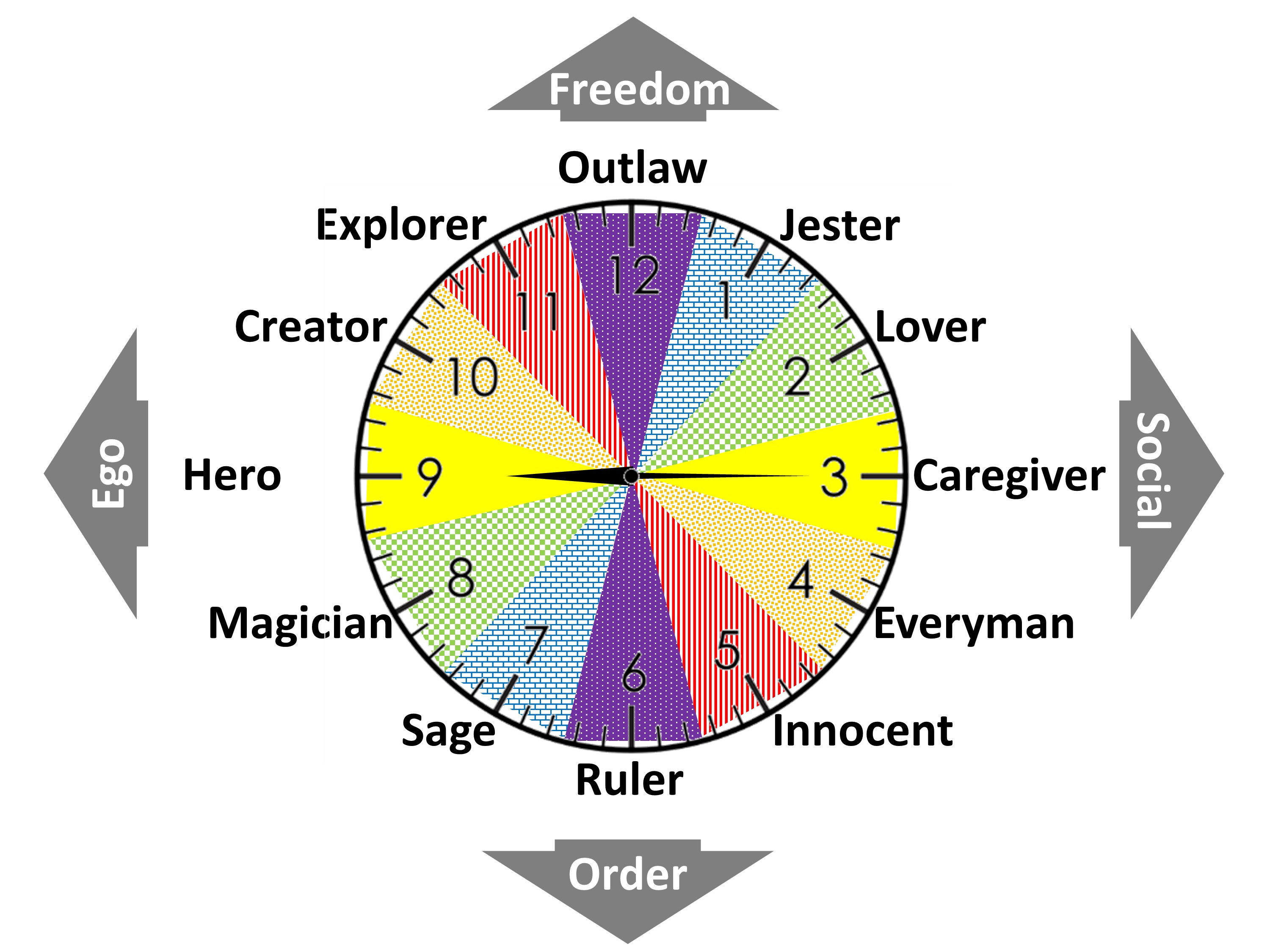
The philanthropic archetypes
How do these characters fit into a donation story? Any of the characters could help someone. Any could be, at least a little, charitable. But only two characters are philanthropic by definition. Only the Hero and the Caregiver are defined by good works.
The Innocent is good. But the goodness is based upon what is not done, rather than what is done. The Sage58 is good. But the goodness is based upon advising to act. It’s not based on actually performing the act. All others can perform bad acts without breaking character at all.
Border archetypes
The location on the two axes creates border archetypes. These complement each other. They fit together because they share similar axis orientations. Adding bordering character elements can enhance the central character. This can strengthen the story.
Consider the donor’s hero story. The Hero borders the Creator and the Magician. Adding these bordering character elements can enhance the donor’s hero story. A donor-hero character can also be a Creator-Hero. The donor creates a distinctive good work. It would not have existed without him. He brings it into being.
The donor may also be a Magician-Hero. A gift can serve as
“a kind of magic potion or magic wand that helps bring about the desired situation.”59
A gift that transforms a situation or organization is magical. It matches this character. Michel Jansen explains,
“Transformation is the key word for the Magician archetype.”60
Leland Kaiser also touches on this magical element. He says,
“I love philanthropy because it allows me to substitute realities.”61
Adding border elements also strengthens the other philanthropic archetype. The Caregiver borders the Lover and the Everyman. The most inspirational Caregiver is the loving Caregiver. Adding Everyman elements also enhances the Caregiver story. The Caregiver helps because it’s what we all should do to support our shared community and values.
Shadow archetypes
The archetypal circle also reveals the shadow archetypes.62 These reside opposite each other on the circle. They’re focused on the same issue, but they have an opposite orientation.
Opposite the Ruler is the Outlaw. Both are focused on law, but they differ along the freedom-order axis. The Outlaw represents more freedom. The Ruler represents more order. Focus on personal experiences shadows in the Explorer (more freedom and ego) and the Innocent (more order and social). Enchantment can come from a Lover (more freedom and social) or a Magician (more ego and order). Focus on talking shadows in the Sage (more order and ego) and the Jester (more freedom and social). Focus on work can build something new, individual, and unique (the Creator/Artist). Or, it can solidify something established, shared, and common (the Everyman/Worker).63
The final shadow pair are the two philanthropic archetypes. Both the Hero and the Caregiver focus on helping others. The Hero is a sacrificial protector of group members or values. So is the Caregiver. But these characters differ sharply. They are opposites on the ego-social axis.
The conflict of philanthropic archetypes
Does a donor strongly resist the hero story? This might reflect attraction to the shadow archetype. Resistance to the Donor-Hero matches attraction to the Donor-Caregiver. If the Caregiver archetype feels natural, the Hero will feel too egocentric. The hero is at the wrong location on the ego-social axis.
This ego-orientation conflicts with the Caregiver archetype. It also conflicts with the Lover-Caregiver and Everyman-Caregiver. This creates emotional resistance. For example,
Heroism can feel too focused on the self. It’s not mainly about expressing emotional concern for others. (This violates the Caregiver character).
Heroism can make the donor stand out. It’s not what typical people do. (This violates the Everyman-Caregiver character.)
Heroism can be too focused on projects and creations. It’s not just about love and relationships. (This violates the Lover-Caregiver character.)
Dropping the hero story
One approach to this conflict is easy. Just use the donor’s preferred character. If the donor is naturally drawn to the Caregiver story, use it. For example,
The gift provides a small help to those in need. This matches the Caregiver.
The gift is what we all should do to support our shared community. This matches the Everyman-Caregiver.
The gift shows love to the recipients. This matches the Lover-Caregiver.
This works. But there is a problem. The Caregiver story does encourage giving. But it encourages small, widely dispersed gifts. The Caregiver ideal is doing a little bit of good in a lot of different places. It inspires the scattered light of a lamp that brightens a room. But it does not inspire the focused light of a laser that cuts through steel.
If we want donors to make regular, small, scattered gifts in response to regular, small, scattered appeals, then the Caregiver story works. But if we want to move the donor to make a major, focused, transformational gift, the story doesn’t match. For those gifts, we must look to the Hero. We must advance the donor’s hero story.
But the story must match the donor. By itself, a hero story may not fit. It may conflict with the donor’s ego-social orientation. But there is a solution. A hero story can be reframed. It can be reshaped to match the donor’s orientation. It can be custom made to fit the donor. The next chapter looks at this.